
Note: I originally wrote this before Frontier’s 31 January stream, which revealed surprisingly pleasant news. I considered rewriting this post for a few days. However, I decided to post it as is and then write an update later.
Frontier Developments PLC (or Frontier), the developer of Elite Dangerous (or Elite), recently published its interim 2024 financial reports. I have played Elite for thousands of hours. Considering the lacklustre Odyssey expansion launched two years ago, Elite‘s vague roadmap, and Frontier’s economic woes, I was interested in what this said about Elite‘s future.
Two slides from the financial report summarize Elite‘s situation well. The first is the “Cumulative Revenue” graph, shown below. This graph shows Elite favourably, earning the second-highest cumulative revenue of all Frontier’s Intellectual Properties (IPs).

However, the “Cumulative Cash Flow” graph tells a less rosy story. Elite has earned the least of Frontier’s big IPs. Elite‘s current (right-most) line is almost flat, meaning its income roughly matches its costs.
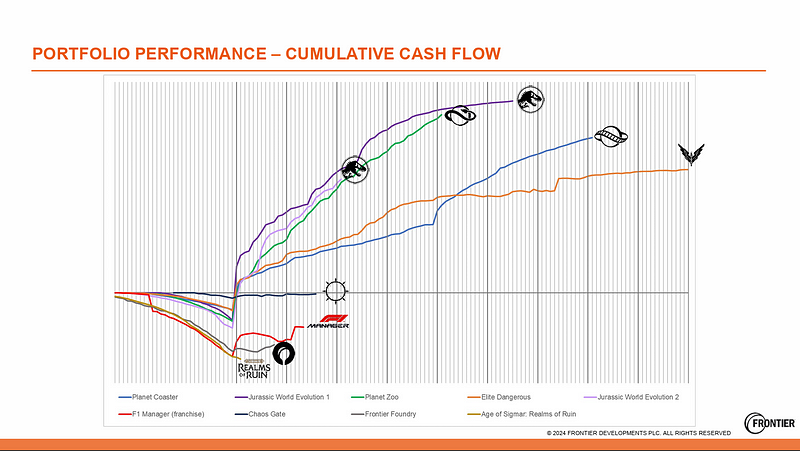
Given Frontier’s financial troubles, what does this mean for the future of Elite? The critical question is, “What are Frontier’s goals?” If Frontier wants to keep Elite as a “pet project”, they need not do anything different. Frontier can continue maintaining the game, likely entertaining the hardcore players for years. Frontier and Elite are synonymous, and Elite should continue as long as it does not lose money.
Unfortunately, Frontier needs its IPs to generate income. David Braben, Frontier’s founder and previous CEO, may love Elite. However, Frontier is a business, not a charity. Their investors, including the Chinese game giant Tencent, rue the declining share price. The relative success of Star Citizen, No Man’s Sky and similar IPs of the same age and genre must weigh heavily.
While, technically, it may have been the correct decision, Frontier’s decision not to support consoles likely had a significant financial impact. Frontier had invested heavily in Elite‘s console support before ceasing it without realizing any revenue. As shown in the Cumulative Revenue graph above, releases on other platforms boosted all IPs significantly.
Frontier may also be using Elite to hide costs. Frontier shares many development resources, such as the game engine, audio, marketing and community relations. Frontier may disproportionately attribute costs to Elite to bolster other IPs. However, given the lack of evidence and specifics, I am ignoring this.
Elite makes most of its money from the initial purchase or selling ARX, its cosmetics currency. Therefore, Frontier must attract new players or convince existing players to purchase cosmetics like ship paint jobs.
Unfortunately, the “Cumulative Cash Flow” graph indicates Frontier failed. Not in creating a good game – that is another discussion – but in creating a game that generates significant revenue.
One way to generate revenue is to improve gameplay. Frontier needs to identify new foci that engage players. For example, Eve Online wants to focus on “conflict, identity, and community” per Eve Online‘s 2024 roadmap. Elite needs beginner-friendly gameplay with less “grind” (repetition). However, gameplay changes are another discussion, as mentioned above.
Another way to generate revenue is through hype and promise. Star Citizen is a prime example. Players “pledge” thousands of dollars for new ships to be released years from now, if ever. Players happily shrug off poor performance and reliability. Elite has lost this over the years. Better marketing and community relations could help, but Frontier needs that inspiring vision or dream.
An alternate could be changing the business model. The game designers may have created the ideal Elite but for a different monetization model.
For example, Elite could go “free to play”. A free version may allow players access to specific star systems or ships, requiring a purchase to unlock the full game. However, this is unlikely. Elite has a famously steep learning curve and lacks a clear story or path, meaning a low conversion rate to paying customers.
Elite could shift to a monthly or yearly fee, like Eve Online. This shift would increase revenue but would likely drive most players away. Many players drift into and out of Elite, while others enjoy it precisely because it is free after the initial purchase.
Elite could alleviate the grind. For example, it could offer blocks of engineering materials for ARX or increase the materials gathered. Another possibility is buying Federation or Imperial rank to unlock ships and gain access to systems like Sol. Warframe and other “free to play” games have similar offerings. Many enjoy Elite but are time-poor or only enjoy some game loops. Unfortunately, this is getting close to “pay to win”. It can frustrate or alienate those who put in the effort.
Frontier could generate more revenue from a regular, smaller expansion model instead of the current “big bang” model. Eve Online and No Man’s Sky do this. The high development time and cost mean a misdirected or incomplete expansion, such as Odyssey, can endanger an IP’s financial viability. “Big bang” expansions are typically sold at a significant discount in regular sales.
Thinking more pessimistically, Frontier could sell Elite to another company. Daybreak Games, the owner of old MMORPGs like Everquest and Lord of the Rings Online, is one possible home. Pearl Abyss, the new owner of CCP games who make Eve Online, is another.
Selling Elite would give Frontier a much-needed cash injection. This injection could fund another creative management game or two, something Frontier has monetized more effectively.
However, a sale is unlikely. As stated above, Elite holds a special place at Frontier. It uses Frontier’s proprietary Cobra engine, unused outside of Frontier. Elite is still profitable, albeit marginally, so the price would be high. Thus, making a decent return on investment could be difficult.
Predictions are always tricky. We need more information on the development team’s size and capabilities, the quality of the code base, and Frontier’s plans. Frontier’s next stream on 31 January will also lay out plans for Elite, although this will likely be just a teaser for the upcoming update 18.
However, if I had to predict, little will happen beyond update 18 for 2024. If anything, Frontier will continue drip-feeding the irregular updates planned as part of Odyssey. Anything else that happens will be completing existing work.
This prediction may sound pessimistic. However, Frontier’s communications mention no new Elite content but plenty of content for other games. The recent restructuring has seen many senior members of the Elite team leave. Rebuilding and realigning afterwards will take time.
Reading between the lines, Frontier is moving Elite into the “too hard basket” for now. They want to focus on creative management simulations. They need revenue to correct their balance sheet and appease investors.
What would I like to see? I would love an inspiring and engaging “vision” for Elite. The hype around Odyssey drove huge player numbers and an undeniable anticipation. A focus on gameplay and marketing like that would be ideal. However, that requires creating a compelling vision, investing in marketing and community relations and commitment to see it through. These are improbable for a game in the “too hard basket”.
I would also love a “season” (like in Path of Exile or Diablo) or an “expedition” model (like in No Man’s Sky). These are separate versions of the game with interesting or exciting changes. Imagine Elite with a different economy, ships/modules, weapon balance or location/setting! Imagine replaying stories from Elite‘s lore!
Realistically, moving to smaller, cheaper, regular expansions will occur in 2025 or later. It deviates the least from current patterns, creates a constant revenue stream and reduces risk.
That said, it is remarkable that a game as old as Elite still makes money. Plenty of space games have come and gone over the years. Elite is still profitable and will be around for a while. However, in an industry dominated by hits, Elite may not be enough of a success to get the resources and attention it deserves.
 The Single Player