“Universe for Sale” Review: Zig Zagging through Spirituality

Universe for Sale is a science fiction “point and click” visual novel with a distinct, hand-drawn art style. It was developed by Tmesis Studio and published by Akupara Games.

Universe for Sale follows Master and, later, Lila. Master is an ascetic monk from the Cult of Detachment. The Cult believes that physically separating parts of their body also detaches negative emotions or experiences. By the time we first meet Master, he is little more than a skeleton with ears. He wakes up each day, having slept on the ground in the market, and seeks out Lila.

Lila is more human, although her hair consists of blue-green tentacles after an accident where she lost her father. She wakes each day to sell custom universes in the market or use the proceeds to decorate her home. At least, she did until Master came along.

Universe for Sale‘s gameplay consists of walking around, exploring, conversing with different people, interacting with objects, and completing minigames. Most minigames are straightforward, although some, like the Lila creating universes, can take some experimentation. The minigames’ purpose is immersion, not challenge or mastery.

Master stands in a dark basement of the church. Behind him, stands a bookcase full of confiscated artifacts.
Assorted knick-knacks, with a few pop culture references for the keen-eyed

Universe for Sale’s setting, the colony, is a wonderful fusion of fantasy and technology, hanging precipitously in the upper atmosphere of Jupiter. Powered by rusting windmills and protected from acid rain with hydrophobic fabric sheets, every scene reveals more about how such a fantastical world exists and functions.

The hand-drawn art style, apart from minimizing development costs, keeps the tone light by avoiding squalor and “cartoonifying” Cult members with detached body parts. It also allows for easy exaggeration of features, making the various characters larger than life.

The colony’s inhabitants push the boundaries of humanity, from intelligent orangutans to robots. Neither Lila, with her tentacle hair, nor Master, a walking skeleton, are out of place.

The colony’s juxtaposition of technology and poverty feels familiar, but every scene’s bizarre or technological oddity reminds you of the futuristic, alien setting. Only in such a setting could Lila’s profound ability to create and manipulate universes be so minimised.

A visual novel game like Universe for Sale hinges on its writing. Thankfully, it delivers, mainly via nonlinear storytelling. Lila’s daily grind, Master’s enigmatic task and a children’s fairy story weave together as Master tries to order events into something coherent. The slow emergence of relationships while learning more about the world is intriguing. Each day brings curiosity, excitement, and some trepidation.

Universe for Sale is a story about spirituality and recovery. There are many ways to tell a story, impart wisdom or heal emotional trauma. Each person’s journey is unique. Focusing on one religion or method blinds you to others.

Universe for Sale contrasts the rigid control and doctrine of established religion with self-actualization and fulfilment. The dominant “church” in the game is probably meant to be fictional. While the futuristic and imaginative setting helps de-anchor it from reality, the cathedral-like stained glass windows and pews are hard to miss.

The Cult of Detachment’s teachings, by comparison, are initially alienating but then softened by including them in a children’s fairy tale. Master’s patience, sincerity and compassion contrast with the preaching, control and dismissiveness of the church.

Master stands in an alley way, deserted except for a cat-like Lomri
Master shares a moment with Lomri

Meanwhile, some unspoken natural order or authority is patiently asserting itself. Plants continually grow into and infest buildings. The church cannot eradicate the cat-like “lomris” that nest near Lila. Lila’s octopus-like hair, her friendship with the colony’s animal-like inhabitants, and the Kraken gatekeeper between the physical and spiritual realms hint at animism. Metaphors and references abound.

Universe for Sale has limited replayability. There is a single ending and dialog choices only satiate curiosity. The game awards achievements for reaching story milestones, as well as for doing humorous or unexpected things, so a second playthrough may help fill any gaps.

For those intrigued with fantastical worlds, non-linear storytelling or unravelling mysteries, Universe for Sale is ideal. Universe for Sale is short, taking four to five hours to finish, but tells its story well within that time. Like the varied universes Lila creates, it encourages us to open our minds to myriad spiritual possibilities.

“Everspace 2” Review: A Wonderful Space ARPG

Everspace 2 is a space fight simulator with 3D movement focusing heavily on combat, exploration and puzzles. Rockfish Games, the developer, describes Everspace 2 as a “space shooter” with “RPG elements” on its Steam page. That is untrue. Everspace 2 is an action role playing game (ARPG) like Diablo or Path of Exile. And it is terrific.

You play Adam Roslin, an ex-military fighter pilot working for an uncaring and manipulative corporation. After a routine mission goes wrong, you are captured by outlaws and escape to a long abandoned base. You and your fellow escapees then rebuild and prepare for a heist that could set you all free.

Flying your ship in Everspace 2 is a joy. The controls are less detailed than those of more complex space simulators like Elite Dangerous. Still, such an outwardly arcade-like game offers a surprising degree of control. Dodging enemy fire, circling capital ships, and navigating maze-like tunnels all feel fluid and natural.

The combat is vibrant, frantic and engaging. Like most ARPGs, you usually fight swarms of weaker enemies, each with different weapons, defences, and abilities. This structure provides constant variety and changing tactics. Your relative strength also fuels the requisite power fantasy. 

A warm red star and a blue nebula shine through an asteroid field

Locations also contain puzzles, providing cerebral but slower-paced play. As you fly around, your sensors can detect and track nearby loot, mineral deposits or other points of interest. Your ship has a tractor beam that you can use to pick up and move things around, such as removing debris from a passage or picking up a battery to slot it into a socket elsewhere. These usually unlock doors or containers of potential ship upgrades.

Everspace 2 tells its main story through cut scenes showing hand-drawn images with voice-overs. While low-budget, this style works well for a game focused on flying spaceships. The main quest has excellent pacing while introducing more about the universe and its inhabitants.

There are plenty of side quests and activities, too. As with many RPGs, they are often the most interesting, flesh out the world and introduce unique NPCs. Chasing rogue AIs, rescuing trapped miners, or appeasing crime lords are all on the cards. Racing tracks and rifts filled with difficult enemies satiate those seeking a challenge.

Mechanically, Everspace 2 is a testament to game balance. Everything, including your character, gear, and enemies, is geared to a level. Level differences are more pronounced than in other games. Foes more than a few levels above you are deadly. Those a few levels beneath you will be merely speed bumps. Everspace 2 periodically increases the level of enemies to keep the challenge consistent.

A ringed planet seen from the surface of a desert planet

Aesthetically, Everspace 2 is beautiful. Each location is a postcard, with asteroids, massive space stations, aging wrecks, vertigo-inducing icebergs and/or vibrant nebulae. Many are varied and original, like an iceberg in a solar flare or a megafauna skeleton, evoking wonder and appreciation. Each star system also has its distinct look, making them feel unique. 

The electronica soundtrack is also on point, supporting the sci-fi feel. The zen-like cruising pieces contrast with the exciting, upbeat combat ones.

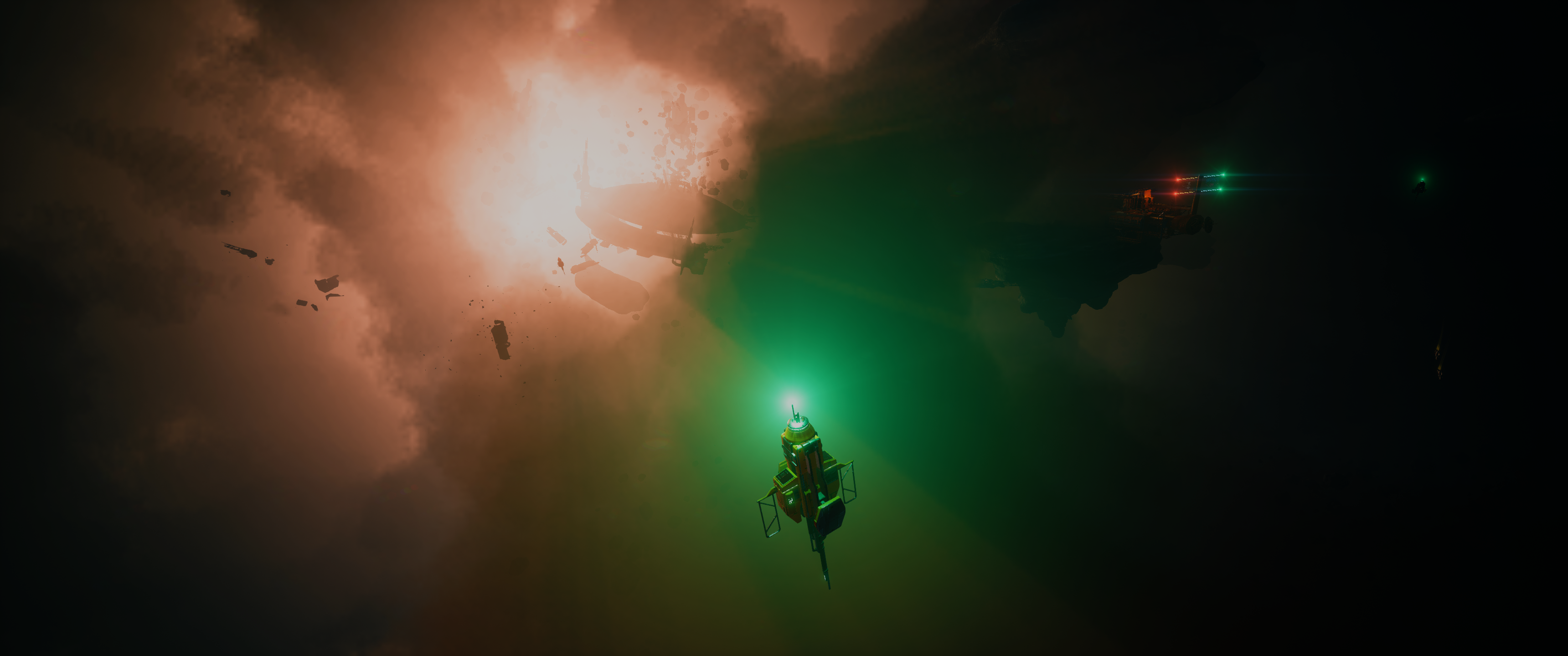
A green beacon in the middle of a dark gas cloud

However, Everspace 2 is not perfect. My biggest gripe is with the writing in the main storyline. No one expects deep or complex writing from an ARPG, but this does not excuse poor writing. 

The characters need more substance. Ben and Delia are just cardboard cutouts and deserve motivation and agency. Maddock becomes a contrived, grumpy omni-antagonist. Combining some supporting characters, like Ben and Tareem, would have enhanced both. Everspace 2 also unnecessarily sexualizes a female supporting character at one point. 

Similarly, the early main story has too much “I need you to do this, but I am not going to tell you why for at least two cut scenes.” It feels unnecessarily opaque and confrontational. The game also removes the player’s agency at a few key moments, railroading you. 

My other gripe is with loot management. Most of the copious loot enemies drop is trash you sell or disassemble for crafting components. The rare upgrade is fun, and Everspace 2‘s crafting system means you will always have suitable weapons, modules or consumables. 

However, the constant gear drops and level churn mean periodically yanking yourself out of the fun combat and puzzle game loops to clear your inventory. Loot management is a broader problem with ARPGs’ variable intermittent reward structure, but it is still a problem.

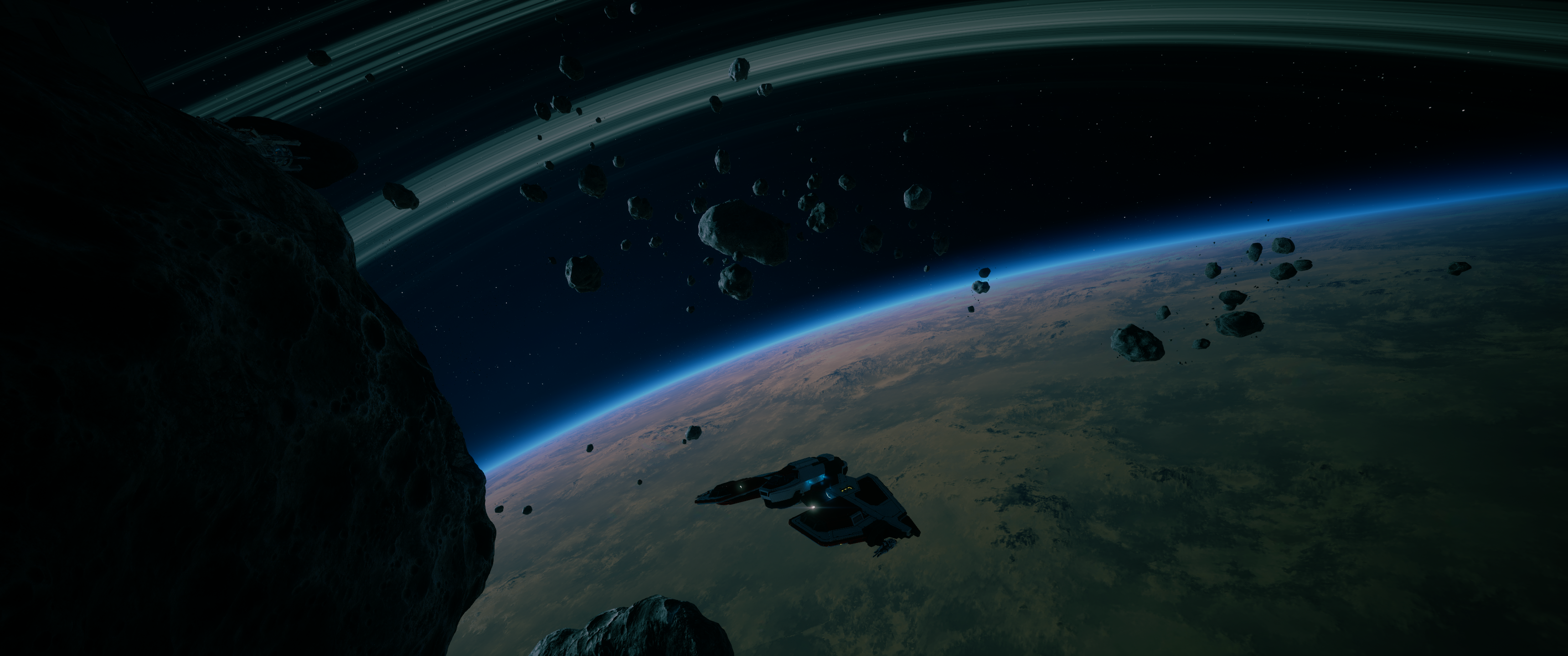
A ship in an asteroid field hovering over a ringed planet

I initially thought Everspace 2‘s lack of replayability would be a problem. It lacks a skill tree or other ARPG elements that specialize your character. No advancement or story choice blocks off content. ARPGs have traditionally used these to encourage players to create different characters to replay content differently.

However, being able to quickly switch out a new ship or experiment with new weapons or modules means experimentation or change is refreshingly easy. Meanwhile, the perk and challenge systems provide attainable alternative goals that offer useful benefits instead of gatekeeping high-level content from less dedicated players. 

Ultimately, Everspace 2 is a game that knows what it wants to be. It doubles down on that explore -> shoot -> loot -> craft game loop. If you enjoy that loop, and you will find out quickly or via the free demo, the game promises hours of the same. Otherwise, you will bounce off Everspace 2 hard.

Everspace 2 also knows what it does not want to be. It is single-player and offline, eschewing the complex code, gameplay loops and community management required for multiplayer or online play. It focuses on quality over quantity, providing a few well-developed star systems to explore. There is no piracy, salvage, political simulation or other distractions.

It took me about 60 hours to complete the main quest, including most side quests and challenges. As with most RPGs, you could complete it in under half that time, but you would miss the best content. Meanwhile, the developers continue expanding and enhancing the game, showing a welcome love and attention to detail. If only all ARPGs were this good.

“Stray Gods” Review: A Musical Romp Through Greek Mythology

Stray Gods poster showing the cast jamming at the ruined Mt Olympus

Stray Gods: The Role Playing Musical, or just Stray Gods, is an interactive musical game, as its name suggests. Summerfall Studios developed it, the first game for this Australian studio.

You play as Grace, a leather jacket- and boot-wearing directionless 20-something. After sitting through uninspiring auditions for a new band member, Calliope happens by. The muse from Greek mythology inspires Grace, weaving the words from her mournful song into hope.

Later that evening, a wounded Calliope bursts into Grace’s apartment. She dies in Grace’s arms, gifting Grace her powers and catapulting Grace on an adventure to clear her name.

Mechanically, Stray Gods is similar to point-and-click dialog games. However, this mechanic extends to songs, where the player’s choice determines the subsequent words and music sung. This design alone puts Stray Gods in almost unique territory.

Some dialog and most song choices are associated with one of three traits: caring (green), kick-ass (red) or clever (blue). You select one at the start and another when you max it out. Choices accumulate. Some options may only be available with a sufficiently high score in its trait. 

A musical lives and dies by the quality of its music. Thankfully, Stray Gods’ music is excellent. One would have expected no less from Austin Wintory with help from Tripod and Montaigne.

“Adrift”, the first song, is probably the best. It sets the game’s moody, elemental tone. Its waltz-like triple time gives the feel of constant motion or bobbing, reinforcing Grace’s relatable malaise. 

“Old Wounds”, another memorable song, is an argument between Persephone and Apollo. Its chorus is a welcome respite between the angry words, and the verses tear open millennia-old wounds. It is almost uncomfortable to hear. It reinforces how the Idols are divided, self-righteous and entrenched.

However, Stray Gods also surprised me with its writing and voice acting. Its story is deceptively deep and intelligent, reminding me of the musical Wicked. Instead of subverting The Wizard of OzStray Gods reinterprets the Greek gods and how they would function in modern society. 

It is not just Grace who is adrift. For example, burdened by history and the guilt of his prophecies, Apollo has receded into himself. He has become a meek, softly spoken shadow, whispering most of his lines. He is the opposite of what a sun god should be.

Persephone embodies rage and resentment, often depicted with her back to Grace or the world. Every word seethes and resents her injustices, like losing her underworld.

Pan is more faithful to himself, revelling in chaos and mischief. He copes by living in the moment and seeking advantage where he can.

The game’s writers also showed love and attention to detail. I spent twenty minutes chatting with Apollo as he mournfully whispered the Idols’ history and current challenges. There is also a bit of humour, such as with Apollo’s or Hecate’s unease with modern technology.

The art style is dreamlike and stylised. The main characters are cell-shaded, with minimal animations between poses. The backgrounds vary. Some are detailed. Some, like Calliope’s apartment, are merely pencil lines over patches of colour.

My criticisms of Stray Gods’ are few. Despite a patch intended to fix this, the sometimes inconsistent dialog volume can be jarring or make some lines hard to hear.

Stay Gods also has superficial libertarian or “woke” undertones. Some romance options are same-sex. It hints strongly that one idol is transgender. Some characters have piercings and tattoos. None of this should matter. However, some will read too much into it.

If you like musicals, Greek gods, murder mysteries and a bit of romance, Stray Gods has you covered. It is short and sweet at about six hours. However, multiple playthroughs are required to see all possible outcomes and get all achievements.

“Deliver Us Mars” Review: Grim but Emotional

Deliver Us Mars poster, showing a space suited Kathy Johanssen climbing a precarious Martian cliff using pickaxes.

Deliver Us Mars is an interactive fiction game developed by KeokeN Interactive. While some consider it an adventure puzzle game, Deliver Us Mars focuses on story over puzzles and mechanics.  

Deliver Us Mars follows on from the prequel, Deliver Us the Moon. Earth’s resources are exhausted and its environment is rapidly degrading. You play the teenage Kathy Johannson as she travels to Mars with her crew. They want to find the three ARK ships that fled the moon in the prequel, then use the ARKs’ technology to fix Earth.

Mechanically, Deliver Us Mars shifts between three modes. The first is engine-rendered cut scenes, where the game tells much of its story. Deliver Us Mars shows off the facial animation features of the Unreal engine, not to mention the animators’ skills.

The second is exploration, walking or travelling around near linear maps. You often find objects to scan or read that flesh out the world. This is natural to those familiar with RPGs and adventure games. However, finding them all will likely require multiple playthroughs.

The third is mini-games. Some mini-games require traversal, including climbing or driving a rover across the Martian surface. The climbing mechanics are designed well, requiring coordination to survive palm-sweating moments. Some mini-games are puzzles, like using energy beams to power doors or machinery. 

The mini-games are mostly easy, although their controls or intended results are sometimes unclear. Most have an additional achievement for fast or exceptional completion, yet another reason for subsequent playthroughs.

Mini-games and exploration are also not the game’s central focus. They supplement and reinforce the story. Instead, the success of a game like Deliver Us Mars relies on the quality of the storytelling and the characters. Thankfully, the game delivers.

For example, Deliver Us Mars periodically revisits Kathy’s youth. These flashbacks are initially tutorials, such as swimming teaching how to manoeuvre in zero gravity. They momentarily break the tension, reminding the player of less stressful times in Kathy’s life. 

However, later flashbacks exacerbate the tension and add context. For example, the game hints at the death of Isaac’s wife and Kathy’s mother early. However, the game delays the event to maximize the emotional impact. 

Deliver Us Mars also uses subtle analogies, such as Kathy’s home on Earth. It represents the family dynamic and Earth’s perilous state. Initially, it is inviting with a warm sun and a loving, successful family, albeit with subtle hints of external unrest. As flashbacks recur, disagreements boil over, and dust storms darken the sky. Eventually, a storm destroys the house while Isaac, the father, must leave Kathy in the hands of Claire, her sister. It then gets worse.

Deliver Us Mars is pessimistic. Superficially, it is about how humanity’s talent for internal conflict often sabotages our best efforts. It examines how decision-makers can lose context and grounding, succumbing to revenge, narcissism or paranoia. It highlights the unreconcilable sacrifices some make. Even the worst climate prediction models do not show the Earth becoming inhospitable in the game’s timeframe. 

The character of Kathy Johannson is one exception. The first flashback shows her irresponsible playfulness as she swims with her new and not waterproof moonbear toy. She grows over the game, watching the mantle of responsibility pass from her father to her sister and finally to herself. When Isaac first sees Kathy on Mars, he remarks how she has grown, and this is not just physically. Players presume and impose a default heroism on her, and she does not disappoint.

Delver Us Mars hinges on the emotional connection between Kathy and Isaac. Like in Deliver Us the Moon, Kathy and Isaac show how family and close relationships often motivate us the most. A single word from Isaac, “moonbear”, is enough to spur Kathy onward. The love of his daughter also inspires Isaac when all seems lost.

Isaac Johannson is initially sympathetic, torn between duties as a father and saving Earth. However, unlike Kathy, Isaac plays a tragic role. Time will tell whether Kathy or Isaac represent modern-day governments trying to appease their citizens while protecting the environment. 

It may be my inherent optimism, but Deliver Us Mars is more about not running away from problems. Like the sacrifices people make. Like the relationship between Kathy and Isaac. Like the environmental problems on Earth.

Even when things seem grim, there is always time and more opportunities. This is a pre-apocalyptic setting, not a post-apocalyptic one, and there is still a chance to prevent it. Deliver Us Mars believes that human ingenuity and hard work can solve significant issues.

Aesthetically, Delver Us Mars is influenced by near-future science fiction like Gravity, Interstellar, Ad Astra or 2001: A Space Odyssey. Most technology is slightly ahead of our own, making the game relatable. Some models are superb, particularly the detail in the crashed ARK Lados. The blue Mars sunset is also realistic.

However, Deliver Us Mars skims over many dangers of living on Mars. Its dust is abrasive and toxic. It receives more radiation than Earth. However, I suspect the game designers wanted space or the hostile, desolate Martian environment for spectacle and impact. A game set in safe but sterile metal corridors would quickly feel dull and mundane.

Playing Deliver Us The Moon first is recommended. Like the flashbacks, the prequel adds gravitas and emotional context. For example, Deliver Us Mars almost ignores Sarah Baker, the expedition leader. Appreciating Sarah’s importance and perspective from her small part in Deliver Us Mars is difficult.

While the realistic graphics are gorgeous, they are sometimes inconsistent. It is a minor criticism, but little things can break immersion, like a buggy not leaving tire tracks or the sprite-based thrust from a manoeuvring spacecraft. Higher resolutions are unkind to some of the models and textures. Stylized graphics like cell-shading may have been a better choice. It would have simplified the art and given better cohesion.

Deliver Us Mars is about the right length at about ten hours to complete, more if you want to get all the achievements. It is darker than its prequel but worth it for science fiction or interactive fiction game fans. Hopefully, KeokeN has a sequel planned to continue or conclude the story.

“Rebel Galaxy Outlaw” Review: A Homage to Privateer

Rebel Galaxy Outlaw Game Poster

Rebel Galaxy Outlaw is a single-player, space sandbox game developed by Double Damage Games. It was initially an Epic Store exclusive in 2019 and released on Steam and other platforms a year later.

Rebel Galaxy Outlaw is infamous for being the first Epic store exclusive. This decision led to review-bombing and bad press. However, this is unfair. The poor early reviews had little to do with the game itself.

Rebel Galaxy Outlaw is also not the best space sandbox game available. Elite Dangerous and its peers do just about every game loop better. However, Rebel Galaxy Outlaw never intends to compete at that level. Instead, it is cheap and developed by a small studio that lacks the resources of a AAA behemoth. It packs a lot into a small package.

You play as Juno Markev, an out-of-luck ex-space pirate. The opening cell-shaded cinematic shows her crashing on a planet after unsuccessfully confronting her husband’s killer. Juno calls in a favour to get a modest replacement. She then must juggle repaying her debts, upgrading her ship and unravelling her past.

Rebel Galaxy Outlaw‘s gameplay consists mainly of combat with some trading, piracy and asteroid mining. These earn credits to afford better ships and equipment. Experimenting and exploring are helpful but optional. They can reveal poorly explained mechanics, side quests, rare weapons, lucrative mining spots or beautiful nebulae. 

Unlike Elite Dangerous and similar games, Rebel Galaxy Outlaw has a light, grungy, blue collar, “space trucker” style. The default radio station plays heartland rock and advertises discount ammunition and cheap beer. All technology looks retro-futuristic, old and second-hand. Many star systems are named after working-class southern or central US states. The region of space is called Dodge, like the famous lawless US frontier town. You can play eight-ball pool or dice poker to unwind, the genre equivalent of fishing. 

Rebel Galaxy Outlaw is the prequel to Rebel Galaxy, Double Damage Game’s previous game. They share the setting and style. However, the games are different. Rebel Galaxy is about flying capital ships on a 2D plane fighting with broadside cannons. Rebel Galaxy Outlaw is about 3D fighter combat.

Instead, Rebel Galaxy Outlaw is a homage to Wing Commander: Privateer and Freelancer. While there is a central campaign and side missions, you can ignore them to explore, fight or trade as you see fit. You can unlock buddies to fight with you temporarily. You can side with the law, against it or both. 

Even the graphics look like upscaled MCGA, used in Wing Commander: Privateer. The cockpit and HUDs are blocky and favour the old EGA colours. The stars are square. The game renders debris as sprites. Ships have distinct silhouettes and blocks of bright colours. 

Rebel Galaxy Outlaw plays best on a controller. While not as precise as a keyboard and mouse, the vibration makes you feel every shudder of acceleration and weapon recoil. The game’s aim-assist helps, too.

To be fair, Rebel Galaxy Outlaw is not flawless. Encounter difficulty can vary considerably. Auto-saves are regular and reloads quick, but unexpected deaths can still be frustrating. One mission requires non-lethal takedown of enemies, but you must manually remove any turrets beforehand. It is easy to miss some side missions, like those in Eureka.

However, Rebel Galaxy Outlaw surprised me. I had a fun 40 hours or so. You can complete the campaign faster if you do the minimum. However, getting distracted and blazing your own trail is part of the point. Fans of space sandboxes, Wing Commander: Privateer or something light and stylized will enjoy themselves. Do not let the poor early reviews fool you. 

“The Unfinished Swan” Review: Painting with Heart

A monochrome frog in a swamp looking overlooking the title "The Unfinished Swan".

The Unfinished Swan is a first-person exploration and traversal game developed by Giant Sparrow, the same developer that created What Remains of Edith Finch. The Unfinished Swan is not new, having released in 2012 on PlayStation 3 and then on PC in 2020, but I only now got around to playing it.

You play as Monroe, a newly orphaned boy, inheriting from his mother a single painting depicting an unfinished swan. One night the swan leaps out of the painting. Monroe follows it, embarking on a magical journey through a surreal, dream-like world.

The Unfinished Swan‘s world is initially wholly white. However, Monroe can hurl paint drops onto it, revealing details like walls and furniture. The game’s world is a blank canvas that only solidifies when painted. For example, what was formless white is suddenly a black frog that leaps into a nearby pond.

As the game progresses, it introduces new mechanics, such as the physics-defying, AntiChamber-like puzzles; buttons and levers to activate ladders and bridges; or hurling water to encourage the growth of climbable vines. You can also find hidden balloons that unlock upgrades and additional material.

The game slowly reveals a fairytale-like story through narration, about or from the world’s prodigious but eccentric king, and storyboards, complete with child-friendly line art. The music is also ethereal, consisting of glockenspiels and light strings, reminiscent of Tchaikovsky’s Dance of the Sugar Plum Fairy.

Thematically, The Unfinished Swan views grief and impermanence through a child’s imagination. The normally mischievous act of splattering paint allows Monroe to find certainty, meaning and agency where there is none. The shared act of painting links Monroe with his mother. Metaphors have power.

The Unfinished Swan is also moving because, by seeing the world through Monroe’s eyes, we can experience things both superficially, as he does, and with an adult’s experience and context. Implication and inference also have power.

Despite its age, The Unfinished Swan still holds its own as novel and thought-provoking. It is short, taking under four hours to complete, and wraps up its story positively but with restraint. Those looking for something contemplative and unusual will enjoy it.

“Cloudpunk” Review: Heart in the Sky

Standing outside the Cloudpunk office in game. The neon "U" is dimmed.
Outside the Cloudpunk office in-game, with the neon “U” dimmed

Cloudpunk, developed by Ion Lands, is a third person, story-based exploration game set in a future, dystopian city. It has a distinctive voxel art style that is both beautiful and distinct.

You control Rania, an out-of-work musician and recent migrant to the city of Nirvalis. Destitute and desperate, she signs up for Cloudpunk, a pseudo-legal company that delivers packages away from law enforcement’s often-corrupt eyes. Like the player, she knows how the world works but is new to Nirvalis, becoming a compelling point-of-view character.

The game takes place over a single long, rainy night shift. Most gameplay involves piloting Rania’s flying car, or “HOVA”, like the Delorean from the Back to the Future series. Occasionally you disembark and walk around the elevated streets, picking up or delivering packages and talking to other inhabitants. 

However, you get the most out of Cloudpunk by taking the time to explore. Nirvalis’s verticality can be disorienting, and the HOVA’s controls can take some getting used to. Wandering reveals NPCs with interesting stories or discarded items you can sell. You can even decorate your flat.

This premise is excellent. It allows Cloudpunk to start on seemingly random deliveries, drip-feeding details about the world and its various strata. Delivering parts to someone doing illegal street racing? Check. Delivering food to the impoverished? Check. Delivering a pizza to an executive? Check. You just need to follow the rules: never miss a delivery or ask what is in the package.

However, Rania quickly gains some agency. Do you deliver a ticking package to the recipient, knowing it could be a bomb? Do you return a replaced HOVA part to the garage or sell it? While no choice branches the story, there are consequences.

This premise also allows for telling longer and broader stories. You visit some characters multiple times, slowly revealing their tales. Can you help a detective solve a case? What about unearthing more about Nirvalis’s history?

Outside the plot, Cloudpunk‘s voxel graphics are disarming but expressive, reminiscent of Minecraft. Volumetric lighting and lens flare render life-like graphics. You only notice the blockiness close to individuals or HOVAs, giving Cloudpunk a unique charm.

The city of Nirvalis is beautiful, even when rendered in voxels. The streams of HOVAs act like the city’s arteries, providing a relaxing, constant buzz and stream of lights. The Bladerunner-like neon signs and periodic audio advertisements for virtual holidays and insurance against computer viruses help make the world consistent and believable.

Cloudpunk‘s synthwave soundtrack is atmospheric, on-point for the genre and sets the mood well, such as the more meditative pieces when driving, the pressure of an urgent delivery or a club’s upbeat, drum-heavy dance track. The track names read like cyberpunk staples, like “Neon Rain”, “Sleepless City”, and “A Million Different Faces”. One important track is different, though.

Cloudpunk keeps the mood in a deliberate balance. Like in many cyberpunk stories, they wanted Nirvalis to be distant enough from the modern day to be disarming but close enough to be relevant.

On the one hand, there is depressing, omnipresent exploitation and inequality. Rapid gentrification means rents can rise by the hour, evicting people instantaneously. The ruthless and efficient debt corps practically enslave without remorse, if needed. It is easy to despair at the environmental damage and the crumbling city.

On the other, there are many lighter moments. Advertisements warn about the unlicensed playing of jazz or retro computer games. Gang members build children’s playgrounds to be subversive. Vendors sell cherry pies with “real” cherries. You could not taste the difference, anyway. 

Canus, your AI canine assistant uploaded into your HOVA, also plays a vital role in setting the mood. Part researcher, part moral compass and isolation-busting companion, Canus’s naivety is endearing. The contrast with Rania’s world-weariness also subtly focuses the player’s attention on the moment’s moral quandary.

While full of cyberpunk tropes, it leverages them to reflect on important questions, not just as a lazy crutch. For example, how do we treat each other in a world where we value humans and intelligent AIs by their wealth? Can we learn to love those with whom we vehemently disagree? At its core, Cloudpunk is a game about heart. Nirvalis has never needed Rania, a Arabic name meaning queen, and her music more.

Cloudpunk takes about ten hours to finish, not outlasting its novelty. It will appeal to fans of the cyberpunk genre or those looking for something unusual, pensive and emotional.

“Diablo IV” Beta Review: Having It Both Ways

Lilith holding Diablo’s skull next to the Diablo IV logo

The recent free “server slam” weekend was an excellent chance to experience a late beta version of the upcoming Diablo IV. After my Path of Exile foray, I wanted to see Blizzard’s forthcoming offering and how it compared.

Action Role Playing Games (ARPGs), a genre that the first Diablo practically founded, has come to be dominated by live service, “forever games” aimed at hardcore players. The story, characters, and world-building take a back seat to optimising character progression and end-game power, like in Diablo III and Path of Exile.

Diablo IV aims to put the “role playing game” back into “action role playing game”. It delivers Blizzard-standard fantastic cut scenes. It promises a long campaign with biblical, mysterious, dangerous antagonists and prophetic dread. Those wanting immersion in atmospheric and sometimes squeamish gothic horror will not be disappointed. Memorable and relatable characters are back. Saving the world (again) gets old. Saving someone you care about means more.

The success of Diablo IV will likely depend on how you measure it. The buzz created by a large existing player base, previous goodwill, social media-friendly cut scenes and copious beta programs will likely ensure significant initial sales. 

However, Diablo IV‘s longevity and long-term player counts depend on appealing to the hardcore crowd. Those focused on the story will play through the campaign and then move on, perhaps revisiting occasionally. MAU (Monthly Active User) or DAU (Daily Active User) targets require people to keep playing (and paying). 

Thankfully, Blizzard is trying to create a game that appeals to both story-driven casual and optimisation-driven hardcore audiences. The server slam demonstrated the appeal to the former. Unfortunately, the server slam’s level 20 cap makes judging late-game content, important to hardcore players, harder. 

The potential is there. Diablo IV promises a huge paragon progression path after level 100 and seasons. Adventure mode allows players who have completed the campaign to bypass cut scenes and the main quest line for new characters.

However, Blizzard also needs to get the basics right. Many have written about Diablo IV‘s uneven class balance. Sorcerors were considered overpowered, barbarians underpowered, and necromancer pets were both at different times. 

The classes shown in the server slam are unlikely to be their final versions. Balance adjustments will continue before and after the release. However, resource limitations and risk prevent the designers from changing much before the June release date.

Many other design changes since Diablo III are both good and bad. For example, automatic enemy scaling always ensures an appropriate challenge. This auto-scaling means players can advance through the content at their own pace. Yet, not having the opportunity to be over- or under-powered can reduce the feeling of achievement or challenge.

Diablo IV procedurally generates dungeons like most ARPGs, but the above-ground world is fixed. This decision allows incidental player interactions, whether cooperative, social or PvP, instead of just at hubs. However, these interactions may not be always welcome.

The designers then leveraged this fixed, open world to facilitate and reward exploration. They hid temporary events or dungeons in corners. The reputation mechanic rewards focusing on particular zones. This decision, at odds with recent ARPGs, appeals to the less mechanically-focused players. However, it forces mechanics-oriented players or speed runners to waste valuable time.

Some design decisions make mechanical sense but threaten to break immersion. Limiting healing potions to four helps the designers balance fights. It simplifies healing and inventory management for newer players. However, boss fights broadcasting when they will drop potions on their health bar seemed too convenient. Non-boss creatures dropped health potions like rain, too, which seemed excessive.   

What I enjoyed most during the server slam were the little things. Revisiting Tristram, hearing its spine-tingling motif and being chased by the Butcher reminded me of the best bits of early Diablo games. The reveal of Inarius after ascending the long, ivory-coloured staircase was wonderful. I loved Sanctuary’s (literal and metaphorical) cold and unforgiving nature. 

That probably puts me in the more story-driven audience, focused on the lore and the world. Diablo IV may not be a “forever game” for me. Diablo III‘s early focus on the auction house and repetition put me off. However, the server slam made me impatient to see Diablo IV‘s story unfold. I hope Blizzard realises the game’s potential for both audiences, not just me.

“Dungeons & Dragons: Honor Among Thieves” is Finally a Good D&D Movie

"D&D Honor Among Thieves" movie logo

Dungeons & Dragons: Honor Among Thieves is a comedy and action fantasy movie based on Dungeons and Dragons (D&D), the tabletop role playing game. You follow Edgin and his adventuring band as they attempt to rescue Edgin’s daughter. They are betrayed, then drawn into something larger and more insidious that threatens the whole city of Neverwinter within the Forgotten Realms.

One challenge with bringing D&D to the screen is that D&D is a game system upon which different locations and characters are built and played. It is not a single place with known characters. Even the game’s themes vary with different settings, such as Dark Sun’s post-apocalyptic rebuilding, the pseudo-Middle Earth of Greyhawk and the intrigue-filled Forgotten Realms.

Another challenge is what makes D&D successful and enjoyable, like the many tabletop role playing games that followed it, is active participation. While there is a Dungeon Master that guides play, D&D is about cooperative storytelling and spontaneity over fixed character development arcs and well-developed plots. It is camaraderie. It is living popular tropes, not just passively consuming them.

By comparison, fantasy and science-fiction movies and novels usually adopt the setting to disarm the reader for some form of social commentary. For example, J. R. R. Tolkien’s The Hobbit was about conflict between the English upper, middle and lower classes. Robert E. Howard’s Conan warned against the evils of unrestrained technology. Characters develop and events occur to support that aim, all under the director’s or author’s strict guidance. 

Previous D&D movies and many novels failed because they took the settings or signature creatures, spells and classes from D&D and put them in heroic and epic but themeless fantasy stories. They inherited the disadvantages of both D&D and movies or novels without either’s advantages.

Thankfully, Honor Among Thieves learns from these mistakes and recent successes, like the Marvel franchise. It works for four reasons.

The first is respecting the soul of D&D. D&D is about heroic fantasy, where inspiring good and terrifying evil exist. Players raise sword and spell to defend those who cannot.  

However, the players or audience need to feel emotionally invested. It has to be personal. Without emotional grounding, gravitas becomes self-importance and the solemn becomes cringeworthy. Honor Among Thieves starts at the most basic, with a husband pining after his wife and daughter, routes through betrayal and only then ups the ante to something epic. The movie has heart.

The second reason is respecting D&D as a beloved, forty-year-old IP. Players will recognise iconic spells, classes and creatures. Those familiar with the Forgotten Realms setting will enjoy the references, from the overt, like Baldur’s Gate and the Harpers, to the subtle, like Selune’s Tears. The adventurers from the 1980s Dungeons and Dragons cartoon appear in the arena. There are not one but two dragons.

Honor Among Thieves feels like a D&D “campaign” or sequence of play sessions. It is long at around two hours but keeps the pace moving, jumping locations quickly without labouring. Locales include medieval cities, the Underdark and eponymous dungeons. The swerving plot gives the feeling of spontaneity and improvisation. The special effects and fight choreography are on point, giving each character a chance to shine. The final climactic battle demonstrates the power of the adventuring group at its satisfying culmination.

To be fair, Honor Among Thieves is not always faithful to the D&D rules. Paladins making Handle Animal skill checks and druids wild shaping into The Incredible Hulk-like owlbears will leave D&D rules lawyers shaking their heads. Under the guise of a relatable audience surrogate, the movie strips Edgin’s bard of his magic and combat prowess. However, these transgressions are minor and forgivable.

The third reason is not taking itself too seriously without being disrespectful. Often, an unexpected joke or an Instagram-worthy lousy dice roll can be a highlight of the session. Honor Among Thieves contains plenty of humour, from accidentally setting off traps, underestimating the literal wording of spells or the questionable tastes of intellect devourers. Without it, this movie would be a sequence of action-heavy fights having to one-up itself each time. It keeps the tone light.

For example, Xenk, the Paladin, could easily be overplayed to the point of ridicule. He literally and metaphorically does not swerve from his path of righteousness. However, his misunderstanding of irony is endearing. His aloofness opens room for forgiveness. He simultaneously contrasts the more chaotic nature of the rest of the party and inspires them toward greatness. Edgin, his adventuring band and the audience want to make fun of Xenk but cannot.

The fourth reason Honor Among Thieves works is its themes. Like Guardians of the Galaxy and The Avengers, it deals with family and self-realisation. You know the good guys are going to win. The question is how and whether they can overcome their relatable self-doubt and dysfunction to realise their potential. Seeing heroes struggle with the same fears as us brings the audience and players closer, humanising the heroes and subtly suggesting that we can all be heroic.

Honor Among Thieves is fun. It is fast and flashy enough to keep the audience’s attention and sassy enough to be credible without disrespecting D&D. You will enjoy Honor Among Thieves if you like the recent Marvel movies, heroic fantasy or play any tabletop role-playing game. If not, it will continually imply that you are missing something. Honor Among Thieves will not win any awards but is a solid cross-over that players have been waiting decades for.

“Wednesday” Review

Many were curious when Netflix previewed Wednesday as a reboot of the 1960s black and white The Addams FamilyThe Addams Family poked fun at those who are different, subtly reinforcing American cultural superiority during globalism’s infancy. Recent versions softened this stance but reduced the central family to a travelling freak show. Would Wednesday repeat the same mistakes?

Wednesday begins as Wednesday Addams starts at a new boarding school, Nevermore Academy, after being expelled from yet another traditional American high school. Her parents, Gomez and Morticia, also went to Nevermore Academy. Their legacy threatens to smother Wednesday’s emerging identity under her parent’s shadow. Meanwhile, Wednesday struggles to define herself in a world that wants to force her into a mold. 

The first few episodes introduce the characters while entertaining the viewer with succinct and acerbic dialog, particularly from Wednesday herself. The main plot then starts to assert itself. A supernatural mystery threatens to overwhelm Nevermore Academy and the nearby town. Wednesday takes it upon herself to solve the mystery, guided by her psychic premonitions.

Jenna Ortega portrays the unblinking, monochrome titular character brilliantly. Wednesday outwardly revels in her isolation. She even convinces her nemesis that she cares little for others’ opinions. However, her black, frozen heart predictably melts after a visit from her uncle Fester, her feelings for Thing and young love.

Thing, Wednesday’s disembodied hand companion, is the most transformed character from the original The Addams Family, both by special effects and a new purpose. Thing moves from a recurring gag to the perfect companion and sidekick: loyal, competent, occasionally comedic but never taking the spotlight from Wednesday. 

Enid, Wednesday’s werewolf roommate, plays Wednesday’s foil. Enid represents everything that Wednesday is not: colourful, energetic, warm, forgiving, technically savvy and extroverted. This tug of war plays out in the not-so-subtle contrast of their shared dorm room between Enid’s rainbow and Wednesday’s gothic drabness.

Wednesday eschews almost all classroom scenes typical to the Harry Potter-like genre. Weems, the stoic, long-suffering headmistress played by Gwendoline Christie, vacillates between dominance, patience and political correctness. 

For original series fans, Wednesday subverts many tropes from The Addams Family, like snapping fingers twice or the adoring love between Morticia and Gomez. However, some merely lighten emotional moments and strengthen the bond between characters. Wednesday and Pugsley, her brother, casually fishing using hand grenades is a good example.

However, Wednesday has its frustrating flaws, too. Wednesday’s character sometimes veers into the Mary Sue trope. Her knowledge of macabre topics, archery or the cello is unmatched, dismissively besting others. Wednesday’s friends’ affection is unrequited and undeserved.

Wednesday also touches on the Chosen One trope. Her constant self-righteousness and lack of remorse grates. She would have been expelled and arrested for her actions in any other context. 

Wednesday will resonate with young adults. It deals with social status, love triangles, the struggle to find one’s identity, the bravado and self-righteousness of youth and the changing relationship with parents from a dependent child to a semi-independent teen.

Wednesday is unashamedly feminist. Women play most main roles. The series reduces Gomez from a 1960s-style family head to a love-struck doter. Pugsly is a pot-purri-eating weakling constantly needing Wednesday’s protection. However, the series loses little from doing so, and the new perspective is refreshing and fundamental to the story.

Underneath that, by moving the spotlight away from the Addams family and onto Nevermore Academy, Wednesday can examine diversity and inclusion. The ridicule of Nevermore’s student “freaks” by the nearby town’s “normies” will appeal to anyone bullied or victimized. 

The town’s financial dependence on Nevermore Academy forces an uneasy truce, preventing the resentment from escalating into open conflict. This arrangement gives more credibility and context while giving key characters more depth.

However, the series is sometimes one-sided. No one sympathizes with those Wednesday belittles or harms. The nearby townspeople are right to be wary, given the recent murders and Nevermore Academy’s students’ powers. 

Wednesday is aimed at a modern audience, who consider a show a competition between writers and viewers. The plot moves quickly, never dwelling on any scene or character more than necessary. It foreshadows enough for the audience to feel clever predicting the next event, only for the plot to swerve at the last moment.

Ultimately, the original series riffed on medieval or occult tropes for comedic effect. Wednesday uses a modern lens, crisp dialog and a fast-paced, economic plot to tell a different story. It appeals differently but successfully to both newer and older generations. However, the latter may find Wednesday a tad self-righteous and superficial.