“Star Trek: Lower Decks” Seasons 1 and 2 Review

Star Trek: Lower Decks, an animated series available on Amazon Prime Video and Paramount+, is Star Trek’s attempt to tread the well-worn path of self-deprecation. It pokes fun at the seemingly pretentious and self-important Star Trek: The Next Generation and Star Trek: Deep Space Nine era.

Other recent Star Trek shows like Discovery or Picard have leveraged technology to create gorgeously detailed ships, photo-realistic sets and better special effects. However, Star Trek: Lower Decks’ simple animation style does the opposite, making it disarmingly accessible for an audience that still considers animation a vehicle primarily for children or comedy.

Similarly, while those with a comprehensive recollection of the earlier series will find many subtle and humorous references, Star Trek has permeated the Western cultural consciousness enough for most to understand the settings and premises.

Star Trek: Lower Decks segregates itself from the franchise’s previous incarnations from the first scene. The credits, replete with the characteristic blue font on a starry background and brassy theme song, show an uncharacteristically unheroic U.S.S. Cerritos fleeing danger or screwing up. A star fleet ensign drinks blue Romulan whiskey when on duty, “lampshading” that it is not the cannon green Romulan ale. 

Star Trek: Lower Decks is not about “boldly going where no one has gone before”. The U.S.S. Cerritos, Spanish for an uninspiring “little hills”, does routine and less glamourous “second contact” missions. The main characters are not on the glamourous, charismatic and high-stakes bridge crew but the ensigns who perform thankless, routine maintenance and sleep at the ship’s rear.

The show humanizes the crew by focusing on flawed but relatable characters. We follow Boimler, who is bookish and obsessed with promotion. Tendi is a naive but optimistic and brilliant scientist working in medicine. Rutherford is an engineer who genuinely loves his work, oblivious to all else. 

However, Mariner steals the spotlight. She is a skilled Starfleet officer but constantly rebels, whether by the subtle rolled-up sleeves, smuggling contraband, or openly disobeying orders. 

The writers intended her to represent experience and savviness chaffing at Starfleet’s rigidity and regulations. She yawns at mission briefings and breaks more rules than she follows.

Perhaps Star Trek: Lower Decks is trying to be relatable and say that there is still a place for the rest of us in a franchise full of over-achievers. Talent and intelligence are nothing without wisdom and cunning. 

However, Mariner is hardly an underdog. Her uncanny ability puts her on a level above most and the U.S.S. Cerritos’ captain protects Mariner from any real consequences of her actions, tacitly glorifying her insubordination. These threaten to change her character from a relatably cool rebel to an unbelievably competent “Mary Sue”. Why create such a character?

Star Trek: Lower Decks is all about status. Are the privileges of rank deserved? Is there a pecking order between those of the same rank? Would Starfleet be a strict meritocracy, as cannon implies, or would the attractive and charismatic but less able rise to the top? 

Mariner constantly exposes and stresses the established hierarchy. For example, she practically ridicules Boimler in the episode “Envoys”, showing savviness beats knowledge. However, the Riker caricature first officer humbles her in the following episode by showing unforeseen skill and wisdom.

Mariner is the antagonistic foil to the other main characters. She berates Boimler for his bookishness and insecurity, is the pessimist to Tendi’s optimism and the leader to fill Rutherford’s vacuum of purpose.

Unfortunately, Mariner’s role sometimes lessens the show with too much unresolved and unnecessary interpersonal drama. She constantly dismisses her competency and, by doing so, others’. A good example is Mariner revealing she actually listened to the mission brief in the episode “Moist Vessel” (an unnecessary double entendre that will elicit an immature giggle from the intended audience) when she saves the day after arguing with the captain most of the episode.

The first series tries to give some thematic insight, such as dealing with the ecological and social implications of destroying an errant moon in “Cupid’s Errant Arrow”. However, the first series’ pacing and structure draws more from sitcoms, focusing on irony and absurdity, and lacks Futurama’s satire or Orville’s heart.

Sitcoms rely on characters remaining consistent and avoiding change. However, stagnation frustrates. Mariner’s relationships and past need confronting. Boimler needs to grow past his insecurities into the officer he aspires to be. Tendi needs the self-confidence to realize her brilliance. Rutherford requires the self-awareness that he is more than an excellent engineer.

Thankfully, characters start to develop in the second series. Boimler gets his revenge for “Envoys”. Rutherford and Tendi gain respect and leadership opportunities. The ensigns are paired differently, showing different parts of their personalities. Mariner relaxes from the constant antagonist role. 

The second series also examines its source material and themes more closely. It contrasts the U.S.S. Titan’s bravado and militarism with the U.S.S. Cerritos’ dedication and determination, mirroring Starfleet’s identity crisis. It depicts the Pakleds as both comically naive and dangerously unpredictable, a brilliantly relevant and thematically helpful portrayal. Appearance and charisma lose out to effort and ability in “wej Duj”. The final episode cleverly contrasts the “Lower Decks” experience for crews from different races.

The highlight vocal performance is Jeffery Combs as Agimus in the episode “Where Pleasant Fountains Lie”. The actor who portrayed Weyoun in Star Trek: Deep Space Nine and Shran in Star Trek: Enterprise shifts effortlessly between menace and insincere manipulation.

The best thing about Star Trek: Lower Decks is that it treats the franchise with both satire and respect. Star Trek has always been slightly absurd, where crew members are as likely to die from a Klingon Bat’leth as sentient ice cream. Unlike other Star Trek shows, Star Trek: Lower Decks leverages this absurdity to tell refreshingly different stories from different perspectives.

“Star Trek Picard” Review

Star Trek Picard Logo

Star Trek Picard, or just Picard, is a science fiction series streaming on Amazon Prime. Its premise is that the Romulan star threatens to go supernova and destroy the Romulan homeworld. The Federation offers to help and constructs a fleet of transports to resettle the populace. This offer would save the majority of Romulans and potentially heal the animosity between the Romulans and the Federation.

Of course, things go awry. The transport ships mysteriously attack the Federation shipyards on Mars, destroying the transport ships and means of production. 

So far, so good. It is a galaxy-impacting event worthy of the Star Trek brand and the eponymous now Admiral’s attention. The series also weaves in questions around the ethics of synthetic life, something suitably contentious.

However, the series immediately deviates from expectation. The galaxy blames the Federation for its woes. It forgot the supernova or that the Federation was also a victim of the attack. Far from showing its skill in diplomacy, compassion and problem-solving displayed during almost every Star Trek season and episode, the Federation turns inward and tacitly accepts the blame. 

Jean-Luc Picard sulks in his chateau for fourteen years rather than showing the stubbornness and ingenuity evident throughout Star Trek The Next Generation (TNG). Instead of getting a ship or helping, something that takes a single call at the series’ start, he abandons both his cause and crew.

Even when Jean-Luc Picard returns at the series’s start, he is oblivious to his charisma, unwillingly tormenting characters like Raffi and Elnor. He forgets to respect and be patient with others, even scoring points with Federation Admirals when the old Picard would think strategically, building a trusting relationship.

Perhaps the writers felt a seemingly perfect character needed a fall to develop. It is hard to improve perfection. However, Picard’s blinkered self-righteousness endangers any pathos.

Meanwhile, examining synthetic life’s ethics promised much. Star Trek has a history of exploring what makes us human. The original series contrasted emotional humans with Spock, the logical Vulcan. TNG had Data. However, the series reduces synthetic life to a MacGuffin. The series would have lost little by substituting an alien race or a unique technology.

Picard, the series, wants to be the gritty, dark Star Trek for the new millennium, where we see every leader and public institution in shades of grey rather than the more straightforward “black and white” of yesteryear. Heroes tire from the impossible standards to which others hold them, and their faults are laid bare. The hopeful patience of the Federation has waned, as seen in other series like Discovery.

By contrast, while the almost perfection of TNG characters was unrealistic, TNG presented an aspirational version of humanity. While TNG often dealt with ethical issues superficially, it introduced them to a broad audience. While humanity faced challenges, TNG’s underlying themes were always positive.

Instead, this series seems obsessed with fan service. It provides a touching farewell for Data. However, while seeing familiar characters helps rekindle parasocial relationships, their age also shows the thirty years since TNG finished. TNG and the subsequent movies were fun and much loved. However, time moves on.

When not lounging in nostalgia, the series gets endlessly sidetracked. Picard’s companions invent gravitas in each episode by a rushed flashback, then deal with it by boarding themselves in their quarters to brood. Of course, they briefly exit their stupor to perform plot-dictated tasks.

Each character deserves more screen time to develop organically and subtly. Alternatively, consolidate characters. The writers could have combined Rios with Raffi or Jurati, for example.

Despite the complaints above, the series is enjoyable. The plot weaves unpredictably, taxing the viewer just enough, and leads to a suitable climax. The acting and special effects are what you would expect for such a series.

Patrick Stewart portrays perhaps his most memorable role well. His deep, resonant voice and slightly-British accent give him a disarming, reassuring authority and grandfatherly charm. However, Stewart appears awkward when expressing genuine emotion, like during the Raffi and Elnor character arcs. Picard’s emotions are most impactful when understated.

The series is at its best when dealing with the psychology and ruthlessness of Romulans. The early, slow-burn mystery is enticing. The series finally shows the terrifying potential of the Tal Shiar, the Romulan secret police.

However, the test of a work is whether it stands on its own. Remove the fan service and nostalgia, and I wonder whether anyone would have produced Picard. Add potential misinterpretation of or disrespect to its source material, and you have a contentious, polarising series.

The trailers for season 2 appear to continue the nostalgia trip, revisiting the “fish out of water” time travel trope from the admired movie Star Trek IV: The Voyage Home. Perhaps I am old fashioned, but the producers are treading dangerous ground.

“Elite Dangerous Odyssey” Review

Elite Dangerous Odyssey image showing armed, suited commanders on a planet surface with an Anaconda and Cobra Mk II (space ships) flying above them

I had mixed feelings when Frontier Development released the Odyssey expansion for Elite Dangerous. On the one hand, new content and improved graphics could breathe life into Elite Dangerous and take it in a new direction. However, the on-foot play could dilute the core premise of flying spaceships. The inevitable launch bugs could also cause a player backlash. Both turned out to be true.

Odyssey introduced the ability to finally leave your ship and walk on planets or in space stations, what some call “space legs”. It added two new ranks to progress: Mercenary (on-foot combat) and exobiology (scanning plant-like organisms on alien worlds). Suits and guns appeared alongside ships as the things to upgrade and engineer. Settlements, small planetary outposts, became mission locations. Surface conflict zones hinted at mixing ship and ground combat.

The problem with the above description is that, while accurate, it is ambiguous. For example, the above could turn Elite Dangerous into a universe simulator, where ships become tools rather than classes. However, Frontier provided something more modest, much to many players’ disappointment.

For example, many players were looking forward to walking around inside their ships. Frontier mentioned this early in Elite Dangerous‘s development as a long-term goal. Unfortunately, Odyssey lacks this. Many feel “teleporting” to your pilot seat from outside your ship breaks immersion. While that is true, I cannot think of anything I would sacrifice in Odyssey to add ship interiors given Frontier’s finite resources.

The new Exobiology rank added thousands of new types of plant-like alien life to find and scan. It adds additional play loops to exploration and more reason to land on planets. However, it could have been more than scan three organisms more than a few hundred metres apart.

I liked the better world-building in Odyssey. Elite Dangerous largely eschews lore to let players write their own stories. However, Odyssey’s in-game advertising and bar music emphasize things that make Elite’s galaxy unique, like the various companies that produce ships and weapons or the rare commodities players can trade. The new engineers are not just tools for progression, each having personalities and visually interesting planets.

One of the most polarizing aspects of Odyssey is the new graphics engine. The new planet graphics are gorgeous, turning Horizon’s (the previous expansion’s) beige into coloured hues and blocky barrenness into beautiful vistas. Anyone playing Elite Dangerous for sense pleasure, like many explorers, found a galaxy worth re-exploring just for the visuals.

However, the new graphics engine led to other problems, particularly in Odyssey’s new settlements. PCs that happily played Horizons on maximum settings were suddenly humbled. While Frontier is working hard to improve performance, fixing it is a long-term effort.

Odyssey’s FPS combat is polarizing. For example, some weapons are more effective against shielded opponents than non-shielded opponents and vice versa. While an Elite Dangerous staple, constantly swapping weapons frustrated many.

Some felt that high-end suits were too resilient, requiring too much damage to take down. However, while engineered suits help, you are hardly impregnable. The resilience forced a tactical- rather than twitch-based playstyle.

Many speculate Frontier released the expansion too early, possibly due to financial commitments. The poor reception and low quality were enough for Frontier to delay Odyssey’s release on consoles (PS and Xbox).

Whereas many blast Odyssey with hyperbole- and expletive-ridden rants, I take a long-term perspective. No Elite Dangerous release has been bug-free. No online game release, either. Frontier has also improved communication with a player-voted issue list and more “meet the developer” sessions. 

Odyssey is not perfect. I was frustrated by the poor performance and felt exobiology was underdeveloped. However, I enjoyed the new content. The visuals are spectacular, particularly the local star casting its rays through a coloured atmosphere. On-foot conflict zones capture FPSs’ frenetic pace while still being characteristically Elite. 

Odyssey demonstrates why many AAA FPS games have nine-figure budgets. It is hard to make an FPS with a bespoke engine (Frontier’s Cobra engine) and a setting whose scale precludes pregenerated optimizations. 

Handling player expectations is harder. As mentioned above, the promise of “space legs” conjured desires for exploring ship interiors and a Star Citizen-like experience. Many players also looked at the work required to complete the new ranks and engineer suits and decided to seek their space game thrills elsewhere.

Elite Dangerous is a relatively old game, and the wonder has faded for many. Some players yearn for unexplored mechanics and settings. Novelty has a strong gravity, even to the unreliable and incomplete Star Citizen with its dubious funding practices.

My main criticism of Odyssey is the lack of content. After a few hundred hours, most players had sufficiently engineered on-foot gear and Elite ranks in Mercenary and Exobiology. For a game that prides itself on complexity and self-discovery, even the popular Elite Dangerous Youtubers ran out of Odyssey content after a few months. Idleness breeds discontent, as they say.

Take engineering as an example. Unlocking engineers from Horizons, the previous Elite Dangerous expansion, required players to experience the game’s breadth. You had to travel far into deep space, mine, sell stolen cargo at black markets, trade rare commodities and fight. This requirement was a great example of exposing players to neglected parts of the game while leveraging existing game loops to provide new gameplay.

I suspect Frontier wanted to do something similar for the new on-foot engineers in Odyssey. However, the required content did not exist. Instead, unlocking many on-foot engineers requires a frustrating grind. Players need to repeat tasks for hours, like logging out then back in at the same location, hoping for rare materials to spawn. 

Moreover, Odyssey relies on having a strong “middle game”, specifically randomly generated on-foot missions, settlement assaults and conflict zones for replayability. From Frontier’s perspective, this maximizes the number of players using the new features. However, even fun game loops lose their appeal after hundreds or thousands of hours.

Instead, Elite Dangerous needs more “late game” content. For example, something akin to Thargoid combat with a higher difficulty level, a social aspect, and correspondingly better rewards. Such content keeps the experienced players engaged and is aspirational for new players.

Such content will likely not arrive soon. Until Odyssey releases for consoles, Frontier appears focused on performance and stability. That makes sense, given every new Odyssey-only feature added incites more resentment in console players.

Meanwhile, Frontier includes “hero” features in each monthly patch, like on-foot emotes and a new surface vehicle. They promised fleet carrier interiors for early 2022. These are all welcome. However, none will add more than a few hours of new content. They continue to emphasize “middle game” content, reusing what is already there. Perhaps new ships or on-foot Thargoid combat are coming later.

Is Odyssey “good” or “worth buying”? These are the wrong questions to ask. I have enjoyed the new content and am glad I bought it. Yes, there are performance issues and bugs. However, Frontier will have to fix these to get the revenue from the console release. 

Is Odyssey the best FPS game available? No. Many specialist FPS games offer deeper or more varied FPS play. Odyssey, like Elite as a whole, is a victim of its breadth and shallowness, becoming unintentionally comparable with specialist games that do niches better. 

However, Odyssey’s FPS is fun, distinctly Elite Dangerous and integrates well with Elite’s other game loops. New features will likely be Odyssey only. Odyssey is the best choice if you want more of the same but better. 

Odyssey takes Elite Dangerous in a new direction. Like Horizons, Odyssey starts a journey and is not the end. If you want something with a different vision, Odyssey will only constantly remind you of that. 

“Star Wars: Visions” Review

Star Wars: Visions is a series of short Star Wars-themed animations created by Japanese studios. It continues the rise of anime in Western culture and examines a beloved franchise through different eyes.

Not surprisingly, the episodes show a strong Japanese influence. Jedi ronin fight with lightsabre katanas or wakizashis. Fights embody arguments around ideals and purity. The environment mirrors the story’s mood, such as the foreboding rain in The Elder or lifegiving sunshine in TO-B1. The music uses characteristic flutes, strings and drums. Even the architecture and society in later episodes are distinctly Japanese.

However, the episodes are still unmistakably Star Wars. The Force and Jedi feature in every story, even if implied in Tatooine Rhapsody, and are almost overused. Sidekick droids are plentiful. Iconic star destroyers and X-wings appear although space combat is mainly absent.

Star Wars stories always centre around a human element despite the alien races and the untethering decrepit, rusting technology. Star Wars: Visions is no different, examining family in Lop & Orcho or The Twins or the coming of age in The Village Bride or The Ninth Jedi.

The niche audience also allows some episodes to stray from traditional Star Wars themes. 

I enjoyed the protagonist’s moral ambiguity (and the almost monochromatic colour palette) in The Duel and twists in Akakiri (meaning “red mist”). The Star Wars universe is known for balance. Does good always win, or is that just the way we tell the stories?

Tatooine Rhapsody’s premise is music can be as consequential and relevant as a Jedi. It would be laughable fan fiction if released stand-alone but contrasts other works in the compilation nicely.

The Elder deals with impermanence, a humbling and reflective theme. It is the opposite of Star Wars’ usual galaxy-shaking space opera. 

Star Wars has traditionally bypassed biases or prejudices by removing countries or times – by being set “a long time ago in a galaxy far, far away”.

However, a few Star Wars: Visions episodes also consider current themes like environmentalism. Sometimes it subtlely shows the Jedi religion’s animist roots, such as in TO-B1 and The Village Bride. Sometimes it underlies a political or economic divide, like in Lop & Orcho. Referencing a passionate and current political and cultural theme threatens to break the disarming isolation that Star Wars enjoys. 

The California-style alternative rock in Tatooine Rhapsody threatens the same reassociation. Music in Star Wars has always been passive, like the cantina scene in A New Hope, or foreign to western ears, like The Hu‘s theme to the game Star Wars Jedi: Fallen Order.

I enjoyed The Ninth Jedi the most. Its story weaves many subtleties, like Kara destroying the pursuer’s speeder bike but leaving the rider unharmed or the chilling danger revealed by the blue colour of Ethan’s lightsaber.

The shadow of famous anime casts long over some episodes. TO-B1 is very like Astroboy, with the Dr Elephant-like father figure and a naive boy robot protagonist with a heart of gold. The Twins has a strong Kill-la-kill vibe, with its loose and exaggerated animation style, casual and metaphoric destruction and focus on siblings.

I hope to see more nuanced and cerebral content like Star Wars: Visions revitalising and expanding the franchise. Japanese cinema and folklore famously inspired George Lucas. A Japanese perspective on Star Wars brings it full circle.

“Breathedge” Review

Breathedge is a space survival crafting game from Red Ruins, a small Russian development team. It is superficially similar to Subnautica and similar games in the genre, but how deep do the similarities go? 

In Breathedge, you play as a dutiful grandson accompanying his deceased grandfather on spacecraft. A catastrophe ensures, leaving you stranded. Your oxygen and propulsion are initially limited, meaning you can only visit nearby parts of the wreckage. You scavenge materials from the wreck and craft food and equipment to survive, then venture further. Eventually, with the aid of your fast-talking suit AI, you start to discover more about the catastrophe. Except for the first sentence, these elements are common to survival crafting games.

Both Subnautica and Breathedge create a feeling of weightlessness, the controls allowing six axes of movement. However, Breathedge creates the feeling of being in space. The laboured breathing constantly reminds you of the limited oxygen supply and claustrophobic spacesuit. The subdued soundtrack and subtle blue light of the nearby star impart space’s loneliness and alienness. 

Subnautica and Breathedge structure their maps differently. Most of the game-relevant stuff occurs on the seafloor or surface in Subnautica. It is essentially a two dimensional game with some vertical shafts. Subnautica also has a limited draw distance due to the water’s “fog” effect. 

However, Breathedge places areas of interest everywhere, including above, below and behind other objects. Areas of interest must be within a reachable distance of safety, such as the player’s ship. There was also no need for “filler” like barren parts of the seafloor in Subnautica or credible life to populate it.

These differences mean the Breathedge developers have more control over where things are. Moving content is quicker and easier. Far away areas need to be large or otherwise distinct. Developers can focus more on the areas of interest, including intricately detailed debris or frozen plumes of liquid. However, they must manage the level of detail to keep the frame rate up.

Thematically, Breathedge replaces Subnautica‘s wonder and horror with challenge and tension. The surface, with its supply of breathable air, is everywhere in Subnautica. However, pockets of safety are rare in BreathedgeBreathedge delays access to vehicles and base building, with their safety and increased range, until the late game. Subnautica has an infinite supply of water and food once you know where to look. Breathedge‘s supply of these is limited.

These changes reduce the available play styles. Subnautica‘s meandering exploration is not possible. With areas of note in all directions in Breathedge, exploration is slower and more disorienting, unlike Subnautica‘s focus on the seafloor. It is easy to miss something important.

However, initially restricting the player to small areas allows Breathedge to tell a more linear story. Subnautica has several light story threads the player experiences at their own pace. Breathedge can also gate progress more effectively. For example, you cannot reach the milestone for the next chapter until you have found sufficient upgrades.

Breathedge swaps Subnautica‘s subtle, occasional deadpan humour with an initially self-deprecating then fourth-wall-breaking humour. This swap is not so bad by itself. However, it is constant, unyielding and delivered poorly.

The suit AI prattles on like a syrupy, fast-taking American game show host. Concentrating hard on the game’s dialog while distracted with the punishing gameplay mechanics (like limited oxygen, slow movement and resource scarcity) not only restricts the humour’s impact but induces stress. Subtitles help but do not alleviate the problem.

Add “Babe”, a parody of innuendo-filled spam emails, and a chicken with superavian survival abilities, and it becomes hard for the player to relate. Is the game meant to be YouTube fare, played while inebriated as you laugh at the protagonist’s misfortune? Is Breathedge meant to be a harrowing tale of survival in a universe of dysfunctional equipment? Is Breathedge a satire of Russian engineering?

Breathedge is not a bad game. Instead, it subverts the expectations that successful games like Subnautica entrenched. Many distant asteroids and wreckage pieces glimpsed as you first open the airlock are still inaccessible late in the game. Tools’ fragility quickly dashes the relief of finally crafting what you need.

While the developers could reduce the humour and tighten the thematic focus, Breathedge‘s small development team successfully pushes boundaries. This game is not Subnautica in space. Those looking for meditative exploration will be disappointed. Those looking for a gorgeous game that mixes challenge and irreverent humour will fare better.

“X4 Foundations” Review

X4 Foundations, released in 2018 but continuously patched, is the latest game in the long-running X franchise. I made several false starts with the franchise previously but, given my recent interest in space games, it was an excellent chance to revisit it.

Superficially, the game plays and looks like a single-player space sim akin to Elite Dangerous or Star Citizen. You pilot a spaceship and trade, fight, mine or explore. You progress by increasing reputation with in-game factions, gaining access to better ships, upgrades, commodity pricing and missions, and accumulating credits to buy those better ships and upgrades.

The small but not claustrophobic map segregates space into hexagonal sectors. Most interaction is with space stations, although sectors contain other objects like minable asteroids and gas clouds. Ships travel between sectors using jump gates.

X4 Foundations handles this space sim play well. Ships are customizable with compelling tradeoffs, although not as varied as the other games mentioned above. Ships can perform like real-world aircraft or a more straightforward, uniform handling for those used to a more Star Wars: Squadrons style of play. The variety of mission types is unusually varied.

However, X4 Foundations is not only a space sim. Once you realize you can hire pilots for purchased ships that can automate simple tasks like mining, trading, exploring or fighting, the game’s focus shifts from the pilot and their ship to logistics and strategy. As you start building space stations to process raw materials through a complex web of production facilities into spacecraft, the game’s focus switches again to economy.

X4 Foundations is more a 4X game about rising from nothing to something on the galactic level. What exactly that “something” is depends on the player. There is no defined end, and little actively opposes the player. Instead, the challenge is transitioning from one level of play, like assembling a small fleet or building and running profitable space stations, to enabling the player to attain their own goals, like fighting off the game’s alien nemeses or amassing a fortune.

However, X4 Foundations is also a frustrating game. Progression slows once you reach the 4X playstyle at the middle game. While missions are vital in the early game and the occasional late-game “build base” or “build fleet” mission is lucrative, passive income quickly overtakes them. Often simply waiting for credits to accumulate or production to finish is the most effort-effective strategy.

X4 Foundations lacks the statistics and insights you need to identify opportunities or trends, despite the heavily menu-driven interface. For example, it does not provide easy access to the total credits traded for a commodity, high buy and sell price differences or details about trades between sectors.

X4 Foundations’ modular approach to building space stations brings out creative fun. However, building stations is seemingly meant to follow a progression, starting at cheaper modules then purchasing better ones as you accumulate wealth. Unfortunately, this progression takes tens of hours. Following the optional but well-written mission arc can short-circuit it but, if the progression is not fun and skippable, why have it?

X4 Foundations’ space ship and space station models are intricately detailed. Each faction has a unique style, whether it be the angular shapes of the Argon (humans) or the rounded, organic style of the Paranid.

However, beyond the models and textures, the graphics are dated. The force field over landing pads is simply a moving texture with transparent portions. The representation of humans practically fell into the uncanny valley, almost taking immersion with it. A stylized representation may have been more effective.

X4 Foundations certainly has its moments, though. When roaming space stations on foot, you cannot help but admire their scale, the kineticism of large ships regularly docking and undocking and the ground staff scampering to service them. It is the glee of a child watching trains or bulldozers.

Similarly, standing on the bridge of your capital ship as you order your formationed fleets to engage your enemy makes you feel like an admiral from many science fiction franchises. You can teleport into the pilot seat of a fighter to take out that troublesome turret or engine, then back to your capital ship to admire the target’s demise at a safe distance. Alternatively, you can order your marines to capture the ship. Your fleets can ignore enemy ships and destroy their space stations to cripple their production capability. The strategic options are surprisingly deep.

X4 Foundations is a victim of its breadth, becoming unintentionally comparable with specialist games that do their narrower pieces better. Perhaps these issues are addressed in the expansion packs or mods. It is also a long game, requiring dozens of hours to learn and more to finish. However, the X4 Foundations’ unique gameplay combination is compelling for those willing to endure the grind through the middle game or enact their own “rags to riches” story.

“Elite Dangerous” Review

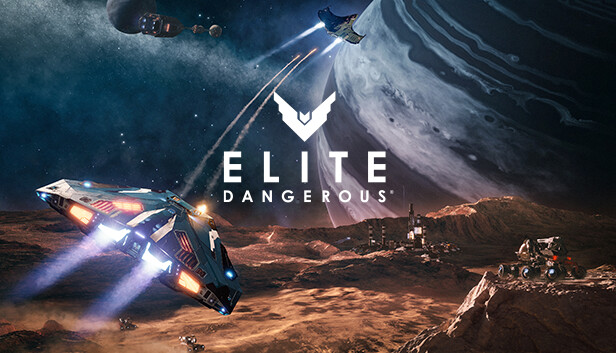
Elite Dangerous promotional image

Elite Dangerous is a space trading, exploration and combat simulator released in December 2014 and regularly updated since then. Based on the 1984 Elite that seemingly crammed a galaxy into 64KB, Elite Dangerous expands this to a massively multiplayer online (MMO) game with modern graphics and gameplay.

You play a pilot flying a single spacecraft. You start with a small fighter, then work your way up via combat, exploring, trading, mining, ferrying passengers and completing missions to earn larger, better or more specialized ships. The Horizon expansion adds landing on planets, driving a ground vehicle and limited multi-crew. The upcoming Odyssey expansion adds “space legs”, allowing pilots to leave their vehicles and walk around space stations and some planet surfaces.

Elite Dangerous is set in the Milky Way galaxy. All of it. As you zoom out on the galaxy map for the first time, its sheer enormity becomes apparent. The game is set a bit after the year 3300, where humanity has colonized “the bubble” around 150 lightyears from Earth, encompassing over 20,000 inhabited star systems. However, 400 billion stars are accessible, backed by hard science, where possible, and procedural generation, otherwise. Looking at the sky and realizing you can travel to most visible stars is a humbling experience.

Life in the Milky Way is not static. Like many space trading games, an economic and political simulation underpins Elite Dangerous. Perform enough missions for your favourite faction or fight along one side in a war and see the borders shift and economies wax and wane. Although more as a backdrop to weekly in-game events than a narrative, there are also ongoing events and lore.

While the original Elite’s graphics were appropriate for their time, it left a lot to the imagination. Elite Dangerous’s renders planets, nebulae, gas clouds, asteroids and other stellar objects beautifully. It has spawned a whole stellar cartography and photography community.

Stations’, settlements’ and ships’ beautiful graphics have an industrial, semi-realistic aesthetic. Space stations are gorgeously detailed, with triangular reinforcement struts, flashing warning lights and BladeRunner-like holographic advertising. Ships’ thrusters fire realistically as they manoeuvre. Lasers rake glowings arcs of molten yellow-orange metal on ships’ hulls.

The sound design is also exemplary. Ships have distinctive sounds. You can hear the subtle creaks and vibrations as a ship decelerates into a planet’s atmosphere or the shudders and groans as a landing pad retracts into a space station. Closing your eyes as you dock with a station reveals many small sound effects that add so much.

Unlike many games, Elite Dangerous’ soundtrack is more atmospheric and ambient than inspiring and memorable. One notable exception is the rousing orchestral choral theme for a capital ship jumping into a conflict zone. It is reminiscent of John Williams’s scores to any of the Star Wars films. Another exception is Straus’s “Blue Danube”. It plays whenever auto-docking and is a nod to the similar scene in 2001: A Space Odyssey and the original Elite.

While I play with neither, Elite Dangerous is considered one of the premier examples of virtual reality (VR) and using a HOTAS (Hands-On Thrust and Stick). Using both apparently creates an immersive experience few games can match.

I usually choose single-player games (note the blog’s name) with more apparent stories or themes. At first glance, Elite Dangerous does not fit that mould.

Instead, Elite Dangerous is an example of great game design. Despite some lingering bugs, Elite Dangerous consists of many different games strung together. At the lowest level are the simple mechanics like targeting, shooting and manoeuvring. The game combines these into dynamics like combat, exploration and trading. Above them, you have more abstract and strategic activities like advancement, supporting in-game factions or galactic superpowers. It reminds me of how Paradox Interactive, the developer of games like Crusader Kings and Europa: Universalis, builds games.

This breadth allows players to construct their own goals. One goal could be working toward an expensive or reputation-locked ship. Another could be travelling to the edges of the galaxy. Many choose to focus on the combat, whether it be against NPC opponents or other players.

While Elite Dangerous is an MMO, you can still play solo or with small groups of friends. I spent my first several weeks solo, but I still rarely interacted with a human even after “graduating” to open play. Almost all content is soloable. Even PvE content seemingly made for cooperation, like fighting aliens introduced in the recent expansion, is frequently soloed.

That does not mean players are absent. While the game economies and politics are not player-centric like in Eve Online, there are many thriving squadrons and player groups, both for good and bad. PVP-focused players frequent star systems where others congregate, praying on the weak. By comparison, the “Fuel Rats” is a group of volunteer players who help those that have run out of fuel.

Meanwhile, Elite Dangerous’s greatest strength and biggest weakness is its demand for self-discovery. While there are some tutorials, players must learn most of the game’s mechanics themselves, either through player-generated content or trial and error. Even seemingly basic things like landing a spacecraft are difficult for first-time players. This demand attracts some but repulses many.

Elite Dangerous delivers a form of retro-futuristic nostalgia. The crackly radio transmissions you overhear are reminiscent of the attenuated analogue radio used during the moon landing. Spacecraft fly like World War II or Korean era fighters, at least until you turn off “flight assist”. All text in the user interface is uppercase like early computers.

With a few exceptions like faster than light travel, Elite Dangerous is about a realistic simulation of the future as you can find. In its future, artificial gravity does not exist, meaning spinning space stations or. Physics rules spaceflight and spaceship modifications. Make it heavier and your spacecraft will be slower and less manoeuvrable. Space is big. Travelling, even with a faster than light drive, takes time.

Elite Dangerous is a game for serious space fans willing to invest time learning the game. It is also for those comfortable setting their path. Those looking for something thematic or more casual will find it unfulfilling.

Why did I play this game? I remember watching Carl Sagan’s Cosmos as a young child. He talked of a ship of the imagination, allowing you to travel to only dreamt places. Elite Dangerous provides that. I felt the joyous wonder when I first jumped into a system, seeing the kineticism of hurtling toward a star when decelerating. I felt it when I saw my first black hole and the light lensing around it. I felt it seeing starlight reflecting off an alien gas giant at sunrise, illuminating a ring of asteroids. Elite Dangerous is for those happy to head to the “second star to the right and straight on ‘til morning”.