Star Wars Jedi: Survivor (or Jedi: Survivor) is a science-fiction adventure RPG developed by Respawn Entertainment, the same company that created the prequel, Jedi: Fallen Order. Thankfully, Jedi: Survivor is a worthy sequel, improving on the prequel in every way.
You play Cal Kestis, a Jedi Knight, continuing his fight against the Empire. Retreating to the backwater planet Koboh after a mission on Coruscant goes horribly wrong, Cal stumbles upon a forgotten planet that could be a hidden refuge for those he holds dear.
At first glance, Jedi: Survivor appears mechanically similar to Journey to the Savage Planet, the previous game I played. Both are exploration traversal games set on alien planets, where you wander, discover new areas, fight foes and collect resources. You have the traversal mainstays like the double jump and a grappling hook. You gain upgrades as you progress, allowing you to access more areas, defeat stronger enemies and complete challenging timed events.
However, the similarity ends there. Journey to the Savage Planet is about fun with cartoonish violence, densely packed levels and self-aware humour. Jedi: Survivor is about mastery, both in combat and traversal.
Jedi: Survivor‘s combat is “Souls-like”. Enemies hit hard and often outnumber you. Success requires learning enemy abilities and correctly timing parries and dodges. Combat is challenging, meaning you will die frequently as you learn and experiment, but not punishing, assuming you unlock shortcuts to shorten the journey back from the respawn point.
Jedi: Survivor adds two new lightsaber stances to the versatile single-blade, fast dual-blade and defensive double-blade stances from Jedi: Fallen Order. The crossguard stance, inspired by Kylo Ren’s lightsaber, adds a slow but damaging greatsword. The blaster stance, as its name suggests, has Cal Kestis wielding a blaster and lightsaber, fulfilling Han Solo or Wild West gunslinger-style fantasies.
Jedi: Survivor is also about exploration, with big, broad maps filled with traversal puzzles, riding mounts and even a speeder bike sequence.
Jedi lend themselves well to this style of play. Ever since Luke’s first training scene on Dagobah in The Empire Strikes Back, Jedi have demonstrated themselves to be acrobatic and athletic. They often befriend local wildlife.
Structurally, Jedi: Survivor has peaks of action during intense, story-relevant scenes and boss fights, followed by more leisurely downtime. Players can spend these breaks exploring, collecting or bounty hunting. You can expand their very own cantina via recruiting NPCs, fishing (by interacting with an NPC that appears at water), finding music tracks for the DJ, collecting plant seeds to fill a garden or scanning defeated opponents to use in holotactics games. Companions sometimes join Cal for story-specific sequences, often opening new areas or teaching Cal new abilities.
Jedi: Survivor‘s storyline explores purpose, sacrifice, friendship and acceptance. The story is told mainly through cutscenes, conversations with the many supporting characters and force echoes, which reveal past events or conversations. While it deals with galactic-relevant events and drops a few familiar names, the story focuses mainly on its characters, creating a personal story that tugs at heartstrings.
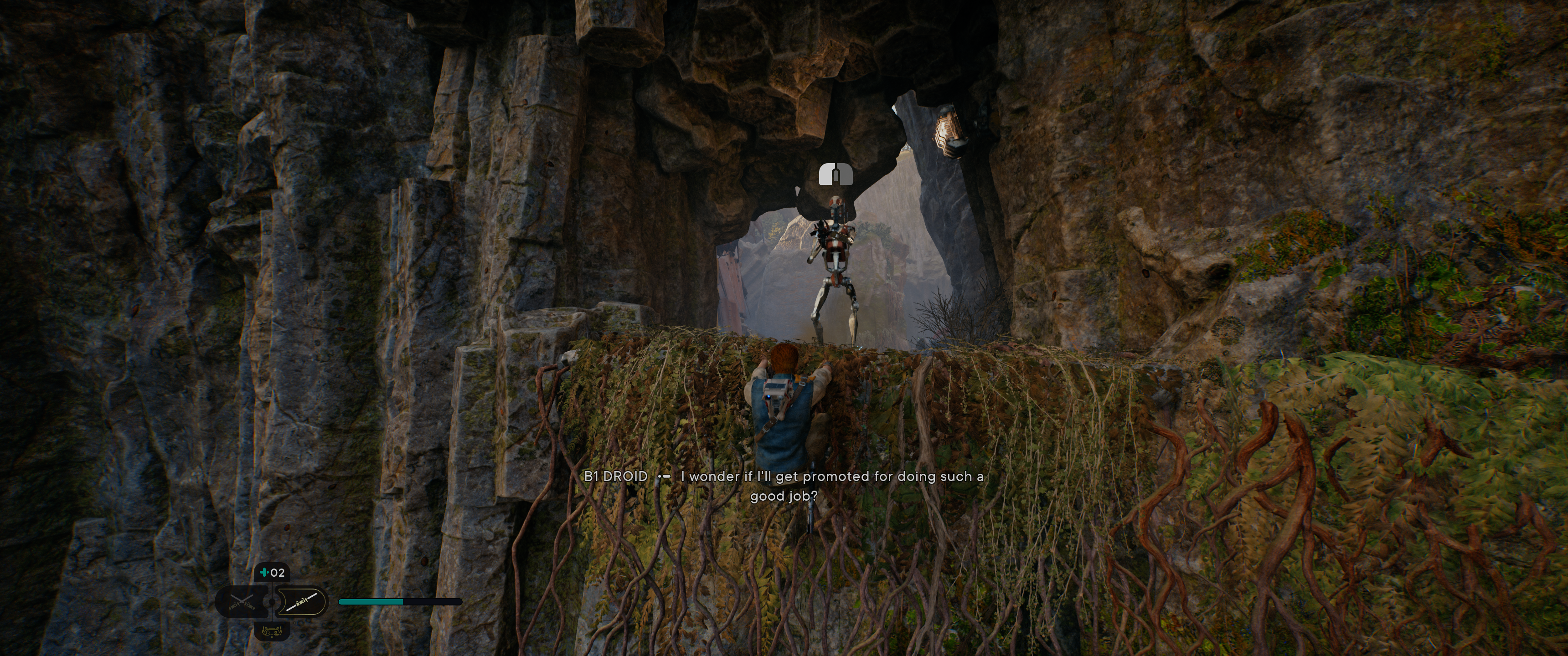
A B1 droid about to learn to fly
Just like in the movies, Jedi: Survivor has occasional bursts of humour, like the overheard banter between enemies, particularly the B1 droids introduced in the prequel movies. Struggling through tough fights to face Rick, the door technician, will bring a smirk to your face.
A now stubbled Cal even has a brush with romance, a taboo subject for Jedi, but handled tastefully and respectfully. It adds a little sexual tension, like in The Empire Strikes Back.
However, Jedi: Survivor‘s themes are only deep enough to motivate you, and not a genuine examination like in Cyberpunk 2077 or The Witcher series. While minor characters can sometimes point you to interesting parts of the map, there are no true side missions or plot choices to add depth or consequence.
Jedi: Survivor is unmistakably a Star Wars game, and not just because it involves lightsaber-wielding Jedi using the force against the Empire and other instantly recognisable tropes. Jedi: Survivor continues the themes of droids as people and good fighting an asymmetric battle against a seemingly overwhelming evil. Cal’s ship, the Mantis, is a Millennium Falcon equivalent, a similarly delapidated but faithful steed carrying Cal and his pseudo-family from stage to stage.
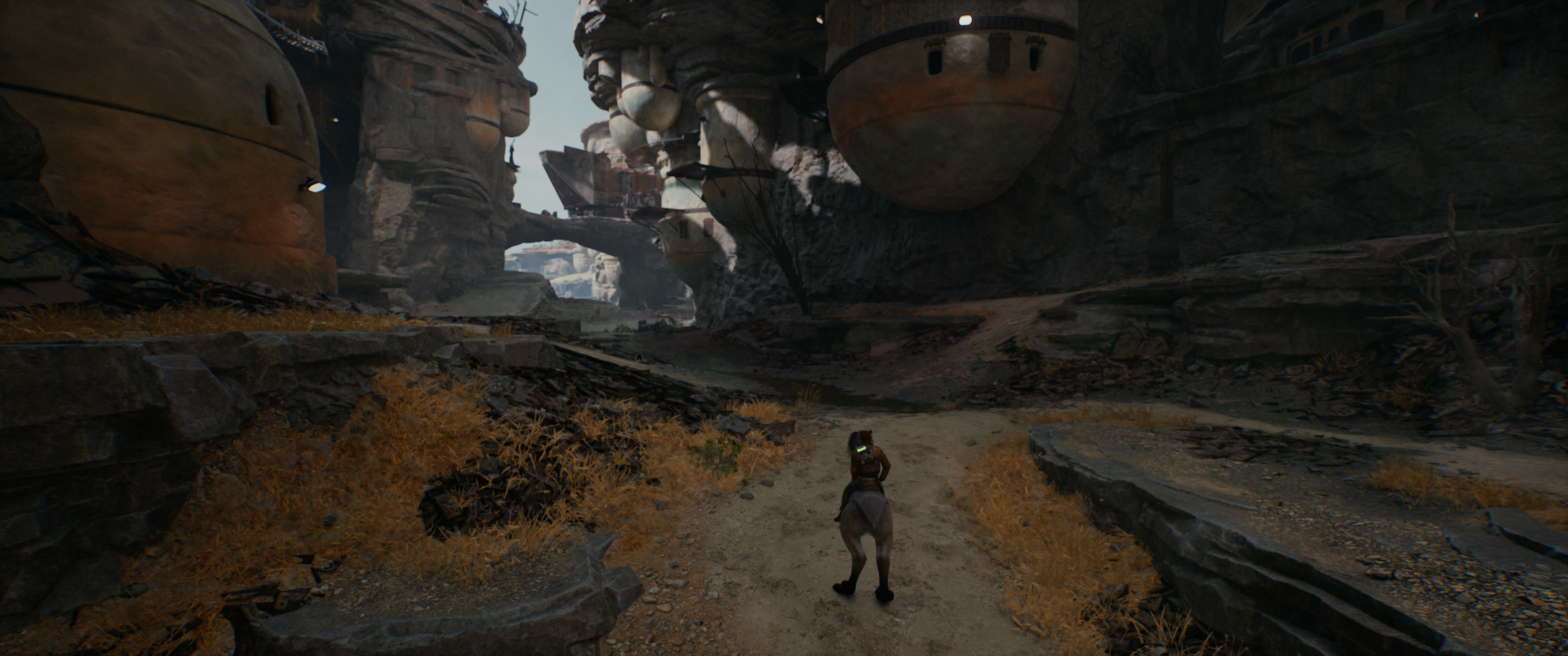
Cal views the path ahead, which juxtaposes the technological sandcrawler in the background with primitive ochre buildings
The game is faithful to Star Wars in its environment design. Most worlds you visit are technological backwaters, where primitive ochre and stone buildings are juxtaposed with automatic doors, artificial lighting and droids. Like the movies, Jedi: Fallen Order mixes the familiar with the alien or technologically different.
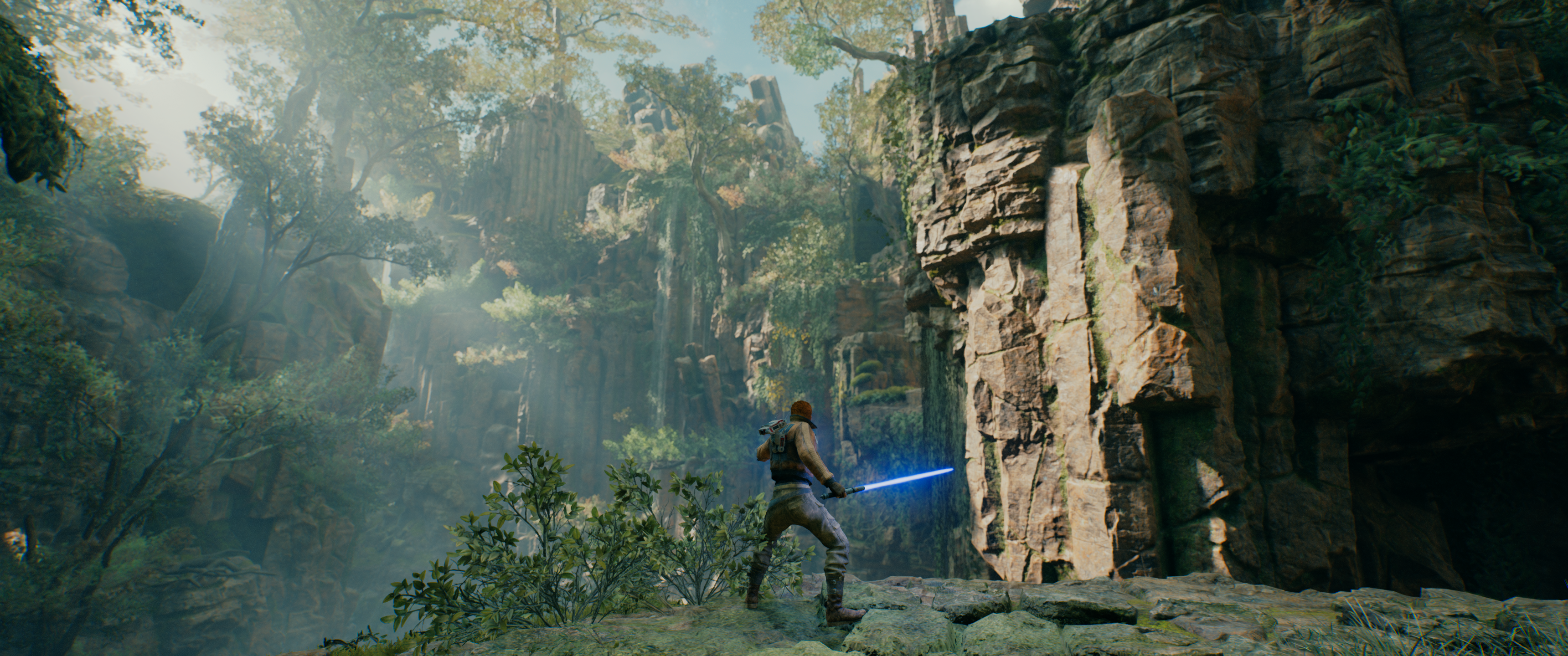
A lush, misty valley on Koboh, showing sandstone cliffs and gentle sunbeams
The colour palettes are muted pastels. Gone are the brilliant greens of Kashyyk and the purples of Dathomir in the first game. Instead, there are the reds of Dune-like Jedha, the greys of Coruscant and Californian scrub-like Koboh. These palettes give the game a realistic feel and make each location clearly unique.
Jedi: Survivor has Star Wars‘ audio pedigree. Stephen Barton and Gordy Haab return from Jedi: Fallen Order to deliver an emotional, epic, orchestral soundtrack that evokes the best of John Williams. The distinctive lightsaber whoosh, blaster ping and AT-ST foot clang abound.
Like Jedi: Fallen Order, Jedi: Survivor respects Star Wars as an intellectual property and a genre. It is neither derivative nor uninteresting and avoids redefining elements for its own ends. NPCs, like Darth Vader, are used faithfully. Jedi are noble, humble and capable, not the flawed, inflexible strawmen presented in later works.
Cal is a young male Jedi with a droid sidekick like Luke Skywalker. However, Cal is motivated by survival and the desire to protect, rather than seeking adventure or saving his father. Cal’s later dabbles with the force’s dark side present it as seductively and terrifyingly powerful while implying Cal’s greatest challenges lie ahead.
This series has cemented itself as a worthy addition to Star Wars lore and canon. At about thirty hours to finish for a storyline-only playthrough, Jedi: Fallen Order is about double the length of Jedi: Survivor. Those looking for a challenging and faithful Star Wars RPG will relish it. I look forward to the inevitable sequel.
Dune Prophecy is a science fiction thriller and political intrigue series based on the novel Sisterhood of Dune, exploring the formation of the Bene Geserit. Dune Prophecy is aesthetically inspired by the recent Dune movies and funded due to their success.
Dune Prophecy is set ten thousand years before the Dune novel and movies, with the machine wars still in recent memory and much of the main elements of Dune already in place, such as spice, Arrakis, personal shields, noble houses and the Imperium.
The series is the story of Valya Harkonnen and her rise from unremarkable daughter in a minor noble house to head of the Sisterhood meddling in galactic affairs. Ostensibly, the Sisterhood is a group of female truthtellers and advisers to nobles. In reality, they are a spy network looking to subtly control events. The series opens as a Sisterhood-arranged marriage that would cement the future viability and pliability of the Imperium goes awry.
I initially found Valya’s motivation weak. Revenge drives Valya Harkonnen: revenge against the Imperium for the lie of Harkonnen cowardice during the machine war and revenge against house Atreides for her brother’s assassination. It drives her to kill, manipulate and subvert with no regard for others.
The problem is all this setup happens offscreen. We do not see what the Harkonnen did during the war to warrant such ostracisation. We do not see her brother’s death, whether he died valiantly in an honourable duel or whether it was a dishonourable stab in the back. Seeing these would have justified Valya’s crusade and outrage. It would have made it personal. Without it, we only have an unrelatable, potentially biased character’s word.
Meanwhile, everyone else seems to accept things. They may not be happy – the Harkonnens live on an inhospitable, frigid world, pitifully peddling whale fur – but they move on. They find Valya’s resistance, if not hostility, to the status quo grating and disrespectful. Valya self-righteously dismisses their protests as weakness. Add it to her revenge tally.
Perhaps Dune Prophecy is a parable about Darwinian survival in a (literal) cut-throat universe. However, survival is easier with access to the highest levels of government through a network of flawless lie detectors. Survival is easier when using “the voice” to compel others forcibly. Survival is easier when you and your sisters can easily slaughter elite guards. Her final conversation with Evgeny, the weak and wheezing Harkonnen patriarch, is both a mercy culling and a ploy to bring someone more easily controlled into the fray.
Perhaps Dune Prophecy is about righteous justice, but the Harkonnen sisters’ exceptionalism and unreasonable sacrifices demanded from others show a skewed moral compass. “Sisterhood above all” becomes an autocratic rallying call. Valya fights against forces within the Dune universe because they challenge the Sisterhood’s control, not because of justice, skewed or otherwise.
Valya is the anti-hero the twisted, dystopian Dune universe needs. Her ends justify her means. Whether you believe her version of events or sympathise with her is ultimately immaterial. Valya is the only character in Dune Prophecy with any real agency, so her actions are key.
Meanwhile, Dune Prophecy adopts the aesthetic of recent Dune movies: dimly lit ochre and grey stone buildings contrast with airy, open outdoor spaces. However, while the Dune movies contrasted the black, organic Harkonnen machines, the weathered, practical Fremen and the boxy Atreidies, none of that appears in Dune Prophecy. The budget for the series was likely a fraction of the movies’. Hence, there are no ornithopters, extras for imperial sycophants or the hallmark lingering wide landscape shots from the recent Dune movies. The Dune movies felt like “larger than life” documentaries. Dune Prophecy feels small and not about momentous events that could reshape the universe.
Perhaps I am being unfair. Frank Herbert’s original novel sets a high bar for other stories in the same universe to meet. Not every story can say so much about politics, gender roles, military science and sociology. However, there is so much potential here. Instead of fulfilling it, Dune Prophecy seems too focused on unnecessarily exploring headcanon, while blurring the line between science fiction and fantasy with spiritualism and predestination.
Lost potential aside, Dune Prophecy is not a boring or poorly made series. The plot weaves unpredictably, creating tense moments. The non-linear storytelling sometimes exaggerates the impact of events, reversing the order of cause and effect. The score keeps that retrofuturistic feel, combining tribal and modern instruments to underscore the unsettling feudal and futuristic mix the Dune universe is known for. The costume design is excellent, with the black-veiled sisterhood “witches” and grey, Gestapo-like palace guard uniforms hinting at authoritarianism.
Regardless, Dune Prophecy focuses on merely unravelling the status quo it initially presents and then setting up a subsequent series. The outcomes, if not the plot, are predictable. Dune Prophecy functions well as a thriller but lacks anything substantial. Hopefully, the next season will deal with more profound concepts, like those that elevated the original novel.
Universe for Sale is a science fiction “point and click” visual novel with a distinct, hand-drawn art style. It was developed by Tmesis Studio and published by Akupara Games.
Universe for Sale follows Master and, later, Lila. Master is an ascetic monk from the Cult of Detachment. The Cult believes that physically separating parts of their body also detaches negative emotions or experiences. By the time we first meet Master, he is little more than a skeleton with ears. He wakes up each day, having slept on the ground in the market, and seeks out Lila.
Lila is more human, although her hair consists of blue-green tentacles after an accident where she lost her father. She wakes each day to sell custom universes in the market or use the proceeds to decorate her home. At least, she did until Master came along.
Universe for Sale‘s gameplay consists of walking around, exploring, conversing with different people, interacting with objects, and completing minigames. Most minigames are straightforward, although some, like the Lila creating universes, can take some experimentation. The minigames’ purpose is immersion, not challenge or mastery.
Assorted knick-knacks, with a few pop culture references for the keen-eyed
Universe for Sale’s setting, the colony, is a wonderful fusion of fantasy and technology, hanging precipitously in the upper atmosphere of Jupiter. Powered by rusting windmills and protected from acid rain with hydrophobic fabric sheets, every scene reveals more about how such a fantastical world exists and functions.
The hand-drawn art style, apart from minimizing development costs, keeps the tone light by avoiding squalor and “cartoonifying” Cult members with detached body parts. It also allows for easy exaggeration of features, making the various characters larger than life.
The colony’s inhabitants push the boundaries of humanity, from intelligent orangutans to robots. Neither Lila, with her tentacle hair, nor Master, a walking skeleton, are out of place.
The colony’s juxtaposition of technology and poverty feels familiar, but every scene’s bizarre or technological oddity reminds you of the futuristic, alien setting. Only in such a setting could Lila’s profound ability to create and manipulate universes be so minimised.
A visual novel game like Universe for Sale hinges on its writing. Thankfully, it delivers, mainly via nonlinear storytelling. Lila’s daily grind, Master’s enigmatic task and a children’s fairy story weave together as Master tries to order events into something coherent. The slow emergence of relationships while learning more about the world is intriguing. Each day brings curiosity, excitement, and some trepidation.
Universe for Sale is a story about spirituality and recovery. There are many ways to tell a story, impart wisdom or heal emotional trauma. Each person’s journey is unique. Focusing on one religion or method blinds you to others.
Universe for Sale contrasts the rigid control and doctrine of established religion with self-actualization and fulfilment. The dominant “church” in the game is probably meant to be fictional. While the futuristic and imaginative setting helps de-anchor it from reality, the cathedral-like stained glass windows and pews are hard to miss.
The Cult of Detachment’s teachings, by comparison, are initially alienating but then softened by including them in a children’s fairy tale. Master’s patience, sincerity and compassion contrast with the preaching, control and dismissiveness of the church.
Master shares a moment with Lomri
Meanwhile, some unspoken natural order or authority is patiently asserting itself. Plants continually grow into and infest buildings. The church cannot eradicate the cat-like “lomris” that nest near Lila. Lila’s octopus-like hair, her friendship with the colony’s animal-like inhabitants, and the Kraken gatekeeper between the physical and spiritual realms hint at animism. Metaphors and references abound.
Universe for Sale has limited replayability. There is a single ending and dialog choices only satiate curiosity. The game awards achievements for reaching story milestones, as well as for doing humorous or unexpected things, so a second playthrough may help fill any gaps.
For those intrigued with fantastical worlds, non-linear storytelling or unravelling mysteries, Universe for Sale is ideal. Universe for Sale is short, taking four to five hours to finish, but tells its story well within that time. Like the varied universes Lila creates, it encourages us to open our minds to myriad spiritual possibilities.
The Invincible is a science fiction thriller and adventure game developed by Starward Industries. Based loosely on Stanislaw Lem’s novel of the same name, published in 1964, does its premise still hold up after sixty years?
You play as Dr Yasna, an astrobiologist from the Interstellar Commonwealth spaceship Dragonfly. You awaken on a Regis III, a distant and desolate planet, with little memory of recent events. Your job is to discover what happened to your expedition while unravelling the planet’s mysteries.
The overused amnesia trope may dissuade some. However, given the source material’s age, the original novel likely inspired the trope. Yasna’s amnesia is also central to the story. Yasna regains some memories through flashbacks, but The Invincible‘s first hour or two asks more questions than it answers.
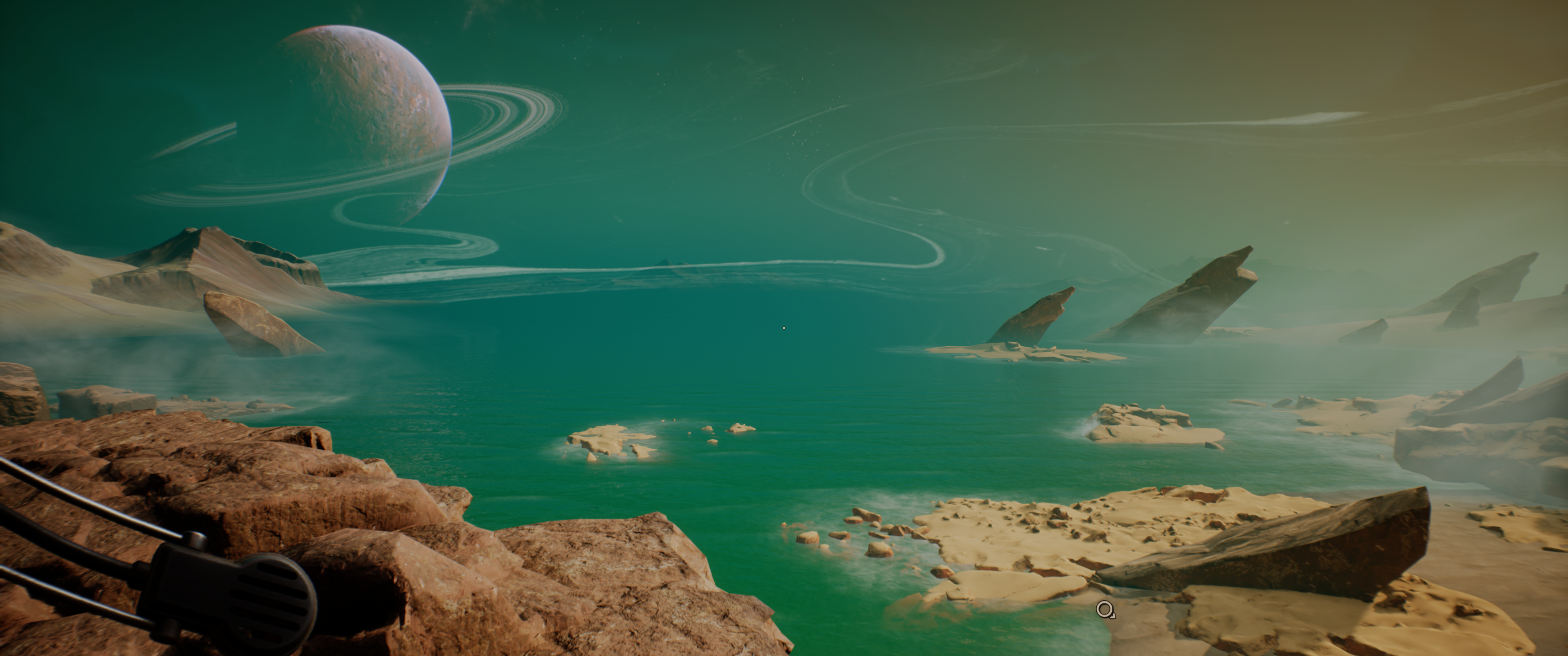
Regis III has some beautiful vistas
Mechanically, you walk and climb around the desert environment. You drive rovers, operate computers and navigate with a scanner and a metal detector. Dr Yasna automatically tracks important notes and maps in her journal, which you can refer to if lost. She talks over the radio with Novik, the Dragonfly’s “astrogator” or captain, getting context and guidance.
The Invincible has a fantastic retro-futuristic aesthetic, reminiscent of The Forbidden Planet, Gerry Anderson’s Thunderbirds or Space 1999. Controls are large and analog. Robots lack the modern pseudo-organic look. Spaceships are gleaming rockets. Technology is practical and grounded, electromechanical instead of electronic. Even futuristic inventions like force fields are just applied electromagnetism with bulky wires, magnets, and insulators.
The aesthetic makes The Invincible believable and distinct hard science fiction. It also reduces complex apparatuses to simple controls that require no instructions, which is perfect for a game.
The aesthetic grounds The Invincible to the late 1950s or early 1960s. The developers did not introduce modern sensibilities or conveniences. The characters smoke. They lack the equivalent of mobile phones, although you can find a bulky Pong game console. The developers even retained some esoteric names from the novel, like calling a spaceship’s captain an “astrogator”.
The soundtrack is unsettling, an often discordant mix of percussive and theremin-like synthesized instruments. It ensures you always feel on edge. Nothing is ever quite right. It recasts the barren scenery, often starkly beautiful, as alien and isolating. The instrument choice also reinforces the 1950s/60s science fiction feel.
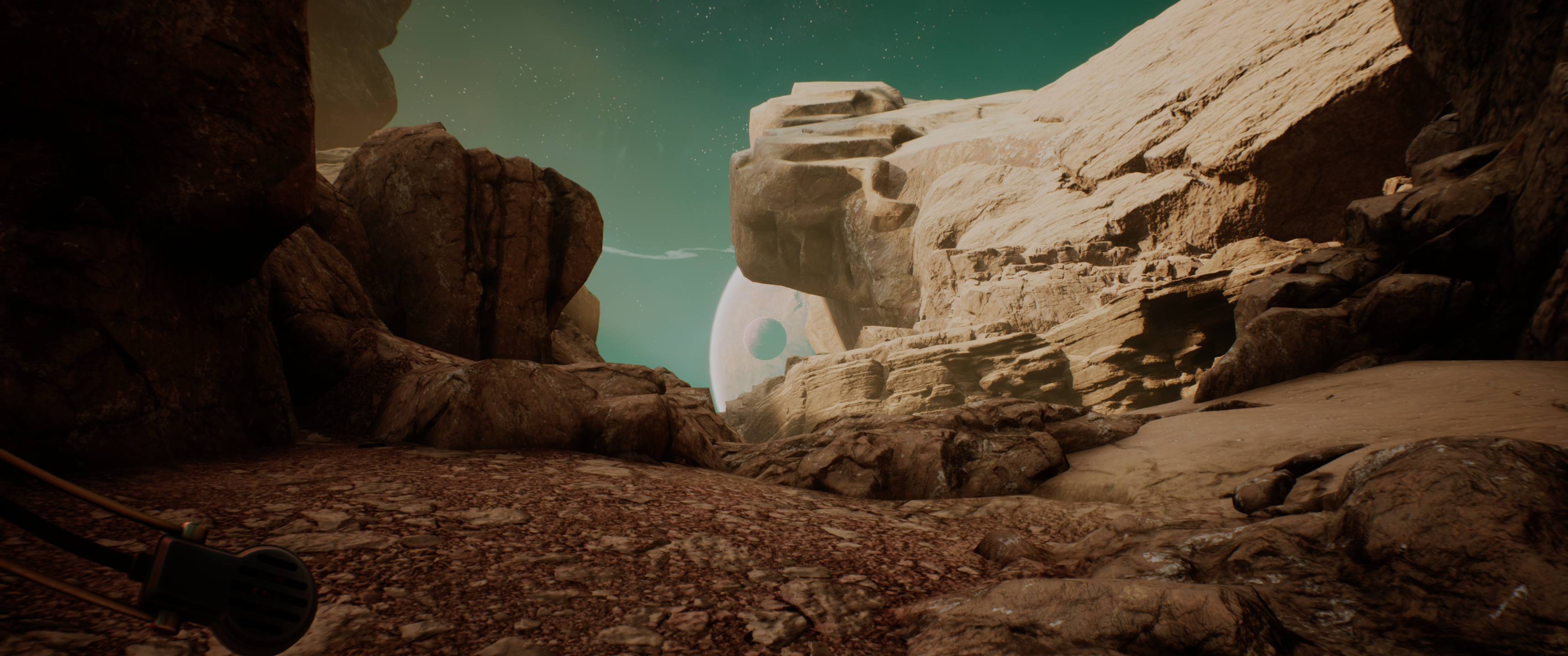
Your microphone and nearby alien planets are a subtle but constant reminder of where you are
The Invincible generates a comic of Yasna’s progress and decisions. It summarises the story and highlights important decisions. The game shows you the last panel when reloading a save to give the player context quickly. Once again, it fits with the pulp comics popular during the 1950s and 60s.
Thematically, The Invincible deals with humility and hubris. Humanity’s Ozymandian discoveries on Regis III challenge our understanding of life and intelligence. Our anthropomorphization and existing taxonomies can hinder as much as help. For example, the separation between biological and machine is not always clear. Yansa’s isolation means she has to resort to her basic wits and grit.
The Invincible shows us some things will always be beyond our mastery. Humanity’s weapons, for all their might, assume human constraints and thinking. Even humanity’s advanced medical science cannot regain lost memories. The significance and irony of the game’s title slowly becomes clear toward the game’s end.
Despite its futuristic setting and existentialism, The Invincible is ultimately about human nature. Amidst the Cold War-like paranoia and mistrust between Yansa’s pseudo-European Commonwealth and the pseudo-American Alliance, our similarities outnumber our differences. The Commonwealth’s and Alliance’s different technologies are interoperable. Human touches like sharing cigarettes can potentially unite us, as can challenges like those on Regis III.
The Invincible is short, taking six or seven hours to complete, but it is about the right length. There is some replayability. Most of the game is linear despite appearances, although you can make decisions at key moments to steer the remaining story and reach different endings. Achievements reward attention to detail or acting unpredictably.
The Invincible will appeal to those looking for contemplative science fiction with a strong visual and audio aesthetic. The developers have been faithful to Stanislaw Lem’s vision, which still holds up today. While humanity has not visited other planets as in the game, it is easy to consider humanity the master of its domain. The Invincible reminds us that the universe may have other plans.
Everspace 2 is a space fight simulator with 3D movement focusing heavily on combat, exploration and puzzles. Rockfish Games, the developer, describes Everspace 2 as a “space shooter” with “RPG elements” on its Steam page. That is untrue. Everspace 2 is an action role playing game (ARPG) like Diablo or Path of Exile. And it is terrific.
You play Adam Roslin, an ex-military fighter pilot working for an uncaring and manipulative corporation. After a routine mission goes wrong, you are captured by outlaws and escape to a long abandoned base. You and your fellow escapees then rebuild and prepare for a heist that could set you all free.
Flying your ship in Everspace 2 is a joy. The controls are less detailed than those of more complex space simulators like Elite Dangerous. Still, such an outwardly arcade-like game offers a surprising degree of control. Dodging enemy fire, circling capital ships, and navigating maze-like tunnels all feel fluid and natural.
The combat is vibrant, frantic and engaging. Like most ARPGs, you usually fight swarms of weaker enemies, each with different weapons, defences, and abilities. This structure provides constant variety and changing tactics. Your relative strength also fuels the requisite power fantasy.
A warm red star and a blue nebula shine through an asteroid field
Locations also contain puzzles, providing cerebral but slower-paced play. As you fly around, your sensors can detect and track nearby loot, mineral deposits or other points of interest. Your ship has a tractor beam that you can use to pick up and move things around, such as removing debris from a passage or picking up a battery to slot it into a socket elsewhere. These usually unlock doors or containers of potential ship upgrades.
Everspace 2 tells its main story through cut scenes showing hand-drawn images with voice-overs. While low-budget, this style works well for a game focused on flying spaceships. The main quest has excellent pacing while introducing more about the universe and its inhabitants.
There are plenty of side quests and activities, too. As with many RPGs, they are often the most interesting, flesh out the world and introduce unique NPCs. Chasing rogue AIs, rescuing trapped miners, or appeasing crime lords are all on the cards. Racing tracks and rifts filled with difficult enemies satiate those seeking a challenge.
Mechanically, Everspace 2 is a testament to game balance. Everything, including your character, gear, and enemies, is geared to a level. Level differences are more pronounced than in other games. Foes more than a few levels above you are deadly. Those a few levels beneath you will be merely speed bumps. Everspace 2 periodically increases the level of enemies to keep the challenge consistent.
A ringed planet seen from the surface of a desert planet
Aesthetically, Everspace 2 is beautiful. Each location is a postcard, with asteroids, massive space stations, aging wrecks, vertigo-inducing icebergs and/or vibrant nebulae. Many are varied and original, like an iceberg in a solar flare or a megafauna skeleton, evoking wonder and appreciation. Each star system also has its distinct look, making them feel unique.
The electronica soundtrack is also on point, supporting the sci-fi feel. The zen-like cruising pieces contrast with the exciting, upbeat combat ones.
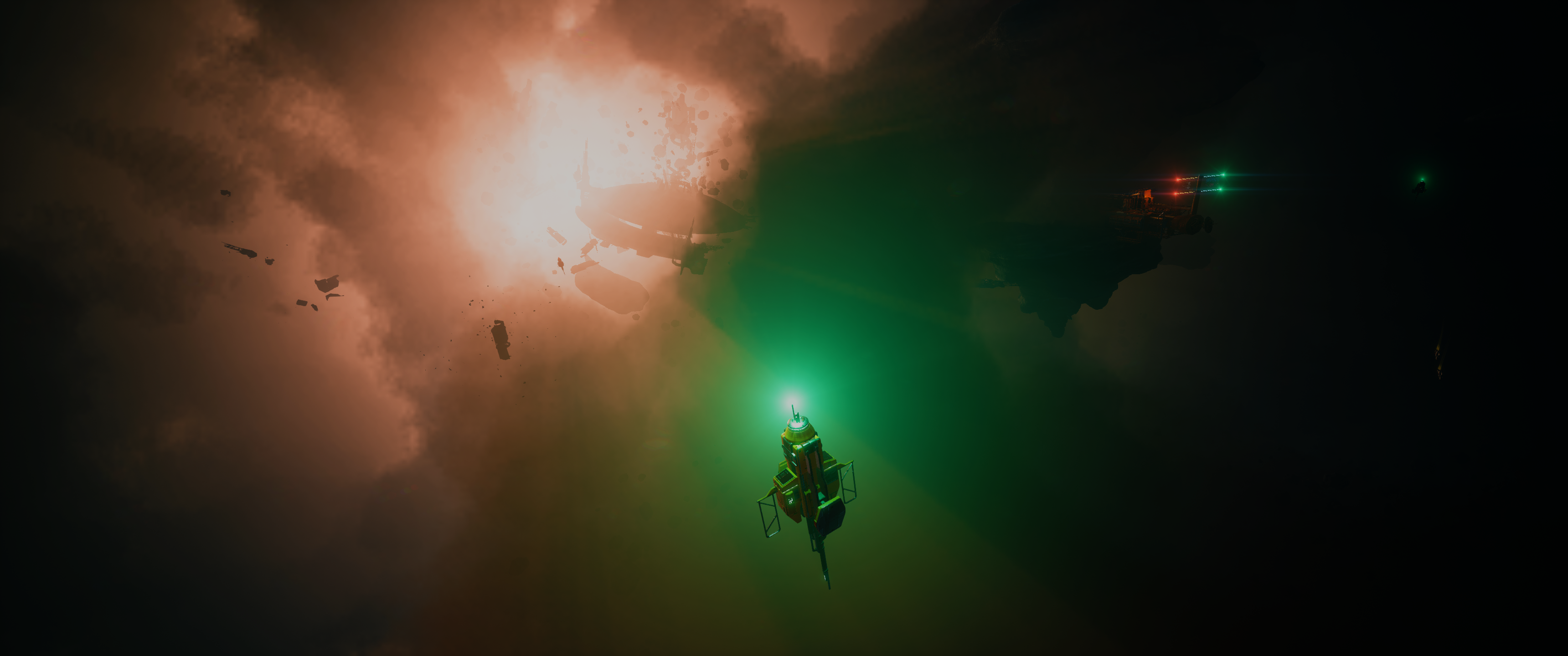
A green beacon in the middle of a dark gas cloud
However, Everspace 2 is not perfect. My biggest gripe is with the writing in the main storyline. No one expects deep or complex writing from an ARPG, but this does not excuse poor writing.
The characters need more substance. Ben and Delia are just cardboard cutouts and deserve motivation and agency. Maddock becomes a contrived, grumpy omni-antagonist. Combining some supporting characters, like Ben and Tareem, would have enhanced both. Everspace 2 also unnecessarily sexualizes a female supporting character at one point.
Similarly, the early main story has too much “I need you to do this, but I am not going to tell you why for at least two cut scenes.” It feels unnecessarily opaque and confrontational. The game also removes the player’s agency at a few key moments, railroading you.
My other gripe is with loot management. Most of the copious loot enemies drop is trash you sell or disassemble for crafting components. The rare upgrade is fun, and Everspace 2‘s crafting system means you will always have suitable weapons, modules or consumables.
However, the constant gear drops and level churn mean periodically yanking yourself out of the fun combat and puzzle game loops to clear your inventory. Loot management is a broader problem with ARPGs’ variable intermittent reward structure, but it is still a problem.
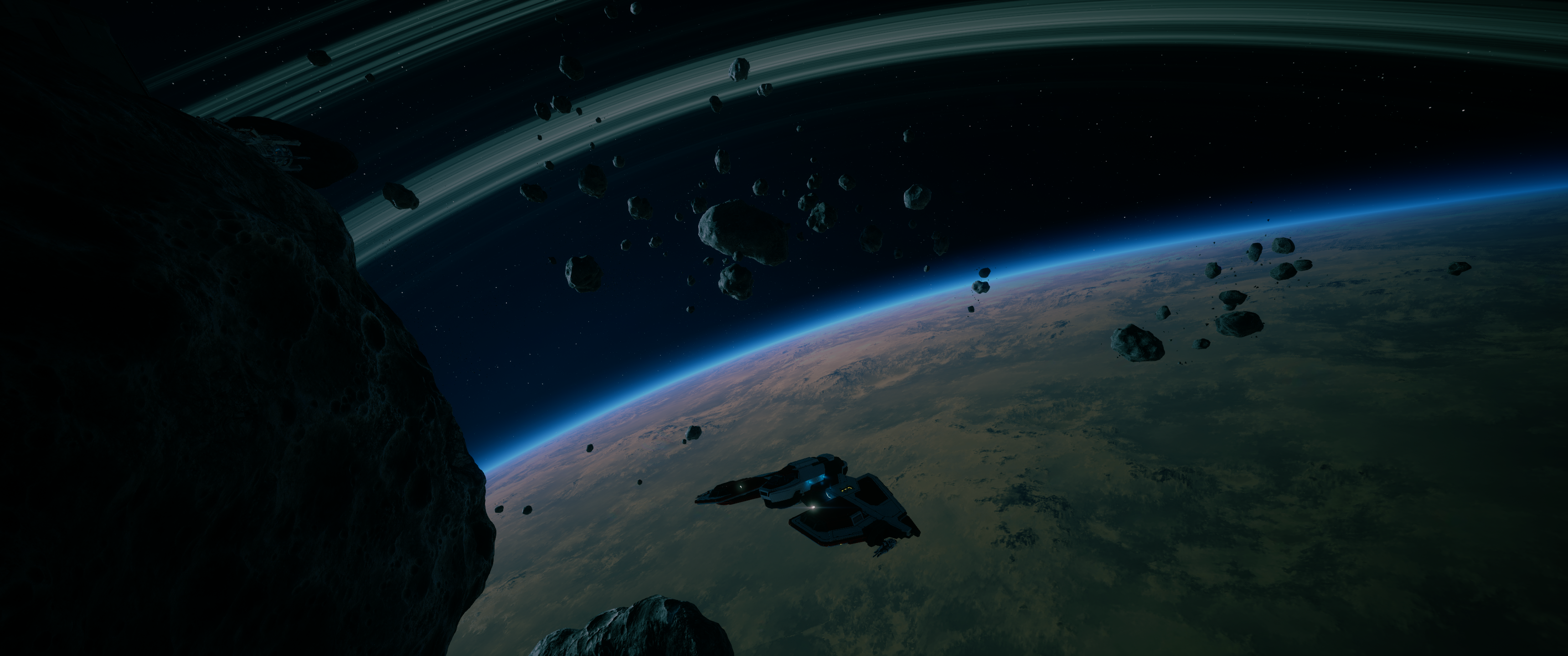
A ship in an asteroid field hovering over a ringed planet
I initially thought Everspace 2‘slack of replayability would be a problem. It lacks a skill tree or other ARPG elements that specialize your character. No advancement or story choice blocks off content. ARPGs have traditionally used these to encourage players to create different characters to replay content differently.
However, being able to quickly switch out a new ship or experiment with new weapons or modules means experimentation or change is refreshingly easy. Meanwhile, the perk and challenge systems provide attainable alternative goals that offer useful benefits instead of gatekeeping high-level content from less dedicated players.
Ultimately, Everspace 2 is a game that knows what it wants to be. It doubles down on that explore -> shoot -> loot -> craft game loop. If you enjoy that loop, and you will find out quickly or via the free demo, the game promises hours of the same. Otherwise, you will bounce off Everspace 2 hard.
Everspace 2 also knows what it does not want to be. It is single-player and offline, eschewing the complex code, gameplay loops and community management required for multiplayer or online play. It focuses on quality over quantity, providing a few well-developed star systems to explore. There is no piracy, salvage, political simulation or other distractions.
It took me about 60 hours to complete the main quest, including most side quests and challenges. As with most RPGs, you could complete it in under half that time, but you would miss the best content. Meanwhile, the developers continue expanding and enhancing the game, showing a welcome love and attention to detail. If only all ARPGs were this good.
An Elite Dangerous ship build that heals shielded “tank” ships when fighting Thargoid interceptors in wings or teams.
This arrangement is similar to how MMORPGs structure groups. The “tanks”, usually Imperial Cutters or Federal Corvettes with Prismatic Shields, try to draw the interceptor’s fire by staying close, hot and dishing out damage. Healers try to keep the tanks’ shields up, particularly when hit by an interceptor’s lightning attack. Dedicated anti-swarm and anti-scout ships handle the thargon swarms and scouts. The rest try to draw damage using more traditional anti-xeno builds and tactics.
This post assumes you are familiar with Thargoid interceptor combat.
Goals
Create a ship to:
Heal tanks’ shields. This requires the Regenerative Sequence experimental effect on Beam Lasers.
Remove the caustic debuff from tanks. This requires a Decontamination Limpet Controller and a Cargo Rack for limpets.
Reach tanks. Beam lasers and limpets are only effective within a kilometre or so. This build needs the speed and agility to reach them.
Survive around hostile thargoids, including thargon swarms and scouts. This requires strong shields, strong hull and removing your own caustic debuff.
Link: EDSY (have it open as you read about the build for easy reference)
Healing is a fun way to contribute while giving a different set of challenges. Elite Dangerous rarely creates opportunities for different roles within a team. A healer’s focus is on enabling others to be more effective.
Other ships, notably the Anaconda, can provide more raw healing power because they have more hard points and a larger power distributor. However, the Krait Mk II is faster and more agile, helping you get to more mobile tanks when needed or be more forgiving when you are out of position.
Healing:
Healing Beams: Efficient Beam Lasers with the Regeneration Sequence experimental effect are the best way to regenerate allies’ shields. The Regeneration Sequence experimental effect restores a team- or wingmate’s shields instead of damaging them. Efficient means you can fire the lasers for as long as possible, healing to heal through an interceptor’s lightning attack. The Concordant Sequence experimental effect increases the regeneration rate of the shield for ten seconds. However, the buff does not stack and tanks’ prismatic shields often have a slow regeneration rate.
Fixed Weapons: Tanks are usually large, slow-moving targets. Fixed weapons give enough extra damage/healing to make them worth it.
Power Distributor: An interceptor’s lightning attack will drain a tank’s shield quickly, particularly if it temporarily disables the tank’s Power Distributor. A Weapon Focused Power Distributor, four pips weapons and a full capacitor allow you to keep restoring the shields for 30+ seconds.
Decontamination: A Decontamination Limpet Controller and copious Cargo Racks for limpets means you can help remove the caustic debuff from tanks or, if attention permits, other allies. However, this can be challenging. Scouts, thargon swarms and interceptors often shoot off attached limpets. Limpets are also slow, and even a slow Federal Corvette can outrun a limpet. Cooperation with the tank is required. In a pinch, decon limpets can repair hull, including your own.
Tagging: Remember to shoot the interceptor a few times for a second. Otherwise, you will not get any combat bonds when it dies.
Defence
Shields: Many AX pilots prefer to go shieldless. However, given nearby tanks should be keeping the interceptor’s attention and scouts, thargon swarms or other interceptors may be nearby, strong shields soak up most of the damage that should be coming this ship’s way. If the shield drops, consider a reboot/repair to quickly restore it to 50%.
Caustic Sink Launcher: Given the difficulty of heating up with a shield and Efficient Beam Lasers along with the prominence of caustic clouds and missiles, a Caustic Sink Launcher helps keep the healer focused on the tank’s health and not its own.
Absolute Damage: Guardians do absolute damage so maximize raw shield and hull strength where possible.
No Guardian Modules: A Glaive’s anti-guardian module field will not worry this build.
No Shutdown Field Neutralizer: Most tanks have a Shutdown Field Neutralizer that will protect you. If not, swap one of the Shield Boosters for it.
Tactics
Team structure: Ensure you are in a wing or team with the tanks. Otherwise, your Regeneration Sequence Beam Lasers will damage their shields, not heal them. It also helps you easily locate your tanks by looking at the blue points on your radar.
Positioning: Keep the tanks within one kilometre and between the interceptor and you. Beam Lasers are most effective within 800 m. This position also reduces the chance the interceptor will target you.
Pip management: The default choice is two pips in systems and four in weapons. You will occasionally need to put pips into engines to boost away from caustic missiles or catch up to a distant tank.
Anti-Interceptor Shield: If your team is struggling against an interceptor, firing five beam weapons against its shield will bring it down quickly. However, this will bring you in range of its lightning attack and will put you on its target list for caustic missiles. Target the shield with care.
Anti-scout: Destroying scouts is challenging but surprisingly doable if you can get up close. It can keep you occupied while waiting for interceptors to jump in.
Get the commander to/from on-foot missions introduced with Odyssey. This requirement includes transporting an SRV (for mission support or raw material gathering) and a Detailed Surface Scanner (for finding points of interest).
Endure a sustained assault from on-foot enemies. This requirement ensures you can complete mission goals rather than rushing back to defend your ship.
Land at every surface settlement, outpost or station, effectively requiring a small ship.
Provide fire support to kill scavengers and other ground enemies. As these are too small to target with most ship-mounted weapons, this effectively means missiles or mines.
Have a fast boost speed. The build should reach supercruise distance quickly for material farming or escaping hostile ships.
Have a reasonable jump range and a Fuel Scoop for travelling to on-foot engineers or distant missions.
Link: EDSY (have it open as you read for easy reference)
When I first approached the problem of getting my commander to on-foot missions, the Cobra Mk III seemed to be the perfect choice. I still had the one I used early in my commander’s career. Its versatility and repurposing a ship I loved made it an attractive choice.
However, I recently unlocked all the on-foot engineers on a second or alternate (alt) account. I took it as an opportunity to try different things, including different ships. The Dolphin proved to be surprisingly effective at this role compared to my Cobra Mk III On-Foot Support build:
Feature
Cobra Mk III
Dolphin
Comment
Jump Range
30.58 LY
33.93 LY
Pitch/Roll/Yaw (seconds for a complete turn)
3.4/1.2/12
4.0/1.1/5.3
Dolphin has better yaw, making flying more natural and attacking ground targets easier.
Boost
605 m/s
591 m/s
Raw Shield Strength
625 MJ
681 MJ
Hull Strength
665
1001
Fuel Scoop Size
4
5
Faster fuel scooping.
Thrusting Heat
40%
31%
Easier fuel scooping.
Comparison of Cobra Mk III and Dolphin builds
Where the Cobra Mk III was superior, it was not relevant. For example, the Dolphin has only two small hard points compared to the Cobra’s two medium and two small. However, the Dolphin’s two small hard points have better convergence, making hitting small ground targets like on-foot scavengers easier. The Dolphin’s lower ammunition capacity is rarely a constraint.
The Dolphin has more flexibility and utility. The Dolphin’s extra utility slot frees up internal module slots that the Cobra Mk III needs for Guardian Shield Reinforcement Packages. The Dolphin could even use a size five Prismatic Shield Generator, although this makes power management challenging.
The only real difference is aesthetics. Some people dislike the Dolphin’s more organic shape and the wheezing sound of its boost. The Cobra Mk III looks and sounds more like an Elite Dangerous ship should.
Defence:
Prismatic Shields and Overchanged Power Plant: Most of the defensive measures are the same as with the Cobra Mk III. Strong prismatic shields protect it when attacked by scavengers or pirates. The Power Plant is Overcharged so it can service the power-hungry shields.
Strong Hull: Unlike the Cobra Mk III, this ship can afford strong hull protection. It has the internal slots for Hull and Module Reinforcement Packages. Its size five Thrusters can maintain a fast speed with the extra weight.
Offence:
Ground Attack: The Advanced Missile Racks provide explosive area damage against on-foot scavengers or guards. The Dolphin’s hard points are close, making targeting easier, and the fast yaw means moving sideways faster to change targets or to dodge incoming projectiles.
Utility:
Double SRV bay: This can transport both a Scarab and a Scorpion or two of your favourite kind of SRV. Dropping down to a 2G does not give any significant advantage. Coupled with the Cargo Rack, you could use this build for surface missions.
Advanced Docking Computer: Odyssey added the ability to auto-land on planet surfaces. This module allows easy landing when distracted or on uneven terrain near surface points of interest.
Solo Tactics
Flee: This build runs, not fights. Its prismatic shields protect it long enough for it to escape. This build will outrun almost everything with its almost 600+ m/s boost speed. Most enemies will mass lock this build, so the high speed is welcome.
Power (pip) management: Place four pips in systems and two in engines when landing to maximize shield protection. Otherwise, do the reverse to maximize boost frequency, speed and agility.
Wing or Team Tactics
Pairing: This build can transport two commanders to and from an on-foot mission location, providing each with an SRV.
Rescue: This build can rescue an on-foot commander who has lost their ship or would otherwise wait for an Apex. Use missiles to kill any ground targets, land to pick up the commander, and then boost to supercruise before enemy ships take down the shields.
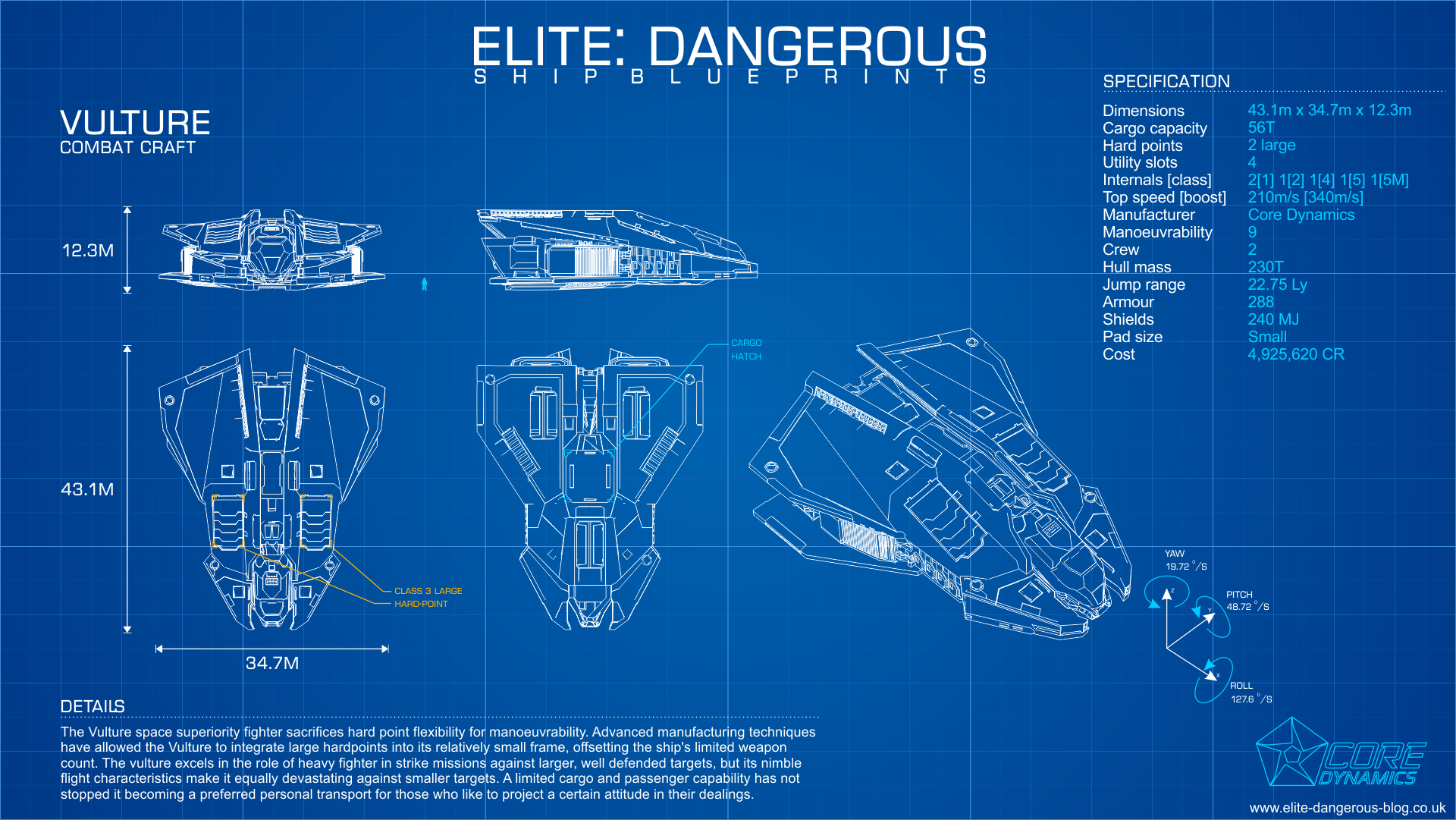
An Elite Dangerous ship build for more experienced players, effectively an end-game version of the Beginner PvE Combat Vulture Build.
Goals
The goals are:
Create a build that uses the Vulture effectively for late-game PvE combat, such as Hazadous Resource Extraction Sites, High Intensity Conflict Zones and Threat 7 Pirate Activity signal sources.
Use any module or engineering in the game to maximize effectiveness and the Vulture’s strengths.
Links: EDSY (have it open as you read the guide for easy reference)
As mentioned in my Beginner PvE Combat Vulture Build, the Vulture is a wonderful small ship to learn PvE combat. It is cheap, packs oversized weapons and teaches good skills like pip (power) management.
However, the Vulture is rarely seen during end-game combat. Large ships like the Federal Corvette and medium ones like the Fer-de-Lance and Chieftain tend to dominate. They have more firepower, better hull and shields, speed and/or agility.
No clever engineering or obscure modules will change this balance. However, the Vulture is far from useless. Some even see its disadvantages as a challenge. Killing NPC pirates in a fully engineered Federal Corvette is relatively easy. Doing so in a Vulture requires more skill.
Offence:
Intertial Impact: The Internal Impact experimental effect changes the damage from 100% thermal to 50% thermal and kinetic. This change means the Burst Lasers become effective against both shields and hull. However, it adds a 3% jitter, which is much larger than it sounds.
Efficient: Some people use the Short Range Blaser blueprint to maximize damage output but this drains the distributor quickly. Using Efficient means you can fire indefinitely with four pips to weapons.
Fixed: A small, nimble ship is the perfect platform for fixed weapons. The extra damage over gimballed weapons helps, as does the immunity to chaff or even needing to select your target.
FSD Interdictor: An FSD Interdictor is useful for interdicting assassination mission targets, wanted ships for bounty vouchers or even powerplay ships for merits. Swap for another Guardian Module or Hull Reinforcement Package otherwise.
Defence:
Resistance: This build focuses on high resistances for shields instead of raw strength. Unless you consistently fight plasma-armed enemies and cannot dodge the slow-moving projectiles, this focus gives a high effective strength with fast regeneration.
Fast Charge versus Lo-Draw: Like most ships using Fast Charge on a Bi-Weave Shield Generator, the Power Distributor cannot supply enough power with two pips in systems to rebuild the ship at the optimal rate. This build’s shields should drop rarely but, if they go down often, replace the Fast Charge experimental effect on the shield generator with Lo-Draw.
Reactive Surface Composite and Thermal Resistance: Reactive Surface Composite inverts the standard resistances for armour, making it strong against kinetic and explosive weapons but weak against thermal. To compensate, the build uses Thermal Resistant on one of the Hull Reinforcement Packages. This gives the build net positive resistances on the hull.
Guardian Shield and Module Reinforcements: Guardian Module Reinforcement Packages provide slightly more protection than Module Reinforcement Packages but cost some power. Swap for normal Module Reinforcement Packages if you do not have them unlocked. The Guardian Shield Reinforcement Package is the only non-utility module that buffs a shield.
Variations
Shieldless: A shieldless version (EDSY) reduces longevity but lets you put the system pips into engines for greater speed and agility. Consider it a challenge. Replace the Shield Generator and Shield Reinforcement Module with Guardian Module Reinforcement Packages and a Hull Reinforcement Package respectively. Replace the Shield Boosters with Shielded Point Defence and Chaff Launchers. Replace the Efficient blueprint on the Burst Lasers with Sturdy, giving them more protection and higher armour penetration. Sturdy costs more power but you have power to spare, even with an Armoured Thermal Spread Power Plant.
Anti-Thargoid Scout or Hunter: To create an AX version (EDSY), take the shieldless version and replace the burst lasers with Azimuth Enhanced AX Multi-Cannons. Fill the utility slots with Caustic Sink Luanchers and an Enhanced Xeno Scanner. Replace the FSD Interdictor with a 1A AMFU and the Guardian Module Reinforcement Packages with normal Module Reinforcement Packages to reduce power use and prevent a Glaive field from damaging them. Replace the Reactive Surface Composite with Military Grade Composite, because the additional resistances are unnecessary. Once again, other ships fulfil this role better but this build can hold its own.
Tactics
Finding targets: This build works best against wing-less large or less agile targets. Anacondas, Asps, Pythons and Type-10s are generally easy prey. Using fixed and jittery weapons against fast or agile targets, like Elite Vultures and Vipers, is doable but frustrating.
Point blank: Get as close as possible to enemy ships, preferably above or below where their surface area is maximized. Avoid jousting as it reduces time on target. Instead, circle strafe, pre-turn and landing gear-turn to track ships as they pass by. Hold down fire. Even with only two pips to weapons, exhausting the distributor or overheating will take minutes.
Power (pip) management: Two pips in systems and four in weapons are usually sufficient. Temporarily shift pips into engines to boost or run down fleeing ships. Ironically, power management is easier in this build than in the beginner version. An Overcharged Monstered Power Plant gives more than enough power. A Charge Enhanced Power Distributor gets it to where it needs to be.
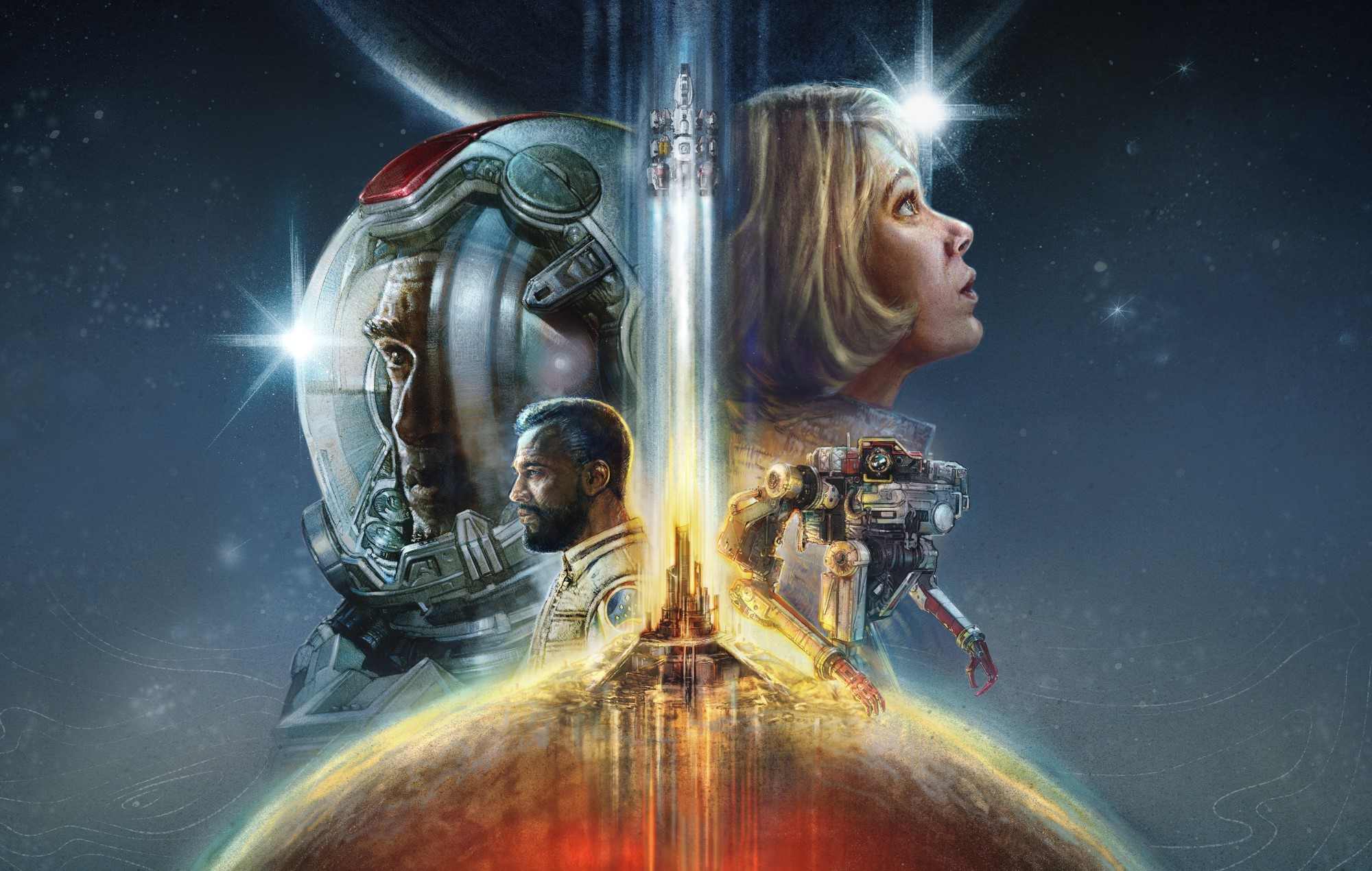
Starfield is the latest action role playing game (RPG) from Bethesda, the developers of Skyrim and Fallout.
Starfield, the first new RPG setting from Bethesda in a long time, is set in 2330. The Earth’s magnetosphere dissipated over a century earlier, rendering it lifeless. Thankfully, humanity mastered faster-than-light travel via the gravity drive. They rapidly evacuated to the star systems near Earth, deserting old nations and building new institutions.
You start Starfield as a lowly asteroid miner, listening to your coworker’s banter. You unearth a seemingly alien artifact that gives you strange visions. After an attack by space pirates, you are inducted into a quaint, exploration-focused organization called Constellation and whisked off onto an adventure.
Structurally, Starfield has a similar “in media res” style introduction to Skyrim. It quickly teaches you the basic mechanics, gives you a short fight to get the blood pumping, establishes you as the “chosen one”, sets you on the main quest, and then gets out of the way. Much of the exposition happens later.
Starfield‘s strength is the breadth, if not depth, of game loops. Its gameplay is fun, but only exploration is remarkable. The combat is standard first person shooter fare, although melee could be more varied. The stealth mechanics are good but not up to Deus Ex or Cyberpunk 2077. Bethesda nailed the sci-fi feel of lock picking, but once you understand it, less player skill is required than in Skyrim. Your scanner is helpful for exploration, identifying enemies, or satiating hoarding instincts by finding things to pick up.
The gameplay is repetitive but not grindy. You do not need to repeat boring activities to enable more enjoyable gameplay. Sufficient variety in the quests and randomly generated or placed content prevents boredom. Once you exhaust the scripted quests, Starfield offers randomly generated versions to pass the time or continue adventuring. Alternatively, land on a planet and start exploring.
Starfield‘s main quest line is suitably epic and galaxy-spanning, providing mystery and motivation. It draws you above the drama occurring elsewhere in the settled systems. However, this distance means the main quest line loses some emotional grounding and gravitas. Starfield‘s setting and side quests provide the most content, variety and potential like most RPGs.
Starfield contains many visually and thematically diverse places. After leaving the dusty, decrepit asteroid mine and a short detour, you first visit the city of New Atlantis. It is the capital of the United Colonies. Visually, it resembles the citadel from the Mass Effect series: clean, bright, organic curves, open spaces with water and greenery integrated seamlessly with technology.
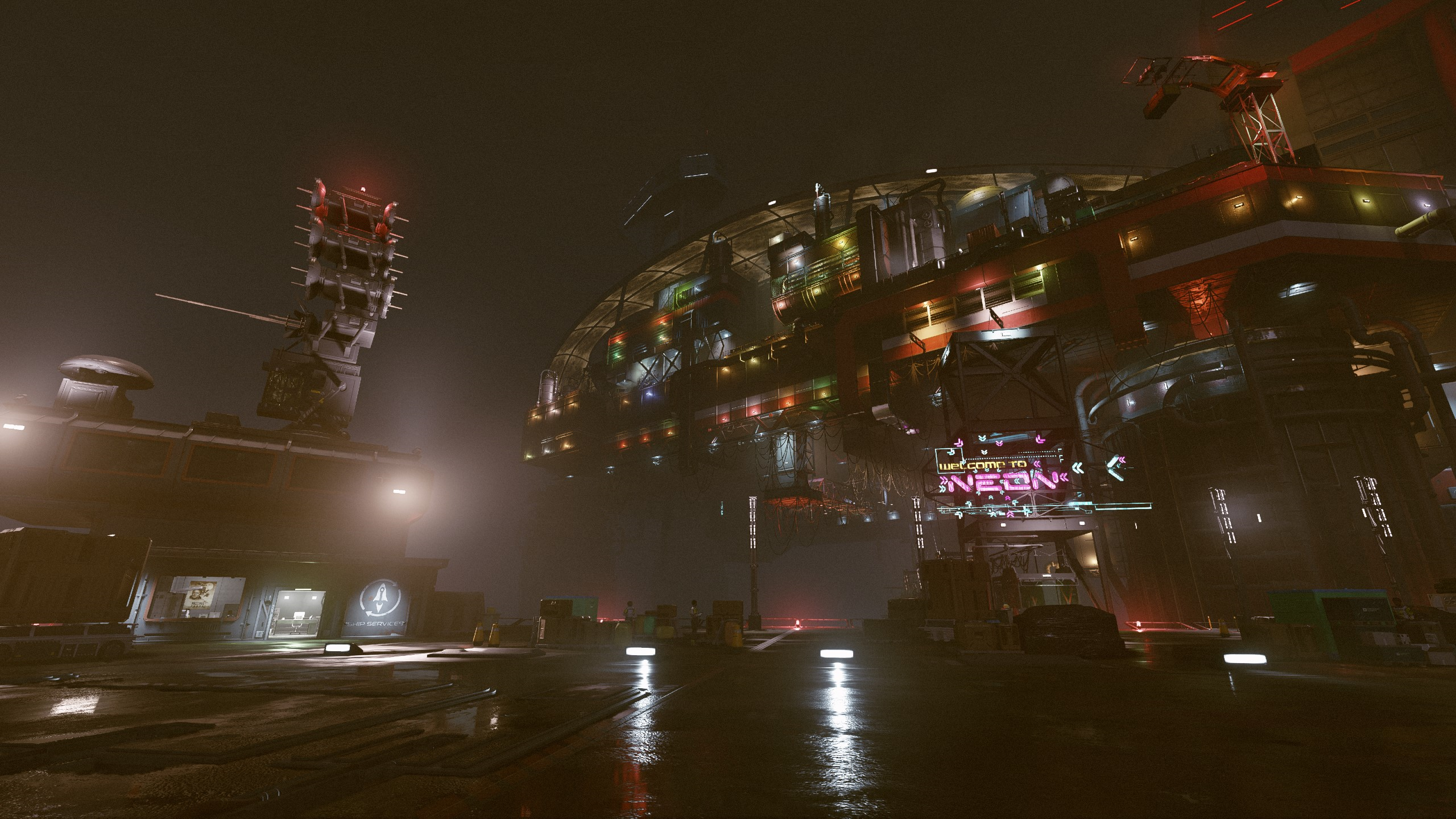
New Atlantis contrasts with other places like Akila City, the capital of the Freestar Collective. Its mud roads and stone buildings make it feel like the Wild West in space, complete with a bank robbery. As its name suggests, Neon is a cyberpunk (the genre) style metropolis on a rain-drenched water world. It is where to indulge in less savoury activities, like gang warfare, corporate espionage, or elicit substances.
Neon’s exterior in all its multicoloured glory.
Exploration is integral to Starfield, being the primary mission of Constellation. Mechanically, it is similar to No Mans Sky or Elite Dangerous. However, Starfield does it better. Starfield supports multiple biomes per planet, adding variety. Starfield is about exploring a known, finite universe, not the near-infinite set of random ones no one else will ever visit. Planet surfaces intersperse improbably frequent natural phenomena and enemy-filled bases to break up the gameplay. You can improve your exploration skills, like increasing scanner range, sprinting further, or learning more about scanned species.
A misty sunset with trees in the foreground and mountains in the background.
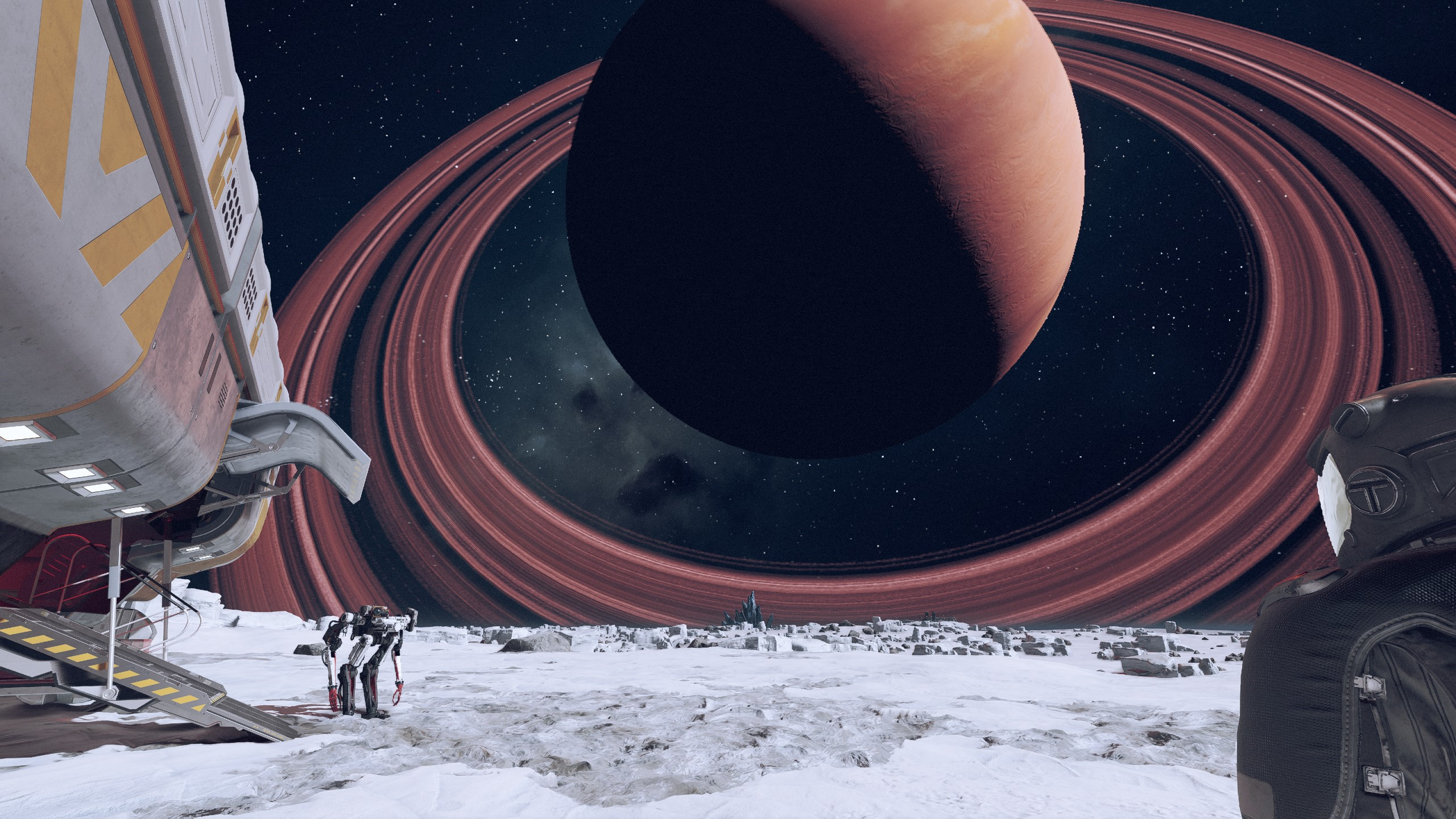
Starfield is visually better than games like No Mans Sky and Elite Dangerous, and “sense pleasure” is integral to exploration. Not just because Starfield is newer. While all generate terrain procedurally, most of everything else in Starfield is hand-crafted. Starfield‘s alien flora and fauna are more plausible, not just a random assortment of limbs. Think Star Wars, where humanity is not at the top of the food chain. Starfield‘s designers often placed moons and planets to create picturesque views, like ringed planets filling the sky. Starfield also has weather, like dreamy mist-filled sunrises, savage dust storms, or dreary rain.
A beautiful ringed planet viewed from a moon.
You need a starship to explore. Your starting ship, the Frontier, is a masterful example of worldbuilding. From the venting gas from its landing thrusters, whose exhaust is ignited by sparks like modern rockets, to its white, vaguely aerodynamic shape reminiscent of the space shuttle, it anchors the setting to a believable near future.
Unfortunately, you pilot your ship rarely. It is either in space, docked or landed. Docking and landing are automated. Flying between planets or systems is “fast travel”, using a short cutscene.
Approaching the starstation “The Eye”.
Starfield has ship combat, but it is arcade-like and closer to No Mans Sky than Elite Dangerous. It devolves into building ships with better shields and weapons. Manoeuvring is all but useless. The camera views block too much with either the cockpit or your ship’s back. Power management is awkward, particularly in the heat of battle. Macros would be helpful. The targeting mode loses any situational awareness.
However, once you master the clunky interface, the shipbuilder is a beautiful avenue for self-expression. Like the Galactic Civilization franchise, you customize and assemble ships using modular components. In a clever touch of worldbuilding, different vendors’ modules have different styles, such as the blocky, angular Deimos or Taiyo’s almost organic curves.
You can also walk around your ship, board enemy ships and add crafting stations and containers. However, to prevent punishing those with large ships, you can board into or leave directly from the cockpit. Elite Dangerous‘s designers should take note.
The back of a Stroud-Ekland cockpit.
Starfield allows building outposts on different planets to store excess equipment, gather resources, craft materials, and refuel ships flying past. You can also create trade links to automate the transfer of materials between them. Starfield almost rivals factory games like Satisfactory with its web of materials and resources.
However, the capacity of even the largest storage buildings needs to increase. A lot. No Mans Sky offers more variety, including positioning individual walls, roof and floor tiles.
In terms of companions, there are dozens that you can hire or find around the galaxy. Of these, four companions have unique quest lines. Each quest line companion follows roughly the same moral compass: generally good and favouring exploration. Although not my thing, this limits the potential for less noble playstyles.
Some want Vasco, your robot companion, to have a quest line and opportunity for growth or change. However, with the world currently enraptured by the potential and danger of AI, seeing a robot follow its programming is a welcome piece of sanity.
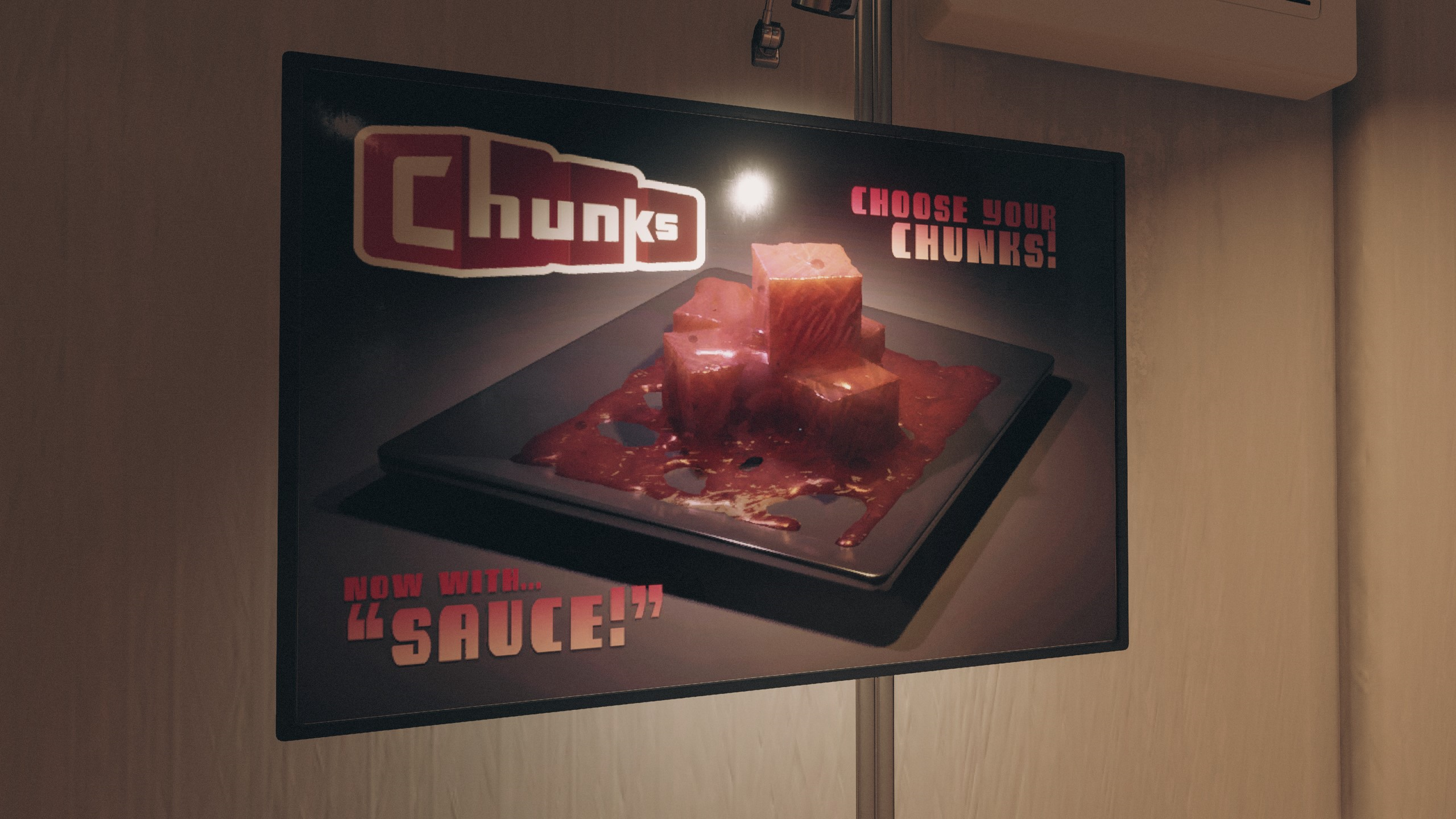
Thankfully, Starfield does not take itself too seriously. Catching up with your parents in an alien petting zoo or watching them pretend they did not try illicit substances is touching and amusing. Various “inspirational” posters line the walls of shady secret research labs. Chunks, the ubiquitous cubic fast food of the 24th century, “meet all minimal nutritional requirements”. Vasco has some innocent but cuttingly insightful wit. Your adoring fan’s flattery never gets old.
Hmmm. Appetizing.
Starfield‘s music is orchestral, reminiscent of Star Wars or Star Trek. Most tracks are slow and use periodic gradual crescendos to emphasize the wonder and grandeur of Starfield‘s universe. The soundtrack is composed to support a game with lots of voice dialog and critical sound queues, such as in combat. It does not call attention to itself. For example, the restrained, almost mournful menu theme is the opposite of Skyrim‘s rousing call to action. Rather than assaulting the player with aggressive emotion, Starfield‘s version hints that the player has to come to the game (or music), not vice versa.
My main criticism of Starfield is not that it is too easy, at least on “normal” difficulty. I may have played many Bethesda RPGs, but even “hard” provided little challenge. Assuming you do not intentionally engage in challenging content, there is little pressure to specialize your character’s skills, ship, outposts or use consumables for temporary buffs. These become more role playing opportunities.
My main criticism is also not that Starfield is the usual Bethesda RPG oxymoron. Starfield empowers you, creating a feel-good power fantasy where you are important and can make galaxy-affecting changes. However, as the conveniences in your favour accumulate, like free ship fuel or unkillable companions, immersion and suspension of disbelief get harder. Starfields‘ roots in points-based mechanics mean large level differences between you and your target can create unrealistic bullet sponges.
I do not mind that, despite Starfield having the best facial and hair animation of any Bethesda RPG, it still falls into that uncanny valley. NPCs wander aimlessly and still get stuck in walls occasionally.
My main criticism of Starfield is an absent central or recurring theme. For example, in a world where AIs are more intelligent and capable than humans, and the powerful are unshackled from laws and ethics, Cyberpunk 2077 examines humanity. The Fallout series deals with the difficulties of survival and that the best choices are often hard or impossible. The Witcher series shows that, when monsters walk among humans, humans are sometimes the most monstrous of all. The Nier series deals with loss.
In fairness, a game does not need to be profound to be good. Making action movies or games requires skill. Bethesda more than demonstrated it with careful level design, regular mixing of gameplay modes, managing tension, and catering to familiar sci-fi tropes and fantasies. The usual meme-worthy glitches are thankfully absent. The greater attention to quality after Cyberpunk 2077‘s problematic launch is apparent.
Instead, Starfield is pure, fun sci-fi escapism. It is a series of concurrent action movies. RPGs are defined by how well they let you play out fantasies. Starfield delivers on that.
For example, the Vanguard quest line plays like a rerun of Starship Troopers. The Ryujin quest line is a sci-fi James Bond or Mission Impossible coupled with corporate espionage and intrigue. Completing the Mantis quest allows you to play as a space Batman. The Sysdef/Crimson Fleet quest line has palpable tension as you play a double agent, playing criminals and the law against each other. Join the Rangers and play as a space cowboy.
A “Neil Armstrong moment” standing on the surface of Luna, the moon, looking toward the Sun.
Starfield is unoriginal. Almost everything in the game is “heavily inspired” by something else. That is OK. Successful RPGs help players fulfil fantasies by immersing players in familiar tropes. Where Skyrim opened the fantasy genre to a broader audience, Starfield attempts to do the same with science fiction.
That said, I was disappointed there were not more overt references to other movies, shows or games. Many will pick the few references to Skyrim‘s sweet rolls and Meridia quests. Yes, there was some well-known voice talent from Star Trek: Deep Space 9 and a subtle reference to the 1986 Transformers movie. Cyberpunk 2077 did this comparatively better.
Without strong themes and notwithstanding a few minor nods to modern sensibilities like same-sex relationships, there is little to offend or demand too much of its players. Perhaps Bethesda wanted to play it safe and avoid controversy.
However, Bethesda missed the opportunity to do something more. So many quests touch on real-world themes. For example, the war between the United Colonies and the Freestar Collective that ended 20 years before the game’s start still has lasting social and economic impacts. The United Colonies has to deal with the compromises and the demands strict order creates. The Freestar Collective juggles freedom with the criminal behaviour it facilitates. The Rangers’ quest line deals with the place of veterans in a postwar society. Meanwhile, the wealthy flatter themselves on luxury space cruises.
DLC or the modding community may fill the gap. Like Skyrim and Fallout, Starfield is as much a gaming platform as a game. Much of the work establishes content for future expansion or use. Outposts and shipbuilding, for example, go far beyond what Starfield currently needs. The Va’ruun, relegated to mysterious bogeymen, have much potential.
If you enjoyed Fallout or Skyrim or like science fiction games, you have probably already played or plan to play Starfield. You can race through key quests in 30 hours, but the complete experience takes at least 100 more. Starfield is fun, emphasizes exploration and knows its target audience well. However, the lack of anything original, introspective or thought-provoking may limit its long-term impact on the gaming landscape. Playing Starfield is like eating Chunks. It tastes good and you want more but the nutrition is questionable.
Deliver Us Mars is an interactive fiction game developed by KeokeN Interactive. While some consider it an adventure puzzle game, Deliver Us Mars focuses on story over puzzles and mechanics.
Deliver Us Mars follows on from the prequel, Deliver Us the Moon. Earth’s resources are exhausted and its environment is rapidly degrading. You play the teenage Kathy Johannson as she travels to Mars with her crew. They want to find the three ARK ships that fled the moon in the prequel, then use the ARKs’ technology to fix Earth.
Mechanically, Deliver Us Mars shifts between three modes. The first is engine-rendered cut scenes, where the game tells much of its story. Deliver Us Mars shows off the facial animation features of the Unreal engine, not to mention the animators’ skills.
The second is exploration, walking or travelling around near linear maps. You often find objects to scan or read that flesh out the world. This is natural to those familiar with RPGs and adventure games. However, finding them all will likely require multiple playthroughs.
The third is mini-games. Some mini-games require traversal, including climbing or driving a rover across the Martian surface. The climbing mechanics are designed well, requiring coordination to survive palm-sweating moments. Some mini-games are puzzles, like using energy beams to power doors or machinery.
The mini-games are mostly easy, although their controls or intended results are sometimes unclear. Most have an additional achievement for fast or exceptional completion, yet another reason for subsequent playthroughs.
Mini-games and exploration are also not the game’s central focus. They supplement and reinforce the story. Instead, the success of a game like Deliver Us Mars relies on the quality of the storytelling and the characters. Thankfully, the game delivers.
For example, Deliver Us Mars periodically revisits Kathy’s youth. These flashbacks are initially tutorials, such as swimming teaching how to manoeuvre in zero gravity. They momentarily break the tension, reminding the player of less stressful times in Kathy’s life.
However, later flashbacks exacerbate the tension and add context. For example, the game hints at the death of Isaac’s wife and Kathy’s mother early. However, the game delays the event to maximize the emotional impact.
Deliver Us Mars also uses subtle analogies, such as Kathy’s home on Earth. It represents the family dynamic and Earth’s perilous state. Initially, it is inviting with a warm sun and a loving, successful family, albeit with subtle hints of external unrest. As flashbacks recur, disagreements boil over, and dust storms darken the sky. Eventually, a storm destroys the house while Isaac, the father, must leave Kathy in the hands of Claire, her sister. It then gets worse.
Deliver Us Mars is pessimistic. Superficially, it is about how humanity’s talent for internal conflict often sabotages our best efforts. It examines how decision-makers can lose context and grounding, succumbing to revenge, narcissism or paranoia. It highlights the unreconcilable sacrifices some make. Even the worst climate prediction models do not show the Earth becoming inhospitable in the game’s timeframe.
The character of Kathy Johannson is one exception. The first flashback shows her irresponsible playfulness as she swims with her new and not waterproof moonbear toy. She grows over the game, watching the mantle of responsibility pass from her father to her sister and finally to herself. When Isaac first sees Kathy on Mars, he remarks how she has grown, and this is not just physically. Players presume and impose a default heroism on her, and she does not disappoint.
Delver Us Mars hinges on theemotional connection between Kathy and Isaac. Like in Deliver Us the Moon, Kathy and Isaac show how family and close relationships often motivate us the most. A single word from Isaac, “moonbear”, is enough to spur Kathy onward. The love of his daughter also inspires Isaac when all seems lost.
Isaac Johannson is initially sympathetic, torn between duties as a father and saving Earth. However, unlike Kathy, Isaac plays a tragic role. Time will tell whether Kathy or Isaac represent modern-day governments trying to appease their citizens while protecting the environment.
It may be my inherent optimism, but Deliver Us Mars is more about not running away from problems. Like the sacrifices people make. Like the relationship between Kathy and Isaac. Like the environmental problems on Earth.
Even when things seem grim, there is always time and more opportunities. This is a pre-apocalyptic setting, not a post-apocalyptic one, and there is still a chance to prevent it. Deliver Us Mars believes that human ingenuity and hard work can solve significant issues.
Aesthetically, Delver Us Mars is influenced by near-future science fiction like Gravity, Interstellar, Ad Astra or 2001: A Space Odyssey. Most technology is slightly ahead of our own, making the game relatable. Some models are superb, particularly the detail in the crashed ARK Lados. The blue Mars sunset is also realistic.
However, Deliver Us Mars skims over many dangers of living on Mars. Its dust is abrasive and toxic. It receives more radiation than Earth. However, I suspect the game designers wanted space or the hostile, desolate Martian environment for spectacle and impact. A game set in safe but sterile metal corridors would quickly feel dull and mundane.
Playing Deliver Us The Moon first is recommended. Like the flashbacks, the prequel adds gravitas and emotional context. For example, Deliver Us Mars almost ignores Sarah Baker, the expedition leader. Appreciating Sarah’s importance and perspective from her small part in Deliver Us Mars is difficult.
While the realistic graphics are gorgeous, they are sometimes inconsistent. It is a minor criticism, but little things can break immersion, like a buggy not leaving tire tracks or the sprite-based thrust from a manoeuvring spacecraft. Higher resolutions are unkind to some of the models and textures. Stylized graphics like cell-shading may have been a better choice. It would have simplified the art and given better cohesion.
Deliver Us Mars is about the right length at about ten hours to complete, more if you want to get all the achievements. It is darker than its prequel but worth it for science fiction or interactive fiction game fans. Hopefully, KeokeN has a sequel planned to continue or conclude the story.












 The Single Player