“Breathedge” Review

Breathedge is a space survival crafting game from Red Ruins, a small Russian development team. It is superficially similar to Subnautica and similar games in the genre, but how deep do the similarities go? 

In Breathedge, you play as a dutiful grandson accompanying his deceased grandfather on spacecraft. A catastrophe ensures, leaving you stranded. Your oxygen and propulsion are initially limited, meaning you can only visit nearby parts of the wreckage. You scavenge materials from the wreck and craft food and equipment to survive, then venture further. Eventually, with the aid of your fast-talking suit AI, you start to discover more about the catastrophe. Except for the first sentence, these elements are common to survival crafting games.

Both Subnautica and Breathedge create a feeling of weightlessness, the controls allowing six axes of movement. However, Breathedge creates the feeling of being in space. The laboured breathing constantly reminds you of the limited oxygen supply and claustrophobic spacesuit. The subdued soundtrack and subtle blue light of the nearby star impart space’s loneliness and alienness. 

Subnautica and Breathedge structure their maps differently. Most of the game-relevant stuff occurs on the seafloor or surface in Subnautica. It is essentially a two dimensional game with some vertical shafts. Subnautica also has a limited draw distance due to the water’s “fog” effect. 

However, Breathedge places areas of interest everywhere, including above, below and behind other objects. Areas of interest must be within a reachable distance of safety, such as the player’s ship. There was also no need for “filler” like barren parts of the seafloor in Subnautica or credible life to populate it.

These differences mean the Breathedge developers have more control over where things are. Moving content is quicker and easier. Far away areas need to be large or otherwise distinct. Developers can focus more on the areas of interest, including intricately detailed debris or frozen plumes of liquid. However, they must manage the level of detail to keep the frame rate up.

Thematically, Breathedge replaces Subnautica‘s wonder and horror with challenge and tension. The surface, with its supply of breathable air, is everywhere in Subnautica. However, pockets of safety are rare in BreathedgeBreathedge delays access to vehicles and base building, with their safety and increased range, until the late game. Subnautica has an infinite supply of water and food once you know where to look. Breathedge‘s supply of these is limited.

These changes reduce the available play styles. Subnautica‘s meandering exploration is not possible. With areas of note in all directions in Breathedge, exploration is slower and more disorienting, unlike Subnautica‘s focus on the seafloor. It is easy to miss something important.

However, initially restricting the player to small areas allows Breathedge to tell a more linear story. Subnautica has several light story threads the player experiences at their own pace. Breathedge can also gate progress more effectively. For example, you cannot reach the milestone for the next chapter until you have found sufficient upgrades.

Breathedge swaps Subnautica‘s subtle, occasional deadpan humour with an initially self-deprecating then fourth-wall-breaking humour. This swap is not so bad by itself. However, it is constant, unyielding and delivered poorly.

The suit AI prattles on like a syrupy, fast-taking American game show host. Concentrating hard on the game’s dialog while distracted with the punishing gameplay mechanics (like limited oxygen, slow movement and resource scarcity) not only restricts the humour’s impact but induces stress. Subtitles help but do not alleviate the problem.

Add “Babe”, a parody of innuendo-filled spam emails, and a chicken with superavian survival abilities, and it becomes hard for the player to relate. Is the game meant to be YouTube fare, played while inebriated as you laugh at the protagonist’s misfortune? Is Breathedge meant to be a harrowing tale of survival in a universe of dysfunctional equipment? Is Breathedge a satire of Russian engineering?

Breathedge is not a bad game. Instead, it subverts the expectations that successful games like Subnautica entrenched. Many distant asteroids and wreckage pieces glimpsed as you first open the airlock are still inaccessible late in the game. Tools’ fragility quickly dashes the relief of finally crafting what you need.

While the developers could reduce the humour and tighten the thematic focus, Breathedge‘s small development team successfully pushes boundaries. This game is not Subnautica in space. Those looking for meditative exploration will be disappointed. Those looking for a gorgeous game that mixes challenge and irreverent humour will fare better.

“Star Wars Jedi: Fallen Order” Review

Star Wars Jedi: Fallen Order, released at the end of 2019, is a single-player, action-adventure game. Think bits of Darksiders, Dishonored and Dark Souls combined with the Star Wars setting, music and visuals.

You play as Cal Kestis, a padawan that survived order 66. He etches a mediocre existence on the planet Bracca, salvaging spaceship parts to fuel the empire’s war machine, when an accident reveals his force powers. Cere Junda, a former Jedi, rescues him from the inquisitors, the empire’s Jedi hunters, then Cal embarks on a quest to protect other force-sensitive children from the empire.

Cal starts with minimal force powers. He learns or acquires new abilities by achieving in-game goals, which initiate cut scenes re-enacting parts of his childhood padawan training. These reflections contrast Cal’s old and current lives, help us empathize with his repressed grief and provide a temporarily safe learning environment for the player.

The levels are complex but well-designed. They are bi-directional, and the backward traversal often needs newly acquired abilities. Many short branches provide exploration opportunities. However, some require powers gained later, meaning the player must revisit old areas.

The level designers made each planet distinctive, such as the ochre sandstone and bright, yellow sun of Bogano; Dathomir’s reds, browns and sinister twilight or the vibrant, lush, green, humid Kashyyyk. Imperial interiors continue the original three Star Wars films’ styling with stadium-framed fluorescent lighting set into austere blacks and greys.

The parkour gameplay fits well with Jedi and Star Wars lore, going back to Luke’s training on Dagobah. Star Wars has always emphasized verticality to imply danger and declutter sets, such as in A New Hope’s death star.

The combat is defence-oriented, built around blocking and dodging to reveal short moments where you can attack. You eventually gain the expected gamut of Jedi powers, like pulling, pushing and jumping, and a double-bladed lightsaber.

However, you rarely feel comfortable enough to have a dominance or power fantasy. Once you can comfortably beat an opponent, the game throws in more or harder ones.

The soundtrack is standard Star Wars “John Williams-esque” orchestral, with playful woodwind and ominous brass and strings. However, other than a brief appearance from the Mongolian band “The Hu”, it lacks memorable musical moments.

Star Wars Jedi: Fallen Order is challenging. Repeatedly failing can be frustrating, but iterative learning is the path to the required and desired mastery. Dying is progress. Star Wars Jedi: Fallen Order is essentially a puzzle-solving game, whether learning and countering enemies or combining force powers and movement to reach a seemingly unnavigable goal.

Thematically, Star Wars Jedi: Fallen Order is about healing after trauma and loss. As Cere says, failure is part of the process and is not the end. For Cal, it is about the loss of his mentor and father figure. For Cere, it is about the loss of her padawan and estrangement from her master. For Trilla and Merrin, it is about abandonment and betrayal. These parallel the setting, both the fall of the republic/rise of the empire and the descent of the ancient Zeffo race, whose tombs you explore.

Almost all thematic treatment is during cut scenes, conversations between missions, journal entries or enemy banter during boss fights. Later cut scenes, in particular, effectively embody the “show, don’t tell” mantra, symbolism and abstractness reminiscent of Star Wars. Even the main menu theme is subdued and mournful.

Unfortunately, Star Wars Jedi: Fallen Order does not extend themes into missions. In other words, most of the game. It is not ludonarrative dissonance, more a missed opportunity. The player will repeatedly fail with the game’s challenging mechanics. However, respawning when you mistime a jump or an enemy defeats you may be frustrating but not a genuine loss.

Meanwhile, Star Wars Jedi: Fallen Order’s challenging game mechanics easily distract players from internalizing and examining themes. You are focused on how to get places or beat opponents, not what doing so means or its impact on the game’s characters.

One solution is involving other characters more during missions. They steal the show in their brief appearances with spot-on voice acting and scripts. Apart from BD-1, the R2-D2 substitute with the requisite cuteness and courage, Cal only briefly works with two other characters during missions

Cal’s personality is also underdeveloped. This “blank canvas” may make him a better player surrogate, but the developers could flesh him out beyond his withdrawal, grief, and the wide-legged swagger the animators gifted him.

That said, genuine love and attention to detail have gone into the game, whether it is the authentic motion blur and whoosh of a whirling lightsaber or the fantasy-fulfilling glee of briefly piloting an AT-AT. I laughed at the mundane stormtrooper banter, Cal not translating BD-1’s jokes or BD-1 beeping a Star Wars motif when hacking a security droid.

Star Wars Jedi: Fallen Order strives to be a good game and not just a faithful Star Wars game. Perhaps this is why it lacks the signature Star Wars initial text crawl and subverts the opening star destroyer camera pan. The game is a challenging but enjoyable 35 hours to finish, more for all achievements, and worth it for action-adventure fans, not just Star Wars fans.

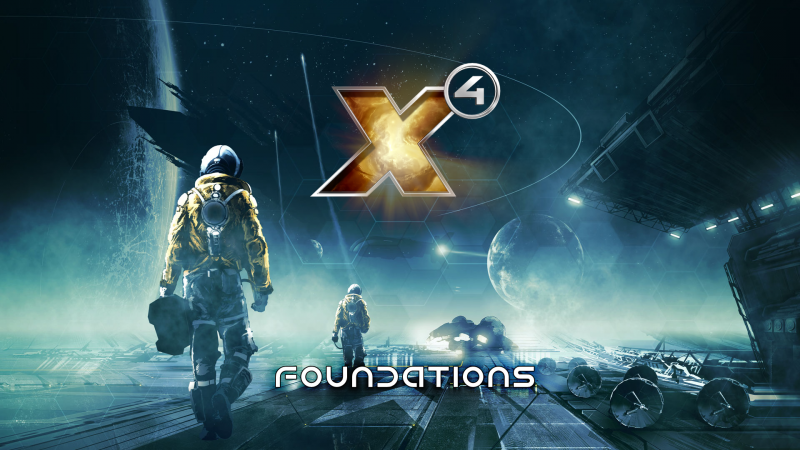
“X4 Foundations” Review

X4 Foundations, released in 2018 but continuously patched, is the latest game in the long-running X franchise. I made several false starts with the franchise previously but, given my recent interest in space games, it was an excellent chance to revisit it.

Superficially, the game plays and looks like a single-player space sim akin to Elite Dangerous or Star Citizen. You pilot a spaceship and trade, fight, mine or explore. You progress by increasing reputation with in-game factions, gaining access to better ships, upgrades, commodity pricing and missions, and accumulating credits to buy those better ships and upgrades.

The small but not claustrophobic map segregates space into hexagonal sectors. Most interaction is with space stations, although sectors contain other objects like minable asteroids and gas clouds. Ships travel between sectors using jump gates.

X4 Foundations handles this space sim play well. Ships are customizable with compelling tradeoffs, although not as varied as the other games mentioned above. Ships can perform like real-world aircraft or a more straightforward, uniform handling for those used to a more Star Wars: Squadrons style of play. The variety of mission types is unusually varied.

However, X4 Foundations is not only a space sim. Once you realize you can hire pilots for purchased ships that can automate simple tasks like mining, trading, exploring or fighting, the game’s focus shifts from the pilot and their ship to logistics and strategy. As you start building space stations to process raw materials through a complex web of production facilities into spacecraft, the game’s focus switches again to economy.

X4 Foundations is more a 4X game about rising from nothing to something on the galactic level. What exactly that “something” is depends on the player. There is no defined end, and little actively opposes the player. Instead, the challenge is transitioning from one level of play, like assembling a small fleet or building and running profitable space stations, to enabling the player to attain their own goals, like fighting off the game’s alien nemeses or amassing a fortune.

However, X4 Foundations is also a frustrating game. Progression slows once you reach the 4X playstyle at the middle game. While missions are vital in the early game and the occasional late-game “build base” or “build fleet” mission is lucrative, passive income quickly overtakes them. Often simply waiting for credits to accumulate or production to finish is the most effort-effective strategy.

X4 Foundations lacks the statistics and insights you need to identify opportunities or trends, despite the heavily menu-driven interface. For example, it does not provide easy access to the total credits traded for a commodity, high buy and sell price differences or details about trades between sectors.

X4 Foundations’ modular approach to building space stations brings out creative fun. However, building stations is seemingly meant to follow a progression, starting at cheaper modules then purchasing better ones as you accumulate wealth. Unfortunately, this progression takes tens of hours. Following the optional but well-written mission arc can short-circuit it but, if the progression is not fun and skippable, why have it?

X4 Foundations’ space ship and space station models are intricately detailed. Each faction has a unique style, whether it be the angular shapes of the Argon (humans) or the rounded, organic style of the Paranid.

However, beyond the models and textures, the graphics are dated. The force field over landing pads is simply a moving texture with transparent portions. The representation of humans practically fell into the uncanny valley, almost taking immersion with it. A stylized representation may have been more effective.

X4 Foundations certainly has its moments, though. When roaming space stations on foot, you cannot help but admire their scale, the kineticism of large ships regularly docking and undocking and the ground staff scampering to service them. It is the glee of a child watching trains or bulldozers.

Similarly, standing on the bridge of your capital ship as you order your formationed fleets to engage your enemy makes you feel like an admiral from many science fiction franchises. You can teleport into the pilot seat of a fighter to take out that troublesome turret or engine, then back to your capital ship to admire the target’s demise at a safe distance. Alternatively, you can order your marines to capture the ship. Your fleets can ignore enemy ships and destroy their space stations to cripple their production capability. The strategic options are surprisingly deep.

X4 Foundations is a victim of its breadth, becoming unintentionally comparable with specialist games that do their narrower pieces better. Perhaps these issues are addressed in the expansion packs or mods. It is also a long game, requiring dozens of hours to learn and more to finish. However, the X4 Foundations’ unique gameplay combination is compelling for those willing to endure the grind through the middle game or enact their own “rags to riches” story.

“Eve Online” versus “Elite Dangerous” Comparison

Eve Online image

As a long-time player of Elite Dangerous, Eve Online had always intrigued me. Being almost 20 years old, Eve Online is known for massive PvP battles and intrigue, ganking and its player-driven economy. I wanted to experience Eve Online to understand its design philosophy and re-examine Elite Dangerous with different eyes.

The goal was to only highlight the fundamental differences in design, intention, and appeal between Elite Dangerous and Eve Online. A detailed comparison would fill volumes. Developers also evolve mechanics and features so a detailed comparison would also quickly date.

Elite Dangerous is more intimate than Eve Online. Flying a ship in Elite Dangerous is like flying a modern-day fighter. Many use a HOTAS (hands-on thrust and stick) and enjoy the sensation of flight. Eve Online uses more abstract, high-level commands, such as fly to this navigation point, with a keyboard and mouse. Elite Dangerous has a first-person camera view. Eve Online uses a usually zoomed out third-person camera view to get a better tactical perspective.

Combat in Elite Dangerous involves manoeuvring the opponent into your weapon sights, lining up a shot and firing at the correct time. It occurs at a range of a few kilometres. Combat in Eve Online is more tactical, with the game aiming for you, and battlefields can span hundreds of kilometres.

Graphically, Elite Dangerous’ textures, models and effects are more detailed then Eve Online because you see them up close. Elite Dangerous‘ sound design is brilliant and immersive, with each ship having distinct sounds. Elite Dangerous is even more immersive in VR, which Eve Online does not support.

Eve Online focuses more on player-interaction. While both are MMOs, Elite Dangerous involves smaller groups of players and ships than Eve Online. While both have large squadrons (Elite Dangerous) or corporations (Eve Online), Eve Online has more tools for managing large corporations like alliances, inter-corporation war and in-game calendars. Eve Online’s corporate tax system sequesters a portion of each member’s income to support combined activities or reimburse members. Many play Elite Dangerous in solo mode, sharing the same galaxy but not interacting with players.

An Elite Dangerous player can exploit or ignore the in-game politics and universe around them. Eve Online players are the politics and universe, including building and destroying space stations. Before introducing Triglavians in Eve Online, the only endgame was large scale PvP. Elite Dangerous’ endgame is mainly PvE, including a detailed simulation of galactic politics called the “background simulation”.

Eve Online has a much more complex economy and industry than Elite Dangerous. You cannot construct or purchase ships or components from players in Elite Dangerous, the opposite of Eve Online. Building a ship from the blueprints you researched and from the ore you mined in Eve Online is a great feeling. At least, it is until you realize how uneconomical it is compared to specialist players.

Mining in Elite Dangerous is more involved than Eve Online, requiring prospecting individual asteroids and gathering the released ore fragments, but only translates time into credits. Mining in Eve Online is simpler, coining the phrase “AFK mining”, but provides the raw material for the broader economy and has specialist ships and skills.

Elite Dangerous is more forgiving. Non-consensual PvP is a fact of life in Eve Online – I lost more ships in my first two weeks of Eve Online to ganking than in thousands of hours of Elite Dangerous. Elite Dangerous, by comparison, has player groups like the “Fuel Rats”, who altruistically deliver fuel to players whose ships ran out of fuel. If you lose a ship in Elite Dangerous, you pay a rebuy price of 5% of the ship’s total cost and respawn in a fitted, engineered ship matching your original. If you lose a ship in Eve Online, you get back a smaller portion of the cost then must manually purchase and fit a replacement.

Eve Online comes from an earlier game design mindset where challenge and setback were necessary to contrast achievements and progress. Eve Online’s age also shows in its UI, reminiscent of Everquest, with many information-heavy windows. Elite Dangerous’ UI is less cluttered and simpler, partially driven by Elite Dangerous’ console support, but deals with less information than Eve Online. Elite Dangerous replaces Eve Online‘s sometimes ambiguous warning buzzes and tones with an unambiguous and science fiction-style cockpit voice assistant.

While both games provide tutorials, both require experimentation, help from third parties or patience to learn and master. Various tools and websites support both games, supplementing the game UIs.

Mechanically, a significant difference between the two is Eve Online’s skill system. Elite Dangerous allows any pilot to fly any ship, assuming they have sufficient credits and reputation. However, Eve Online’s skills both determine what the pilot can do and how effective they are.

Eve Online’s skill system means players can specialize in a role or type of ship. For example, one player may specialize in missile weapons and one race’s destroyers. Another may specialize in laser weapons and a different race’s cruisers. Another may specialize in mining ships and industry. This system means there is no “one size fits best” ship or fit, unlike Elite Dangerous. It creates niches and encourages cooperation. Skills are easy to learn but hard to master, so experimenting or role switching is still possible.

However, the only in-game way to increase skills is time. Skill points accumulate at a constant rate, even when not playing. The player’s actions neither predispose nor increase the rate of accumulation. Long-time players benefit, even if absent. Eve Online’s developers get a revenue stream through new players purchasing skill boosts.

This contrast highlights the different revenue models. You pay for the Elite Dangerous game upfront then, optionally, cosmetic upgrades. Eve Online has a limited free mode but frequently nags to upgrade to a monthly subscription. You can earn enough in-game currency to upgrade to the paid tier. However, it is only possible in the late game and requires a significant time investment.

Another key mechanical difference is exploration. Exploration in Elite Dangerous consists of flying to unexplored star systems, scanning then selling the cartographic data. Players have discovered less than one percent of Elite Dangerous’ over 100 billion star systems in a 1:1 model of the Milky Way galaxy. In-game photography is common, particularly when players find beautiful rings or other stellar vistas. You can land on planets and experience a “Neil Armstrong moment” as you walk on them.

Exploration in Eve Online consists of scanning known star systems for points of interest that do not appear in regular scans. These points of interest could be wormholes, hidden bases, wrecks (destroyed ships) or players not at warp. The latter is an important part of PvP in Eve Online compared to Elite Dangerous – other players can easily find you and attack you. Players can salvage wrecks for crafting components. Wormholes lead to unmapped star systems with a higher risk/reward.

These different approaches reinforce and support existing gameplay. Elite Dangerous’ exploration spreads the players out and encourages more individual play. Eve Online’s exploration supports PvP or industry.

Eve Online is influenced by the Homeworld series and Warhammer 40K with the larger fleet battles, constructing huge engines of war and trade, and emphasis on rediscovering ancient or abandoned technology. Elite Dangerous owes more to Freelancer or the Wing Commander series – a single pilot surviving and thriving in a space “wild west”. Both games have extensive lore that serves mainly to give context to the current world. Neither game is story-based or examines themes.

I liked Eve Online’s “try before you buy” model by playing an Alpha (unpaid) for a while then upgrading to Omega (subscription) temporarily with a starter kit. Elite Dangerous has a high upfront cost. However, once purchased, Elite Dangerous lacks any “pay to win” mechanics or nagging.

I also liked Eve Online’s complex industry and economy, which has no equivalent in Elite Dangerous. It opens whole new play styles, earning the moniker “spreadsheets in space” from its depth and complexity.

However, Eve Online’s Darwinian environment was frustrating. The solution, and a tenet of Eve Online, is cooperation. Whereas Elite Dangerous leans toward meditative soloing and slow constant progression, Eve Online is more tribal and brings together communities to play and progress with and against other players.

Eve Online and Elite Dangerous scratch different itches. Both games have withstood the test of time and flourish, despite a few bumps with Elite Dangerous’ recent expansion.

“The Outer Worlds” Review

The Outer WorldsThe Outer Worlds, a science fiction action adventure role playing game, is a spiritual successor to Fallout: New Vegas. While Bethesda developed most of the revamped Fallout series, Obsidian Entertainment developed Fallout: New Vegas, widely considered to be amongst the best of them. Obsidian has done it again.

The “Fallout” series contrasted blithe advertising against bleak nuclear devastation to show how consumerism had detached us from reality, like a subtler Rad Bradbury’s There Will Come Soft Rains. This contrast was particularly evident of the pro-industry, pro-American optimism and nationalism of the 1950’s, whose aesthetic the “Fallout” series borrowed for its retro-futuristic style.

However, The Outer Worlds takes this in a different direction. It retains the futurist 1950’s aesthetic but immediately confronts the player with capitalist authoritarianism. What starts as kitsch descends into absurdity then horror as the bureaucratic oppressiveness and repetitive, vapid advertising jingles grate.

Meanwhile, the almost surreally vibrant alien landscapes replace the bleak, practically monochromatic art style of the “Fallout” series’s post-nuclear war America. The scene is relatable enough with plants and water and clouds. However, the plants are strange puffballs and oversized mushroom trees. While the pinks and oranges of clouds in a sunset are beautiful, they are set beneath the red rings of an alien gas giant.

This alienness extends to its soundtrack. As the character first steps onto a planet, the music has sequences of solos followed by answers from the broader orchestra after unsettling, awkward pauses. Even the title theme played over the main menu starts with two flutes playing at their lowest register, giving an ethereal feel, followed by a subdued, almost mournful but resolute motif.

Both the music and art differentiate scenes and anchor the player in a location. For example, a visual overload of neon assaults the senses as the door to the promenade on the Groundbreaker recedes. The bass riffs with subtle harmonica overtones played when entering the Edgewater are reminiscent of the wild west. The intense primary colours of Terra 2 (green grass, blue water or red lava and rings) contrast against the yellow, sulphurous tones of Monarch and the dull, monotonous grey of Byzantium.

Like the “Fallout” series, The Outer Worlds thrusts the player as an outsider into a plot that subverts the status quo. Whether this subversion is for the better or worse is determined by the player’s choices. The ultimate enjoyment of the game is exploring choice and effect. A cathartic, offensive approach is an option but finding the best outcome, typically a non-violent compromise, is often harder, requiring exploration and lateral thinking.

Mechanically, The Outer Worlds is generally an evolution from standard science fiction RPG fare. As the character advances through levels, they increase skills and choose special abilities, called perks, that give bonuses. A time dilation mechanic replaces “Fallout”’s VATS, allowing the player to aim at discrete body parts to inflict penalties like blindness for a headshot. There are crafting mechanics for those so inclined.

However, the “flaw” system is noteworthy. They allow taking penalties for a bonus perk. As tabletop RPG game designers have known for some time, imperfect characters are often more fun to play than perfect ones. Flaws enshrine role playing decisions into mechanics and give a greater challenge. They are optional but must be earned. For example, you can gain phobia of a particular species, represented by temporary penalties, by fighting them too often.

The Outer Worlds also adds a new stealth mechanic by adding a personal holographic projector. Instead of save scumming your way around guards, after finding the appropriate MacGuffin, you disguise yourself as one of them but with a strict time limit. When it expires, you can renew the time limit by convincing a guard to let you pass, a task that becomes more difficult each time you try. It makes a welcome change of pace.

As for side quests, the inclusion of Pavarti’s love affair with Junlei as most fleshed-out companion quest will wrinkle the nose of some as political correctness. However, her endearing awkwardness, the relationship’s slow build and the absence of physical love scenes create a restrained and mature approach often lacking in earlier RPGs like Mass Effect.

Including Scientism, a religion to underpin the authoritarianism is a brilliant piece of world-building. Why justify people’s caste-like working conditions when you make it religious duty? Why circumvent science like other religions when you can justify fate with mathematical determinism? More exploration of these through the eyes of your companion Vicar Max or the NPC Graham would have been fascinating.

However, the purpose of religions like Scientism and its polar opposite, Philosophism, is not existential introspection like in Nier: Automata. Instead, they are contrasting strawmen, both with good and bad points. They allow the player to plot themselves on a spectrum and appreciate significant decisions are often between imperfect options.

The Outer Worlds is also not without humour. While it eschews overt pop culture references to emphasise the setting’s remoteness, it does not take itself too seriously. The deadpan sarcasm of ADA, your ship’s onboard computer, sometimes takes a moment to process but leaves a wry smile. The conversation options to persuade guards to let you pass alludes to Obi-Wan Kenobi’s “these are not the Droids you are looking for” from Star Wars. The name of your ship, the “Unreliable”, is self derogatory. There is even an achievement for shooting at opponent’s crotches during time dilation.

The Outer World’s single-player campaign as twenty to thirty hours of gameplay, depending on how much you explore or indulge the side quests. This game, a homage and evolution of the “Fallout” series, is lovingly crafted and I look forward to the inevitable sequel.

“Stellaris” Review

Stellaris

Stellaris is Paradox Interactive’s entry into the science fiction 4X (eXplore, eXpand, eXploit, eXterminate) genre. Now almost four years old and after many patches and DLCs, I decided to revisit it.

The Paradox Interactive formula combines multiple simple but faithful systems into a challenging whole. For example, historic Paradox Interactive games like Europa Universalis IV or Hearts of Iron IV deal with decisions and challenges appropriate for their periods. You can recreate historical events, experiencing similar pressures and choices to historical figures, or rewrite history.

Science fiction lacks historical references. Some science fiction-based 4X games substitute a particular narrative or setting. Instead, Stellaris creates a stage with elements drawn from many and varied science fictions settings, not to mention a plethora of lesser-known, seminal science fiction authors.

For example, you can build a “Death Star” from Star Wars. You can play out the clash of ancient empires, taking sides or uniting the younger races against them, like in Babylon 5. You can try to assimilate the galaxy like Star Trek’s “Borg”. You can build a ringworld, like in Halo, or an ecumenopolis (cover a planet with a single metropolis), like “Coruscant” from Star Wars. You can defend the galaxy from Warhammer: 40,000’s Tyranid-like scourge. You can form a Star Trek-like federation, defending more peaceful empires from militaristic ones while taking advantage from cooperation.

However, the choices do not end there. You can play as a corporation and build branch offices on other empire’s worlds. You can play as a robotic empire that keeps its biological creators as pampered trophies. You can play as lithovores (rock eaters) that colonize planets by hurling asteroids at them. You can unearth remnants of precursor empires. If you conquer another race, you can shower them with utopian wealth, evict them, kill them, chemically sedate them, enslave them, eat them or calmly welcome them as fellow citizens. The choice is yours!

All 4X games are about telling stories, whether they be faithful recreations or your own. However, Stellaris enables a breadth and depth of stories rarely seen in 4X games. Stellaris also tells stores at the grandest scale, showing an evident love for galaxy-spanning science fiction. Some games are triumphant victories, with grandiose achievements emerging from in-game decades of planning. Some games are tragedies, succumbing to your enemies’ fleets or backstabbing politics.

Like many Paradox Interactive games, Stellaris requires a significant time investment, both to learn the mechanics and run a game (20 hours or more). Despite recent improvements, it also noticeably slows towards the end of a game. However, if you have the time and desire to climb the learning curve and write new stories amongst the stars, Stellaris is a game for you. Consider investing in DLCs, too, which have improved the game markedly over the years since its release.