Beginner PvE Combat Vulture Build

An Elite Dangerous ship build for beginner players. See PvE Combat Vulture Build for an end-game version.

Goals

The goals are:

  1. Create a build that excels at early PvE combat, such as Low- and Medium-Intensity Resource Extraction Sites and Low-Intensity Conflict Zones.
  2. The build must be accessible to early-game commanders. It should be cheap and require no engineering, rank, reputation or unlockable ships or modules.

Build

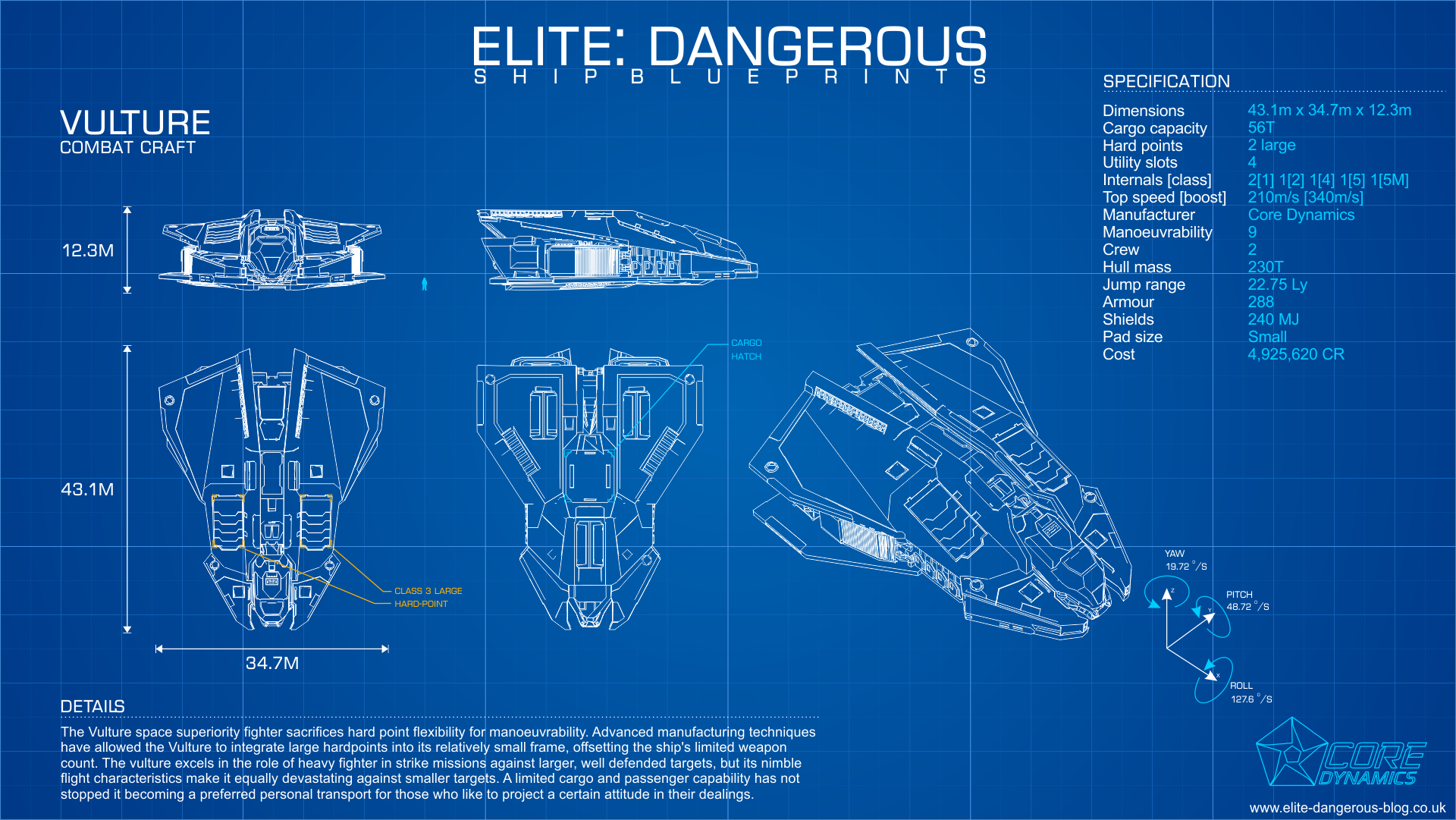
Vulture Blueprint by CMDR-Arithon (https://swat-portal.com/forum/gallery/image/9464-vulture/)

Links: EDSY and Coriolis (have your preferred one open as you read the guide for easy reference)

When only considering combat, the Vulture is a giant among small ships. An unengineered Vulture is faster, more agile, has better shields, harder and thicker armour and more firepower than any other similarly outfitted and unengineered small ship, including the Viper Mk III. 

Unfortunately, this build costs around 20 million credits. This cost might seem high for a beginner build. You can outfit a combat Viper Mk III for 2.5 million credits, a figure much easier to attain for an early-game player. This Vulture build’s rebuy is also high at about 1 million credits. 

However, you want the best odds when you are new to combat. A Viper Mk III will struggle against all but the weakest enemies. Its smaller hardpoints have lower Armour Piercing. It has fewer utility points, so you have to sacrifice shield boosters for chaff.

You also want to be established enough to afford rebuys. The Viper mentioned above is cheap but, at that stage, a new commander may not have the experience or ships to quickly earn it back. In this build, you can earn the Vulture’s rebuy cost in under an hour of fighting in a Low-Intensity Resource Extraction Zone.

If cost is a limiting factor, B-rating the Frame Shift Drive, Thrusters and Power Distributor saves 5 million credits. You can sell the B-rated modules with no loss and upgrade when you have the credits.

Finding a station that sells everything can be a challenge. Early- to mid-game players will not have access to Jameson Memorial station in Shinrarta Dezhra. Thankfully, both EDSY and Coriolis can locate nearby stations selling this build’s ship and modules in Inara. 

This build is far from original. Unengineered Vulture builds go as far back as 2015. However, the discussion below should help new pilots understand why this build works and useful variations.

Offence:

  1. Gimballed weapons: Gimballed weapons auto-aim, but chaff confuses them. They are a good compromise between the more difficult aiming with fixed weapons versus the lower damage output of turreted weapons.
  2. Burst Lasers: Burst Lasers compromise between the low power, damage and heat Pulse Lasers and the high power, damage and heat beam lasers. They do not require ammunition, so you can focus on flying and combat instead of watching ammunition counts. 
  3. Heat management: With four pips to weapons, these Burst Lasers can fire for 18 seconds. This time is usually more than long enough for the enemy to pass by. The weapons’ heat build-up is slow, making them quite forgiving. It is difficult to self-inflict heat damage with this build.
  4. FSD Interdictor: An FSD Interdictor is useful for interdicting assassination mission targets, wanted ships for bounty vouchers or even powerplay ships for merits.
  5. Kill Warrant Scanner: A Kill Warrant Scanner gives about 25% bonus credits for each kill. It generates additional, needed cash early on. Assign it to the same fire group as your Burst Lasers. The scan takes ten seconds, and the range of the 0E version is only 2000 m. However, this build fights best when up close, so that range is acceptable.

Defence:

  1. Power management: The biggest challenge with outfitting a Vulture is its small Power Plant. It is a class too low given the power demands of its other modules. Without the Overcharged engineering blueprint, you need to make tradeoffs with your outfitting. This build moves the Frame Shift Drive and Cargo Hatch to a low power priority. They are unpowered when deploying hardpoints, meaning you have to stow them before scooping engineering materials or jumping out. The Fast Boot engineering blueprint on the Frame Shift Drive would also help with fast get-a-ways.
  2. Shields: Bi-weave shields are generally weak when unengineered. However, they are sufficient given this build’s power constraints and the likely weak enemies. Two D-rated shield boosters give the best shield increase considering the remaining available power.
  3. Chaff: A Chaff Launcher is the best choice for the remaining utility slot. It requires minimal power and works against all gimballed weapons. 

Variations

  1. Laser and Multi-cannons: Burst Lasers are sufficient for weaker enemies. However, Expert and better NPC pilots have noticeably better armour. This build’s pure thermal damage from lasers is less effective against them. Replace one Burst Laser with a 3C Multi-Cannon to swap some thermal for kinetic damage. Keep everything on the same fire button for simplicity or use separate fire buttons to micromanage ammunition.
  2. Fixed weapons: If you back your flying skills, replace the gimballed weapons with fixed versions. It can be frustrating at first, particularly against smaller or agile craft, but you will improve with practice.
  3. More hull: Replace the FSD Interdictor with a 1D Hull Reinforcement Package if you do not plan to use it. However, it is worth experimenting on a few wanted targets at supercruise, if not just to familiarise yourself with how interdictors work.
  4. Fighting without life support: Equip a 3A Life Support, then give it a low power priority. Deploying hardpoints means fighting without oxygen. However, A-rated life support gives you 25 minutes of oxygen, which is more than long enough for an engagement. It means you have more power for better Shield Boosters or whatever you prefer. This change is an interesting take on power management, but I find no life support’s altered soundscape distracting.

Solo Tactics

  1. Finding targets: The short sensor range required more flying around to locate targets than builds with better sensors. Look for telltale distant laser fire or explosions or follow system authority ships. Scan potential targets first to ensure you only fire on wanted ships.
  2. Point and shoot: Flying this build is pretty basic. Speed up to get close to the target, throttle down to 50% when they get within one km, and then fire. Pulse lasers are most effective within 800 m. Turn as they fly past, then repeat the process. Experiment with thrusters and pre-turning to increase time on target.
  3. Power (pip) management: This build works fine with the default two pips in every category. However, it comes alive when you actively manage your pips, moving points into what you need at the time.
  4. Shield management: Start every fight with shields at 50% or better integrity. Put four pips in systems to maximize the shield protection and rebuild/regeneration rate between fights or when not firing. Putting pips in systems is faster than doing a reboot/repair when shields are down for this build.
  5. Chaffing: Chaff when shields get low, multiple targets engage you, or you need to escape. 
  6. Fun: Once I reset my expectations for an unengineered ship, I found flying this Vulture surprisingly fun. It can almost continually kill Novice-piloted or easier ships. The multi-cannon variant can take down wings of Expert- or Master-piloted NPC ships without too much hassle.
  7. Upgrade path: Consider the Alliance Chieftain or, reputation willing, the Federal Assault Ship or Imperial Clipper as the logical next step in combat ships. See PvE Combat Vulture Build for an end-game version of this build.

Team or Wing Tactics

  1. Unchanged: Fly in a wing or team as you would in solo. Whether you tank depends on your teammate’s ships and builds.

Beginner Passenger Mission Type-6 Transporter Build

An Elite Dangerous ship build aimed at beginner players.

Goals

The goals are:

  1. Create a ship specialized for evacuating survivors from burning stations. The game loop is described below. These missions efficiently increase reputation with the Federation or Empire, useful for unlocking ships or system permits. Evacuation missions are usually offered the first week after stations are attacked.
  2. The build should be accessible by an early-game player. This means a cheap ship with no engineering, unlockable ships or modules.

The high-level game loop for burning station passenger missions is:

  1. Dock at the burning station. Manoeuvring can be tricky. You cannot use a docking computer and the station’s interior is dimly lit and full of debris. Heat increases quickly inside the station, so use heat sinks to prevent heat damage.
  2. Accept passenger missions. This is pretty standard if not for the atmospheric flakey holographic display and the station interior’s fiery glow.
  3. Undock and leave the station. The same challenges with docking apply to undocking.
  4. Supercruise to the nearby rescue ship, usually a few megameters away.
  5. Hand in the passenger missions, disembarking your passengers.
  6. Rearm heat sinks and repair any damage.
  7. Travel back to the burning station and repeat.

Build

Type-6 Transporter Blueprint by CMDR-Arithon (https://swat-portal.com/forum/gallery/image/9476-type6/)

Link: EDSY and Coriolis (have your preferred one open as you read the guide for easy reference)

The Type-6 Transporter sits at an optimal price point, carrying 52 economy class passengers with a shield generator. The build linked above costs just over one million credits before discounts, including outfitting. See the table below for a comparison.

ShipCost (CR)Size 2 SlotsSize 3 SlotsSize 4 SlotsSize 5 SlotsSize 6+ SlotsSmallest Shield SizeTotal Economy Passengers
Cobra Mk III349,72030300326
Cobra Mk IV764,72022400340
Type-6 Transporter1,045,95021220352
Dolphin1,337,32031210338
Diamondback Explorer1,894,76022200324
Asp Explorer6,661,16022011356
Economy passenger capacity of selected beginner ships

The next highest economy passenger capacity ship is the Asp Explorer, carrying 56 passengers with a shield generator and costing over 6 million credits before outfitting. Some ships, like the Dolphin, carry fewer passengers but are more expensive.

Finding a station that sells everything for a build can be a challenge. Thankfully, both EDSY and Coriolis link to EDDB, locating nearby stations selling this build’s ship and modules.

Passengers:

  1. Economy class passenger cabins: The survivors from burning stations are not fussy about their accommodation. Pack as many economy class passenger cabins as possible.
  2. Smallest shields possible: Docking at a burning station is challenging. You cannot use a docking computer, the station’s inside is filled with debris, and the occasional dramatic explosion may slam your ship against a wall. Shields protect your ship.
  3. Heat sinks: As its name suggests, the inside of a burning station is hot and will quickly cause heat damage to your ship. Fire off heat sinks to minimize such damage.
  4. Docking computer: Passenger cabins do not come in a class one version. While not usable inside the burning station, a docking computer can help to dock with the rescue megaship.

Variations

  1. Better core internals: This build intentionally skimps on core internal modules to save credits. However, a better Frame Shift Drive means fewer jumps to the burning station. Better Thrusters make manoeuvring easier. Improving these is strongly recommended if you have the credits. That said, an E-rated Type-6 handles surprisingly well.
  2. Shieldless: Removing the Shield Generator squeezes in even more passengers at the risk of hull damage.
  3. Gather materials and cargo: Swap out two passenger cabins for one Collector Limpet Controller and a Cargo Rack. Grab a few limpets then, once you enter the station interior, use the limpets to gather engineering materials and cargo inside the station. Such cargo can also be handed in to complete missions from the rescue ship or sold for a small profit. Passengers are easier and more time-efficient for reputation but this can be a fun diversion.

Tactics

  1. Getting to the burning station: Burning stations are present in systems selected by Elite’s ongoing story. They have often been some distance from the bubble but always have a nearby rescue megaship. One way to get there is to take a ship with a longer jump range and then transfer this ship over. Another is temporarily equipping a fuel scoop, travelling there and then transferring over the replaced module. The rescue megaship sometimes has a shipyard, meaning you can transfer ships and modules to it. Otherwise, a nearby station may have a shipyard.
  2. Game mode: Play in a private group or solo to minimize interruptions. Gankers congregate where lots of players will be, like burning stations. It gives them more targets. The rescue megaship has limited landing pads and you may wait on other players offloading their passengers.
  3. Maximize reputation gain: Go for as many applicable missions as possible. Prioritize missions transporting the fewest passengers to maximize the number of missions accepted per round-trip. Prioritize missions from Federation- or Empire-aligned factions. Some minor factions may be independent. Select the highest reputation reward when completing the mission. The credit and other rewards are often small.

Shield-light PvE Combat Federal Assault Ship Build

Goals

Create a ship to:

  1. Use with Internal Impact pulse lasers. These shift the damage from 100% thermal to 50% thermal and kinetic. This shift equalizes the damage to shields and hull, meaning the ship can damage both with a single weapon. However, they have a 3% jitter, drastically reducing accuracy.
  2. See whether a shieldless build is viable. You can direct the unused power for systems towards weapons and engines.
  3. Try something a bit crazy. Suboptimal builds can be fun due to the increased challenge.

Build

Federal Assault Ship Blueprint by CMDR-Arithon (https://swat-portal.com/forum/gallery/image/9461-federal-assault-ship/)

Links: EDSY and Coriolis (have your preferred one open as you read the guide for easy reference)

Pilots love the Federal Assault Ship for two reasons. The first is its manoeuvrability which recaptures the joy of flight for many pilots used to flying larger, less agile ships. The second reason is ramming things. The Federal Assault Ship’s mass and manoeuvrability give it a lot of momentum. Both are useful here.

Another alternative for these goals is the Alliance Chieftain. It even has slightly higher Armour Hardness and is more agile. The Federal Assault Ship is marginally faster and has more Armour. More consequentially, the Alliance Chieftain substitutes one of the medium hardpoints for three smaller ones. Smaller weapons have lower Armour Piercing values, meaning lower overall damage to the intended targets. The Chieftain’s engines are also exposed, making them prone to damage-induced malfunction.

Offence:

  1. Sturdy Inertial Impact: At first glance, Short Range would be an ideal blueprint for the lasers. However, the hardpoints will be damaged quickly without shields. Instead, the Sturdy blueprint increases integrity. It also increases Armour Penetration, making this build more effective against its intended, highly armoured targets.
  2. Weapon Focused Power Distributor: This build requires firing at enemies for as long as possible. The Weapon Focused blueprint means you can keep firing for 26 seconds with four pips in weapons.
  3. Long Range Sensors: Using Long Range on A-rated sensors helps find ideal targets in expansive resource extraction sites, conflict zones and navigation beacons.

Defence:

  1. Shieldless is impractical: Despite my efforts, any build that lacked a shield was worse than a minimally shielded one. Even a thin shield significantly increased combat longevity. It also makes landing with low hull integrity less stressful.
  2. Shields: For this build’s frail shields, a Shield Generator’s regeneration (0% to 50%) time is more important than recharge (50% to 100%). Regular Shield Generators are ideal because bi-weaves’ faster recharge is not significant. Prismatic shields have a longer regeneration time. The Thermal Resistant blueprint also helps mitigate shields’ innate weakness to thermal weapons.
  3. Shielded blueprint: Given this build’s lack of power-guzzling shield boosters and most modules and hardpoints need additional integrity, this build uses the Shielded blueprint frequently.
  4. Strong armour and hull: Reactive Surface Composite bulkheads coupled with Hull Reinforcements, one with Thermal Resistant and the rest with Deep Plating, maximize integrity. The ratio of hull to module protection is a trade-off.
  5. Advanced Field Maintenance Unit (AFMU): The AFMU is engineered to grade four to not overload the Power Plant.

Variations

  1. Shieldless: Replace the 5A Shield Generator with another 5D Hull Reinforcement Package. The combat longevity shortens without a shield. However, you can place more pips in engines and weapons.
  2. ECM: Swap two of the Chaff Launchers for ECMs for missile protection. ECMs require effort to time but can be effective. Remember, ECMs affect all nearby missiles and limpets, including your teammates’ ones. Change the blueprint on the Power Distributor from Weapon Focused to Charge Enhanced to help power the ECMs.

Solo Tactics

  1. Point blank range: The Inertial Impact Pulse Laser’s massive jitter makes firing at anything over 500 m less effective. This build’s effectiveness is proportional to your ability to keep close to a target.
  2. Ram: Do not be afraid to ram your target, even if your shields are down. All but the most formidable NPC enemies will come off second best.
  3. Strobing shields: Your shields will go down and up frequently during the fight. The telltale ping of damage on weak shields and their subsequent falling evokes almost Pavlovian fear in many pilots. Fight that reflex. Your Power Distributor’s systems capacitor has just enough charge to regenerate your shields in thirty seconds with two pips to systems. 
  4. Live with damage: Seeing your hull on 50% integrity causes panic in most pilots. However, modules willing, this build is still capable until about 15%. Your hardpoints and canopy are the most likely to be damaged. Use your AMFU between fights to keep them above 80% integrity to prevent malfunctions.
  5. Fear missiles: All weapon and utility hardpoints are on the underside of the Federal Assault Ship except one large hardpoint. A ventral missile hit can affect all of them. Point Defense is ineffective due to the Federal Assault Ship’s hardpoints’ restricted fire arcs.
  6. Chaff: With 40 chaff refills spread across four launchers, you should chaff whenever the shields are down. Unfortunately, it does not help against missiles.
  7. Ideal targets: The ideal targets are large, less agile ships. You can get close and have a big target for the build’s inaccurate weapons, even if they chaff. Try to get above or below them because these are the most prominent profiles. Jitter makes targeting modules pointless. 
  8. No ammunition: Ammunition constrains the combat longevity of most builds. Module damage usually curbs this build.
  9. Power (pip) management: Put four pips in weapons and two pips in systems. However, the Weapon Focused Power Distributor means you will need to frequently shift pips from weapons into engines, particularly to boost frequently.

Team or Wing Tactics

  1. Get someone else to tank: You do not have the shields to tank, particularly against teams or wings. Having someone else draw attention means you can get close to the target and above or below it, maximizing the target’s profile. If you are not taking damage, this build can fight for as long as you can.
  2. Getting too close: Getting close to targets when fighting in a wing or team means you often get hit by friendly fire. It is an occupational hazard for this build.

“Raised by Wolves” Season 1 and 2 Review

Raised by Wolves is a science fiction drama series developed by HBO and streamed on HBO Max. Famously proposed by Ridley Scott, it was intended as an introspective, almost arthouse masterwork.

The show’s premise is two androids, Mother and Father, crash land on planet Kepler-22b. They are atheists, fleeing an Earth ravaged by a war between atheists and the Mithraic, worshippers of the deity Sol. The androids carry human embryos, intending to start afresh. The first season opens as Mother, Father and Campion, their one surviving child, juggle the impending arrival of the Mithraic ark, survival and learning the mysteries of their new world. 

Early episodes of season one establish the characters and the bleak but not inhospitable world. The later episodes focus more on the Mithraic and emerging mysteries. Flashbacks expand characters’ backgrounds, such as Mother’s interaction with her creator, and develop the setting. The second season introduces an atheist ark. 

While there is a large ensemble cast, Raised by Wolves focuses on three main characters: Mother, Campion and Marcus, an atheist who replaced an ark crew member to escape Earth. Each is the focus of a theme.

Mother explores the ethics of artificial life, along with Father and later Vrille and Grandmother. She struggles with the human demands of raising children and defending atheist beliefs and her in-human capabilities as a necromancer, a military android impervious to most weapons and capable of gruesome and graphic destruction. She is the target and instrument of humanity’s negativity. Most humans see androids as disposable tools in Raised by Wolves. However, Mother has the firepower to demand respect. 

Mother also contrasts with Father. They invert the stereotyped sexual roles, unlike Marcus and his partner. Mother is the protector while Father is compassionate. She is single-minded and devoted to the atheist cause. He is more pragmatic. Both actors give great performances, personifying a slight unease amongst humans without the autism-like portrayals of yesteryear.

Campion explores self-determination. Without the biases from old Earth, Campion views Mother’s atheism and the Mithraic religion with fresh eyes. 

Campion is inclusive, as expected by contemporary culture. He eventually admires the Mithraic optimism and dedication but rejects their exclusory dogma. He concludes androids have souls and deserve an equal place with humans in society, although the story arc with Vrille feels superficial and rushed. 

Marcus follows the most circuitous route, exploring the impact of blind faith and the dangers of relying on things you do not understand. Raised as a child soldier, Marcus’s experience and trauma always emphasized pragmatism and survival. 

After arriving on Kepler-22b, Marcus is subject to apparently religious revelations and visions. Unprepared, he succumbs and villanizes Mithraism. We slowly learn the mysterious force guiding him may not be coherent or benevolent, mainly by looking through his eyes.

All three characters explore the meaning and implications of family. Whether it be Campion’s relationship with his android “parents” or Marcus’s love for his adopted child, the characters constantly weigh up competing demands. Mother and Father have similar goals but their different approaches drive tension. It shows how parents’ histories impact their children but also childrens’ resilience.

Unfortunately, while introducing many wonderful opportunities to examine these themes, Raised by Wolves comes to few conclusions or answers. The resolutions are either driven by short term goals like survival or complicated by the wider deus ex machina.

Raised by Wolves relies heavily on symbolism and imagery. However, the show avoids offence by not veering too close to any real-world religion or entity and keeping references varied.

Abrahamic religious symbolism is frequent, like serpents, virgin birth, resurrection, the tree of knowledge, the ark concept and Mother’s crucifixion-like flying pose. This imagery gives the show a tinge of credibility and biases our initial reactions subtly, particularly Western audiences.

Other references invoke a romanticism for myths and legends. Mithraism was a religion observed in the Roman Empire before Christianity, and Sol (the sun) was one of its deities. Mother feeding her embryos is reminiscent of a wolf feeding her cubs. This is just like the mythical founding of Rome, where a she-wolf suckled Romulus and Remus, and is a direct reference to the show’s title.

Lamia, Mother’s other name, is the name of a child-eating monster from Greek mythology, and who could also remove her eyes. This dichotomy questions Mother’s motives, especially as she makes a few dubious decisions in season one.

The use of symbolism goes on. The message cards left by ancient humans are traditional symbols of chance or luck. Mithraic vehicles and clothing are always white, a colour of purity and good contrasting with its genocidal view of atheists. The Mithraic dodecahedron is more reminiscent of science fiction, reminding us this is futuristic.

The technology in Raised by Wolves is also magic or mythic, capable of creating life-like human androids, holographic displays, exhaustless flight and immersive, realistic simulations. Interaction is through voice or hand gestures. There are no buttons, dials or switches and nothing mechanical like gears, levers or wheels. Even medicine is automated. Technology falls into the “uncanny valley”, where objects are recognisable but unusual enough to be unsettling. Its presence constantly removes the characters from the present day.

Raised by Wolves is a stream of “Genesis moments,” as if humanity is playing God by creating and manipulating life. Technology in Raised by Wolves is almost organic, like androids’ fuel blood, the internals of the Trust or repairing Grandmother. No character is a technology expert. While it can be damaged or destroyed, the show’s technology does not need regular maintenance. When we see repairs, they are done by a medic, not by a technician. Perhaps humanity’s utilitarian view of its life-like technology mimic’s the entity’s view of humanity.

Unfortunately, both seasons sometimes seem directionless. The character interactions and world-building consume a lot of screen time. In a world where Raised by Wolves’ contemporary shows demonstrate strict economy, Raised by Wolves either gets frequently distracted or focuses on seemingly less important or relevant points.

Raised by Wolves also abuses strawmen arguments by asserting that atheists would always create new gods to follow, like the Trust in season two. Rather than being a benevolent dictator, like the minds of Ian M. Bank’s Culture series, the Trust is manipulative and insincere. Without the Trust, the second season depicts atheists as ill-disciplined rabble and incapable of populating a new world. Perhaps the writers wanted to be even-handed, but they missed the mark if the writers intended metaphors for real-world religious conflict.

It is almost as if Raised by Wolves is a future Mithraic bible dramatization. It deemphasizes details the unseen author feels unimportant and focuses on parables to emphasize subtle points of wisdom.

Raised by Wolves frustrates me. It deals with relevant, timely themes in a novel setting that allows safe exploration. However, the sometimes meandering plot, reliance on strawman arguments and situational conclusions mean it does not realize its potential. Perhaps there is more to come, which will tie it all together, or its point is there are no easy answers to difficult questions.

However, Raised by Wolves excels at promoting thought. The symbolism and imagery are deliberate and the layers deep. I find myself constantly reevaluating what I watched. Maybe its real achievement is promoting discussion into its real intent and meaning via our introspection.

“Star Trek: Lower Decks” Seasons 1 and 2 Review

Star Trek: Lower Decks, an animated series available on Amazon Prime Video and Paramount+, is Star Trek’s attempt to tread the well-worn path of self-deprecation. It pokes fun at the seemingly pretentious and self-important Star Trek: The Next Generation and Star Trek: Deep Space Nine era.

Other recent Star Trek shows like Discovery or Picard have leveraged technology to create gorgeously detailed ships, photo-realistic sets and better special effects. However, Star Trek: Lower Decks’ simple animation style does the opposite, making it disarmingly accessible for an audience that still considers animation a vehicle primarily for children or comedy.

Similarly, while those with a comprehensive recollection of the earlier series will find many subtle and humorous references, Star Trek has permeated the Western cultural consciousness enough for most to understand the settings and premises.

Star Trek: Lower Decks segregates itself from the franchise’s previous incarnations from the first scene. The credits, replete with the characteristic blue font on a starry background and brassy theme song, show an uncharacteristically unheroic U.S.S. Cerritos fleeing danger or screwing up. A star fleet ensign drinks blue Romulan whiskey when on duty, “lampshading” that it is not the cannon green Romulan ale. 

Star Trek: Lower Decks is not about “boldly going where no one has gone before”. The U.S.S. Cerritos, Spanish for an uninspiring “little hills”, does routine and less glamourous “second contact” missions. The main characters are not on the glamourous, charismatic and high-stakes bridge crew but the ensigns who perform thankless, routine maintenance and sleep at the ship’s rear.

The show humanizes the crew by focusing on flawed but relatable characters. We follow Boimler, who is bookish and obsessed with promotion. Tendi is a naive but optimistic and brilliant scientist working in medicine. Rutherford is an engineer who genuinely loves his work, oblivious to all else. 

However, Mariner steals the spotlight. She is a skilled Starfleet officer but constantly rebels, whether by the subtle rolled-up sleeves, smuggling contraband, or openly disobeying orders. 

The writers intended her to represent experience and savviness chaffing at Starfleet’s rigidity and regulations. She yawns at mission briefings and breaks more rules than she follows.

Perhaps Star Trek: Lower Decks is trying to be relatable and say that there is still a place for the rest of us in a franchise full of over-achievers. Talent and intelligence are nothing without wisdom and cunning. 

However, Mariner is hardly an underdog. Her uncanny ability puts her on a level above most and the U.S.S. Cerritos’ captain protects Mariner from any real consequences of her actions, tacitly glorifying her insubordination. These threaten to change her character from a relatably cool rebel to an unbelievably competent “Mary Sue”. Why create such a character?

Star Trek: Lower Decks is all about status. Are the privileges of rank deserved? Is there a pecking order between those of the same rank? Would Starfleet be a strict meritocracy, as cannon implies, or would the attractive and charismatic but less able rise to the top? 

Mariner constantly exposes and stresses the established hierarchy. For example, she practically ridicules Boimler in the episode “Envoys”, showing savviness beats knowledge. However, the Riker caricature first officer humbles her in the following episode by showing unforeseen skill and wisdom.

Mariner is the antagonistic foil to the other main characters. She berates Boimler for his bookishness and insecurity, is the pessimist to Tendi’s optimism and the leader to fill Rutherford’s vacuum of purpose.

Unfortunately, Mariner’s role sometimes lessens the show with too much unresolved and unnecessary interpersonal drama. She constantly dismisses her competency and, by doing so, others’. A good example is Mariner revealing she actually listened to the mission brief in the episode “Moist Vessel” (an unnecessary double entendre that will elicit an immature giggle from the intended audience) when she saves the day after arguing with the captain most of the episode.

The first series tries to give some thematic insight, such as dealing with the ecological and social implications of destroying an errant moon in “Cupid’s Errant Arrow”. However, the first series’ pacing and structure draws more from sitcoms, focusing on irony and absurdity, and lacks Futurama’s satire or Orville’s heart.

Sitcoms rely on characters remaining consistent and avoiding change. However, stagnation frustrates. Mariner’s relationships and past need confronting. Boimler needs to grow past his insecurities into the officer he aspires to be. Tendi needs the self-confidence to realize her brilliance. Rutherford requires the self-awareness that he is more than an excellent engineer.

Thankfully, characters start to develop in the second series. Boimler gets his revenge for “Envoys”. Rutherford and Tendi gain respect and leadership opportunities. The ensigns are paired differently, showing different parts of their personalities. Mariner relaxes from the constant antagonist role. 

The second series also examines its source material and themes more closely. It contrasts the U.S.S. Titan’s bravado and militarism with the U.S.S. Cerritos’ dedication and determination, mirroring Starfleet’s identity crisis. It depicts the Pakleds as both comically naive and dangerously unpredictable, a brilliantly relevant and thematically helpful portrayal. Appearance and charisma lose out to effort and ability in “wej Duj”. The final episode cleverly contrasts the “Lower Decks” experience for crews from different races.

The highlight vocal performance is Jeffery Combs as Agimus in the episode “Where Pleasant Fountains Lie”. The actor who portrayed Weyoun in Star Trek: Deep Space Nine and Shran in Star Trek: Enterprise shifts effortlessly between menace and insincere manipulation.

The best thing about Star Trek: Lower Decks is that it treats the franchise with both satire and respect. Star Trek has always been slightly absurd, where crew members are as likely to die from a Klingon Bat’leth as sentient ice cream. Unlike other Star Trek shows, Star Trek: Lower Decks leverages this absurdity to tell refreshingly different stories from different perspectives.

“Star Trek Picard” Review

Star Trek Picard Logo

Star Trek Picard, or just Picard, is a science fiction series streaming on Amazon Prime. Its premise is that the Romulan star threatens to go supernova and destroy the Romulan homeworld. The Federation offers to help and constructs a fleet of transports to resettle the populace. This offer would save the majority of Romulans and potentially heal the animosity between the Romulans and the Federation.

Of course, things go awry. The transport ships mysteriously attack the Federation shipyards on Mars, destroying the transport ships and means of production. 

So far, so good. It is a galaxy-impacting event worthy of the Star Trek brand and the eponymous now Admiral’s attention. The series also weaves in questions around the ethics of synthetic life, something suitably contentious.

However, the series immediately deviates from expectation. The galaxy blames the Federation for its woes. It forgot the supernova or that the Federation was also a victim of the attack. Far from showing its skill in diplomacy, compassion and problem-solving displayed during almost every Star Trek season and episode, the Federation turns inward and tacitly accepts the blame. 

Jean-Luc Picard sulks in his chateau for fourteen years rather than showing the stubbornness and ingenuity evident throughout Star Trek The Next Generation (TNG). Instead of getting a ship or helping, something that takes a single call at the series’ start, he abandons both his cause and crew.

Even when Jean-Luc Picard returns at the series’s start, he is oblivious to his charisma, unwillingly tormenting characters like Raffi and Elnor. He forgets to respect and be patient with others, even scoring points with Federation Admirals when the old Picard would think strategically, building a trusting relationship.

Perhaps the writers felt a seemingly perfect character needed a fall to develop. It is hard to improve perfection. However, Picard’s blinkered self-righteousness endangers any pathos.

Meanwhile, examining synthetic life’s ethics promised much. Star Trek has a history of exploring what makes us human. The original series contrasted emotional humans with Spock, the logical Vulcan. TNG had Data. However, the series reduces synthetic life to a MacGuffin. The series would have lost little by substituting an alien race or a unique technology.

Picard, the series, wants to be the gritty, dark Star Trek for the new millennium, where we see every leader and public institution in shades of grey rather than the more straightforward “black and white” of yesteryear. Heroes tire from the impossible standards to which others hold them, and their faults are laid bare. The hopeful patience of the Federation has waned, as seen in other series like Discovery.

By contrast, while the almost perfection of TNG characters was unrealistic, TNG presented an aspirational version of humanity. While TNG often dealt with ethical issues superficially, it introduced them to a broad audience. While humanity faced challenges, TNG’s underlying themes were always positive.

Instead, this series seems obsessed with fan service. It provides a touching farewell for Data. However, while seeing familiar characters helps rekindle parasocial relationships, their age also shows the thirty years since TNG finished. TNG and the subsequent movies were fun and much loved. However, time moves on.

When not lounging in nostalgia, the series gets endlessly sidetracked. Picard’s companions invent gravitas in each episode by a rushed flashback, then deal with it by boarding themselves in their quarters to brood. Of course, they briefly exit their stupor to perform plot-dictated tasks.

Each character deserves more screen time to develop organically and subtly. Alternatively, consolidate characters. The writers could have combined Rios with Raffi or Jurati, for example.

Despite the complaints above, the series is enjoyable. The plot weaves unpredictably, taxing the viewer just enough, and leads to a suitable climax. The acting and special effects are what you would expect for such a series.

Patrick Stewart portrays perhaps his most memorable role well. His deep, resonant voice and slightly-British accent give him a disarming, reassuring authority and grandfatherly charm. However, Stewart appears awkward when expressing genuine emotion, like during the Raffi and Elnor character arcs. Picard’s emotions are most impactful when understated.

The series is at its best when dealing with the psychology and ruthlessness of Romulans. The early, slow-burn mystery is enticing. The series finally shows the terrifying potential of the Tal Shiar, the Romulan secret police.

However, the test of a work is whether it stands on its own. Remove the fan service and nostalgia, and I wonder whether anyone would have produced Picard. Add potential misinterpretation of or disrespect to its source material, and you have a contentious, polarising series.

The trailers for season 2 appear to continue the nostalgia trip, revisiting the “fish out of water” time travel trope from the admired movie Star Trek IV: The Voyage Home. Perhaps I am old fashioned, but the producers are treading dangerous ground.

“Elite Dangerous Odyssey” Review

Elite Dangerous Odyssey image showing armed, suited commanders on a planet surface with an Anaconda and Cobra Mk II (space ships) flying above them

I had mixed feelings when Frontier Development released the Odyssey expansion for Elite Dangerous. On the one hand, new content and improved graphics could breathe life into Elite Dangerous and take it in a new direction. However, the on-foot play could dilute the core premise of flying spaceships. The inevitable launch bugs could also cause a player backlash. Both turned out to be true.

Odyssey introduced the ability to finally leave your ship and walk on planets or in space stations, what some call “space legs”. It added two new ranks to progress: Mercenary (on-foot combat) and exobiology (scanning plant-like organisms on alien worlds). Suits and guns appeared alongside ships as the things to upgrade and engineer. Settlements, small planetary outposts, became mission locations. Surface conflict zones hinted at mixing ship and ground combat.

The problem with the above description is that, while accurate, it is ambiguous. For example, the above could turn Elite Dangerous into a universe simulator, where ships become tools rather than classes. However, Frontier provided something more modest, much to many players’ disappointment.

For example, many players were looking forward to walking around inside their ships. Frontier mentioned this early in Elite Dangerous‘s development as a long-term goal. Unfortunately, Odyssey lacks this. Many feel “teleporting” to your pilot seat from outside your ship breaks immersion. While that is true, I cannot think of anything I would sacrifice in Odyssey to add ship interiors given Frontier’s finite resources.

The new Exobiology rank added thousands of new types of plant-like alien life to find and scan. It adds additional play loops to exploration and more reason to land on planets. However, it could have been more than scan three organisms more than a few hundred metres apart.

I liked the better world-building in Odyssey. Elite Dangerous largely eschews lore to let players write their own stories. However, Odyssey’s in-game advertising and bar music emphasize things that make Elite’s galaxy unique, like the various companies that produce ships and weapons or the rare commodities players can trade. The new engineers are not just tools for progression, each having personalities and visually interesting planets.

One of the most polarizing aspects of Odyssey is the new graphics engine. The new planet graphics are gorgeous, turning Horizon’s (the previous expansion’s) beige into coloured hues and blocky barrenness into beautiful vistas. Anyone playing Elite Dangerous for sense pleasure, like many explorers, found a galaxy worth re-exploring just for the visuals.

However, the new graphics engine led to other problems, particularly in Odyssey’s new settlements. PCs that happily played Horizons on maximum settings were suddenly humbled. While Frontier is working hard to improve performance, fixing it is a long-term effort.

Odyssey’s FPS combat is polarizing. For example, some weapons are more effective against shielded opponents than non-shielded opponents and vice versa. While an Elite Dangerous staple, constantly swapping weapons frustrated many.

Some felt that high-end suits were too resilient, requiring too much damage to take down. However, while engineered suits help, you are hardly impregnable. The resilience forced a tactical- rather than twitch-based playstyle.

Many speculate Frontier released the expansion too early, possibly due to financial commitments. The poor reception and low quality were enough for Frontier to delay Odyssey’s release on consoles (PS and Xbox).

Whereas many blast Odyssey with hyperbole- and expletive-ridden rants, I take a long-term perspective. No Elite Dangerous release has been bug-free. No online game release, either. Frontier has also improved communication with a player-voted issue list and more “meet the developer” sessions. 

Odyssey is not perfect. I was frustrated by the poor performance and felt exobiology was underdeveloped. However, I enjoyed the new content. The visuals are spectacular, particularly the local star casting its rays through a coloured atmosphere. On-foot conflict zones capture FPSs’ frenetic pace while still being characteristically Elite. 

Odyssey demonstrates why many AAA FPS games have nine-figure budgets. It is hard to make an FPS with a bespoke engine (Frontier’s Cobra engine) and a setting whose scale precludes pregenerated optimizations. 

Handling player expectations is harder. As mentioned above, the promise of “space legs” conjured desires for exploring ship interiors and a Star Citizen-like experience. Many players also looked at the work required to complete the new ranks and engineer suits and decided to seek their space game thrills elsewhere.

Elite Dangerous is a relatively old game, and the wonder has faded for many. Some players yearn for unexplored mechanics and settings. Novelty has a strong gravity, even to the unreliable and incomplete Star Citizen with its dubious funding practices.

My main criticism of Odyssey is the lack of content. After a few hundred hours, most players had sufficiently engineered on-foot gear and Elite ranks in Mercenary and Exobiology. For a game that prides itself on complexity and self-discovery, even the popular Elite Dangerous Youtubers ran out of Odyssey content after a few months. Idleness breeds discontent, as they say.

Take engineering as an example. Unlocking engineers from Horizons, the previous Elite Dangerous expansion, required players to experience the game’s breadth. You had to travel far into deep space, mine, sell stolen cargo at black markets, trade rare commodities and fight. This requirement was a great example of exposing players to neglected parts of the game while leveraging existing game loops to provide new gameplay.

I suspect Frontier wanted to do something similar for the new on-foot engineers in Odyssey. However, the required content did not exist. Instead, unlocking many on-foot engineers requires a frustrating grind. Players need to repeat tasks for hours, like logging out then back in at the same location, hoping for rare materials to spawn. 

Moreover, Odyssey relies on having a strong “middle game”, specifically randomly generated on-foot missions, settlement assaults and conflict zones for replayability. From Frontier’s perspective, this maximizes the number of players using the new features. However, even fun game loops lose their appeal after hundreds or thousands of hours.

Instead, Elite Dangerous needs more “late game” content. For example, something akin to Thargoid combat with a higher difficulty level, a social aspect, and correspondingly better rewards. Such content keeps the experienced players engaged and is aspirational for new players.

Such content will likely not arrive soon. Until Odyssey releases for consoles, Frontier appears focused on performance and stability. That makes sense, given every new Odyssey-only feature added incites more resentment in console players.

Meanwhile, Frontier includes “hero” features in each monthly patch, like on-foot emotes and a new surface vehicle. They promised fleet carrier interiors for early 2022. These are all welcome. However, none will add more than a few hours of new content. They continue to emphasize “middle game” content, reusing what is already there. Perhaps new ships or on-foot Thargoid combat are coming later.

Is Odyssey “good” or “worth buying”? These are the wrong questions to ask. I have enjoyed the new content and am glad I bought it. Yes, there are performance issues and bugs. However, Frontier will have to fix these to get the revenue from the console release. 

Is Odyssey the best FPS game available? No. Many specialist FPS games offer deeper or more varied FPS play. Odyssey, like Elite as a whole, is a victim of its breadth and shallowness, becoming unintentionally comparable with specialist games that do niches better. 

However, Odyssey’s FPS is fun, distinctly Elite Dangerous and integrates well with Elite’s other game loops. New features will likely be Odyssey only. Odyssey is the best choice if you want more of the same but better. 

Odyssey takes Elite Dangerous in a new direction. Like Horizons, Odyssey starts a journey and is not the end. If you want something with a different vision, Odyssey will only constantly remind you of that. 

“Star Wars: Visions” Review

Star Wars: Visions is a series of short Star Wars-themed animations created by Japanese studios. It continues the rise of anime in Western culture and examines a beloved franchise through different eyes.

Not surprisingly, the episodes show a strong Japanese influence. Jedi ronin fight with lightsabre katanas or wakizashis. Fights embody arguments around ideals and purity. The environment mirrors the story’s mood, such as the foreboding rain in The Elder or lifegiving sunshine in TO-B1. The music uses characteristic flutes, strings and drums. Even the architecture and society in later episodes are distinctly Japanese.

However, the episodes are still unmistakably Star Wars. The Force and Jedi feature in every story, even if implied in Tatooine Rhapsody, and are almost overused. Sidekick droids are plentiful. Iconic star destroyers and X-wings appear although space combat is mainly absent.

Star Wars stories always centre around a human element despite the alien races and the untethering decrepit, rusting technology. Star Wars: Visions is no different, examining family in Lop & Orcho or The Twins or the coming of age in The Village Bride or The Ninth Jedi.

The niche audience also allows some episodes to stray from traditional Star Wars themes. 

I enjoyed the protagonist’s moral ambiguity (and the almost monochromatic colour palette) in The Duel and twists in Akakiri (meaning “red mist”). The Star Wars universe is known for balance. Does good always win, or is that just the way we tell the stories?

Tatooine Rhapsody’s premise is music can be as consequential and relevant as a Jedi. It would be laughable fan fiction if released stand-alone but contrasts other works in the compilation nicely.

The Elder deals with impermanence, a humbling and reflective theme. It is the opposite of Star Wars’ usual galaxy-shaking space opera. 

Star Wars has traditionally bypassed biases or prejudices by removing countries or times – by being set “a long time ago in a galaxy far, far away”.

However, a few Star Wars: Visions episodes also consider current themes like environmentalism. Sometimes it subtlely shows the Jedi religion’s animist roots, such as in TO-B1 and The Village Bride. Sometimes it underlies a political or economic divide, like in Lop & Orcho. Referencing a passionate and current political and cultural theme threatens to break the disarming isolation that Star Wars enjoys. 

The California-style alternative rock in Tatooine Rhapsody threatens the same reassociation. Music in Star Wars has always been passive, like the cantina scene in A New Hope, or foreign to western ears, like The Hu‘s theme to the game Star Wars Jedi: Fallen Order.

I enjoyed The Ninth Jedi the most. Its story weaves many subtleties, like Kara destroying the pursuer’s speeder bike but leaving the rider unharmed or the chilling danger revealed by the blue colour of Ethan’s lightsaber.

The shadow of famous anime casts long over some episodes. TO-B1 is very like Astroboy, with the Dr Elephant-like father figure and a naive boy robot protagonist with a heart of gold. The Twins has a strong Kill-la-kill vibe, with its loose and exaggerated animation style, casual and metaphoric destruction and focus on siblings.

I hope to see more nuanced and cerebral content like Star Wars: Visions revitalising and expanding the franchise. Japanese cinema and folklore famously inspired George Lucas. A Japanese perspective on Star Wars brings it full circle.

“Breathedge” Review

Breathedge is a space survival crafting game from Red Ruins, a small Russian development team. It is superficially similar to Subnautica and similar games in the genre, but how deep do the similarities go? 

In Breathedge, you play as a dutiful grandson accompanying his deceased grandfather on spacecraft. A catastrophe ensures, leaving you stranded. Your oxygen and propulsion are initially limited, meaning you can only visit nearby parts of the wreckage. You scavenge materials from the wreck and craft food and equipment to survive, then venture further. Eventually, with the aid of your fast-talking suit AI, you start to discover more about the catastrophe. Except for the first sentence, these elements are common to survival crafting games.

Both Subnautica and Breathedge create a feeling of weightlessness, the controls allowing six axes of movement. However, Breathedge creates the feeling of being in space. The laboured breathing constantly reminds you of the limited oxygen supply and claustrophobic spacesuit. The subdued soundtrack and subtle blue light of the nearby star impart space’s loneliness and alienness. 

Subnautica and Breathedge structure their maps differently. Most of the game-relevant stuff occurs on the seafloor or surface in Subnautica. It is essentially a two dimensional game with some vertical shafts. Subnautica also has a limited draw distance due to the water’s “fog” effect. 

However, Breathedge places areas of interest everywhere, including above, below and behind other objects. Areas of interest must be within a reachable distance of safety, such as the player’s ship. There was also no need for “filler” like barren parts of the seafloor in Subnautica or credible life to populate it.

These differences mean the Breathedge developers have more control over where things are. Moving content is quicker and easier. Far away areas need to be large or otherwise distinct. Developers can focus more on the areas of interest, including intricately detailed debris or frozen plumes of liquid. However, they must manage the level of detail to keep the frame rate up.

Thematically, Breathedge replaces Subnautica‘s wonder and horror with challenge and tension. The surface, with its supply of breathable air, is everywhere in Subnautica. However, pockets of safety are rare in BreathedgeBreathedge delays access to vehicles and base building, with their safety and increased range, until the late game. Subnautica has an infinite supply of water and food once you know where to look. Breathedge‘s supply of these is limited.

These changes reduce the available play styles. Subnautica‘s meandering exploration is not possible. With areas of note in all directions in Breathedge, exploration is slower and more disorienting, unlike Subnautica‘s focus on the seafloor. It is easy to miss something important.

However, initially restricting the player to small areas allows Breathedge to tell a more linear story. Subnautica has several light story threads the player experiences at their own pace. Breathedge can also gate progress more effectively. For example, you cannot reach the milestone for the next chapter until you have found sufficient upgrades.

Breathedge swaps Subnautica‘s subtle, occasional deadpan humour with an initially self-deprecating then fourth-wall-breaking humour. This swap is not so bad by itself. However, it is constant, unyielding and delivered poorly.

The suit AI prattles on like a syrupy, fast-taking American game show host. Concentrating hard on the game’s dialog while distracted with the punishing gameplay mechanics (like limited oxygen, slow movement and resource scarcity) not only restricts the humour’s impact but induces stress. Subtitles help but do not alleviate the problem.

Add “Babe”, a parody of innuendo-filled spam emails, and a chicken with superavian survival abilities, and it becomes hard for the player to relate. Is the game meant to be YouTube fare, played while inebriated as you laugh at the protagonist’s misfortune? Is Breathedge meant to be a harrowing tale of survival in a universe of dysfunctional equipment? Is Breathedge a satire of Russian engineering?

Breathedge is not a bad game. Instead, it subverts the expectations that successful games like Subnautica entrenched. Many distant asteroids and wreckage pieces glimpsed as you first open the airlock are still inaccessible late in the game. Tools’ fragility quickly dashes the relief of finally crafting what you need.

While the developers could reduce the humour and tighten the thematic focus, Breathedge‘s small development team successfully pushes boundaries. This game is not Subnautica in space. Those looking for meditative exploration will be disappointed. Those looking for a gorgeous game that mixes challenge and irreverent humour will fare better.

“Star Wars Jedi: Fallen Order” Review

Star Wars Jedi: Fallen Order, released at the end of 2019, is a single-player, action-adventure game. Think bits of Darksiders, Dishonored and Dark Souls combined with the Star Wars setting, music and visuals.

You play as Cal Kestis, a padawan that survived order 66. He etches a mediocre existence on the planet Bracca, salvaging spaceship parts to fuel the empire’s war machine, when an accident reveals his force powers. Cere Junda, a former Jedi, rescues him from the inquisitors, the empire’s Jedi hunters, then Cal embarks on a quest to protect other force-sensitive children from the empire.

Cal starts with minimal force powers. He learns or acquires new abilities by achieving in-game goals, which initiate cut scenes re-enacting parts of his childhood padawan training. These reflections contrast Cal’s old and current lives, help us empathize with his repressed grief and provide a temporarily safe learning environment for the player.

The levels are complex but well-designed. They are bi-directional, and the backward traversal often needs newly acquired abilities. Many short branches provide exploration opportunities. However, some require powers gained later, meaning the player must revisit old areas.

The level designers made each planet distinctive, such as the ochre sandstone and bright, yellow sun of Bogano; Dathomir’s reds, browns and sinister twilight or the vibrant, lush, green, humid Kashyyyk. Imperial interiors continue the original three Star Wars films’ styling with stadium-framed fluorescent lighting set into austere blacks and greys.

The parkour gameplay fits well with Jedi and Star Wars lore, going back to Luke’s training on Dagobah. Star Wars has always emphasized verticality to imply danger and declutter sets, such as in A New Hope’s death star.

The combat is defence-oriented, built around blocking and dodging to reveal short moments where you can attack. You eventually gain the expected gamut of Jedi powers, like pulling, pushing and jumping, and a double-bladed lightsaber.

However, you rarely feel comfortable enough to have a dominance or power fantasy. Once you can comfortably beat an opponent, the game throws in more or harder ones.

The soundtrack is standard Star Wars “John Williams-esque” orchestral, with playful woodwind and ominous brass and strings. However, other than a brief appearance from the Mongolian band “The Hu”, it lacks memorable musical moments.

Star Wars Jedi: Fallen Order is challenging. Repeatedly failing can be frustrating, but iterative learning is the path to the required and desired mastery. Dying is progress. Star Wars Jedi: Fallen Order is essentially a puzzle-solving game, whether learning and countering enemies or combining force powers and movement to reach a seemingly unnavigable goal.

Thematically, Star Wars Jedi: Fallen Order is about healing after trauma and loss. As Cere says, failure is part of the process and is not the end. For Cal, it is about the loss of his mentor and father figure. For Cere, it is about the loss of her padawan and estrangement from her master. For Trilla and Merrin, it is about abandonment and betrayal. These parallel the setting, both the fall of the republic/rise of the empire and the descent of the ancient Zeffo race, whose tombs you explore.

Almost all thematic treatment is during cut scenes, conversations between missions, journal entries or enemy banter during boss fights. Later cut scenes, in particular, effectively embody the “show, don’t tell” mantra, symbolism and abstractness reminiscent of Star Wars. Even the main menu theme is subdued and mournful.

Unfortunately, Star Wars Jedi: Fallen Order does not extend themes into missions. In other words, most of the game. It is not ludonarrative dissonance, more a missed opportunity. The player will repeatedly fail with the game’s challenging mechanics. However, respawning when you mistime a jump or an enemy defeats you may be frustrating but not a genuine loss.

Meanwhile, Star Wars Jedi: Fallen Order’s challenging game mechanics easily distract players from internalizing and examining themes. You are focused on how to get places or beat opponents, not what doing so means or its impact on the game’s characters.

One solution is involving other characters more during missions. They steal the show in their brief appearances with spot-on voice acting and scripts. Apart from BD-1, the R2-D2 substitute with the requisite cuteness and courage, Cal only briefly works with two other characters during missions

Cal’s personality is also underdeveloped. This “blank canvas” may make him a better player surrogate, but the developers could flesh him out beyond his withdrawal, grief, and the wide-legged swagger the animators gifted him.

That said, genuine love and attention to detail have gone into the game, whether it is the authentic motion blur and whoosh of a whirling lightsaber or the fantasy-fulfilling glee of briefly piloting an AT-AT. I laughed at the mundane stormtrooper banter, Cal not translating BD-1’s jokes or BD-1 beeping a Star Wars motif when hacking a security droid.

Star Wars Jedi: Fallen Order strives to be a good game and not just a faithful Star Wars game. Perhaps this is why it lacks the signature Star Wars initial text crawl and subverts the opening star destroyer camera pan. The game is a challenging but enjoyable 35 hours to finish, more for all achievements, and worth it for action-adventure fans, not just Star Wars fans.