“Starfield” Review: Vast, Exciting and Fun but Shallow

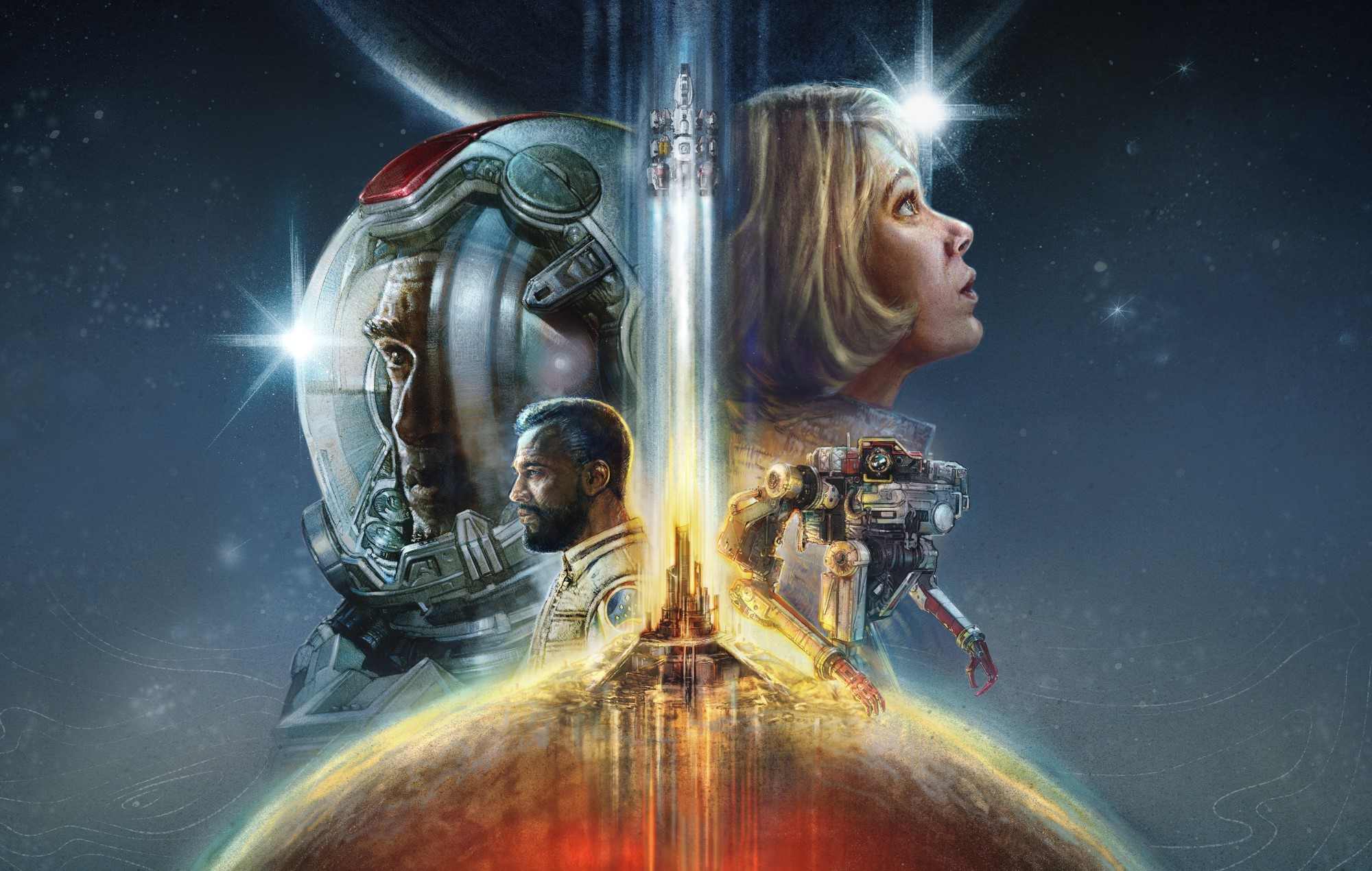
Starfield movie-like poster

Starfield is the latest action role playing game (RPG) from Bethesda, the developers of Skyrim and Fallout

Starfield, the first new RPG setting from Bethesda in a long time, is set in 2330. The Earth’s magnetosphere dissipated over a century earlier, rendering it lifeless. Thankfully, humanity mastered faster-than-light travel via the gravity drive. They rapidly evacuated to the star systems near Earth, deserting old nations and building new institutions. 

You start Starfield as a lowly asteroid miner, listening to your coworker’s banter. You unearth a seemingly alien artifact that gives you strange visions. After an attack by space pirates, you are inducted into a quaint, exploration-focused organization called Constellation and whisked off onto an adventure.

Structurally, Starfield has a similar “in media res” style introduction to Skyrim. It quickly teaches you the basic mechanics, gives you a short fight to get the blood pumping, establishes you as the “chosen one”, sets you on the main quest, and then gets out of the way. Much of the exposition happens later.

Starfield‘s strength is the breadth, if not depth, of game loops. Its gameplay is fun, but only exploration is remarkable. The combat is standard first person shooter fare, although melee could be more varied. The stealth mechanics are good but not up to Deus Ex or Cyberpunk 2077. Bethesda nailed the sci-fi feel of lock picking, but once you understand it, less player skill is required than in Skyrim. Your scanner is helpful for exploration, identifying enemies, or satiating hoarding instincts by finding things to pick up. 

The gameplay is repetitive but not grindy. You do not need to repeat boring activities to enable more enjoyable gameplay. Sufficient variety in the quests and randomly generated or placed content prevents boredom. Once you exhaust the scripted quests, Starfield offers randomly generated versions to pass the time or continue adventuring. Alternatively, land on a planet and start exploring.

Starfield‘s main quest line is suitably epic and galaxy-spanning, providing mystery and motivation. It draws you above the drama occurring elsewhere in the settled systems. However, this distance means the main quest line loses some emotional grounding and gravitas. Starfield‘s setting and side quests provide the most content, variety and potential like most RPGs.

Starfield contains many visually and thematically diverse places. After leaving the dusty, decrepit asteroid mine and a short detour, you first visit the city of New Atlantis. It is the capital of the United Colonies. Visually, it resembles the citadel from the Mass Effect series: clean, bright, organic curves, open spaces with water and greenery integrated seamlessly with technology.

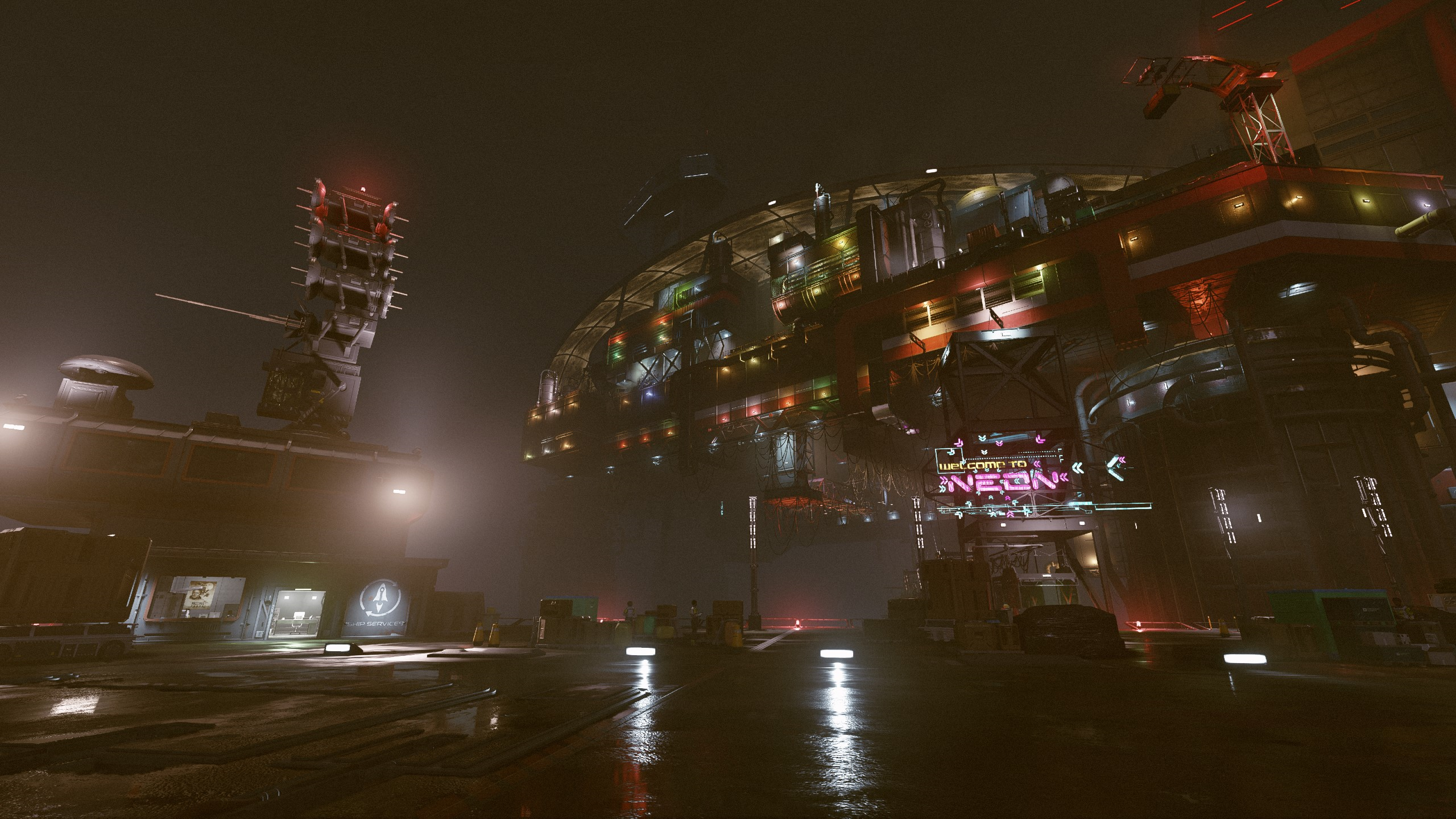
New Atlantis contrasts with other places like Akila City, the capital of the Freestar Collective. Its mud roads and stone buildings make it feel like the Wild West in space, complete with a bank robbery. As its name suggests, Neon is a cyberpunk (the genre) style metropolis on a rain-drenched water world. It is where to indulge in less savoury activities, like gang warfare, corporate espionage, or elicit substances.

Neon in all its multicoloured glory.
Neon’s exterior in all its multicoloured glory.

Exploration is integral to Starfield, being the primary mission of Constellation. Mechanically, it is similar to No Mans Sky or Elite Dangerous. However, Starfield does it better. Starfield supports multiple biomes per planet, adding variety. Starfield is about exploring a known, finite universe, not the near-infinite set of random ones no one else will ever visit. Planet surfaces intersperse improbably frequent natural phenomena and enemy-filled bases to break up the gameplay. You can improve your exploration skills, like increasing scanner range, sprinting further, or learning more about scanned species.

A misty sunset with trees in the foreground and mountains in the background.

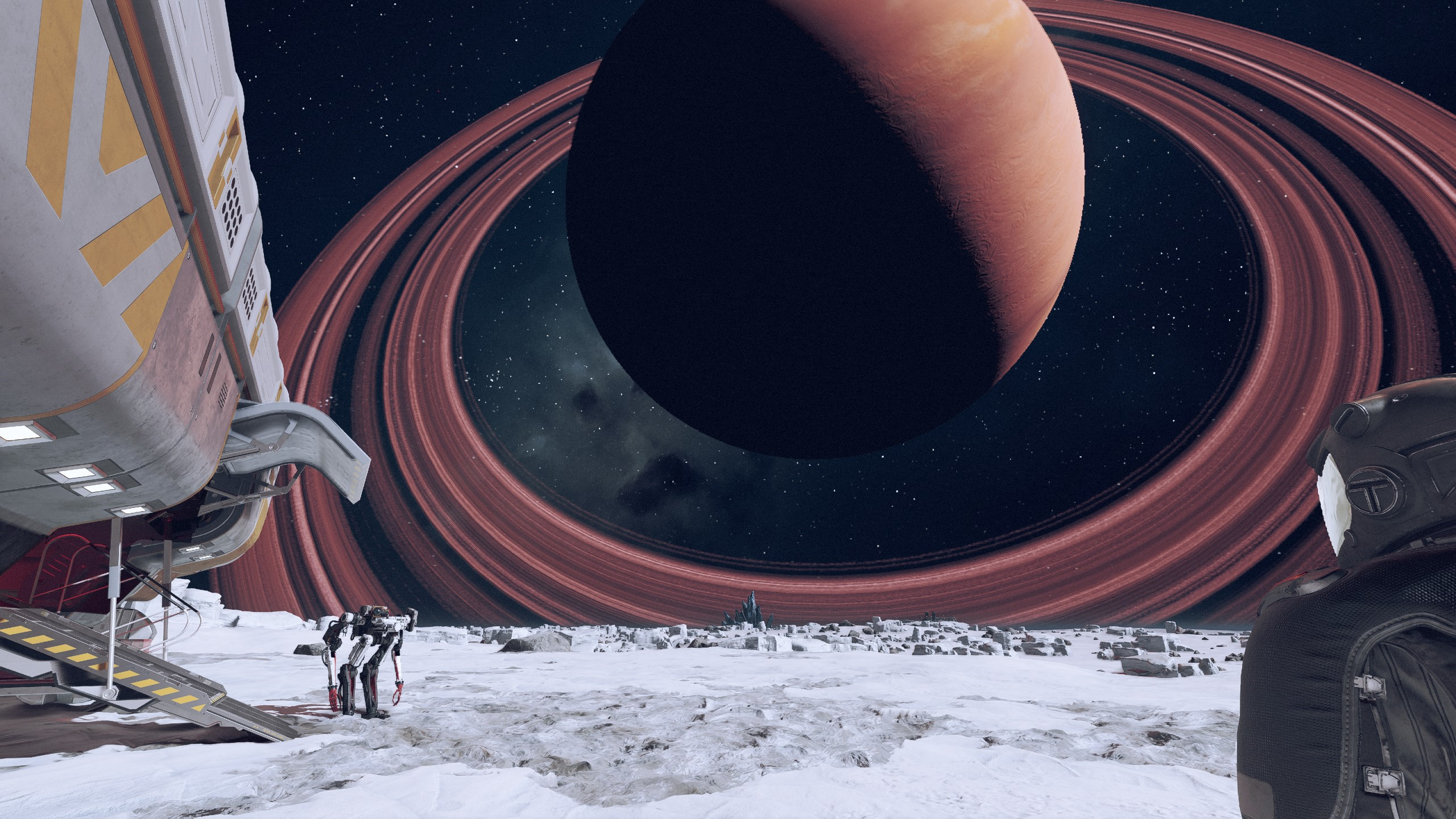
Starfield is visually better than games like No Mans Sky and Elite Dangerous, and “sense pleasure” is integral to exploration. Not just because Starfield is newer. While all generate terrain procedurally, most of everything else in Starfield is hand-crafted. Starfield‘s alien flora and fauna are more plausible, not just a random assortment of limbs. Think Star Wars, where humanity is not at the top of the food chain. Starfield‘s designers often placed moons and planets to create picturesque views, like ringed planets filling the sky. Starfield also has weather, like dreamy mist-filled sunrises, savage dust storms, or dreary rain. 

A beautiful ringed planet viewed from a moon.

You need a starship to explore. Your starting ship, the Frontier, is a masterful example of worldbuilding. From the venting gas from its landing thrusters, whose exhaust is ignited by sparks like modern rockets, to its white, vaguely aerodynamic shape reminiscent of the space shuttle, it anchors the setting to a believable near future.

Unfortunately, you pilot your ship rarely. It is either in space, docked or landed. Docking and landing are automated. Flying between planets or systems is “fast travel”, using a short cutscene.

Your ship approaching the starstation "The Eye".
Approaching the starstation “The Eye”.

Starfield has ship combat, but it is arcade-like and closer to No Mans Sky than Elite Dangerous. It devolves into building ships with better shields and weapons. Manoeuvring is all but useless. The camera views block too much with either the cockpit or your ship’s back. Power management is awkward, particularly in the heat of battle. Macros would be helpful. The targeting mode loses any situational awareness. 

However, once you master the clunky interface, the shipbuilder is a beautiful avenue for self-expression. Like the Galactic Civilization franchise, you customize and assemble ships using modular components. In a clever touch of worldbuilding, different vendors’ modules have different styles, such as the blocky, angular Deimos or Taiyo’s almost organic curves. 

You can also walk around your ship, board enemy ships and add crafting stations and containers. However, to prevent punishing those with large ships, you can board into or leave directly from the cockpit. Elite Dangerous‘s designers should take note.

A Stroud-Ekland cockpit.
The back of a Stroud-Ekland cockpit.

Starfield allows building outposts on different planets to store excess equipment, gather resources, craft materials, and refuel ships flying past. You can also create trade links to automate the transfer of materials between them. Starfield almost rivals factory games like Satisfactory with its web of materials and resources. 

However, the capacity of even the largest storage buildings needs to increase. A lot. No Mans Sky offers more variety, including positioning individual walls, roof and floor tiles. 

In terms of companions, there are dozens that you can hire or find around the galaxy. Of these, four companions have unique quest lines. Each quest line companion follows roughly the same moral compass: generally good and favouring exploration. Although not my thing, this limits the potential for less noble playstyles.

Some want Vasco, your robot companion, to have a quest line and opportunity for growth or change. However, with the world currently enraptured by the potential and danger of AI, seeing a robot follow its programming is a welcome piece of sanity.

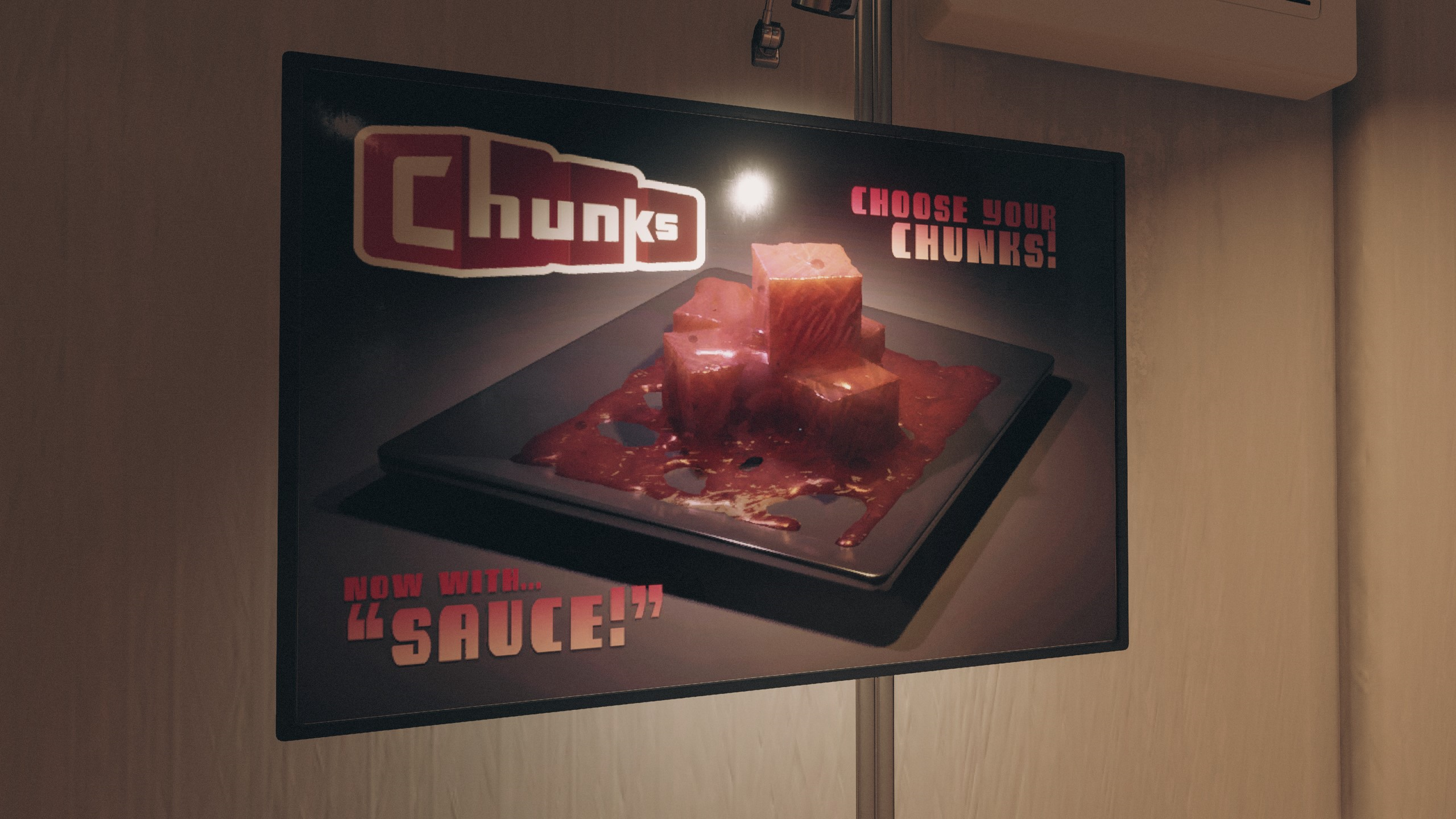
Thankfully, Starfield does not take itself too seriously. Catching up with your parents in an alien petting zoo or watching them pretend they did not try illicit substances is touching and amusing. Various “inspirational” posters line the walls of shady secret research labs. Chunks, the ubiquitous cubic fast food of the 24th century, “meet all minimal nutritional requirements”. Vasco has some innocent but cuttingly insightful wit. Your adoring fan’s flattery never gets old.

An in-game advertising poster for "Chunks". No with "Sauce".
Hmmm. Appetizing.

Starfield‘s music is orchestral, reminiscent of Star Wars or Star Trek. Most tracks are slow and use periodic gradual crescendos to emphasize the wonder and grandeur of Starfield‘s universe. The soundtrack is composed to support a game with lots of voice dialog and critical sound queues, such as in combat. It does not call attention to itself. For example, the restrained, almost mournful menu theme is the opposite of Skyrim‘s rousing call to action. Rather than assaulting the player with aggressive emotion, Starfield‘s version hints that the player has to come to the game (or music), not vice versa. 

My main criticism of Starfield is not that it is too easy, at least on “normal” difficulty. I may have played many Bethesda RPGs, but even “hard” provided little challenge. Assuming you do not intentionally engage in challenging content, there is little pressure to specialize your character’s skills, ship, outposts or use consumables for temporary buffs. These become more role playing opportunities.

My main criticism is also not that Starfield is the usual Bethesda RPG oxymoron. Starfield empowers you, creating a feel-good power fantasy where you are important and can make galaxy-affecting changes. However, as the conveniences in your favour accumulate, like free ship fuel or unkillable companions, immersion and suspension of disbelief get harder. Starfields‘ roots in points-based mechanics mean large level differences between you and your target can create unrealistic bullet sponges.

I do not mind that, despite Starfield having the best facial and hair animation of any Bethesda RPG, it still falls into that uncanny valley. NPCs wander aimlessly and still get stuck in walls occasionally. 

My main criticism of Starfield is an absent central or recurring theme. For example, in a world where AIs are more intelligent and capable than humans, and the powerful are unshackled from laws and ethics, Cyberpunk 2077 examines humanity. The Fallout series deals with the difficulties of survival and that the best choices are often hard or impossible. The Witcher series shows that, when monsters walk among humans, humans are sometimes the most monstrous of all. The Nier series deals with loss.

In fairness, a game does not need to be profound to be good. Making action movies or games requires skill. Bethesda more than demonstrated it with careful level design, regular mixing of gameplay modes, managing tension, and catering to familiar sci-fi tropes and fantasies. The usual meme-worthy glitches are thankfully absent. The greater attention to quality after Cyberpunk 2077‘s problematic launch is apparent.

Instead, Starfield is pure, fun sci-fi escapism. It is a series of concurrent action movies. RPGs are defined by how well they let you play out fantasies. Starfield delivers on that.

For example, the Vanguard quest line plays like a rerun of Starship Troopers. The Ryujin quest line is a sci-fi James Bond or Mission Impossible coupled with corporate espionage and intrigue. Completing the Mantis quest allows you to play as a space Batman. The Sysdef/Crimson Fleet quest line has palpable tension as you play a double agent, playing criminals and the law against each other. Join the Rangers and play as a space cowboy. 

Standing on the surface of Luna, the moon, looking toward the bright sun.
A “Neil Armstrong moment” standing on the surface of Luna, the moon, looking toward the Sun.

Starfield is unoriginal. Almost everything in the game is “heavily inspired” by something else. That is OK. Successful RPGs help players fulfil fantasies by immersing players in familiar tropes. Where Skyrim opened the fantasy genre to a broader audience, Starfield attempts to do the same with science fiction. 

That said, I was disappointed there were not more overt references to other movies, shows or games. Many will pick the few references to Skyrim‘s sweet rolls and Meridia quests. Yes, there was some well-known voice talent from Star Trek: Deep Space 9 and a subtle reference to the 1986 Transformers movie. Cyberpunk 2077 did this comparatively better.

Without strong themes and notwithstanding a few minor nods to modern sensibilities like same-sex relationships, there is little to offend or demand too much of its players. Perhaps Bethesda wanted to play it safe and avoid controversy.

However, Bethesda missed the opportunity to do something more. So many quests touch on real-world themes. For example, the war between the United Colonies and the Freestar Collective that ended 20 years before the game’s start still has lasting social and economic impacts. The United Colonies has to deal with the compromises and the demands strict order creates. The Freestar Collective juggles freedom with the criminal behaviour it facilitates. The Rangers’ quest line deals with the place of veterans in a postwar society. Meanwhile, the wealthy flatter themselves on luxury space cruises.

DLC or the modding community may fill the gap. Like Skyrim and Fallout, Starfield is as much a gaming platform as a game. Much of the work establishes content for future expansion or use. Outposts and shipbuilding, for example, go far beyond what Starfield currently needs. The Va’ruun, relegated to mysterious bogeymen, have much potential. 

If you enjoyed Fallout or Skyrim or like science fiction games, you have probably already played or plan to play Starfield. You can race through key quests in 30 hours, but the complete experience takes at least 100 more. Starfield is fun, emphasizes exploration and knows its target audience well. However, the lack of anything original, introspective or thought-provoking may limit its long-term impact on the gaming landscape. Playing Starfield is like eating Chunks. It tastes good and you want more but the nutrition is questionable.

“Deliver Us Mars” Review: Grim but Emotional

Deliver Us Mars poster, showing a space suited Kathy Johanssen climbing a precarious Martian cliff using pickaxes.

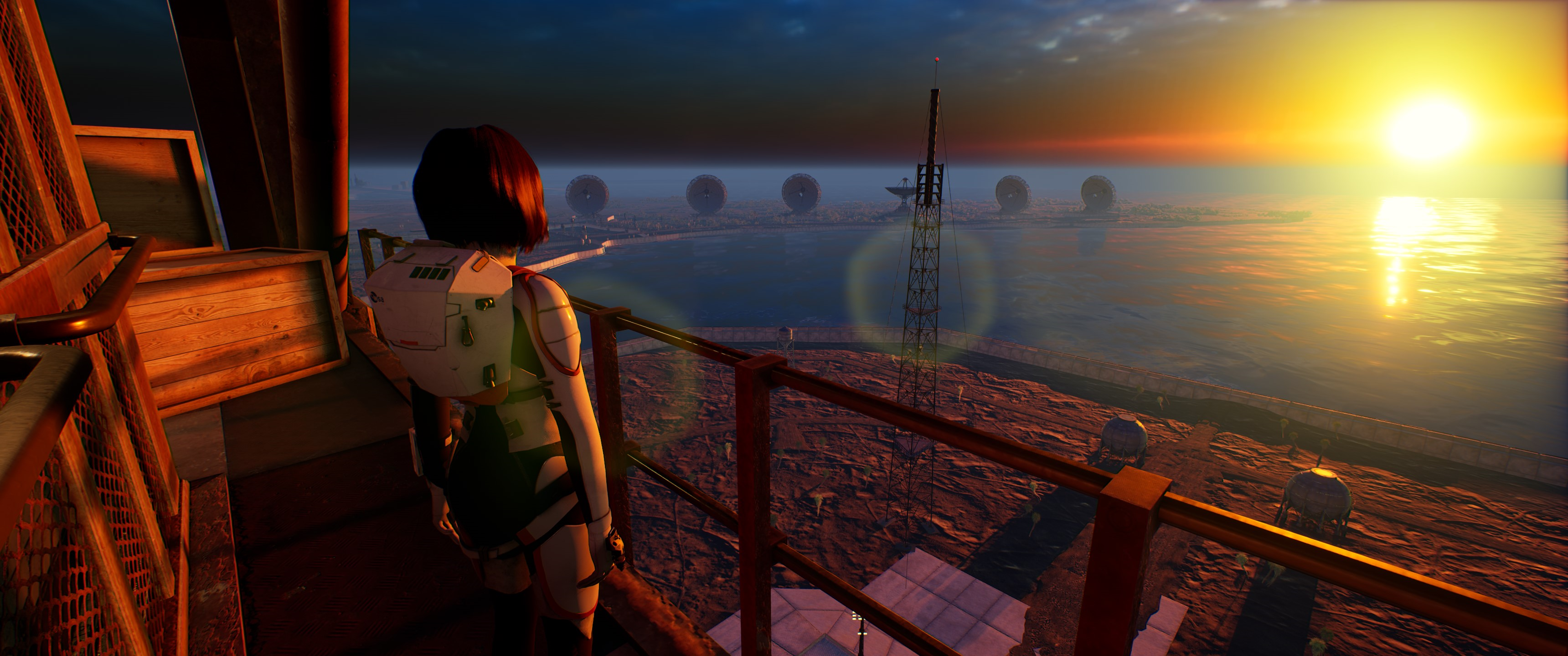
Deliver Us Mars is an interactive fiction game developed by KeokeN Interactive. While some consider it an adventure puzzle game, Deliver Us Mars focuses on story over puzzles and mechanics.  

Deliver Us Mars follows on from the prequel, Deliver Us the Moon. Earth’s resources are exhausted and its environment is rapidly degrading. You play the teenage Kathy Johannson as she travels to Mars with her crew. They want to find the three ARK ships that fled the moon in the prequel, then use the ARKs’ technology to fix Earth.

Mechanically, Deliver Us Mars shifts between three modes. The first is engine-rendered cut scenes, where the game tells much of its story. Deliver Us Mars shows off the facial animation features of the Unreal engine, not to mention the animators’ skills.

The second is exploration, walking or travelling around near linear maps. You often find objects to scan or read that flesh out the world. This is natural to those familiar with RPGs and adventure games. However, finding them all will likely require multiple playthroughs.

The third is mini-games. Some mini-games require traversal, including climbing or driving a rover across the Martian surface. The climbing mechanics are designed well, requiring coordination to survive palm-sweating moments. Some mini-games are puzzles, like using energy beams to power doors or machinery. 

The mini-games are mostly easy, although their controls or intended results are sometimes unclear. Most have an additional achievement for fast or exceptional completion, yet another reason for subsequent playthroughs.

Mini-games and exploration are also not the game’s central focus. They supplement and reinforce the story. Instead, the success of a game like Deliver Us Mars relies on the quality of the storytelling and the characters. Thankfully, the game delivers.

For example, Deliver Us Mars periodically revisits Kathy’s youth. These flashbacks are initially tutorials, such as swimming teaching how to manoeuvre in zero gravity. They momentarily break the tension, reminding the player of less stressful times in Kathy’s life. 

However, later flashbacks exacerbate the tension and add context. For example, the game hints at the death of Isaac’s wife and Kathy’s mother early. However, the game delays the event to maximize the emotional impact. 

Deliver Us Mars also uses subtle analogies, such as Kathy’s home on Earth. It represents the family dynamic and Earth’s perilous state. Initially, it is inviting with a warm sun and a loving, successful family, albeit with subtle hints of external unrest. As flashbacks recur, disagreements boil over, and dust storms darken the sky. Eventually, a storm destroys the house while Isaac, the father, must leave Kathy in the hands of Claire, her sister. It then gets worse.

Deliver Us Mars is pessimistic. Superficially, it is about how humanity’s talent for internal conflict often sabotages our best efforts. It examines how decision-makers can lose context and grounding, succumbing to revenge, narcissism or paranoia. It highlights the unreconcilable sacrifices some make. Even the worst climate prediction models do not show the Earth becoming inhospitable in the game’s timeframe. 

The character of Kathy Johannson is one exception. The first flashback shows her irresponsible playfulness as she swims with her new and not waterproof moonbear toy. She grows over the game, watching the mantle of responsibility pass from her father to her sister and finally to herself. When Isaac first sees Kathy on Mars, he remarks how she has grown, and this is not just physically. Players presume and impose a default heroism on her, and she does not disappoint.

Delver Us Mars hinges on the emotional connection between Kathy and Isaac. Like in Deliver Us the Moon, Kathy and Isaac show how family and close relationships often motivate us the most. A single word from Isaac, “moonbear”, is enough to spur Kathy onward. The love of his daughter also inspires Isaac when all seems lost.

Isaac Johannson is initially sympathetic, torn between duties as a father and saving Earth. However, unlike Kathy, Isaac plays a tragic role. Time will tell whether Kathy or Isaac represent modern-day governments trying to appease their citizens while protecting the environment. 

It may be my inherent optimism, but Deliver Us Mars is more about not running away from problems. Like the sacrifices people make. Like the relationship between Kathy and Isaac. Like the environmental problems on Earth.

Even when things seem grim, there is always time and more opportunities. This is a pre-apocalyptic setting, not a post-apocalyptic one, and there is still a chance to prevent it. Deliver Us Mars believes that human ingenuity and hard work can solve significant issues.

Aesthetically, Delver Us Mars is influenced by near-future science fiction like Gravity, Interstellar, Ad Astra or 2001: A Space Odyssey. Most technology is slightly ahead of our own, making the game relatable. Some models are superb, particularly the detail in the crashed ARK Lados. The blue Mars sunset is also realistic.

However, Deliver Us Mars skims over many dangers of living on Mars. Its dust is abrasive and toxic. It receives more radiation than Earth. However, I suspect the game designers wanted space or the hostile, desolate Martian environment for spectacle and impact. A game set in safe but sterile metal corridors would quickly feel dull and mundane.

Playing Deliver Us The Moon first is recommended. Like the flashbacks, the prequel adds gravitas and emotional context. For example, Deliver Us Mars almost ignores Sarah Baker, the expedition leader. Appreciating Sarah’s importance and perspective from her small part in Deliver Us Mars is difficult.

While the realistic graphics are gorgeous, they are sometimes inconsistent. It is a minor criticism, but little things can break immersion, like a buggy not leaving tire tracks or the sprite-based thrust from a manoeuvring spacecraft. Higher resolutions are unkind to some of the models and textures. Stylized graphics like cell-shading may have been a better choice. It would have simplified the art and given better cohesion.

Deliver Us Mars is about the right length at about ten hours to complete, more if you want to get all the achievements. It is darker than its prequel but worth it for science fiction or interactive fiction game fans. Hopefully, KeokeN has a sequel planned to continue or conclude the story.

“Rebel Galaxy Outlaw” Review: A Homage to Privateer

Rebel Galaxy Outlaw Game Poster

Rebel Galaxy Outlaw is a single-player, space sandbox game developed by Double Damage Games. It was initially an Epic Store exclusive in 2019 and released on Steam and other platforms a year later.

Rebel Galaxy Outlaw is infamous for being the first Epic store exclusive. This decision led to review-bombing and bad press. However, this is unfair. The poor early reviews had little to do with the game itself.

Rebel Galaxy Outlaw is also not the best space sandbox game available. Elite Dangerous and its peers do just about every game loop better. However, Rebel Galaxy Outlaw never intends to compete at that level. Instead, it is cheap and developed by a small studio that lacks the resources of a AAA behemoth. It packs a lot into a small package.

You play as Juno Markev, an out-of-luck ex-space pirate. The opening cell-shaded cinematic shows her crashing on a planet after unsuccessfully confronting her husband’s killer. Juno calls in a favour to get a modest replacement. She then must juggle repaying her debts, upgrading her ship and unravelling her past.

Rebel Galaxy Outlaw‘s gameplay consists mainly of combat with some trading, piracy and asteroid mining. These earn credits to afford better ships and equipment. Experimenting and exploring are helpful but optional. They can reveal poorly explained mechanics, side quests, rare weapons, lucrative mining spots or beautiful nebulae. 

Unlike Elite Dangerous and similar games, Rebel Galaxy Outlaw has a light, grungy, blue collar, “space trucker” style. The default radio station plays heartland rock and advertises discount ammunition and cheap beer. All technology looks retro-futuristic, old and second-hand. Many star systems are named after working-class southern or central US states. The region of space is called Dodge, like the famous lawless US frontier town. You can play eight-ball pool or dice poker to unwind, the genre equivalent of fishing. 

Rebel Galaxy Outlaw is the prequel to Rebel Galaxy, Double Damage Game’s previous game. They share the setting and style. However, the games are different. Rebel Galaxy is about flying capital ships on a 2D plane fighting with broadside cannons. Rebel Galaxy Outlaw is about 3D fighter combat.

Instead, Rebel Galaxy Outlaw is a homage to Wing Commander: Privateer and Freelancer. While there is a central campaign and side missions, you can ignore them to explore, fight or trade as you see fit. You can unlock buddies to fight with you temporarily. You can side with the law, against it or both. 

Even the graphics look like upscaled MCGA, used in Wing Commander: Privateer. The cockpit and HUDs are blocky and favour the old EGA colours. The stars are square. The game renders debris as sprites. Ships have distinct silhouettes and blocks of bright colours. 

Rebel Galaxy Outlaw plays best on a controller. While not as precise as a keyboard and mouse, the vibration makes you feel every shudder of acceleration and weapon recoil. The game’s aim-assist helps, too.

To be fair, Rebel Galaxy Outlaw is not flawless. Encounter difficulty can vary considerably. Auto-saves are regular and reloads quick, but unexpected deaths can still be frustrating. One mission requires non-lethal takedown of enemies, but you must manually remove any turrets beforehand. It is easy to miss some side missions, like those in Eureka.

However, Rebel Galaxy Outlaw surprised me. I had a fun 40 hours or so. You can complete the campaign faster if you do the minimum. However, getting distracted and blazing your own trail is part of the point. Fans of space sandboxes, Wing Commander: Privateer or something light and stylized will enjoy themselves. Do not let the poor early reviews fool you. 

“The Artful Escape” Review: A Rock Fairytale

The Artful Escape is a rock opera masquerading as a musical platforming game from the Australian development studio Beethoven & Dinosaur. 

The Artful Escape follows Francis Vendetti, a teenage guitar prodigy bristling under others’ expectations. An improbable encounter catapults him into a universe-spanning, mind-expanding adventure. Francis sheds his past and discovers who he wants to be.

The gameplay shifts between three loops. The first is exploration and conversations with NPCs. The second is light platforming. The third is playing music by copying button presses, emulating playing different notes.

However, the gameplay is almost unimportant. It is more something to do while gawking at the supersaturated visuals and basking in the music. Holding “X” on the controller allows Francis to improvise on the guitar (“shred”) as he runs, leaps and slides through alien landscapes. I could not wipe the grin off my face from the sheer joy and spectacle. 

The Artful Escape‘s universe has a Douglas Adams-like absurdity and comedy. For example, Francis Vendetti flies a warp turtle through the cosmic extraordinary to a starship called The Galactic Lung. He visits the Hyperion Wailzone, where the danger level is “dolphin”. 

The game’s music is a love letter to the 1980s, particularly psychedelic rock. Much of the inspiration and music come from Johnny Galvatron, one of the developers. He fronted the band “The Galvatrons” in Australia and the UK in the late 2000s. The Artful Escape is part celebration, parody and critique of the music industry.

Unfortunately, The Artful Escape is short, taking about five hours to finish. Those looking for challenges or meaningful choices will be disappointed. Sometimes holding “X” while jumping or moving is awkward.

However, The Artful Escape is bursting with spectacle, absurdity and glee. Its message is hopeful and empowering. It is a fairy tale for the rock era, a monument to the joy of music and self-actualization.

“Cloudpunk” Review: Heart in the Sky

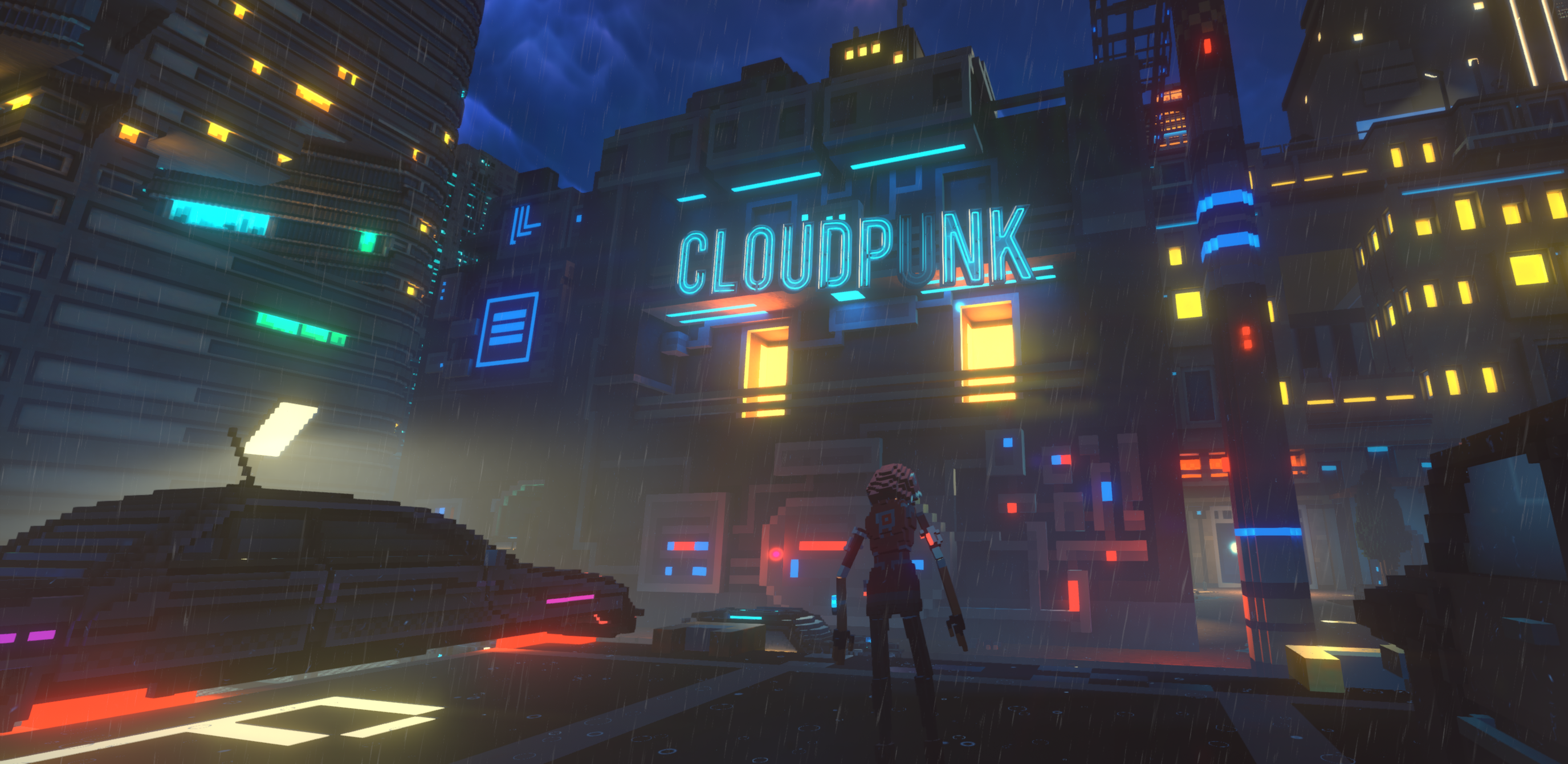
Standing outside the Cloudpunk office in game. The neon "U" is dimmed.
Outside the Cloudpunk office in-game, with the neon “U” dimmed

Cloudpunk, developed by Ion Lands, is a third person, story-based exploration game set in a future, dystopian city. It has a distinctive voxel art style that is both beautiful and distinct.

You control Rania, an out-of-work musician and recent migrant to the city of Nirvalis. Destitute and desperate, she signs up for Cloudpunk, a pseudo-legal company that delivers packages away from law enforcement’s often-corrupt eyes. Like the player, she knows how the world works but is new to Nirvalis, becoming a compelling point-of-view character.

The game takes place over a single long, rainy night shift. Most gameplay involves piloting Rania’s flying car, or “HOVA”, like the Delorean from the Back to the Future series. Occasionally you disembark and walk around the elevated streets, picking up or delivering packages and talking to other inhabitants. 

However, you get the most out of Cloudpunk by taking the time to explore. Nirvalis’s verticality can be disorienting, and the HOVA’s controls can take some getting used to. Wandering reveals NPCs with interesting stories or discarded items you can sell. You can even decorate your flat.

This premise is excellent. It allows Cloudpunk to start on seemingly random deliveries, drip-feeding details about the world and its various strata. Delivering parts to someone doing illegal street racing? Check. Delivering food to the impoverished? Check. Delivering a pizza to an executive? Check. You just need to follow the rules: never miss a delivery or ask what is in the package.

However, Rania quickly gains some agency. Do you deliver a ticking package to the recipient, knowing it could be a bomb? Do you return a replaced HOVA part to the garage or sell it? While no choice branches the story, there are consequences.

This premise also allows for telling longer and broader stories. You visit some characters multiple times, slowly revealing their tales. Can you help a detective solve a case? What about unearthing more about Nirvalis’s history?

Outside the plot, Cloudpunk‘s voxel graphics are disarming but expressive, reminiscent of Minecraft. Volumetric lighting and lens flare render life-like graphics. You only notice the blockiness close to individuals or HOVAs, giving Cloudpunk a unique charm.

The city of Nirvalis is beautiful, even when rendered in voxels. The streams of HOVAs act like the city’s arteries, providing a relaxing, constant buzz and stream of lights. The Bladerunner-like neon signs and periodic audio advertisements for virtual holidays and insurance against computer viruses help make the world consistent and believable.

Cloudpunk‘s synthwave soundtrack is atmospheric, on-point for the genre and sets the mood well, such as the more meditative pieces when driving, the pressure of an urgent delivery or a club’s upbeat, drum-heavy dance track. The track names read like cyberpunk staples, like “Neon Rain”, “Sleepless City”, and “A Million Different Faces”. One important track is different, though.

Cloudpunk keeps the mood in a deliberate balance. Like in many cyberpunk stories, they wanted Nirvalis to be distant enough from the modern day to be disarming but close enough to be relevant.

On the one hand, there is depressing, omnipresent exploitation and inequality. Rapid gentrification means rents can rise by the hour, evicting people instantaneously. The ruthless and efficient debt corps practically enslave without remorse, if needed. It is easy to despair at the environmental damage and the crumbling city.

On the other, there are many lighter moments. Advertisements warn about the unlicensed playing of jazz or retro computer games. Gang members build children’s playgrounds to be subversive. Vendors sell cherry pies with “real” cherries. You could not taste the difference, anyway. 

Canus, your AI canine assistant uploaded into your HOVA, also plays a vital role in setting the mood. Part researcher, part moral compass and isolation-busting companion, Canus’s naivety is endearing. The contrast with Rania’s world-weariness also subtly focuses the player’s attention on the moment’s moral quandary.

While full of cyberpunk tropes, it leverages them to reflect on important questions, not just as a lazy crutch. For example, how do we treat each other in a world where we value humans and intelligent AIs by their wealth? Can we learn to love those with whom we vehemently disagree? At its core, Cloudpunk is a game about heart. Nirvalis has never needed Rania, a Arabic name meaning queen, and her music more.

Cloudpunk takes about ten hours to finish, not outlasting its novelty. It will appeal to fans of the cyberpunk genre or those looking for something unusual, pensive and emotional.

“Deliver Us the Moon” Review

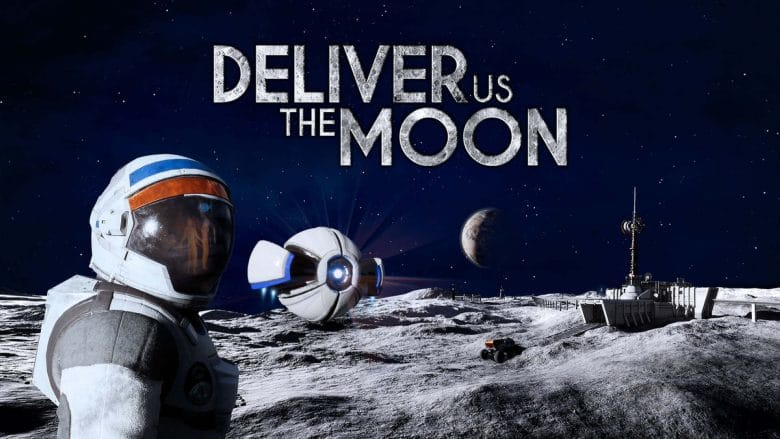
An astronaut and robot standing in front of a lunar landscape.

Deliver Us the Moon is a first-person interactive fiction game similar to Tacoma, Event[0], The Station or Stardrop. You play an astronaut blasting off an environmentally-devastated, near-future Earth to restore the energy transmission from the moon after it mysteriously shuts off. 

Deliver Us the Moon could be called a walking simulator, a genre uncharitably named for its simplicity and monotony. Like many walking simulators, much of Deliver Us the Moon involves the lone player exploring their immediate area, finding notable objects to scan or historical scenes to review then solving simple puzzles to unlock progress to the next area. There is no branching narrative or progression.

However, unlike some walking simulators, Deliver Us the Moon packs variety. It includes multiple mini-games like docking spaceships, driving moon rovers, repairing robots or aiming radar dishes. Its space scenes impart the feeling of weightlessness, potentially disorienting the player with “up” only denoted by the occasional sign, screen or seat. Limited oxygen makes scenes in space or on the lunar surface tense. Sometimes you lose yourself staring at the desolate but beautiful lunar surface. Sometimes you are just desperately surviving. It is more What Remains of Edith Finch than Dear Esther.

Like many interactive fiction games, Deliver Us the Moon is short, taking seven to eight hours to finish. However, given its weighty story, it feels about the right length. Its brevity and economy contrast with unending contemporary live service games. It also becomes more accessible – you complete it in a few gaming sessions.

The success of an interactive fiction game depends on how well it resonates with the player. The key is the adage, “Show, don’t tell”. Rather than telling you how you or some player surrogate acted or felt, it places you in that situation, drip-feeding you background and context. When the game finally asks you to care, it feels natural after surmounting challenges and discovering lore organically.

At first, Deliver Us the Moon‘s setting and premise may seem far-fetched. Climate change is a genuine problem. However, Deliver Us the Moon‘s world exhausts natural resources and desertifies sooner than even pessimistic climate projections. Extended stays in space or on the lunar surface require huge, Earth-side teams to support them. Given our understanding of physics, beaming sufficient energy from the moon to power the Earth is impractical.

However, Deliver Us the Moon is not a game about environmentalism, technology or space. Its puzzles are never hard enough to frustrate or block progress.

Deliver Us the Moon is about how personal connections drive us, such as protecting family or camaraderie. It is about how alienating disconnection can be, even when the world is a stake. Amidst space’s vastness, alienness and hostility, the small things matter.

Deliver Us the Moon will appeal to those who enjoy empathising with a good story and can relate to its themes. You will enjoy Deliver Us the Moon if you enjoyed Firewatch or Gone Home but want more interactivity, some tense moments or a science fiction setting. Like other interactive fiction games, those looking for something challenging, action-filled or longer should look elsewhere.

“Sable” Review

Sable is an exploration and light platforming game developed by Shedworks. You play the titular character during her “gliding”, a coming-of-age ritual. Sable leaves her tribe to explore the desolate desert world and its people to determine her future and satiate her wanderlust.

Sable is a game about exploration and curiosity. It is about discovering new areas and finding dusty corners. It is about uncovering the lore and history of the world. It is about Sable finding her future place in society.

Thankfully, Sable‘s world is intriguing and wonderful. Visually, the world’s deserts are beautiful and varied, from sterile flat salt fields to the Utah-like eroded towers of red sandstone. Zipping around on your hoverbike, a technological marvel teasing what you can discover about the world’s history, is fun and relaxing.

Mechanically, Sable relies on familiar game loops like fetch quests and collection challenges with optional fishing. The quests are interesting and unique, like climbing through a gigantic wyrm, collecting precarious lighting crystals or gathering beetle poo. Sable restrains itself, avoiding the blatant exploitation of people’s curiosity and completionist instincts in other games.

Two things make Sable stand out. The first is its distinctive and vibrant cell-shaded, cartoon-like art style. The solid blocks of colour and black outlines simplify the landscape and scenes, immediately drawing attention to points of interest. It also gives the world an unreality, reinforcing Sable and her journey as fable of self-discovery.

The second is that everyone wears masks, signifying their place in society. Sable starts with a child’s mask but earns new ones by completing others’ tasks. She chooses one to wear when she finishes her gliding.

Interestingly, Sable glosses over the depersonalisation that such a practice would bring. Sable can still recognise people and see smiles or other facial expressions beneath the masks. The game ignores possible commentary on Western society’s fixation with employment as identity or portraying fake versions of yourself.

Avoiding such commentary is a good decision. It would have been too heavy. Sable is self-driven and self-paced, placing little pressure on the player. There is no combat, death, failure state or even conflict.

This decision means Sable fits nicely into the “wholesome game” genre. It also means the game has a positive and uplifting vibe. The world is not scary. Something interesting could always be around the next corner.

One minor gripe is the game’s graphics default to thirty frames per second. Unfortunately, some animations, such as Sable’s running, are limited to that rate. This noticeably contrasts with swaying grass and wind effects that are not.

Sable‘s content also gets more obscure as it progresses. The game may be unchallenging, but you need to work hard, be very curious, or both to complete everything.

That said, Sable does not encourage or require you to do anything. There is no main questline or overarching story. Sable’s mask, and her future, is her decision to make. She can return after getting her first mask or take as long as she wants.

Instead, the focus is on how Sable’s meanderings transform her. Her conversations with her tribe mates at the end are very different to those at the start. As the menu theme’s lyrics say, Sable eventually returns to her tribe as someone else.

Sable is a game for those that enjoy self-guided exploration on multiple levels. It does not outlive its novelty at eight to twelve hours to complete. Those wanting something challenging, story-driven or longer may get bored. However, those looking for something introspective, meditative, uplifting, and positive will enjoy it.

Beginner Anti-Xeno (AX) Krait Mk II

An Elite Dangerous ship platform supporting multiple builds aimed at those new to Thargoid combat.

A detailed explanation of Thargoids and Thargoid combat is beyond the scope of this post. The Anti-Xeno Initiative (AXI) wiki has the best documentation about them, tactics, and ship builds.

Goals

Create a ship to:

  1. Perform one or more roles when fighting Thargoid Interceptors, Thargon Swarms and Thargoid Scouts, such as those found in AX Conflict Zones.
  2. Be self-sufficient, including removing the damage over time debuff from caustic missiles and neutralizing Thargoid shutdown fields. This means the ship can be viable solo or in random groups.
  3. Require no unlockable modules, reputation or rank. This makes it easier to build for newer players.
  4. Outrun and outmaneuver most thargoid interceptors, scouts and caustic missiles. This is unlikely to include the Basilisk interceptor, whose maximum speed is 530 m/s, but should include all others.
  5. Land on a medium-sized pad. This ensures it can land at all outposts and stations, including ones under active Thargoid attack. Medium-sized ships’ purchase and rebuy prices are also generally lower than large-sized ships.

Build

Krait Mk II blueprint by CMDR-Arithon (https://swat-portal.com/forum/gallery/image/9624-krait-mk-ii/)

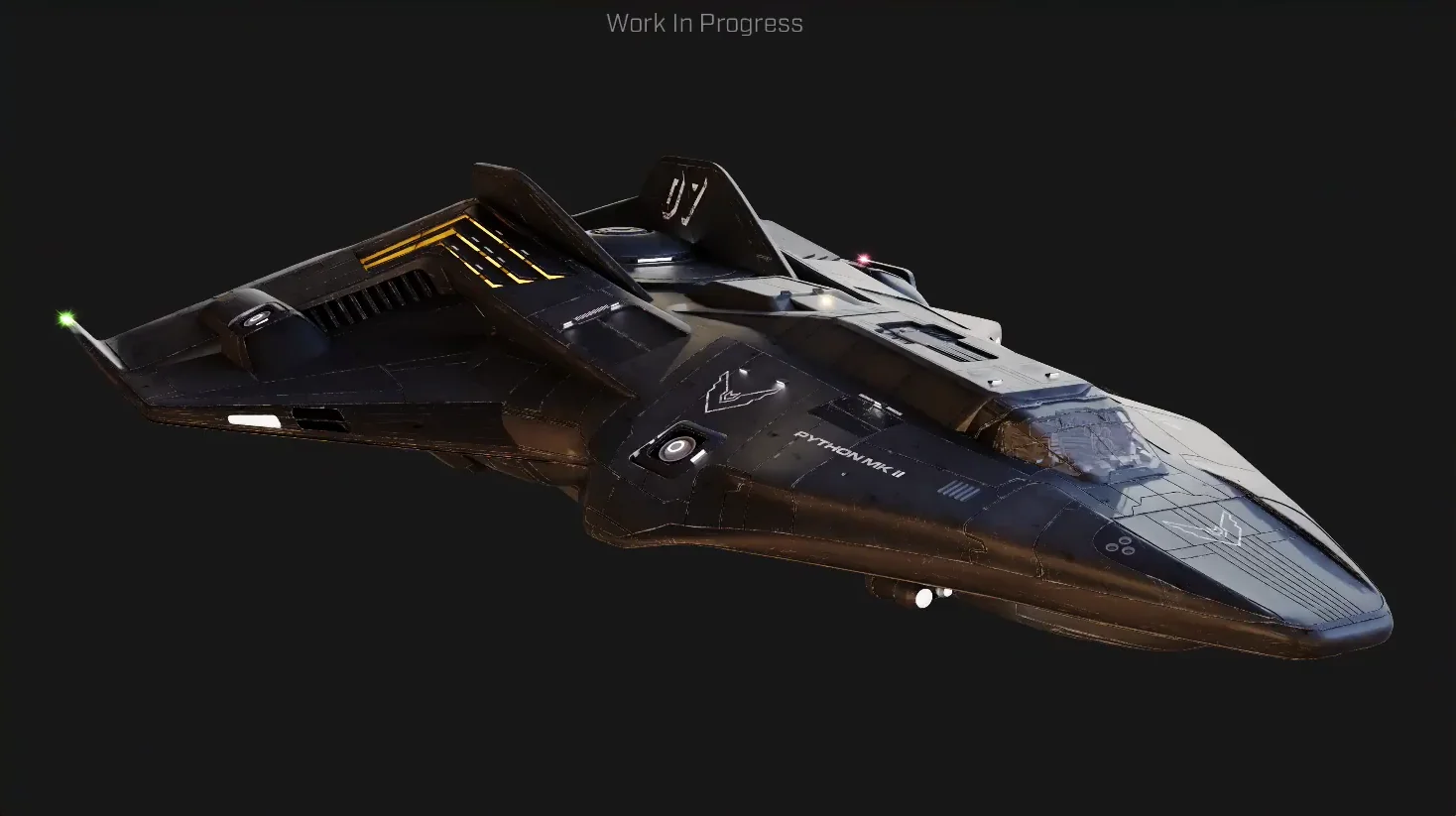
The new large gimballed Enhanced AX Multi-Cannon is the best AX weapon that does not require unlocking. This replaces the turreted version. Unfortunately, the limit of four AX weapons still applies. The Python and Krait Mk II both have three large hardpoints, the most for a medium ship, but the Krait Mk II is faster and more agile, making it the best medium-size AX ship for new commanders.

That said, many ships make viable anti-xeno or anti-thargoid builds. For example, the Alliance Chieftain is also effective but more so against interceptors than scouts. It is more manoeuvrable but has less hull integrity and shields.

These builds are also guidelines. Feel free to experiment but note this build’s goals and motivations.

While you can run AX builds without engineering, Thargoids are intentionally difficult opponents. Unengineered ships are harder to use. Having to repair frequently may leave your team without a needed role. Unlocking engineers and grinding for materials is time-consuming but worth it. You do not need to max out the engineering to be viable, grade 3 or 4 is sufficient, but more engineering means an easier fight.

General:

  1. Maximize Hull: All thargoid damage is phasing, meaning a portion bypasses shields. All thargoid damage is Caustic, meaning traditional resistances like thermal, kinetic and explosive are useless. The damage over time debuff from caustic missiles directly damages hull irrespective of shields. Therefore, while shields help, maximizing hull integrity is imperative to survivability.
  2. Caustic Debuff: Being hit by caustic missiles or entering a destroyed scout or interceptor’s cloud will put a caustic debuff on the ship. Either use a decontamination limpet or overheat to at least 120% to eliminate it. Use the AFMU during downtime to repair malfunctioning modules.
  3. Thargoid Shutdown Field: Interceptors create a pulse that temporarily shuts down ships when (1) they enter the instance or (2) on their last heart. Use the Shutdown Field Neutralizer to prevent you and nearby allies from being shut down.
  4. Finding Targets: AX Conflict Zones tend to spawn scouts at long ranges. Interceptors can travel far away from the centre of a conflict zone during combat. Therefore, A-rated sensors help find scouts or interceptors at extended ranges. AX builds focusing on Non Human SIgnal Sources can operate well with D-rated.
  5. Lo-Draw Shield: The shield has Lo-Draw rather than Fast Charge. Fast Charge draws too much power if the shields ever drop, meaning there will be no power for the Shutdown Field Neutralizer or Decontamination Limpet Controller. However, Lo-Draw slightly decreases the recharge rate.
  6. Speed and Agility: While not as fast as a Basilisk interceptor, this build can outrun other Thargoids, including caustic missiles.

Anti-Scout

Build: Coriolis (Coriolis does not support the enhanced AX multi-cannons yet, so those slots are shown as turretted) or EDSY. Have your preferred one open as you read the guide for easy reference.

You can purchase the Enhanced AX Multi-Cannons from any Sirius megaship.

  1. Weapons: Three large and one medium Enhanced AX Multi-Cannons form the foundation for scout killing. The enhanced versions have a high shot speed. The gimbal allows limited auto-aiming, minimizing missing due to scouts’ manoeuvrability. The Long Range beam laser helps “tag” scouts and interceptors at long range. The Thermal Vent experimental effect reduces heat when striking a target or increases it when missing, helping to burn off the caustic debuff.
  2. Setup: Assign the multi-cannons and laser to the primary fire button and the decontamination to the secondary fire button in the same fire group. Assign a key to the Shutdown Field Neutralizer. This build’s Power Plant and Power Distributor are more than sufficient, meaning pip micro-management is optional.
  3. Target Selection: Engage regenerators first (because these heal nearby scouts), berserkers (because they buff nearby scouts and cause them to fire caustic missiles), inciters (because they buff nearby scouts) and then marauders last. The Xeno Scanner identifies scouts and their health.
  4. Engaging: Engage scouts at a range of one to two kilometres. This is within the AX multi-cannon minimum range but not close enough for scouts’ agility to make them hard to target.
  5. Swarms and Interceptors: Get a hit or “tag” on an interceptor to share in the bonds for killing it but avoid them if you are dealing with scouts. For interceptors, ensure someone in the wing gets a scan so you can target hearts effectively. Avoid using AX multi-cannons against shields, which may trigger the interceptor’s caustic missiles.

Mixed Anti-Swarm and Anti-Scout

As Anti-Scout, above, but replace two of the Enhanced AX Multi-Cannons with Remote Release Flak Launchers. Put the Remote Release Flak Launchers in side hardpoints to maximize the area covered by exploding flak.

  1. Setup: Put the Remote Release Flak Launchers in one fire button, the Enhanced AX Mutli-Cannons and Laser in another and the Decontamination Limpet Controller in another in a separate fire group.
  2. Scanning: Using the Xeno Scanner identifies the interceptor type and allows targeting of exerted hearts for you and everyone in your team. Once you get used to visually identifying interceptors and their hearts, you can replace the Xeno Scanner with another shield booster.
  3. Target Selection: Thargon swarms are your priority because only Remote Release Flak Launchers can meaningfully damage them. Prioritize swarms attacking other team members or, failing that, larger swarms first. Otherwise, prioritise scouts as mentioned above, particularly those attacking team members.
  4. Interceptors: Get a hit or “tag” on an interceptor to share in the bonds but prioritize other targets. While scouts are a nuisance, a single hit can destroy a needed attached limpet or stop an ammunition synthesis.

Anti-Interceptor

As Anti-Scout, above, but equip four 2B Guardian Gauss Cannons (or the salvation versions) and one 2D Long Range Beam Laser with Thermal Vent. Unfortunately, Guardian Gauss Cannons require unlocking.

Once you get familiar with interceptor combat, experiment with other Guardian weapons. However, Guardian Gauss Cannons are the most effective against Thargoid interceptor hearts.

  1. Setup: Placing all four Guardian Gauss Cannons on a single fire button and the Beam Laser on the other. While Guardian Gauss Cannons can fire frequently, they will spike your heat. Use the Beam Laser liberally to minimize heat but be careful not to exhaust the weapon capacitor. Avoid using gauss and other weapons against Thargoid shields, because it may trigger the firing of caustic missiles.
  2. Alternate Setup: Put two adjacent Guardian Gauss Cannons and the Beam Laser in one fire button and the other two Guardian Gauss Cannons and the Beam Laser in the other fire button. This reduces the heat impact of firing all four gauss cannons at once. Grouping the gauss canons into smaller groups with good convergence can make heart sniping easier. Hold the fire button to keep the laser firing to reduce heat.
  3. Range: Guardian Gass Cannons are most effective at the 1 to 1.5 kilometre range. The cannons still do maximum damage, the angular motion of interceptors is minimized and the slight auto-aim feature of fixed weapons is most effective.
  4. Engaging: Stay at least one kilometre from the interceptor unless you use the Xeno Scanner. This helps your Gauss Cannon accuracy, keeps you out of range of the lighting attack and helps any dedicated tanks keep the interceptor’s focus. Also, avoid using Gauss Cannons on shields. They are not very effective and can trigger an interceptor’s caustic missiles.
  5. Scouts: Leave scouts for those with AX Multi-Cannons. Targeting scouts with fixed weapons is harder than against the larger, slower interceptors and gauss cannon ammunition is limited.

Variants

  1. Unlockable modules: Replace the Module Reinforcement Package with the Guardian version to increase module protection. The double-engineered 5A Frame Shift Drive purchased from a Human Technology broker will slightly increase jump range. Replace the 4E Cargo Rack with the corrosive-resistant version if you want to scoop up hearts.
  2. Shieldless: I do not recommend running this build shield-less unless you focus on interceptors. Cold orbiting does not work against scouts or Thargon swarms. Missiling Thargons will quickly disable or destroy hardpoints without a shield. However, to do so, replace the 6C Bi-Weave Shield Generator with a 5D Module Reinforcement Package and the two 0A Shield Boosters with Heat Sink Launchers with Ammo Capacity, preferably the double-engineered versions.

Passenger Rescue and Robigo Mines Python Build

An Elite Dangerous ship build for evacuating passengers in bulk from outposts or settlements that lack a large landing pad. This includes the Robigo Mines to Sothis loop for credits or engineering materials.

Goals

Like the large pad, Anaconda version and the small pad, Type-6 Transporter version, create a ship to:

  1. Carry as many passengers as possible while landing on a medium pad. Evacuating passengers are happy with economy class.
  2. Make the 150+ LY trip to a rescue ship as quickly as possible. This means maximizing the jump distance and range to do the trip without refuelling. Failing that, outfitting a fuel scoop.
  3. Escape a Thargoid hyperdiction or interdiction. This means both the protection and speed to escape.

Build

Anaconda Blueprint by CMDR-Arithon (https://swat-portal.com/forum/gallery/image/9457-python/)

Links: EDSY and Coriolis (have your preferred one open as you read the guide for easy reference)

A comparison of medium ship economy passenger capacity is given below.

Ship23456+Smallest Shield Slot SizeTotal Economy Passengers (Shielded)Total Economy Passengers (Shieldless)
Type-6 Transporter2122035256
Asp Explorer2201135660
Alliance Challenger2200246876
Federal Gunship2001247684
Krait Phantom1303139094
Krait Mk II121223110114
Python121233142146
Medium Ship Economy Passenger Capacity

The Python carries the most passengers in economy class cabins, mainly due to its three size six slots. The Python does so with a 150+ LY jump range without refuelling, making it the ideal medium-sized bulk passenger ship.

Passengers:

  1. Passengers: Running passengers is straightforward. I prefer missions that reward engineering materials, especially ones with fewer passengers for five class five materials. The Advanced Docking Computer helps when repeatedly docking.
  2. Jumping: Even a non-double engineered 5A Frame Shift Drive using Increased Range with Mass Manager is sufficient. It gives a range of over 200 LY. Along with a 2H Guardian Frame Shift Drive Booster, this build does not need a fuel scoop to reach a rescue ship.

Defence:

  1. Speed and agility: Using the Dirty blueprint with the Drag Drives experimental Thrusters minimizes the time in danger during Thargoid encounters. Given the low power requirements, this build also uses a slightly smaller Power Plant and Power Distributor to give it that edge. It can boost every five seconds with four pips to engines and two pips to shields.
  2. Shields: While Thargoid damage is phasing, a Prismatic Shield Generator provides the best protection. Substitute for a regular Shield Generator if you do not have access to Prismatic Shields. It, with Shield Boosters, provides enough protection to comfortably escape Thargoid encounters. Eschew resistances because all Thargoid damage is Caustic.
  3. Armour: Favour speed over hull integrity with Lightweight Alloy.
  4. Cold: The Power Plant uses Low Emissions and Thermal Spread to minimize heat. This reduces Thargoid weapon accuracy and means heat sinks keep the ship under 20% heat for longer.
  5. No weapons: This build runs from fights.

Variations

  1. Robigo Mines: The passenger route from the output Robigo Mines in Robigo to the tourist beacon in Sothis used to be an excellent money earner. While the more lucrative missions now disappear from the mission board after an hour or so, passenger missions can still earn credits and engineering materials. Replace the three 6E Economy Class Passenger Cabins with 6D Business Class Passenger Cabins because some Robigo missions require them. Replace the 2H Guardian Frame Shift Drive Booster and even the 3A Prismatic Shield Generator with economy class passenger cabins because they are unnecessary. Unlike evacuation missions, some Robigo missions can take as few as two passengers and you are far away from any combat.
  2. Maximize range: Replace a smaller passenger cabin with an A-rated fuel scoop. This build will not scoop quickly but the low heat means you can take your time.
  3. Anti-Scout: Equip several turreted enhanced AX multi-cannons and a 7A Power Plant. Bring the fight to any scouts that interdict you or that attack you around stations! This variation can be fun but removing caustic damage from missiles is difficult. This build’s engineering makes overheating slow.

Tactics

This build uses the same tactics as the large pad, Anaconda version.

Passenger Rescue or Evacuation Anaconda Build

An Elite Dangerous ship build for evacuating passengers in bulk from damaged stations (before the events of Update 14) or stations in Thargoid Invasion systems (after Update 14).

Goals

Create a ship to:

  1. Carry as many passengers as possible. Evacuating passengers are happy with economy class.
  2. Make the 150+ LY trip to a rescue ship as quickly as possible. This means maximizing the jump distance and range to do the trip without refuelling. Failing that, outfitting a fuel scoop.
  3. Escape a Thargoid hyperdiction or interdiction. This means both the protection and speed to escape.
  4. (Optional) Collect engineering materials and commodities floating inside or around burning stations. Alternatively, transport critically injured evacuees in escape pods.

Build

Anaconda Blueprint by CMDR-Arithon (https://swat-portal.com/forum/gallery/image/9472-anaconda/)

Links: EDSY and Coriolis (have your preferred one open as you read the guide for easy reference)

A comparison of large ship economy passenger capacity is given below.

Ship23456+Smallest Shield Slot SizeTotal Economy Passengers (Shielded)Total Economy Passengers (Shieldless)
Type-9 Heavy122145154170
Beluga Liner041245168184
Type-10 Defender122136106138
Anaconda103344194202
Federal Corvette012255196212
Imperial Cutter011255188204
Large Ship Economy Passenger Capacity

Given the largest passenger cabin is size 6, the Federal Corvette carries the most passengers in economy class cabins. However, the Anaconda is the second best when shielded and has almost a ten light year longer jump range with a similar build. The Imperial Cutter has a similarly crimped jump range, although its speed makes escaping mass locks easier. Therefore, the Anaconda is the best all-round choice.

Passengers and cargo:

  1. Passengers: Running passengers is straightforward. I prefer missions that reward engineering materials, especially ones with fewer passengers for five class five materials. The autodocking computer helps when repeatedly docking.
  2. Cargo: A small cargo rack and limpet controller can help collect floating engineering materials and commodities in damaged stations. You can pause inside a burning station, activate collector limpets and then use heat sinks to control your heat. Otherwise, it can help carry critically injured evacuees in escape pods from transport missions.
  3. Jumping: This build uses the double-engineered 6A Frame Shift Drive for maximum range. If you lack one, use Increased Range with Mass Manager. The 4A Fuel Scoop is small but sufficient. The build’s low heat means you can throttle to zero at the edge of a star’s exclusion zone without overheating.

Defence:

  1. Shields: While Thargoid damage is phasing, a Prismatic Shield Generator provides the best protection. Substitute for a regular Shield Generator if you do not have access to Prismatic Shields. It, with Shield Boosters, provides enough protection to survive several Thargoid encounters assuming you repair regularly.
  2. Armour: Favour speed over hull integrity with Lightweight Alloys, given the Anaconda already has a tough, strong hull.
  3. Speed and agility: While an Anaconda will never be able to outrun a Basilisk, maximizing the Dirty with Drag Drives engineering on the Thrusters minimizes the time in danger during Thargoid encounters. The Power Distributor engineering ensures it can boost every five seconds with four pips to engines and two to shields.
  4. Cold: Given the Anaconda’s massive size 8 power plant and minimal power requirements, engineering to minimize heat is appropriate. This reduces Thargoid weapon accuracy and makes fuel scooping easier.
  5. No weapons: This build runs from fights.

Variations

  1. Longer jump range: Replace the Cargo Rack with a Guardian FSD Booster. This reduces the jumps required to reach rescue ships.
  2. More passengers: Replace the Cargo Rack and Collector Limpet Controller with more economy-class passenger cabins for a small increase in passenger capacity. Remove the shields if you are happy to take some hull damage during Thargoid encounters.
  3. Anti-Scout: Equip several turreted enhanced AX multi-cannons in the large and huge hardpoints. Bring the fight to any scouts that interdict you or that attack you around stations! This variation can be fun but removing caustic damage from missiles is difficult. This build’s engineering makes overheating slow.

Tactics

  1. Surviving interdictions: Submit to interdictions, put four pips into engines, then boost every repeatedly. Scouts will be a pest until the FSD cools down. Basilisks will mass lock you, preventing you from low waking, but take up to 30 seconds to commence pursuit. That should be long enough to get the required five km to escape their mass lock. Use heat sinks liberally to keep your heat low and minimize thargoid accuracy.
  2. Surviving hyperdictions: Hyperdictions, even from Basilisks, are easier to survive than interdictions because their mass lock does not block high wakes. Boost, fire heat sinks, then high wake as soon as possible. Use the Shutdown Field Neutralizer when you get a message about the impending shutdown field.
  3. Run: This build runs from fights, notwithstanding the anti-scout variation above.