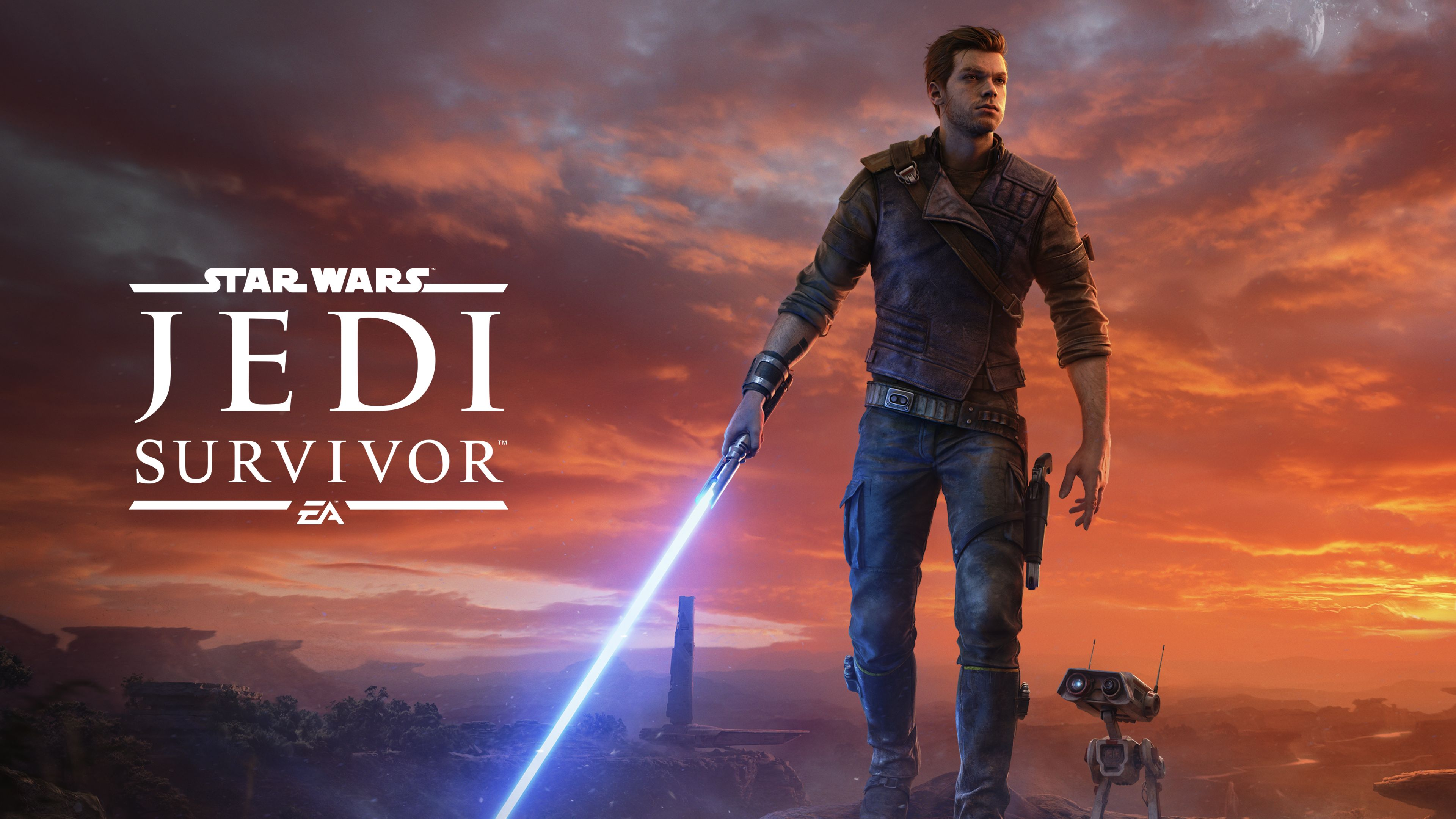
Star Wars Jedi: Survivor (or Jedi: Survivor) is a science-fiction adventure RPG developed by Respawn Entertainment, the same company that created the prequel, Jedi: Fallen Order. Thankfully, Jedi: Survivor is a worthy sequel, improving on the prequel in every way.
You play Cal Kestis, a Jedi Knight, continuing his fight against the Empire. Retreating to the backwater planet Koboh after a mission on Coruscant goes horribly wrong, Cal stumbles upon a forgotten planet that could be a hidden refuge for those he holds dear.
At first glance, Jedi: Survivor appears mechanically similar to Journey to the Savage Planet, the previous game I played. Both are exploration traversal games set on alien planets, where you wander, discover new areas, fight foes and collect resources. You have the traversal mainstays like the double jump and a grappling hook. You gain upgrades as you progress, allowing you to access more areas, defeat stronger enemies and complete challenging timed events.
However, the similarity ends there. Journey to the Savage Planet is about fun with cartoonish violence, densely packed levels and self-aware humour. Jedi: Survivor is about mastery, both in combat and traversal.
Jedi: Survivor‘s combat is “Souls-like”. Enemies hit hard and often outnumber you. Success requires learning enemy abilities and correctly timing parries and dodges. Combat is challenging, meaning you will die frequently as you learn and experiment, but not punishing, assuming you unlock shortcuts to shorten the journey back from the respawn point.
Jedi: Survivor adds two new lightsaber stances to the versatile single-blade, fast dual-blade and defensive double-blade stances from Jedi: Fallen Order. The crossguard stance, inspired by Kylo Ren’s lightsaber, adds a slow but damaging greatsword. The blaster stance, as its name suggests, has Cal Kestis wielding a blaster and lightsaber, fulfilling Han Solo or Wild West gunslinger-style fantasies.
Jedi: Survivor is also about exploration, with big, broad maps filled with traversal puzzles, riding mounts and even a speeder bike sequence.
Jedi lend themselves well to this style of play. Ever since Luke’s first training scene on Dagobah in The Empire Strikes Back, Jedi have demonstrated themselves to be acrobatic and athletic. They often befriend local wildlife.
Structurally, Jedi: Survivor has peaks of action during intense, story-relevant scenes and boss fights, followed by more leisurely downtime. Players can spend these breaks exploring, collecting or bounty hunting. You can expand their very own cantina via recruiting NPCs, fishing (by interacting with an NPC that appears at water), finding music tracks for the DJ, collecting plant seeds to fill a garden or scanning defeated opponents to use in holotactics games. Companions sometimes join Cal for story-specific sequences, often opening new areas or teaching Cal new abilities.
Jedi: Survivor‘s storyline explores purpose, sacrifice, friendship and acceptance. The story is told mainly through cutscenes, conversations with the many supporting characters and force echoes, which reveal past events or conversations. While it deals with galactic-relevant events and drops a few familiar names, the story focuses mainly on its characters, creating a personal story that tugs at heartstrings.
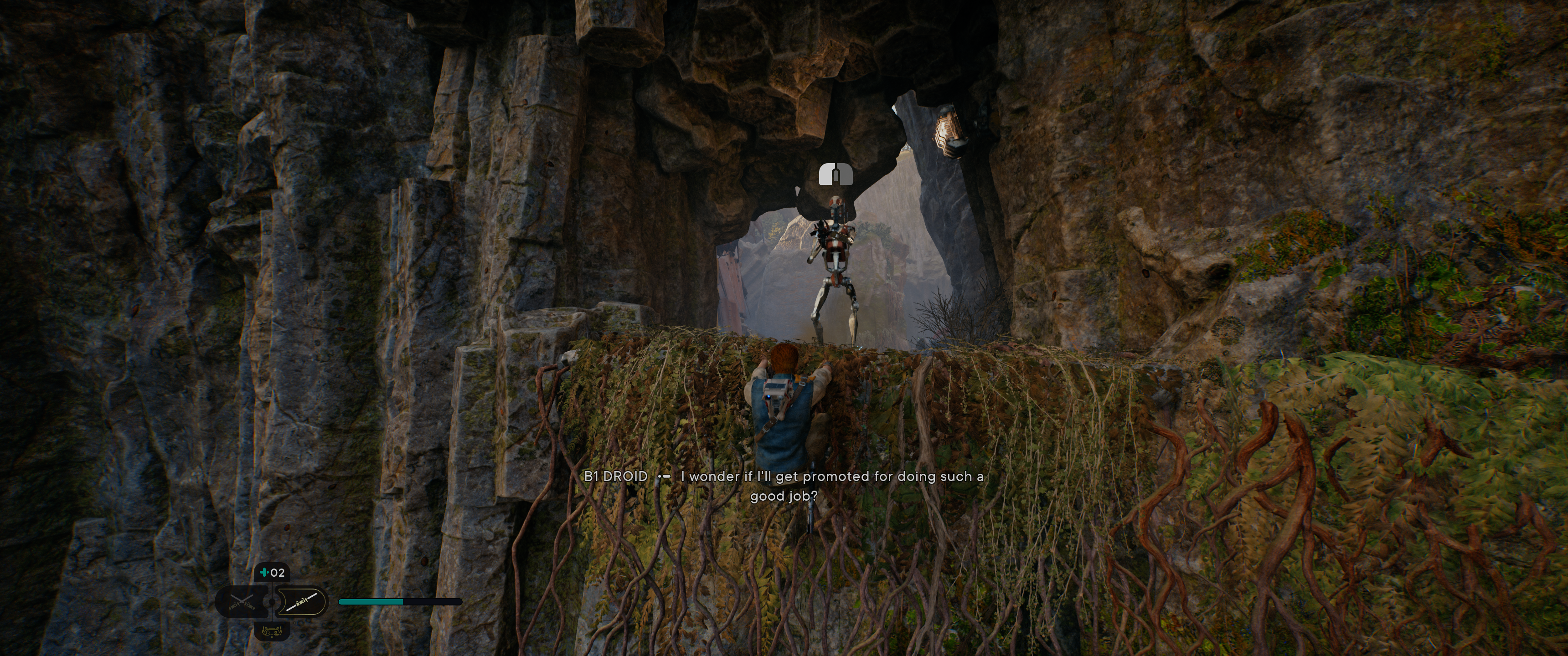
A B1 droid about to learn to fly
Just like in the movies, Jedi: Survivor has occasional bursts of humour, like the overheard banter between enemies, particularly the B1 droids introduced in the prequel movies. Struggling through tough fights to face Rick, the door technician, will bring a smirk to your face.
A now stubbled Cal even has a brush with romance, a taboo subject for Jedi, but handled tastefully and respectfully. It adds a little sexual tension, like in The Empire Strikes Back.
However, Jedi: Survivor‘s themes are only deep enough to motivate you, and not a genuine examination like in Cyberpunk 2077 or The Witcher series. While minor characters can sometimes point you to interesting parts of the map, there are no true side missions or plot choices to add depth or consequence.
Jedi: Survivor is unmistakably a Star Wars game, and not just because it involves lightsaber-wielding Jedi using the force against the Empire and other instantly recognisable tropes. Jedi: Survivor continues the themes of droids as people and good fighting an asymmetric battle against a seemingly overwhelming evil. Cal’s ship, the Mantis, is a Millennium Falcon equivalent, a similarly delapidated but faithful steed carrying Cal and his pseudo-family from stage to stage.
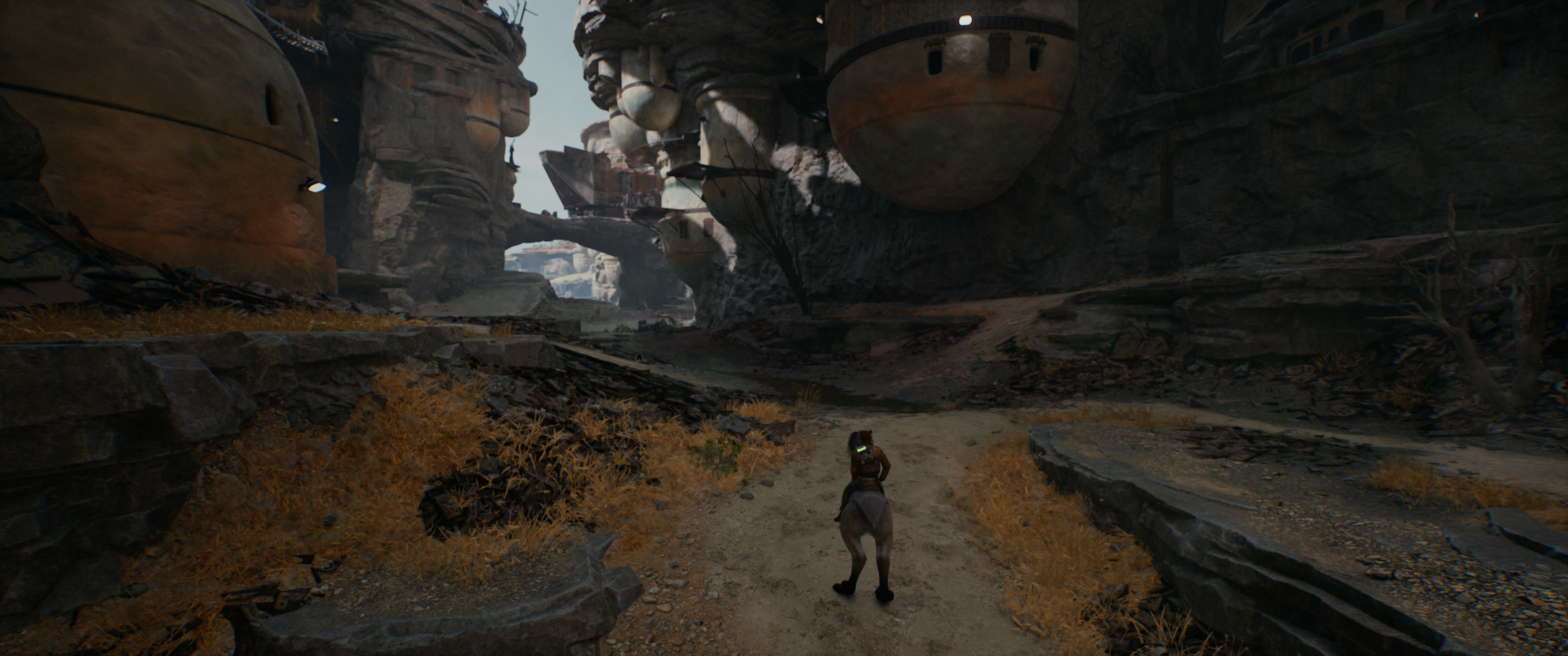
Cal views the path ahead, which juxtaposes the technological sandcrawler in the background with primitive ochre buildings
The game is faithful to Star Wars in its environment design. Most worlds you visit are technological backwaters, where primitive ochre and stone buildings are juxtaposed with automatic doors, artificial lighting and droids. Like the movies, Jedi: Fallen Order mixes the familiar with the alien or technologically different.
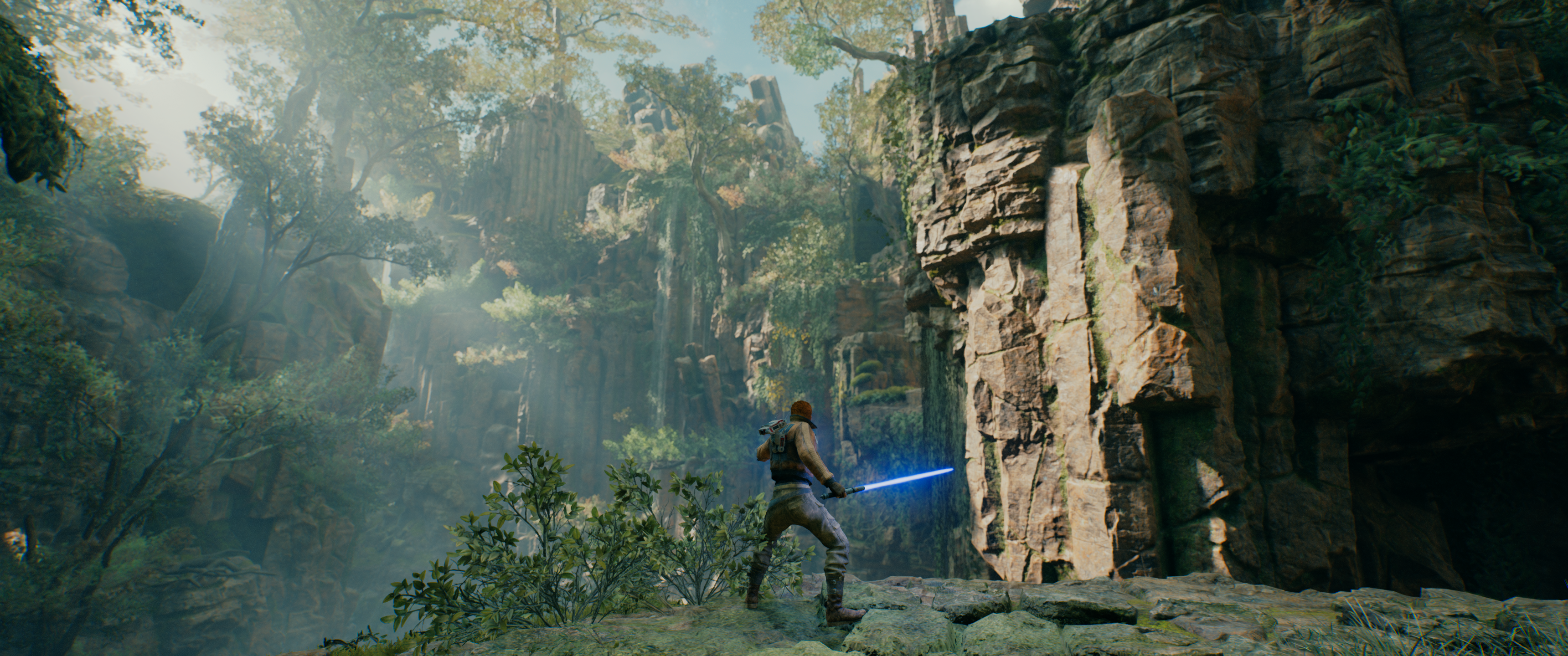
A lush, misty valley on Koboh, showing sandstone cliffs and gentle sunbeams
The colour palettes are muted pastels. Gone are the brilliant greens of Kashyyk and the purples of Dathomir in the first game. Instead, there are the reds of Dune-like Jedha, the greys of Coruscant and Californian scrub-like Koboh. These palettes give the game a realistic feel and make each location clearly unique.
Jedi: Survivor has Star Wars‘ audio pedigree. Stephen Barton and Gordy Haab return from Jedi: Fallen Order to deliver an emotional, epic, orchestral soundtrack that evokes the best of John Williams. The distinctive lightsaber whoosh, blaster ping and AT-ST foot clang abound.
Like Jedi: Fallen Order, Jedi: Survivor respects Star Wars as an intellectual property and a genre. It is neither derivative nor uninteresting and avoids redefining elements for its own ends. NPCs, like Darth Vader, are used faithfully. Jedi are noble, humble and capable, not the flawed, inflexible strawmen presented in later works.
Cal is a young male Jedi with a droid sidekick like Luke Skywalker. However, Cal is motivated by survival and the desire to protect, rather than seeking adventure or saving his father. Cal’s later dabbles with the force’s dark side present it as seductively and terrifyingly powerful while implying Cal’s greatest challenges lie ahead.
This series has cemented itself as a worthy addition to Star Wars lore and canon. At about thirty hours to finish for a storyline-only playthrough, Jedi: Fallen Order is about double the length of Jedi: Survivor. Those looking for a challenging and faithful Star Wars RPG will relish it. I look forward to the inevitable sequel.
Everspace 2 is a space fight simulator with 3D movement focusing heavily on combat, exploration and puzzles. Rockfish Games, the developer, describes Everspace 2 as a “space shooter” with “RPG elements” on its Steam page. That is untrue. Everspace 2 is an action role playing game (ARPG) like Diablo or Path of Exile. And it is terrific.
You play Adam Roslin, an ex-military fighter pilot working for an uncaring and manipulative corporation. After a routine mission goes wrong, you are captured by outlaws and escape to a long abandoned base. You and your fellow escapees then rebuild and prepare for a heist that could set you all free.
Flying your ship in Everspace 2 is a joy. The controls are less detailed than those of more complex space simulators like Elite Dangerous. Still, such an outwardly arcade-like game offers a surprising degree of control. Dodging enemy fire, circling capital ships, and navigating maze-like tunnels all feel fluid and natural.
The combat is vibrant, frantic and engaging. Like most ARPGs, you usually fight swarms of weaker enemies, each with different weapons, defences, and abilities. This structure provides constant variety and changing tactics. Your relative strength also fuels the requisite power fantasy.
A warm red star and a blue nebula shine through an asteroid field
Locations also contain puzzles, providing cerebral but slower-paced play. As you fly around, your sensors can detect and track nearby loot, mineral deposits or other points of interest. Your ship has a tractor beam that you can use to pick up and move things around, such as removing debris from a passage or picking up a battery to slot it into a socket elsewhere. These usually unlock doors or containers of potential ship upgrades.
Everspace 2 tells its main story through cut scenes showing hand-drawn images with voice-overs. While low-budget, this style works well for a game focused on flying spaceships. The main quest has excellent pacing while introducing more about the universe and its inhabitants.
There are plenty of side quests and activities, too. As with many RPGs, they are often the most interesting, flesh out the world and introduce unique NPCs. Chasing rogue AIs, rescuing trapped miners, or appeasing crime lords are all on the cards. Racing tracks and rifts filled with difficult enemies satiate those seeking a challenge.
Mechanically, Everspace 2 is a testament to game balance. Everything, including your character, gear, and enemies, is geared to a level. Level differences are more pronounced than in other games. Foes more than a few levels above you are deadly. Those a few levels beneath you will be merely speed bumps. Everspace 2 periodically increases the level of enemies to keep the challenge consistent.
A ringed planet seen from the surface of a desert planet
Aesthetically, Everspace 2 is beautiful. Each location is a postcard, with asteroids, massive space stations, aging wrecks, vertigo-inducing icebergs and/or vibrant nebulae. Many are varied and original, like an iceberg in a solar flare or a megafauna skeleton, evoking wonder and appreciation. Each star system also has its distinct look, making them feel unique.
The electronica soundtrack is also on point, supporting the sci-fi feel. The zen-like cruising pieces contrast with the exciting, upbeat combat ones.
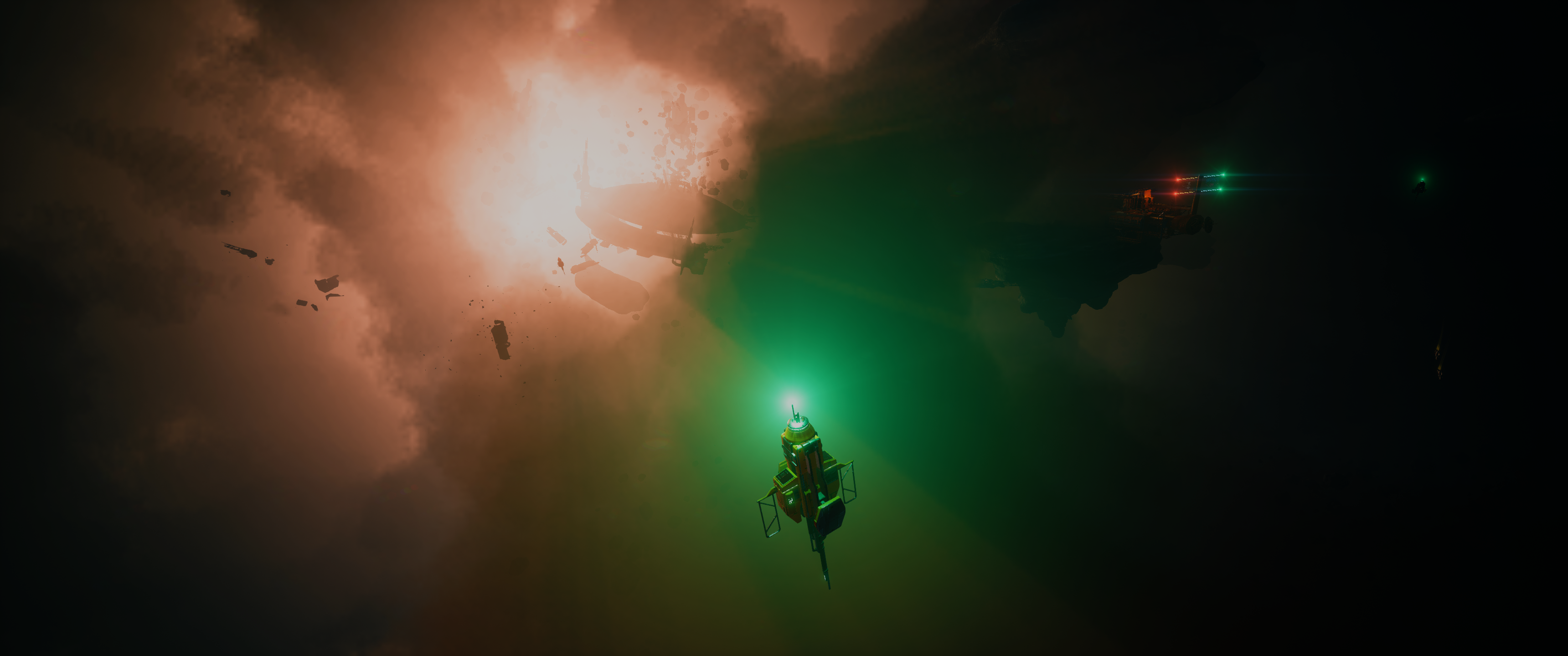
A green beacon in the middle of a dark gas cloud
However, Everspace 2 is not perfect. My biggest gripe is with the writing in the main storyline. No one expects deep or complex writing from an ARPG, but this does not excuse poor writing.
The characters need more substance. Ben and Delia are just cardboard cutouts and deserve motivation and agency. Maddock becomes a contrived, grumpy omni-antagonist. Combining some supporting characters, like Ben and Tareem, would have enhanced both. Everspace 2 also unnecessarily sexualizes a female supporting character at one point.
Similarly, the early main story has too much “I need you to do this, but I am not going to tell you why for at least two cut scenes.” It feels unnecessarily opaque and confrontational. The game also removes the player’s agency at a few key moments, railroading you.
My other gripe is with loot management. Most of the copious loot enemies drop is trash you sell or disassemble for crafting components. The rare upgrade is fun, and Everspace 2‘s crafting system means you will always have suitable weapons, modules or consumables.
However, the constant gear drops and level churn mean periodically yanking yourself out of the fun combat and puzzle game loops to clear your inventory. Loot management is a broader problem with ARPGs’ variable intermittent reward structure, but it is still a problem.
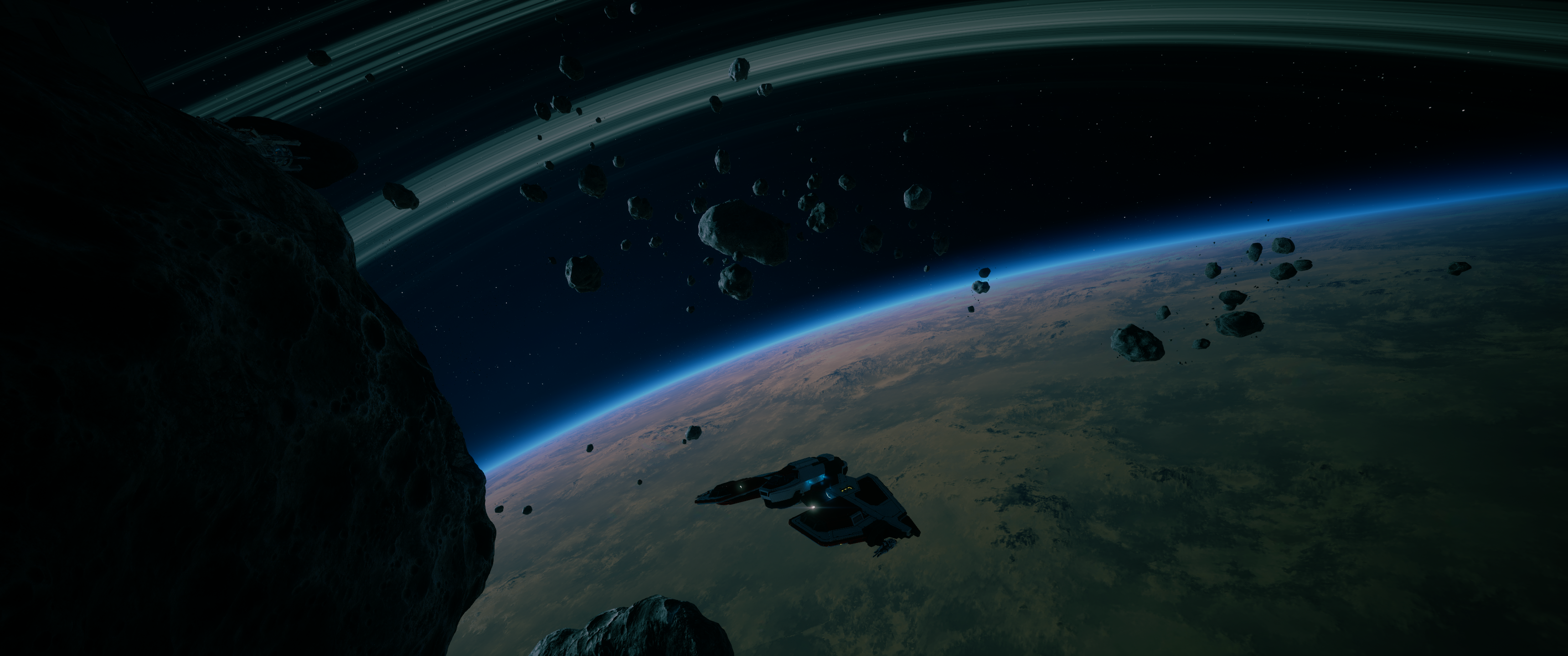
A ship in an asteroid field hovering over a ringed planet
I initially thought Everspace 2‘slack of replayability would be a problem. It lacks a skill tree or other ARPG elements that specialize your character. No advancement or story choice blocks off content. ARPGs have traditionally used these to encourage players to create different characters to replay content differently.
However, being able to quickly switch out a new ship or experiment with new weapons or modules means experimentation or change is refreshingly easy. Meanwhile, the perk and challenge systems provide attainable alternative goals that offer useful benefits instead of gatekeeping high-level content from less dedicated players.
Ultimately, Everspace 2 is a game that knows what it wants to be. It doubles down on that explore -> shoot -> loot -> craft game loop. If you enjoy that loop, and you will find out quickly or via the free demo, the game promises hours of the same. Otherwise, you will bounce off Everspace 2 hard.
Everspace 2 also knows what it does not want to be. It is single-player and offline, eschewing the complex code, gameplay loops and community management required for multiplayer or online play. It focuses on quality over quantity, providing a few well-developed star systems to explore. There is no piracy, salvage, political simulation or other distractions.
It took me about 60 hours to complete the main quest, including most side quests and challenges. As with most RPGs, you could complete it in under half that time, but you would miss the best content. Meanwhile, the developers continue expanding and enhancing the game, showing a welcome love and attention to detail. If only all ARPGs were this good.
Moonring is a top-down, turn-based, retro, fantasy role playing game (RPG) developed by Fluttermind Games. It is the work of a small indy team led by one of the designers of the first Fable game. It is also free.
In Moonring, you play an unnamed protagonist in the eternally shadowy world of Caldera with little early guidance or direction.
Mechanically, you move your character around the world using up, down, left, or right. Moving onto items picks them up. Bumping into enemies attacks them. Bumping into doors opens them. Bumping into allies starts a conversation. Moonring highlights keywords or phrases when you speak to NPCs. You type them in to converse further.
Using these, you piece together what to do. Your deceased father left instructions to continue unravelling a mystery. These involve a tutorialised exploration of your small farming community and then leaving to explore further.
As implied above, playing Moonring needs effort. No quest log or marker is pointing you in the right direction. No dialog tree reminds you what to say. The game helps a little. It captures notes with pertinent information and sometimes puts locations on the map. However, the player deduces what to do.
As you explore and converse, you learn that Caldera plunged into darkness centuries ago. Five moons appeared, each associated with a god. Unlike most, you have not had a god-enthralling dream. As one of the dreamless, is your destiny to become the new Archon and rule Caldera?
You also discover Moonring‘s mechanics are more complex than they appear. The game has a complex stealth system. You can make ranged attacks. Status effects overlap in interesting ways, such as water dousing fire. Ability’s energy costs change as different moons wax and wane.
Moonring has rogue-like elements. Saves are automatic, and there is a single save slot. You cannot save scum. The game generates dungeons when first entered. Dying punts you back to the dungeon’s start, losing your progress. The game randomises potion ingredients in each playthrough.
Moonring can be frustrating. I often felt stuck and had to review old notes or wander until I stumbled into something useful. I died to the end boss of a seven-level dungeon multiple times, having to repeat the whole thing each time.
However, the eureka moments when things clicked, or I finally beat a boss, were exhilarating. Sometimes, it is as simple as finding the one villager with a vital clue or bumping the right wall to open that secret door. Sometimes, it was new tactics and gear inspired by earlier failures.
These highs and lows are like those in the late 1980s RPGs that inspired Moonring. Moonring’s pixel graphics even use the old 16-colour EGA palette; the audio is reminiscent of the old IBM PC speaker, and the music is MIDI-like. There is even an optional blur mode to make the graphics look like an old, interlaced, cathode ray tube monitor.
However, there are conveniences and improvements found in modern games. As mentioned, Moonring takes notes for you. While Moonring intentionally does not explain its mechanics, the game has basic help. When crafting potions, Moonring tells you the potion that ingredients will create. The game explains new status effects each time.
Moonring treats advancement differently from most RPGs. Moonring does not reward killing creatures, discovering new areas, or completing quests. Instead, you earn devotion to one of the five gods. You spend it to gain god-themed abilities and raise that god’s attribute, which makes new items usable.
You earn devotion by using a rare item or fulfilling deity-specific tasks. These tasks can be as simple as a pilgrimage to their holy city or as complex as recovering a sacred relic. The tasks tie into each god’s themes. A god of strength may reward killing many enemies. A god of knowledge may reward discovering ancient artifacts.
This advancement system encourages exploration and discovery, which is the heart of Moonring. This is not just of the map but of mechanics, conversations, crafting, equipment types and even status effects. The game encourages stealth or working around problems. Grinding or clearing out every creature on the level is rarely rewarding.
How else will you discover whether becoming the new Archon is the only way to complete the game? How do I afford a ship deed at that price? Is there more to the fog-like amber? There is no magic system, right?
Moonring will appeal to those who played early RPGs or want a quirky, sometimes frustrating game. You can finish the game in about 10 hours, but most playthroughs will take much longer. It will not appeal to many. However, Moonring shows love and nostalgia for an RPG style long surpassed. Being free is just icing on the cake.
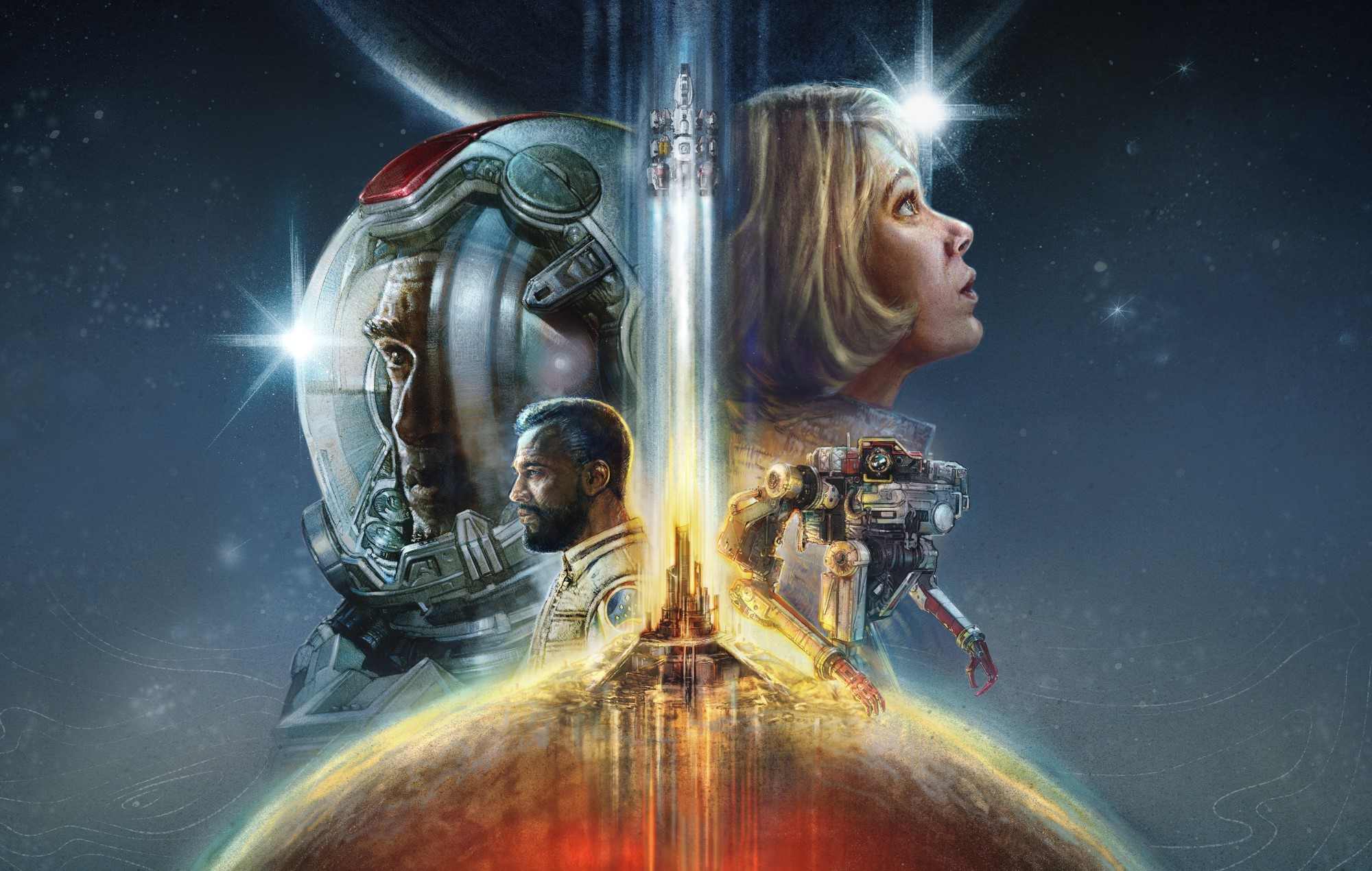
Starfield is the latest action role playing game (RPG) from Bethesda, the developers of Skyrim and Fallout.
Starfield, the first new RPG setting from Bethesda in a long time, is set in 2330. The Earth’s magnetosphere dissipated over a century earlier, rendering it lifeless. Thankfully, humanity mastered faster-than-light travel via the gravity drive. They rapidly evacuated to the star systems near Earth, deserting old nations and building new institutions.
You start Starfield as a lowly asteroid miner, listening to your coworker’s banter. You unearth a seemingly alien artifact that gives you strange visions. After an attack by space pirates, you are inducted into a quaint, exploration-focused organization called Constellation and whisked off onto an adventure.
Structurally, Starfield has a similar “in media res” style introduction to Skyrim. It quickly teaches you the basic mechanics, gives you a short fight to get the blood pumping, establishes you as the “chosen one”, sets you on the main quest, and then gets out of the way. Much of the exposition happens later.
Starfield‘s strength is the breadth, if not depth, of game loops. Its gameplay is fun, but only exploration is remarkable. The combat is standard first person shooter fare, although melee could be more varied. The stealth mechanics are good but not up to Deus Ex or Cyberpunk 2077. Bethesda nailed the sci-fi feel of lock picking, but once you understand it, less player skill is required than in Skyrim. Your scanner is helpful for exploration, identifying enemies, or satiating hoarding instincts by finding things to pick up.
The gameplay is repetitive but not grindy. You do not need to repeat boring activities to enable more enjoyable gameplay. Sufficient variety in the quests and randomly generated or placed content prevents boredom. Once you exhaust the scripted quests, Starfield offers randomly generated versions to pass the time or continue adventuring. Alternatively, land on a planet and start exploring.
Starfield‘s main quest line is suitably epic and galaxy-spanning, providing mystery and motivation. It draws you above the drama occurring elsewhere in the settled systems. However, this distance means the main quest line loses some emotional grounding and gravitas. Starfield‘s setting and side quests provide the most content, variety and potential like most RPGs.
Starfield contains many visually and thematically diverse places. After leaving the dusty, decrepit asteroid mine and a short detour, you first visit the city of New Atlantis. It is the capital of the United Colonies. Visually, it resembles the citadel from the Mass Effect series: clean, bright, organic curves, open spaces with water and greenery integrated seamlessly with technology.
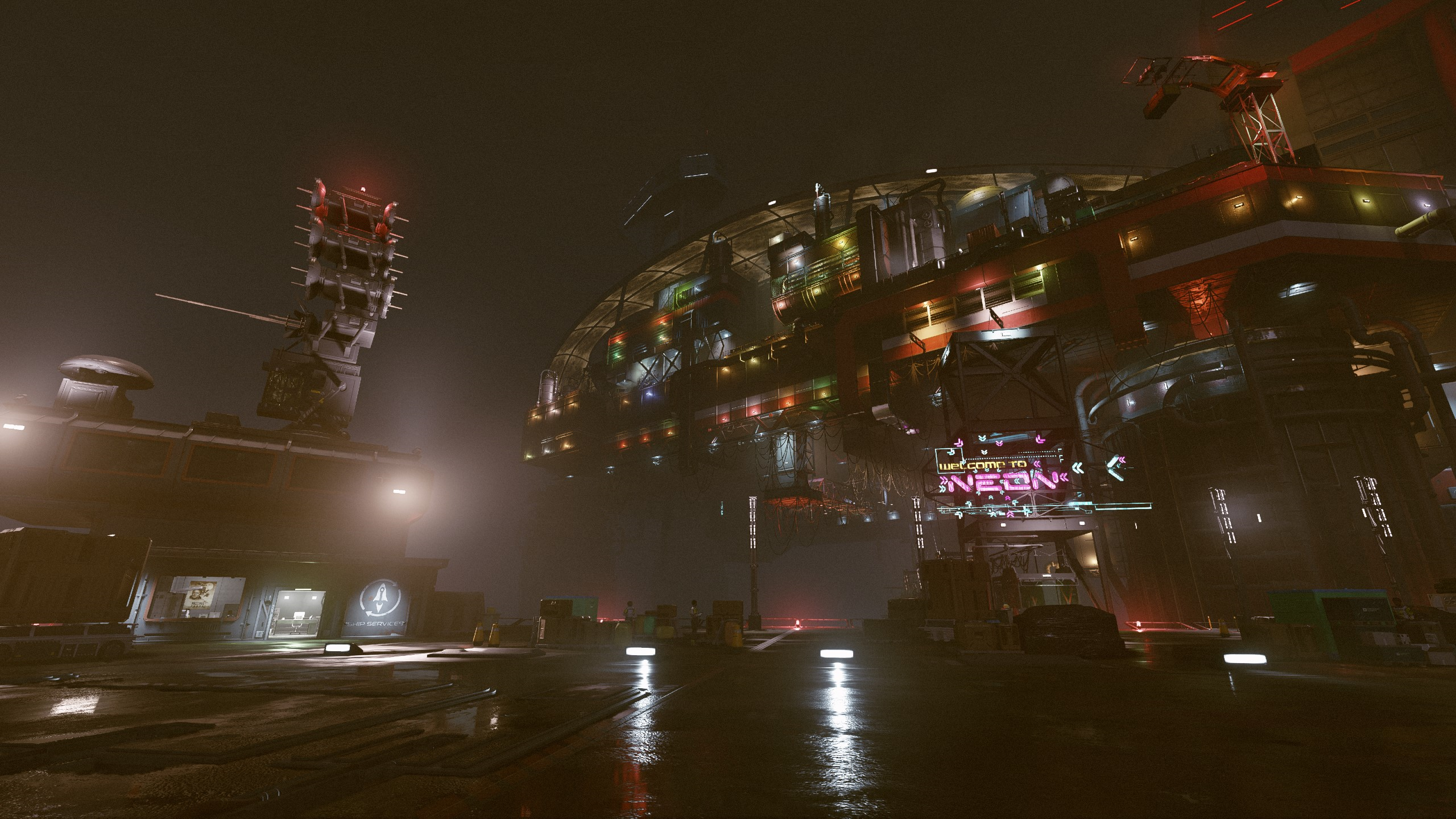
New Atlantis contrasts with other places like Akila City, the capital of the Freestar Collective. Its mud roads and stone buildings make it feel like the Wild West in space, complete with a bank robbery. As its name suggests, Neon is a cyberpunk (the genre) style metropolis on a rain-drenched water world. It is where to indulge in less savoury activities, like gang warfare, corporate espionage, or elicit substances.
Neon’s exterior in all its multicoloured glory.
Exploration is integral to Starfield, being the primary mission of Constellation. Mechanically, it is similar to No Mans Sky or Elite Dangerous. However, Starfield does it better. Starfield supports multiple biomes per planet, adding variety. Starfield is about exploring a known, finite universe, not the near-infinite set of random ones no one else will ever visit. Planet surfaces intersperse improbably frequent natural phenomena and enemy-filled bases to break up the gameplay. You can improve your exploration skills, like increasing scanner range, sprinting further, or learning more about scanned species.
A misty sunset with trees in the foreground and mountains in the background.
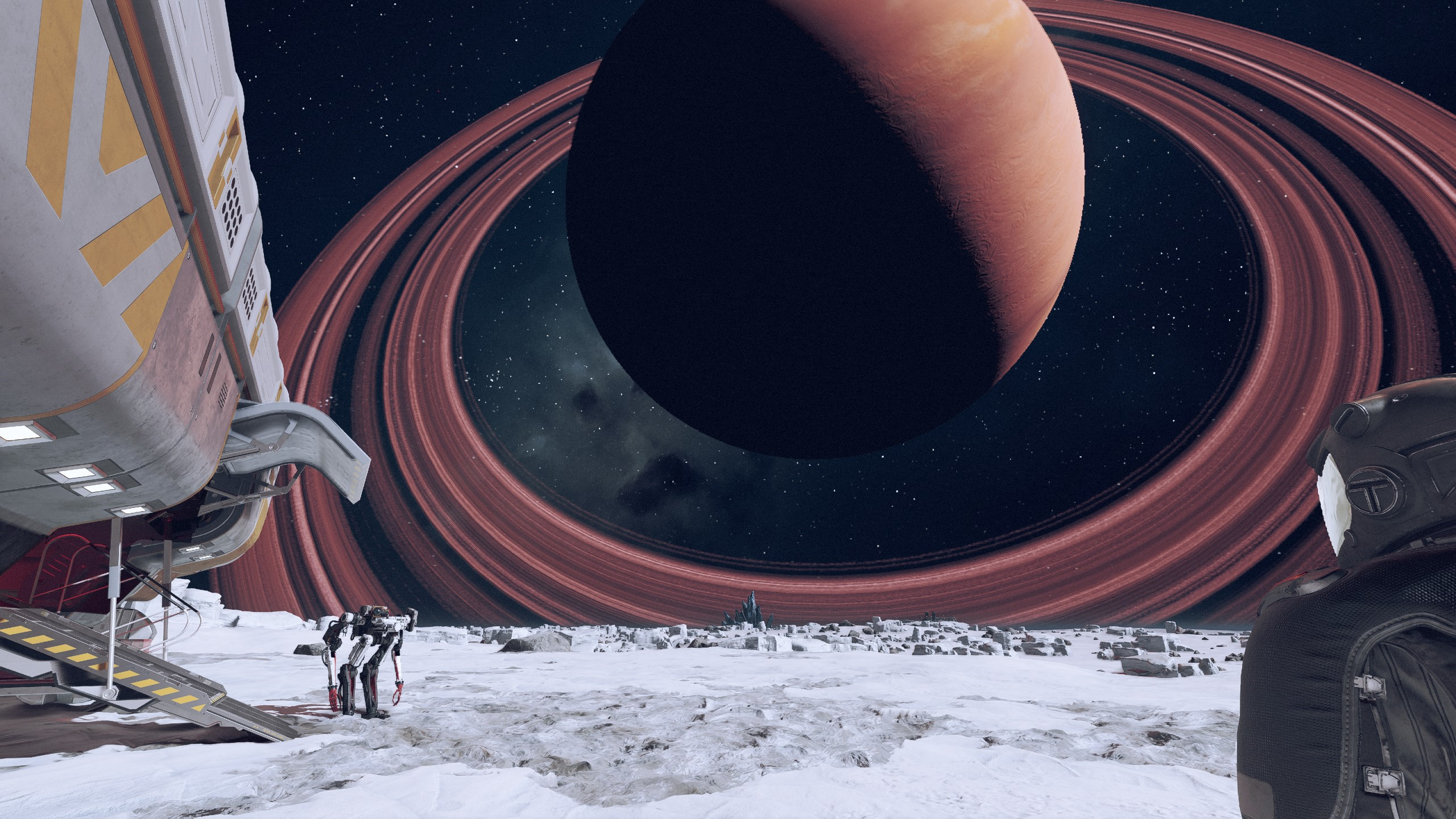
Starfield is visually better than games like No Mans Sky and Elite Dangerous, and “sense pleasure” is integral to exploration. Not just because Starfield is newer. While all generate terrain procedurally, most of everything else in Starfield is hand-crafted. Starfield‘s alien flora and fauna are more plausible, not just a random assortment of limbs. Think Star Wars, where humanity is not at the top of the food chain. Starfield‘s designers often placed moons and planets to create picturesque views, like ringed planets filling the sky. Starfield also has weather, like dreamy mist-filled sunrises, savage dust storms, or dreary rain.
A beautiful ringed planet viewed from a moon.
You need a starship to explore. Your starting ship, the Frontier, is a masterful example of worldbuilding. From the venting gas from its landing thrusters, whose exhaust is ignited by sparks like modern rockets, to its white, vaguely aerodynamic shape reminiscent of the space shuttle, it anchors the setting to a believable near future.
Unfortunately, you pilot your ship rarely. It is either in space, docked or landed. Docking and landing are automated. Flying between planets or systems is “fast travel”, using a short cutscene.
Approaching the starstation “The Eye”.
Starfield has ship combat, but it is arcade-like and closer to No Mans Sky than Elite Dangerous. It devolves into building ships with better shields and weapons. Manoeuvring is all but useless. The camera views block too much with either the cockpit or your ship’s back. Power management is awkward, particularly in the heat of battle. Macros would be helpful. The targeting mode loses any situational awareness.
However, once you master the clunky interface, the shipbuilder is a beautiful avenue for self-expression. Like the Galactic Civilization franchise, you customize and assemble ships using modular components. In a clever touch of worldbuilding, different vendors’ modules have different styles, such as the blocky, angular Deimos or Taiyo’s almost organic curves.
You can also walk around your ship, board enemy ships and add crafting stations and containers. However, to prevent punishing those with large ships, you can board into or leave directly from the cockpit. Elite Dangerous‘s designers should take note.
The back of a Stroud-Ekland cockpit.
Starfield allows building outposts on different planets to store excess equipment, gather resources, craft materials, and refuel ships flying past. You can also create trade links to automate the transfer of materials between them. Starfield almost rivals factory games like Satisfactory with its web of materials and resources.
However, the capacity of even the largest storage buildings needs to increase. A lot. No Mans Sky offers more variety, including positioning individual walls, roof and floor tiles.
In terms of companions, there are dozens that you can hire or find around the galaxy. Of these, four companions have unique quest lines. Each quest line companion follows roughly the same moral compass: generally good and favouring exploration. Although not my thing, this limits the potential for less noble playstyles.
Some want Vasco, your robot companion, to have a quest line and opportunity for growth or change. However, with the world currently enraptured by the potential and danger of AI, seeing a robot follow its programming is a welcome piece of sanity.
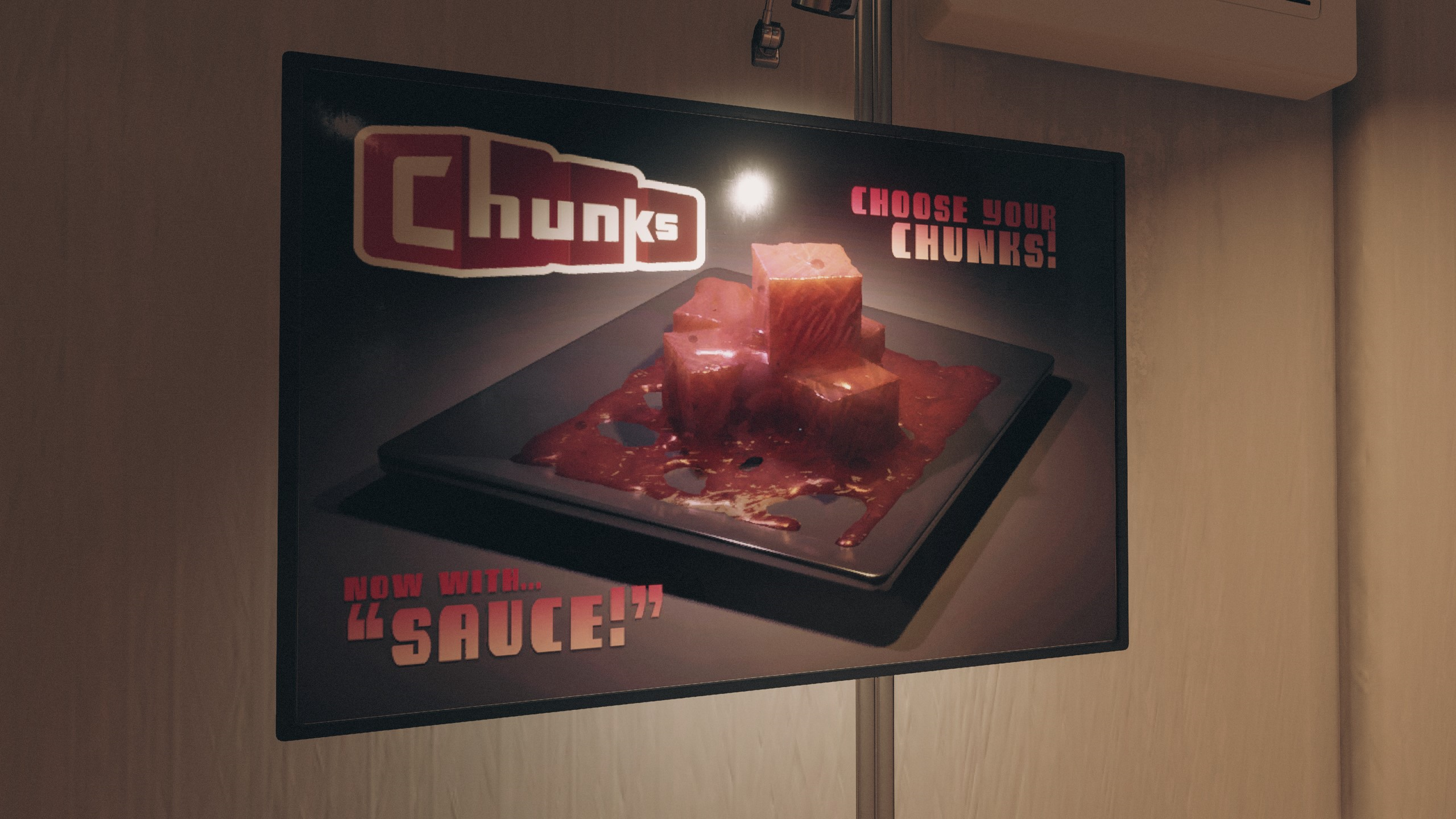
Thankfully, Starfield does not take itself too seriously. Catching up with your parents in an alien petting zoo or watching them pretend they did not try illicit substances is touching and amusing. Various “inspirational” posters line the walls of shady secret research labs. Chunks, the ubiquitous cubic fast food of the 24th century, “meet all minimal nutritional requirements”. Vasco has some innocent but cuttingly insightful wit. Your adoring fan’s flattery never gets old.
Hmmm. Appetizing.
Starfield‘s music is orchestral, reminiscent of Star Wars or Star Trek. Most tracks are slow and use periodic gradual crescendos to emphasize the wonder and grandeur of Starfield‘s universe. The soundtrack is composed to support a game with lots of voice dialog and critical sound queues, such as in combat. It does not call attention to itself. For example, the restrained, almost mournful menu theme is the opposite of Skyrim‘s rousing call to action. Rather than assaulting the player with aggressive emotion, Starfield‘s version hints that the player has to come to the game (or music), not vice versa.
My main criticism of Starfield is not that it is too easy, at least on “normal” difficulty. I may have played many Bethesda RPGs, but even “hard” provided little challenge. Assuming you do not intentionally engage in challenging content, there is little pressure to specialize your character’s skills, ship, outposts or use consumables for temporary buffs. These become more role playing opportunities.
My main criticism is also not that Starfield is the usual Bethesda RPG oxymoron. Starfield empowers you, creating a feel-good power fantasy where you are important and can make galaxy-affecting changes. However, as the conveniences in your favour accumulate, like free ship fuel or unkillable companions, immersion and suspension of disbelief get harder. Starfields‘ roots in points-based mechanics mean large level differences between you and your target can create unrealistic bullet sponges.
I do not mind that, despite Starfield having the best facial and hair animation of any Bethesda RPG, it still falls into that uncanny valley. NPCs wander aimlessly and still get stuck in walls occasionally.
My main criticism of Starfield is an absent central or recurring theme. For example, in a world where AIs are more intelligent and capable than humans, and the powerful are unshackled from laws and ethics, Cyberpunk 2077 examines humanity. The Fallout series deals with the difficulties of survival and that the best choices are often hard or impossible. The Witcher series shows that, when monsters walk among humans, humans are sometimes the most monstrous of all. The Nier series deals with loss.
In fairness, a game does not need to be profound to be good. Making action movies or games requires skill. Bethesda more than demonstrated it with careful level design, regular mixing of gameplay modes, managing tension, and catering to familiar sci-fi tropes and fantasies. The usual meme-worthy glitches are thankfully absent. The greater attention to quality after Cyberpunk 2077‘s problematic launch is apparent.
Instead, Starfield is pure, fun sci-fi escapism. It is a series of concurrent action movies. RPGs are defined by how well they let you play out fantasies. Starfield delivers on that.
For example, the Vanguard quest line plays like a rerun of Starship Troopers. The Ryujin quest line is a sci-fi James Bond or Mission Impossible coupled with corporate espionage and intrigue. Completing the Mantis quest allows you to play as a space Batman. The Sysdef/Crimson Fleet quest line has palpable tension as you play a double agent, playing criminals and the law against each other. Join the Rangers and play as a space cowboy.
A “Neil Armstrong moment” standing on the surface of Luna, the moon, looking toward the Sun.
Starfield is unoriginal. Almost everything in the game is “heavily inspired” by something else. That is OK. Successful RPGs help players fulfil fantasies by immersing players in familiar tropes. Where Skyrim opened the fantasy genre to a broader audience, Starfield attempts to do the same with science fiction.
That said, I was disappointed there were not more overt references to other movies, shows or games. Many will pick the few references to Skyrim‘s sweet rolls and Meridia quests. Yes, there was some well-known voice talent from Star Trek: Deep Space 9 and a subtle reference to the 1986 Transformers movie. Cyberpunk 2077 did this comparatively better.
Without strong themes and notwithstanding a few minor nods to modern sensibilities like same-sex relationships, there is little to offend or demand too much of its players. Perhaps Bethesda wanted to play it safe and avoid controversy.
However, Bethesda missed the opportunity to do something more. So many quests touch on real-world themes. For example, the war between the United Colonies and the Freestar Collective that ended 20 years before the game’s start still has lasting social and economic impacts. The United Colonies has to deal with the compromises and the demands strict order creates. The Freestar Collective juggles freedom with the criminal behaviour it facilitates. The Rangers’ quest line deals with the place of veterans in a postwar society. Meanwhile, the wealthy flatter themselves on luxury space cruises.
DLC or the modding community may fill the gap. Like Skyrim and Fallout, Starfield is as much a gaming platform as a game. Much of the work establishes content for future expansion or use. Outposts and shipbuilding, for example, go far beyond what Starfield currently needs. The Va’ruun, relegated to mysterious bogeymen, have much potential.
If you enjoyed Fallout or Skyrim or like science fiction games, you have probably already played or plan to play Starfield. You can race through key quests in 30 hours, but the complete experience takes at least 100 more. Starfield is fun, emphasizes exploration and knows its target audience well. However, the lack of anything original, introspective or thought-provoking may limit its long-term impact on the gaming landscape. Playing Starfield is like eating Chunks. It tastes good and you want more but the nutrition is questionable.
Greedfall is a third-person, action role playing game set in a unique world reminiscent of colonial, magical-filled seventeenth century Europe. You, de Sadet, accompany your cousin to Teer Fradee, a newly discovered island. You act as an ambassador, investigator and troubleshooter to help him manage and expand the colony while dealing with other factions and native inhabitants. You also seek a cure for the Malichor, a disease ravaging the continent’s populace.
The standout aspect of Greedfall is its setting. Beyond the tricorne hats, flintlock pistols and galleons, colonial Europe is a time of contradictions. Great advances in science and technology promise much, but religious and social views evolve much slower. Greedfall embraces this contradiction instead of safely shying away from it.
Greedfall‘s world contains several main factions. These include the Bridge Alliance, a mix of Arabia and India that pursues science above all else. It wars with the highly devout Theleme, which has clear influences of Spain and Italy. The Congregation of Merchants, de Sadet’s faction, is a pseudo-France, sitting politically between and trading with each. Teer Fradee is an England-like island populated by natives with a Celtic-inspired language.
The setting and factions create a stage for Greedfall’s cutting commentary. The Bridge Alliance grapples with the ethics of its research, Theleme struggles with zealotry and the Congregation with bureaucracy. Watching Theleme’s Ordo Luminous slaughtering innocent people under the false accusation of heresy, the Bridge Alliance comparing human test subjects to lab rats, and wealthy merchants from the Congregation dismissing laws as obstacles bypassable by modest bribes are all confronting.
Greedfall is also clever and respects its inspiration. It depicts organized crime as intelligent and insidious, not something solved by defeating the nearest “bad guy”. The native inhabitants of Teer Fradee have different reactions to the newcomers. Some fight them. Some ignore Some trade with them. Some use them as pawns in their own political games. This pluralism creates interesting dynamics between the various tribes and factions.
Greedfall also knows that constructing emotional investment in characters and a setting takes time. It takes time to build relationships and drip-feed exposition. When the game finally asks you to care, it feels natural and not forced.
Many play RPGs for their tactical combat. You control persistent characters through multiple combat encounters who improve over time. The enjoyment comes from mastering the mechanics and overcoming the challenge.
Unfortunately, Greedfall does not deliver in-depth combat. It hints at a more action-oriented parry and riposte-style melee combat. However, at least when playing as a magic-wielding character, abilities like Stasis and Storm quickly relegate most fights to mere speed bumps — fun but probably not what the designers intended.
The exceptions are the fights against Nadiag (“guardians”). These add an unexpected, welcome, but initially frustrating challenge. When you first encounter one, none of the fights beforehand prepare you for discerning telegraphed attacks, careful positioning and resource management.
A higher difficulty setting will likely flatten the difficulty curve or increase the challenge. A melee-oriented character might have been a different experience, too. However, those seeking a combat-oriented RPG should look elsewhere.
Between quests and fights, you spend much time exploring Greedfall‘s world. Teer Fradee is split into discrete areas, unlocked as you reach the edge of known ones. Crafting ingredients are spread liberally around the map. Alleys and scaffolding in cities reward the curious.
Your character, de Sadet, is joined by several companions. Each hails from a different faction and fulfils a combat archetype. Each also has a unique quest line and can be romanced. You can have up to two at a time but can switch them when fast travelling or at camps. However, their perspective and hints are most useful, especially when taking a companion on their faction’s quests.
Non-combat skills, or talents, provide multiple ways to solve most quests. For example, you may rescue someone from prison by using your “lockpicking” talent to pick the lock, “intuition” to convince the jailor he should let the prisoner go or by using your “science” talent to brew and place an alchemical mixture to blow a hole in the wall.
However, talents are all about early- and mid-game trade-offs. While some items, upgrades, and befriending companions help, you obtain talents slowly, and not every one is helpful in every situation. Otherwise, you may be forced into reputation decreasing threats or violence.
Graphically, Greedfall is no Cyberpunk 2077. It lacks ray tracing and DLSS. A 4K display resolution is unkind to some models and textures. Looking down on grass reveals three flat surfaces arranged like an asterisk.
However, for a non-AAA RPG initially released in 2019, Greedfall is still a pretty game. The game uses light/dark contrast heavily, such as the moment it takes to adjust to the dim lighting indoors or the pale shards of light illuminating caverns. I often stopped to admire the detailed rigging on the moored tall ships. Sunbeams shone down from the golden afternoon sun through the trees or buildings, shedding a warm red glow between the shadows or reflecting from puddles.
Greedfall‘s music is ambient and atmospheric. The encounter music with Teer Fradee’s native inhabitants focuses on percussive and woodwind instruments, giving a musical shorthand to help identify who and where you are. The voice casting is excellent, and only a few strange pronunciations using native accents mar the collective vocal performance.
Some have complained about Greedfall‘s glitches and bugs. Post-release patches may have fixed these, but I counted only a few in my playthrough. Most were low-resolution textures or an NPC struggling to walk around an obstacle – nothing significant or immersion-breaking.
Some have also complained about the lack of animations for minor events. Instead of an NPC drinking a potion or a magic seed growing into a tree, the game fades to black and then shows the result. I do not see this as significant. There needs to be sufficient cost benefit for a small studio to animate these.
For a non-AAA RPG, Greedfall focuses on its strengths to punch above its weight. Greedfall will not satisfy those seeking boundary-pushing graphics, a thumping soundtrack or consistently challenging combat, at least not at the normal difficulty level. However, the novel setting, meditative exploration and great quest design made my sixty hour playthrough thought-provoking and reflective.
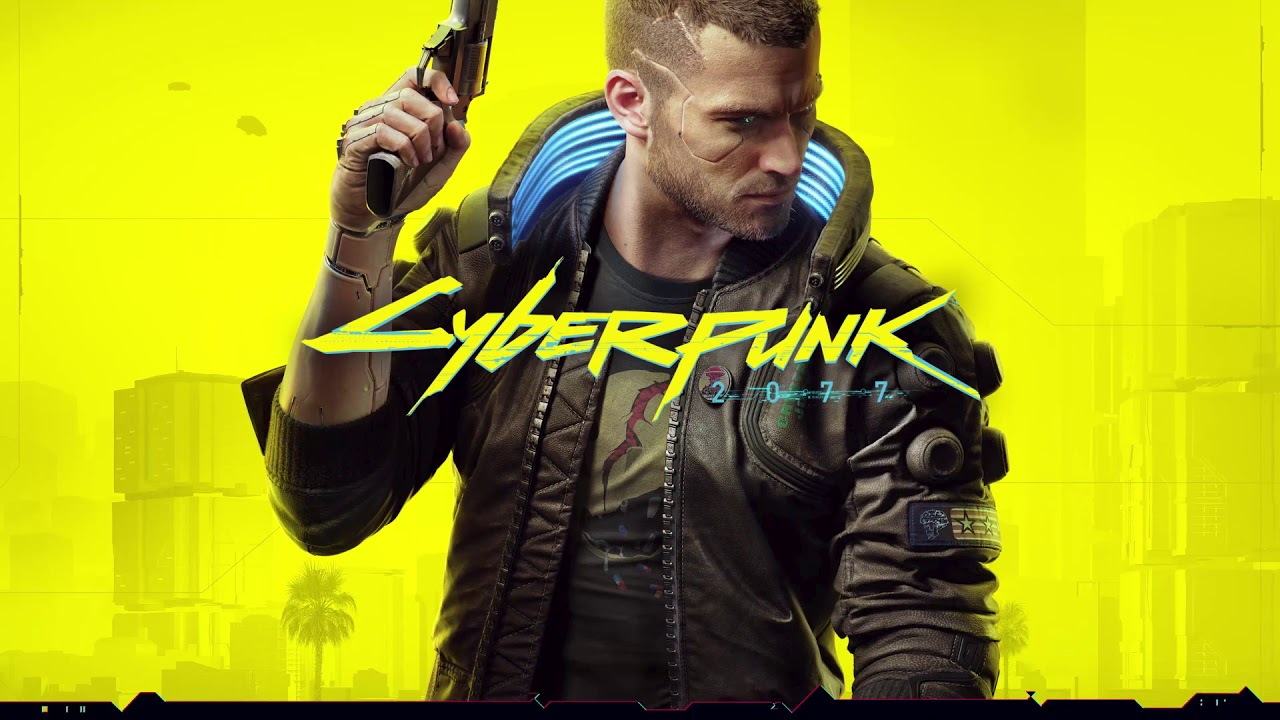
Cyberpunk 2077 is a role playing game (RPG) from CD Project Red, the same developers as The Witcher series. It had a rocky start but has since become a standout, particularly its immersive world, strong exposition and thought-provoking side quests.
Cyberpunk 2077 is a first person RPG using a similar ruleset and setting to the eponymous tabletop RPG. You play as V, a citizen of Night City, a pseudo-San Francisco or Los Angeles. V witnesses the murder of a megacorporation’s owner during a heist gone wrong. Forced to embed a stolen chip in his head while fleeing, V discovers it contains the personality and DNA of the long-dead rockstar and terrorist/freedom fighter, Johnny Silverhand. Now V must solve this mess one way or another before Silverhand takes over his body and mind.
Silverhand is V’s ever-present “lancer” and appears at pivotal moments to provide his perspective. While his self-confidence and aloofness give him superficial charisma, Silverhand is a self-righteous, narcissistic psychopath. You must decide whether V agrees with his single-minded anti-corporation and anti-establishment views, sympathizes with his deeply buried vulnerability or finds his incessant criticisms grating.
Just in case you missed the copious marketing for Cyberpunk 2077, Keanu Reeves provides Johnny Silverhand’s voice and likeness. Silverhand is the opposite of Reeve’s usual humble, softly spoken and slightly vulnerable protagonist. This typecasting sometimes detracts from Silverhand’s intended purposes: a constant reminder of V’s impending doom and a skewed moral compass fitting for an immoral setting.
Mechanically, Cyberpunk 2077 plays like most other RPGs and combines the best aspects of others. Cyberpunk 2077 uses a Witcher 3-like vision mode to scan for clues or interactable objects. The hacking and stealth feel like Deus Ex, although without the omnipresent paranoia. While it lacks police chases, it has the car driving and theft of Grand Theft Auto. “Braindances”, replaying people’s experiences, are similar to watching three-dimensional recordings in Tacoma.
The character advancement options can create unique or, in most cases, derivative characters, from stealthy, handgun-wielding assassins like John Wick to muscled, baseball bat- and minigun-wielding tanks like Arnold Schwarzenegger’s Terminator. Higher-end abilities are potent, fueling power and dominance fantasies.
Cybernetic augmentation is also vital. V starts with basic enhancements such as eyes that can zoom and a computer in his head to view mission briefings and act as a mobile phone. Early enhancements provide additional bonuses while later ones grant new forms of movement, powerful weapons or other surprises.
However, Cyberpunk 2077 goes much further. Cyberpunk 2077 uses cybernetics as a powerful exposition tool in a world where technology surpasses flesh and suppresses individuality. The alien-like dehumanizing enhancements to members of the Maelstrom gang, near interchangeable golden-skinned hotel attendants or the subtle, fashionable enhancements of the elite instantly communicate much about other characters without unnecessary dialog or explanation. Think clothes that you cannot easily change.
The residents of Cyberpunk 2077 even have slang for cybernetics: chrome. It has other jargon, too. People have “chooms” instead of buddies, pals, mates or bros. Only “gonks” (idiots) would rely on “deets” (details or information) that are not “preem” (premium or good). You get paid in “eddies” (eurodollars). The copious voice-acted dialog weaves them into conversations allowing players to infer their meaning and connotation.
Cyberpunk 2077‘sworld-building is broad and deep, and the internal consistency adds realism and believability. The frequent in-game news bulletins, for example, portray a dystopian, corrupt, technologically-dominated future similar to Robocop or Blade Runner. Amidst constant and desensitizing advertisements, radio and TV personalities openly call out the elite’s hypocrisy and power games while relishing the schadenfreude. In-game tobacco advertising has warnings probably only to comply with real-world laws.
The writing continually enforces the setting’s hypercompetitive and unforgiving nature. NPCs and factions have separate and consistent motivations, and V is usually just a tool for their advancement. A small child says your boxing opponent killed their father. Is it true or just a ruse to increase her betting earnings?
The layers of Night City’s neon lights distract from the copious, uncollected trash. The metaphor reflects how the razzle-dazzle barely hides society’s underlying malaise.
Even V’s little flat has no kitchenette. Instead, there’s a vending machine peddling whatever junk food the corporations of the moment deem fit while advertisements sprout insincere warnings about eating organic food.
Cyberpunk, as a genre, has always been more than an aesthetic or bucket for near-future science fiction. It is an avid social commentator, warning that compassion and ethics must bound and guide progress.
Cyberpunk 2077‘s world takes the ideals of right-wing political groups to absurdity. Guns are so prevalent that you can buy plastic, disposable ones from vending machines. The government merely provides services that corporations find unprofitable. Laws exist not to serve or protect society but as blunt instruments of the powerful or as proxies for corporate wars. Society is increasingly stratified. Eighty hour work weeks and forced cybernetic enhancements are considered reasonable. The natural environment crumbles, a necessary price for technological advancement and profit. As one in-game shop owner laments, open expressions of sexuality are considered a social menace, but we must accept murders on every street corner.
The world of Cyberpunk 2077 is different enough to the real world to avoid direct comparisons but is close enough for commentary to be relevant. Its cars are a good example. While there are analogs to real-world brands, all the makes and models are different. Many have a single headlight or brake light and no seatbelts, minimizing safety features to reduce cost or maximize aesthetics. Their barcode-like number plates are for computers to read, not humans. Cars lack indicators, showing a lack of empathy.
Cyberpunk 2077‘s setting is faithful to the 1980s roots of its genre. For example, Japanese corporations were ascendant in the 1980s. Many in the USA feared the conquered would become the conqueror, like in the second Back to the Future movie, and Cyberpunk 2077′sAsaka megacorporation realizes this.
However, some predictions diverged from subsequent real-world advancements and trends. Instead of adding credibility by incorporating forecasts of the future, these now further segregate the game’s setting from reality. Paper magazines with animated pages, for example, hijacked something familiar in the eyes of someone from the 1980s, showing technology’s subtle and insidious progression. However, paper magazines are becoming anachronisms, replaced by purely electronic versions. Much of the Cyberpunk 2077‘s music is 1980s-like electronic and synthpop and not the more urban hip-hop.
Thematically, Cyberpunk 2077‘smain storyline deals with questions of identity and legacy. V has to work out what to do with his (or her) remaining time. Does V go for one last grand heist, allow Silverhand to finish what he started or choose quiet life while still V? Does V rebel against a world where individuals rarely affect meaningful change, finding value in the attempt and the lives touched along the way? Multiple endings provide V with some choice about how to answer.
Beyond the unique premise offered by the setting, the storyline is suitably grand. It is unmistakably cyberpunk and could not exist in any other genre. Each step provides satisfying answers and more yearning questions. It does not always follow the “show, don’t tell” rule of storytelling, but that is more of a guideline.
However, Cyberpunk 2077‘s numerous side quests are far more interesting. For example, the series of Delamin quests deal with artificial intelligence (AI), what rights it has and how it interacts with humans. If an AI creates a copy of itself, are the two copies still one individual, or are they parts of the whole? In the game, AI has displaced many traditional human-only roles like writing novels or fashion design. Should humans fear what AIs can become?
Another recurring but subtle theme is religion and spirituality. It can be a dangerous subject, potentially offending many. However, Cyberpunk 2077 is a world where braindances provide visions as vivid as any religious miracle, moral guidance is greatly needed, and technology offers salvation more tangible than any deity’s promise.
The Sinnerman quest line is the game’s most confronting. A prisoner sentenced to death finds religion. He elects crucifixion and wants his experiences recorded as a braindance for fellow Christians to experience or endure. In a setting with commonplace and fetishized violence, this moment drove introspection more than any other in the game.
Meanwhile, a neon billboard shows a Jesus-like figure but wreathed with network cables instead of a crown of thorns. Do you want to confess your sins? Just visit your nearest automated “Confession Point” vending machine. Buddhist monks ponder whether virtualizing people is compatible with reincarnation or whether an AI can suffer. Tarot cards and imagery not so subtly steer V. AIs are god-like in their stature, facelessness and echoing voice.
Following the RPG trend, V has companions that provide side quests and potentially lead to romance options. Different companions fulfil different sexual orientations, including one that is trans, supporting modern sensibilities and inclusion.
However, some of the impactful companions share genuine vulnerability, contrasting with the setting’s uncaring and brutal reality. Letting kids win at an augmented reality shooting game, for example, has a delightful mundanity and affection that contrasts with the setting’s cynicism.
Cyberpunk 2077 has its share of imaginative and novel quests and environments. One involves SCUBA diving in a flooded town while reminiscing about the displaced inhabitants. You can ride a roller coaster, pilot a tank or riff a guitar solo while playing in a band.
References to other cyberpunk and science fiction media abound, showing light, fourth-wall-breaking humour. You can purchase Kaneda’s red bike from the anime Akira or the Rolls Royce-like FAB 1 from Gerry Anderson’s Thunderbirds. You can find advertisements for mnemonic couriers, similar to Keanu Reeve’s Johnny Mnemonic. The famous “tears in rain” quote from Blade Runner is a memory in the columbarium. One quest pays homage to Portal, using GLADoS’s voice actor and lines. The “baby in a bottle” from Death Stranding appears, and there is even a dig at Star Citizen‘s long development time.
Graphically, Cyberpunk 2077 is beautiful, particularly with ray tracing. I took screenshot after screenshot as the cyberpunk genre’s requisite neon signs and holographs dominated the skyline. Bright lens flares are common enough to make Michael Bay jealous. The sparse but hardy vegetation and red earth of the hills outside Night City resemble postcards of the US midwest. Rain is wonderfully dreary and leaves humble, reflective puddles.
Cyberpunk 2077 uses a “film grain” effect and vignette over its visuals. Like the gold filter used in the Deux Ex series, this effect makes the game visuals distinctive and slightly unreal. It also helps cover a few errant pixels caused by NVidia’s DLSS or similar compromises for the more demanding ray tracing.
The main criticism of Cyberpunk 2077 was the bugs present at the launch. Some were meme-worthy and game-breaking. These problems are common in the industry, especially in large, open-world RPGs or anything developed by Bethesda. However, recent updates have vastly improved Cyberpunk 2077’s quality, and my 100-hour playthrough starting on version 1.3 was practically glitch-free.
Some feel the sidewalk-infesting crowds should be persistent or that they add unnecessary clutter. Previous games eschewed clutter to reduce rendering costs and highlight the environment’s important parts. However, along with the omnipresent neon and holographic signage, the game intentionally visually assaults the player. It takes time in Cyberpunk 2077 to mentally adjust and filter out the noise of Night City, just like its inhabitants do.
Others complain the setting is unrealistic, a caricature of near-future USA. For example, the populace would rebel against corporations or that the claimed murder rate is higher than the birth rate. Debating sociology or economics is beyond the scope of this review. However, the setting provides opportunities where no one is uniquely or consistently good or evil, creating opportunities to side with or against anyone. The setting’s details are intentionally vague, meaning realism can be hand-waved or retrofitted if needed.
Similarly, the world of Cyberpunk 2077‘s technological inequality means MacGuffins and opportunities are plentiful, but society is still familiar. For example, the head of a megacorporation could live forever, while most live regular if not brutal lives. Meanwhile, the asymmetry offered by hacking allows a prodigious youngster to threaten the same megacorporation.
Some criticize the game’s mechanics as shallow. For example, having crimes without pursuing police or car chases feels unrealistic. However, this does not materially harm the game. It only means Cyberpunk 2077 is not Grand Theft Auto. People would have loved to see working trains for a deeper immersion. However, the development effort required is likely not worth the minimal increased sales or goodwill.
The sizable modding scene already addressed issues like police chases and working trains, anyway. Like Skyrim and other RPGs, many strive to fill the gaps or improve the game.
The most significant criticism I had was the awkward keyboard and mouse controls for driving. However, the racing side quests are forgiving, crashes are only minor annoyances, and you eventually compensate for the poor control scheme.
Like many long RPGs, Cyberpunk 2077 is a game you stop playing rather than merely complete. A game this long and involved becomes familiar. Leaving it is like ending a beloved television series.
CD Project Red has faithfully recreated the table top RPG’s setting in both form and spirit. It is fertile ground for many more engaging stories and insightful commentaries about modern social, economic and technology trends. It is a pity that Cyberpunk 2077‘s initial launch was so poor. Many will only recall the game’s early failures and not its world and potential for so much more.
While I did not watch or follow it, I am familiar with Critical Role’s phenomenally successful live stream Vox Machina like most gamers. Amazon Prime’s animated adaptation promised to bring the familiar characters and adventures to a different screen while remaining faithful to its light-hearted but adult premise.
I find using the term “adaptation” strange. It acknowledges that what works for a Dungeons and Dragons (D&D) live stream may not work for an animated series. They are different media.
For example, D&D’s combat mechanics have always been abstract, focusing on die rolls and points systems to represent to tos and fros. Any narrative is emergent, like a lucky high dice roll or a string of unlucky low ones. D&D’s mechanics for hitting secret weak points or fighting internal struggles, both present in the show, are absent or poor.
The enjoyment of D&D comes from the interplay between friends sitting around a table. The players inject modern attitudes and sensibilities into a medieval-like fantasy world that lacks real repercussions for the players, if not their characters. D&D allowed players to be superheroes before superheroes were cool.
Unlike traditional media, D&D players save the world not because the story demands it but through agency and collaborative story-telling. While D&D’s designers biased the mechanics toward the players, failure is often only a single dice roll away. Real-life intrusions also mean players sometimes need to be absent, like Pike’s pilgrimage.
That said, Vox Machina‘s live stream was always partially scripted. Preparing songs or inter-player interactions is, otherwise, difficult.
These factors put the show The Legend of Vox Machina (or just Vox Machina) in an enviable and challenging position. Enviable because its huge audience will enjoy the new perspective on familiar characters and events. The group’s adventures already contain narrative highs, twists and lows.
However, its position is challenging because combat in most media is a narrative tool, not the central focus as in D&D. Narrative twists in D&D, like betrayal, need to be simple and telegraphed to see them amongst distracting banter. Players relish tropes at the game table that can be tired and overused in traditional media.
On the whole, Vox Machina delivers. The players, an extended “five-man band”, work through two story arcs, with the Briarwood arc being the longest. There are enough turns to keep the audience guessing and subtle nods to the live stream for long time watchers to feel nostalgic, like problems with opening doors.
Vox Machina has had to divest itself of anything potentially trademarked or copyrighted. Gone are the signature D&D spells and abilities and Scalan’s lewd songs. However, the show suffers little for their loss. Divorcing it from pop culture and D&D’s rules make the show more accessible and timeless. Compressing forty hours of D&D down to six also forces the show to focus.
The main problem with Vox Machina is its contemporary fantasy animations, like Arcane, offer far deeper thematic treatment. While humanizing the Briarwoods and Percy dealing with the overwhelming desire for revenge are notable, the show’s roots in D&D keep it superficial. It mainly falls back on the milquetoast “strength of friendship”.
Vox Machina’s D&D roots also constrain character development. Percy’s revenge arc and a short, shallow romantic plotline notwithstanding, the characters exist as escapist fantasy – the tabletop equivalent of sports stars – and not tools in a storyteller’s toolset. Other tabletop role playing games have better mechanics to capture and tell these stories.
However, Vox Machina heralds a new acceptance of tabletop role playing games like D&D. Gone are the 1980s when special interest groups ignorantly decried it as a bastion of satanism and witchcraft. Several unmemorable D&D movies came and went. With the increasing “nerdification” of popular culture, D&D has gone from lounge rooms to Twitch streams to standing shoulder-to-shoulder with more accepted media.
As someone that has enjoyed tabletop games for over thirty years, I would have loved to share many of my adventures. While many fantasy tabletop adventures resemble Monty Python more than Tolkein and science fiction tabletop adventures resemble Douglas Adams more than Asimov, they are still communal experiences in popular culture.
Vox Machina gets to the heart of what makes D&D great. It is not using signature spells or characters from published settings. It is channelling the camaraderie and humour of friends sitting around a table without degenerating into farce. Vox Machina teases fourth wall breaks without doing so, having fun without self-deprecation.
Vox Machina is a good show and a great adaptation. Its D&D roots both propel it with momentum and enthusiasm and constrain it from anything too deep. Existing fans will find it enthralling, non-fans possibly less so, but its fast pace and accessibility will enamour it to many.
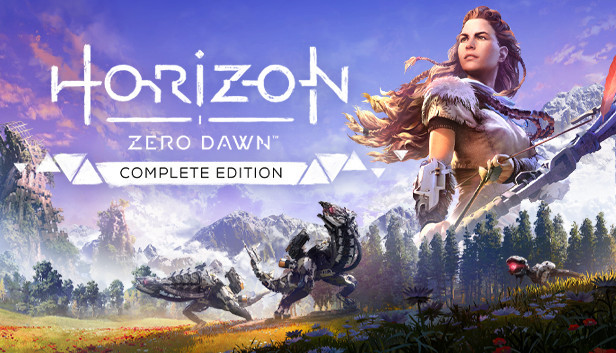
Without reading any of the copious reviews and material on Horizon: Zero Dawn, it is obvious the elevator pitch was akin to “bows and arrows against robotic dinosaurs”. If this game were just a first-person shooter, it would have been merely notable. However, it is so much more.
Horizon: Zero Dawn is a post-apocalyptic, action role-playing game with a third-person camera view. You play as Aloy, an outcast with an unexplained past. A chance encounter as a child in an ancient ruin provides a “focus”: a small, temple-attached device that interacts with ancient computers and detects nearby enemies. When she comes of age, Aloy initially tries to prove herself to her tribe but is then catapulted into a much larger story.
The combat system is the game’s main drawcard. The robotic targets are stronger and tougher than Aloy, particularly in melee. Success requires planning, stealth, laying traps, using terrain, targeting specific components revealed by Aloy’s focus or using particular damage types. Later, Aloy gains the ability to befriend temporarily or ride weaker robots.
These elements create a more cerebral combat system, requiring the forethought and timing of a true hunter. Learning strategies for specific enemy types through experimentation makes combat more straightforward and predictable. Successfully taking down larger robots for the first time is exhilarating.
However, the need for planning or enemy-specific strategies can be challenging early in the game. Limited save points (bonfires) can make the game unforgiving but ensures players do not expend too much ammunition when they fail.
Aloy will not get far without crafting or, more accurately, collecting resources. Aloy can craft ammunition and consumables, even in combat, and will need to do so for longer fights. However, besides giving the sense of “living off the land” and that robots are a resource humanity exploits, the game would have lost little by omitting it and increasing carrying capacity instead.
Exploration is a huge part of the game. Apart from providing crafting materials, exploration offers glimpses into the ancient world through ruins or still functional devices that Aloy can interact with using her focus. There are a few collection quests, and players can purchase maps to help.
The game contains vertigo-inducing but simple climbing puzzles, like the Assassin’s Creed series, and tracking via her focus, like Geralt from The Witcher series. These are integrated well into quests but add variety more than a challenge.
The second drawcard of Horizon: Zero Dawn is its story and themes. Unlike many post-apocalyptic games, Horizons: Zero Dawn isa game about hope. It portrays the apocalypse that befell the ancients with desperation, humanity and grim determination through ghostly holograms and diaries. However, Aloy describes these as “memories”, segregating them from her time as humanity finds its new footing.
The game’s environment reflects this hope. The new world is lush and vibrant. Unlike the muted greys and browns of the Fallout series, there are vivid greens during daylight, faerie-like moonlight and fireflies at night and beautiful reds, pinks and oranges at dawn and dusk. The highly saturated colour palette is more reminiscent of Terra 2 from The Outer Worlds.
The soundtrack, particularly “Aloy’s Theme”, simultaneously mourns the loss of the old world and holds quiet, resolute hope for the new one. The flutes, reed instruments and drums give it a tribal or primitive feel. Julie Elven’s wordless vocals give it a delicate solemnity befitting the game’s strong female protagonist.
The game uses perspective, both Aloy’s and the players, to demonstrate Aloy’s character and build the world around her. Initially, these perspectives are identical. The story starts with Rost, Aloy’s father-like stoic mentor, explaining little and frustrating both the player and Aloy. Aloy is an outsider, a literal outcast from the Nora tribe, and she slowly but resolutely learns about her tribe, fights for a place in it and then progressively the broader world. The player learns with Aloy.
However, the perspective soon diverges. The flashback storytelling mechanism granted by Aloy’s focus shows her insights into the ancient world like advertising or chats between Internet hackers. These would, at best, confuse her. However, the player can understand it and contrast the pre-apocalypse world with the real world.
The environment also invites a dual perspective. A chunk of twisted metal to Aloy is an abandoned car to the player. A strange stone outcrop to Aloy is a ruined building to the player. Is the function of a mug evident to someone who has never seen one?
This dual perspective is also apparent in Aloy’s interactions. For example, Aloy’s first encounter with Erend sees him try to chat her up. He thinks she is just a naive native girl. However, Erend’s intentions are lost on Aloy in this delightfully subtle exchange. Aloy is steadfast but not omniscient, giving her room to grow and making her sympathetic.
These perspectives converge as Aloy learns about herself and the world. This change is not just the bigger picture thinking common to RPGs as the protagonist gains levels, explores the setting and progresses the story. For example, Aloy initially considers Teersa, one of the Nora tribe’s high matriarchs, wise and compassionate. Later, Aloy and the player look at Teersa with wiser eyes, seeing Teersa’s limitations and ignorance.
Aloy’s primary motivation is compassion, even after being initially an outcast. She helps others, not for reward but because she intrinsically knows it is the right thing to do. I found this altruism interesting and refreshing. Modern games often try to give players different moral choices. I tend to pick the “good” option like many, but an “evil” or selfish Aloy would be inconsistent.
Contrast this with Sylens, revealed later in the story and one of the more memorable characters from an otherwise unmemorable cast. I initially saw a second Rost, mirroring Rost’s stoicism and refusal to explain his past and motives. Whereas Rost was a mentor to guide and assist Aloy with the new world, Sylens was one for the ancient world. However, Sylen’s lack of empathy and unforgiving nature hint at something else. He reflects the ancient world’s complexities and compromises.
Horizons: Zero Dawn also examines the decoupling of knowledge from wisdom. Knowledge without wisdom leads to greed and hubris (and the apocalypse that befell the ancients) or exploitation (Sylens). Wisdom without knowledge leads to vapid kindness or irrational cruelty (the Nora high matriarchs). It is easy to see modern parallels.
As for criticisms, those looking for something more gritty may find the altruism and use of the “chosen one” trope trite. Despite the original setting and robotic enemies, Horizon: Zero Dawn relies on many well-trodden RPG elements. Any inclusion of relatable primitive or tribal humans invites criticism. The PC port could have leveraged the keyboard better and relied less on the cumbersome combat wheel.
However, Horizons: Zero Dawn does so much right to be a “must play” for hopeful explorers looking for a slowly revealed but emotionally powerful story. The 30 to 80 hours required to play the game, depending on how sidetracked they get, is not something they will regret.
The Outer Worlds, a science fiction action adventure role playing game, is a spiritual successor to Fallout: New Vegas. While Bethesda developed most of the revamped Fallout series, Obsidian Entertainment developed Fallout: New Vegas, widely considered to be amongst the best of them. Obsidian has done it again.
The “Fallout” series contrasted blithe advertising against bleak nuclear devastation to show how consumerism had detached us from reality, like a subtler Rad Bradbury’s There Will Come Soft Rains. This contrast was particularly evident of the pro-industry, pro-American optimism and nationalism of the 1950’s, whose aesthetic the “Fallout” series borrowed for its retro-futuristic style.
However, The Outer Worlds takes this in a different direction. It retains the futurist 1950’s aesthetic but immediately confronts the player with capitalist authoritarianism. What starts as kitsch descends into absurdity then horror as the bureaucratic oppressiveness and repetitive, vapid advertising jingles grate.
Meanwhile, the almost surreally vibrant alien landscapes replace the bleak, practically monochromatic art style of the “Fallout” series’s post-nuclear war America. The scene is relatable enough with plants and water and clouds. However, the plants are strange puffballs and oversized mushroom trees. While the pinks and oranges of clouds in a sunset are beautiful, they are set beneath the red rings of an alien gas giant.
This alienness extends to its soundtrack. As the character first steps onto a planet, the music has sequences of solos followed by answers from the broader orchestra after unsettling, awkward pauses. Even the title theme played over the main menu starts with two flutes playing at their lowest register, giving an ethereal feel, followed by a subdued, almost mournful but resolute motif.
Both the music and art differentiate scenes and anchor the player in a location. For example, a visual overload of neon assaults the senses as the door to the promenade on the Groundbreaker recedes. The bass riffs with subtle harmonica overtones played when entering the Edgewater are reminiscent of the wild west. The intense primary colours of Terra 2 (green grass, blue water or red lava and rings) contrast against the yellow, sulphurous tones of Monarch and the dull, monotonous grey of Byzantium.
Like the “Fallout” series, The Outer Worlds thrusts the player as an outsider into a plot that subverts the status quo. Whether this subversion is for the better or worse is determined by the player’s choices. The ultimate enjoyment of the game is exploring choice and effect. A cathartic, offensive approach is an option but finding the best outcome, typically a non-violent compromise, is often harder, requiring exploration and lateral thinking.
Mechanically, The Outer Worlds is generally an evolution from standard science fiction RPG fare. As the character advances through levels, they increase skills and choose special abilities, called perks, that give bonuses. A time dilation mechanic replaces “Fallout”’s VATS, allowing the player to aim at discrete body parts to inflict penalties like blindness for a headshot. There are crafting mechanics for those so inclined.
However, the “flaw” system is noteworthy. They allow taking penalties for a bonus perk. As tabletop RPG game designers have known for some time, imperfect characters are often more fun to play than perfect ones. Flaws enshrine role playing decisions into mechanics and give a greater challenge. They are optional but must be earned. For example, you can gain phobia of a particular species, represented by temporary penalties, by fighting them too often.
The Outer Worlds also adds a new stealth mechanic by adding a personal holographic projector. Instead of save scumming your way around guards, after finding the appropriate MacGuffin, you disguise yourself as one of them but with a strict time limit. When it expires, you can renew the time limit by convincing a guard to let you pass, a task that becomes more difficult each time you try. It makes a welcome change of pace.
As for side quests, the inclusion of Pavarti’s love affair with Junlei as most fleshed-out companion quest will wrinkle the nose of some as political correctness. However, her endearing awkwardness, the relationship’s slow build and the absence of physical love scenes create a restrained and mature approach often lacking in earlier RPGs like Mass Effect.
Including Scientism, a religion to underpin the authoritarianism is a brilliant piece of world-building. Why justify people’s caste-like working conditions when you make it religious duty? Why circumvent science like other religions when you can justify fate with mathematical determinism? More exploration of these through the eyes of your companion Vicar Max or the NPC Graham would have been fascinating.
However, the purpose of religions like Scientism and its polar opposite, Philosophism, is not existential introspection like in Nier: Automata. Instead, they are contrasting strawmen, both with good and bad points. They allow the player to plot themselves on a spectrum and appreciate significant decisions are often between imperfect options.
The Outer Worlds is also not without humour. While it eschews overt pop culture references to emphasise the setting’s remoteness, it does not take itself too seriously. The deadpan sarcasm of ADA, your ship’s onboard computer, sometimes takes a moment to process but leaves a wry smile. The conversation options to persuade guards to let you pass alludes to Obi-Wan Kenobi’s “these are not the Droids you are looking for” from Star Wars. The name of your ship, the “Unreliable”, is self derogatory. There is even an achievement for shooting at opponent’s crotches during time dilation.
The Outer World’s single-player campaign as twenty to thirty hours of gameplay, depending on how much you explore or indulge the side quests. This game, a homage and evolution of the “Fallout” series, is lovingly crafted and I look forward to the inevitable sequel.










 The Outer Worlds, a science fiction action adventure role playing game, is a spiritual successor to Fallout: New Vegas. While Bethesda developed most of the revamped Fallout series, Obsidian Entertainment developed Fallout: New Vegas, widely considered to be amongst the best of them. Obsidian has done it again.
 The Single Player