

Chants of Sennaar is a 3D puzzle game developed by Rundisc. It focuses on decoding and translating languages, combining the deductive reasoning from The Return of the Obra Din with the language learning from Heaven’s Gate.
The goal of Chants of Sennaar is to ascend to the top of a vast tower, learning the language of each level’s inhabitants as you go. Of course, nothing tells you that. You infer it from the game’s conversations and level design.
The mechanics of learning languages are simple and ingenious. You encounter glyphs, symbols that represent words, in writing, signs, or conversation. You infer a glyph’s meaning from its context. For example, a glyph on a sign over a bottle probably means bottle.

You automatically capture glyphs in your notebook, where you can type in a meaning or clue. Those meanings are written above the glyphs, giving a rough translation on the fly. You can then iterate with different meanings until you are happy.
Occasionally, you draw pictures in your notebook and then match glyphs to their drawings. If you get all the glyphs correct, the game confirms their meanings, making inferring the meaning of other glyphs easier. In the worst-case scenario, you can keep guessing until you get it right.
Clearly, the main challenge in Chants of Sennaar is inferring or deducing the meanings of glyphs. The languages are simple, restricted to 40 to 50 words each. Some languages even embed hints or patterns in the glyphs themselves.
However, decoding languages is not straightforward. The tower’s levels are non-linear, so missing a vital clue is easy. Language and meaning are also flexible. If I see a glyph next to an arrow pointing up, does the glyph mean up, high, north, ascend, or just arrow?
Meanwhile, Chants of Sennaar is a puzzle game at heart. Beyond language translation, some puzzles are stealth sections where you must sneak past guards. Some areas are maze-like. Some have simple lever combinations. Sometimes, you must find an item that will unlock a puzzle elsewhere. The variety keeps things fresh. There is even a Flappy Bird mini-game to find.
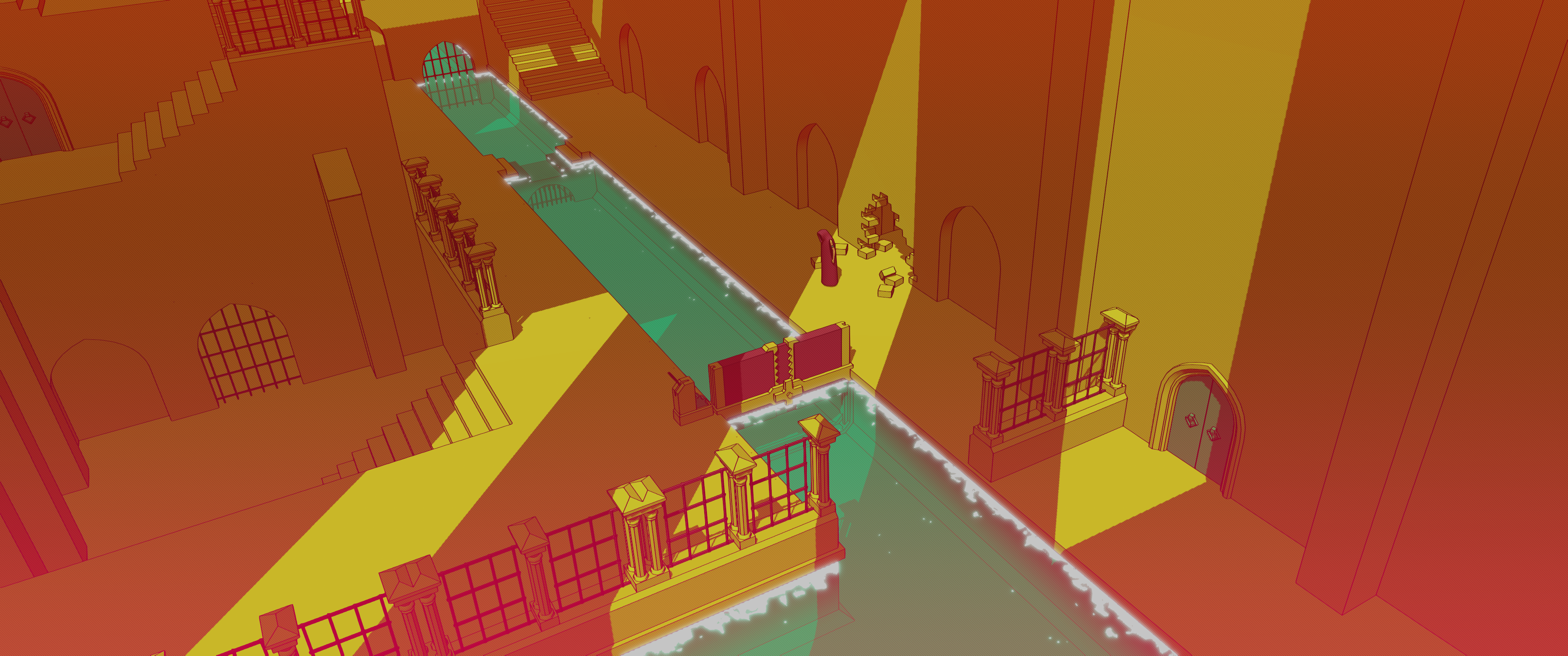
The game’s cel shaded art style is simplistic but on point. For example, the yellow and orange walled areas of the Devotees, complete with cats and crows, are obviously different from the blue walls and red water of the Warriors, complete with distant but intrigued lizards.
The audio and soundtrack are subtle but thematic. Early pieces are mainly orchestral but include obscure instruments, drums, claps and other tribal influences to give it a primitive feel. The instrument balance shifts subtly as you progress and discover the true nature of the tower. The audio is mainly environmental, with wonderfully high-quality bubbling water and wind at times.
My criticisms of Chants of Sennaar are few. While the game tracks the glyphs and meanings, it does not track word order. This omission makes translating between some languages more challenging. You can repeat conversations, but you do not track them in your notebook. This decision keeps your notebook decluttered but means you must return to where that conversation occurred to replay it. Some puzzles get obtuse toward the end, too.
Overall, completing Chants of Sennaar is a cerebral ten to fifteen hours for those who love language puzzles. If you do not, this game will be frustrating, boring or both. However, given that its rarest achievement has a 25.8% completion rate at the time of writing, Chants of Sennaar has found its feet with a niche but dedicated audience.
 The Single Player