
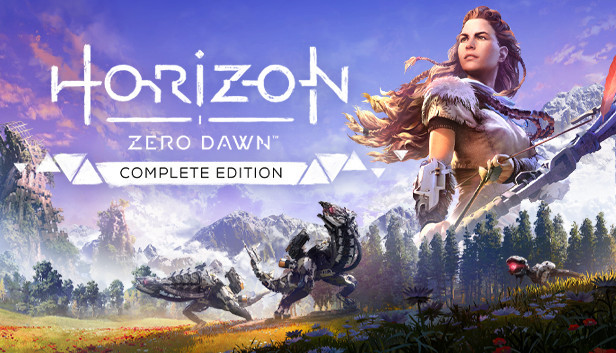
Without reading any of the copious reviews and material on Horizon: Zero Dawn, it is obvious the elevator pitch was akin to “bows and arrows against robotic dinosaurs”. If this game were just a first-person shooter, it would have been merely notable. However, it is so much more.
Horizon: Zero Dawn is a post-apocalyptic, action role-playing game with a third-person camera view. You play as Aloy, an outcast with an unexplained past. A chance encounter as a child in an ancient ruin provides a “focus”: a small, temple-attached device that interacts with ancient computers and detects nearby enemies. When she comes of age, Aloy initially tries to prove herself to her tribe but is then catapulted into a much larger story.
The combat system is the game’s main drawcard. The robotic targets are stronger and tougher than Aloy, particularly in melee. Success requires planning, stealth, laying traps, using terrain, targeting specific components revealed by Aloy’s focus or using particular damage types. Later, Aloy gains the ability to befriend temporarily or ride weaker robots.
These elements create a more cerebral combat system, requiring the forethought and timing of a true hunter. Learning strategies for specific enemy types through experimentation makes combat more straightforward and predictable. Successfully taking down larger robots for the first time is exhilarating.
However, the need for planning or enemy-specific strategies can be challenging early in the game. Limited save points (bonfires) can make the game unforgiving but ensures players do not expend too much ammunition when they fail.
Aloy will not get far without crafting or, more accurately, collecting resources. Aloy can craft ammunition and consumables, even in combat, and will need to do so for longer fights. However, besides giving the sense of “living off the land” and that robots are a resource humanity exploits, the game would have lost little by omitting it and increasing carrying capacity instead.
Exploration is a huge part of the game. Apart from providing crafting materials, exploration offers glimpses into the ancient world through ruins or still functional devices that Aloy can interact with using her focus. There are a few collection quests, and players can purchase maps to help.
The game contains vertigo-inducing but simple climbing puzzles, like the Assassin’s Creed series, and tracking via her focus, like Geralt from The Witcher series. These are integrated well into quests but add variety more than a challenge.
The second drawcard of Horizon: Zero Dawn is its story and themes. Unlike many post-apocalyptic games, Horizons: Zero Dawn isa game about hope. It portrays the apocalypse that befell the ancients with desperation, humanity and grim determination through ghostly holograms and diaries. However, Aloy describes these as “memories”, segregating them from her time as humanity finds its new footing.
The game’s environment reflects this hope. The new world is lush and vibrant. Unlike the muted greys and browns of the Fallout series, there are vivid greens during daylight, faerie-like moonlight and fireflies at night and beautiful reds, pinks and oranges at dawn and dusk. The highly saturated colour palette is more reminiscent of Terra 2 from The Outer Worlds.
The soundtrack, particularly “Aloy’s Theme”, simultaneously mourns the loss of the old world and holds quiet, resolute hope for the new one. The flutes, reed instruments and drums give it a tribal or primitive feel. Julie Elven’s wordless vocals give it a delicate solemnity befitting the game’s strong female protagonist.
The game uses perspective, both Aloy’s and the players, to demonstrate Aloy’s character and build the world around her. Initially, these perspectives are identical. The story starts with Rost, Aloy’s father-like stoic mentor, explaining little and frustrating both the player and Aloy. Aloy is an outsider, a literal outcast from the Nora tribe, and she slowly but resolutely learns about her tribe, fights for a place in it and then progressively the broader world. The player learns with Aloy.
However, the perspective soon diverges. The flashback storytelling mechanism granted by Aloy’s focus shows her insights into the ancient world like advertising or chats between Internet hackers. These would, at best, confuse her. However, the player can understand it and contrast the pre-apocalypse world with the real world.
The environment also invites a dual perspective. A chunk of twisted metal to Aloy is an abandoned car to the player. A strange stone outcrop to Aloy is a ruined building to the player. Is the function of a mug evident to someone who has never seen one?
This dual perspective is also apparent in Aloy’s interactions. For example, Aloy’s first encounter with Erend sees him try to chat her up. He thinks she is just a naive native girl. However, Erend’s intentions are lost on Aloy in this delightfully subtle exchange. Aloy is steadfast but not omniscient, giving her room to grow and making her sympathetic.
These perspectives converge as Aloy learns about herself and the world. This change is not just the bigger picture thinking common to RPGs as the protagonist gains levels, explores the setting and progresses the story. For example, Aloy initially considers Teersa, one of the Nora tribe’s high matriarchs, wise and compassionate. Later, Aloy and the player look at Teersa with wiser eyes, seeing Teersa’s limitations and ignorance.
Aloy’s primary motivation is compassion, even after being initially an outcast. She helps others, not for reward but because she intrinsically knows it is the right thing to do. I found this altruism interesting and refreshing. Modern games often try to give players different moral choices. I tend to pick the “good” option like many, but an “evil” or selfish Aloy would be inconsistent.
Contrast this with Sylens, revealed later in the story and one of the more memorable characters from an otherwise unmemorable cast. I initially saw a second Rost, mirroring Rost’s stoicism and refusal to explain his past and motives. Whereas Rost was a mentor to guide and assist Aloy with the new world, Sylens was one for the ancient world. However, Sylen’s lack of empathy and unforgiving nature hint at something else. He reflects the ancient world’s complexities and compromises.
Horizons: Zero Dawn also examines the decoupling of knowledge from wisdom. Knowledge without wisdom leads to greed and hubris (and the apocalypse that befell the ancients) or exploitation (Sylens). Wisdom without knowledge leads to vapid kindness or irrational cruelty (the Nora high matriarchs). It is easy to see modern parallels.
As for criticisms, those looking for something more gritty may find the altruism and use of the “chosen one” trope trite. Despite the original setting and robotic enemies, Horizon: Zero Dawn relies on many well-trodden RPG elements. Any inclusion of relatable primitive or tribal humans invites criticism. The PC port could have leveraged the keyboard better and relied less on the cumbersome combat wheel.
However, Horizons: Zero Dawn does so much right to be a “must play” for hopeful explorers looking for a slowly revealed but emotionally powerful story. The 30 to 80 hours required to play the game, depending on how sidetracked they get, is not something they will regret.
 The Single Player