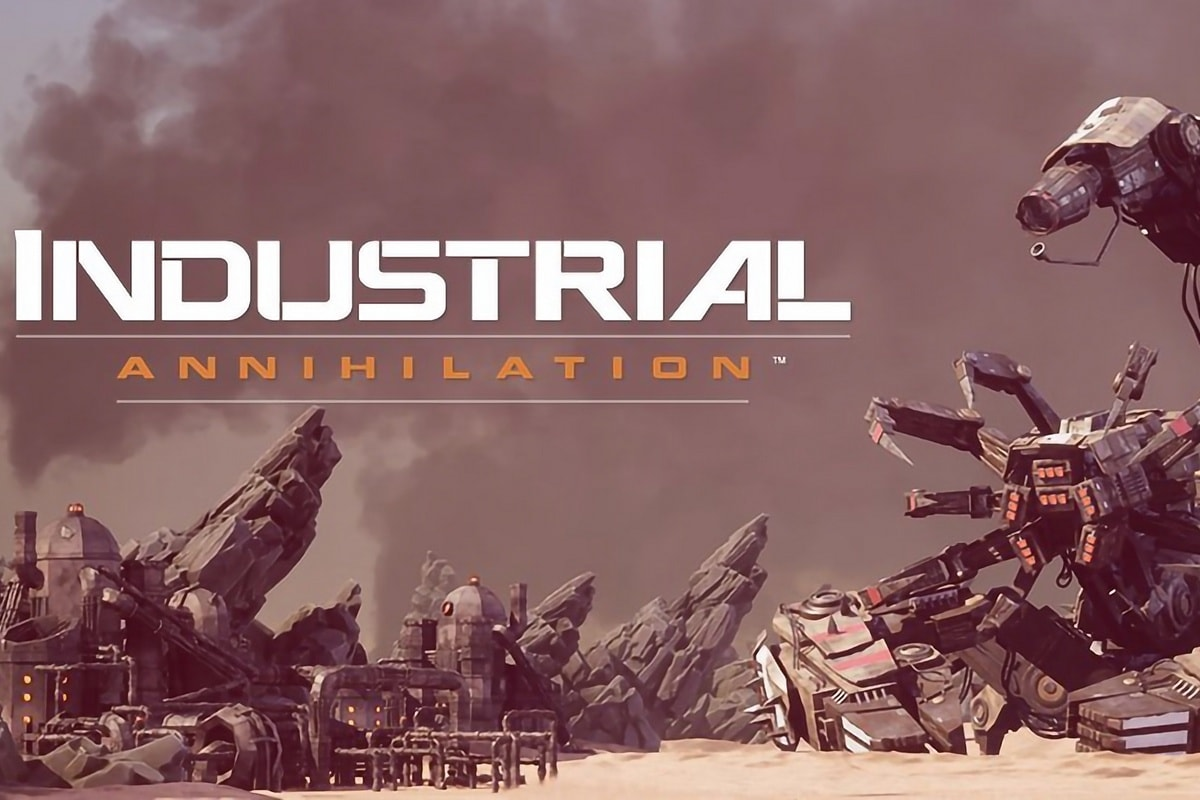
I was lucky enough to receive an early access code for Industrial Annihilation. Initially, it appears to be a standard real-time strategy (RTS) game. You play a giant robot commander teleported onto a battlefield who then gathers resources, builds a base, and raises an army to defeat opponents.
The main difference between Industrial Annihilation and previous RTS games is logistics. Resources must be physically transported between buildings via conveyor belts or trucks. Mid- and late-game buildings or units also require intermediate components instead of just mined or gathered resources.
As a result, Industrial Annihilation is as much a factory game, like Factorio, as it is an RTS, like Planetary Annihilation. Experienced factory game players will feel at home with the early access version’s more strategic, measured play that optimizes base building. However, experienced RTS players may miss the hectic urgency to out-build, out-manoeuvre and destroy their opponents.
Unfortunately, the early access version of Industrial Annihilation does not address how these disparate play styles will complement each other. While both modern RTS and factory games have roots in early RTS games, each engages distinct player groups. The success of Industrial Annihilation hinges on their synergy.
As expected, the pre-release version is not what we would expect from a completed game. For example, Industrial Annihilation comes with a four-mission campaign. These are intended as tutorials, but guidance is minimal. The player has to figure out what buildings and units do and how to achieve the required goals. This can be fun but also tiresome and frustrating.
Moreover, Industrial Annihilation lacks many quality-of-life features, like showing the unit’s weapon range, an energy management overview or double tapping a group’s number to centre the camera on it. Placing conveyor belts and connectors is fiddly. The audio is minimal. You cannot even save your game, so if you get impatient during a tutorial mission and go blasting away with your commander, you may need to replay the entire multi-hour mission if you screw up.
Releasing a version of the game in this state is risky. Many have criticized the developers for Industrial Annihilation‘s poor quality and unclear vision. Early access games are often more polished and complete. However, releasing an early access version is also a brave attempt to engage the player base early to find bugs and elicit broad feedback.
Whether you should engage with Industrial Annihilation now depends on your tolerance for in-complete software and whether you want to be part of the development journey. Industrial Annihilation has the potential for something special, but it is only potential for now.
Everspace 2 is a space fight simulator with 3D movement focusing heavily on combat, exploration and puzzles. Rockfish Games, the developer, describes Everspace 2 as a “space shooter” with “RPG elements” on its Steam page. That is untrue. Everspace 2 is an action role playing game (ARPG) like Diablo or Path of Exile. And it is terrific.
You play Adam Roslin, an ex-military fighter pilot working for an uncaring and manipulative corporation. After a routine mission goes wrong, you are captured by outlaws and escape to a long abandoned base. You and your fellow escapees then rebuild and prepare for a heist that could set you all free.
Flying your ship in Everspace 2 is a joy. The controls are less detailed than those of more complex space simulators like Elite Dangerous. Still, such an outwardly arcade-like game offers a surprising degree of control. Dodging enemy fire, circling capital ships, and navigating maze-like tunnels all feel fluid and natural.
The combat is vibrant, frantic and engaging. Like most ARPGs, you usually fight swarms of weaker enemies, each with different weapons, defences, and abilities. This structure provides constant variety and changing tactics. Your relative strength also fuels the requisite power fantasy.
A warm red star and a blue nebula shine through an asteroid field
Locations also contain puzzles, providing cerebral but slower-paced play. As you fly around, your sensors can detect and track nearby loot, mineral deposits or other points of interest. Your ship has a tractor beam that you can use to pick up and move things around, such as removing debris from a passage or picking up a battery to slot it into a socket elsewhere. These usually unlock doors or containers of potential ship upgrades.
Everspace 2 tells its main story through cut scenes showing hand-drawn images with voice-overs. While low-budget, this style works well for a game focused on flying spaceships. The main quest has excellent pacing while introducing more about the universe and its inhabitants.
There are plenty of side quests and activities, too. As with many RPGs, they are often the most interesting, flesh out the world and introduce unique NPCs. Chasing rogue AIs, rescuing trapped miners, or appeasing crime lords are all on the cards. Racing tracks and rifts filled with difficult enemies satiate those seeking a challenge.
Mechanically, Everspace 2 is a testament to game balance. Everything, including your character, gear, and enemies, is geared to a level. Level differences are more pronounced than in other games. Foes more than a few levels above you are deadly. Those a few levels beneath you will be merely speed bumps. Everspace 2 periodically increases the level of enemies to keep the challenge consistent.
A ringed planet seen from the surface of a desert planet
Aesthetically, Everspace 2 is beautiful. Each location is a postcard, with asteroids, massive space stations, aging wrecks, vertigo-inducing icebergs and/or vibrant nebulae. Many are varied and original, like an iceberg in a solar flare or a megafauna skeleton, evoking wonder and appreciation. Each star system also has its distinct look, making them feel unique.
The electronica soundtrack is also on point, supporting the sci-fi feel. The zen-like cruising pieces contrast with the exciting, upbeat combat ones.
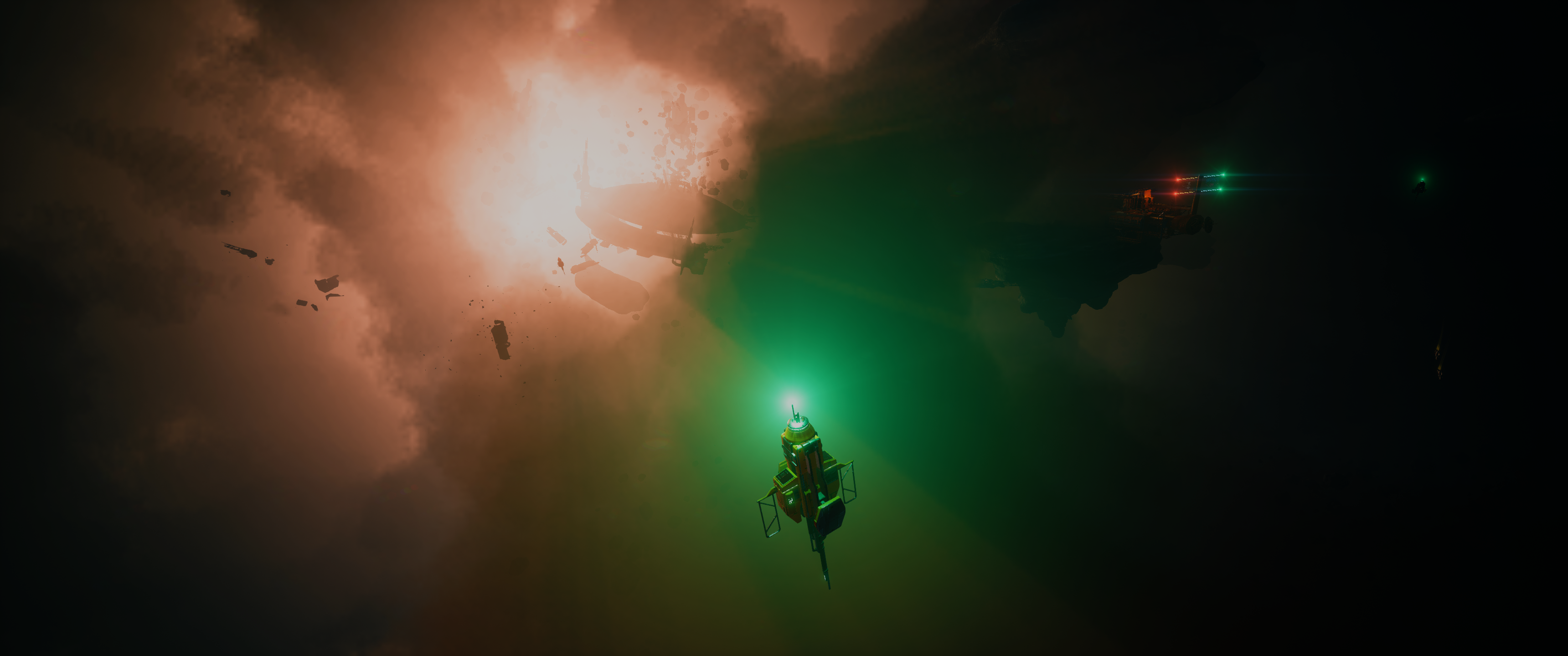
A green beacon in the middle of a dark gas cloud
However, Everspace 2 is not perfect. My biggest gripe is with the writing in the main storyline. No one expects deep or complex writing from an ARPG, but this does not excuse poor writing.
The characters need more substance. Ben and Delia are just cardboard cutouts and deserve motivation and agency. Maddock becomes a contrived, grumpy omni-antagonist. Combining some supporting characters, like Ben and Tareem, would have enhanced both. Everspace 2 also unnecessarily sexualizes a female supporting character at one point.
Similarly, the early main story has too much “I need you to do this, but I am not going to tell you why for at least two cut scenes.” It feels unnecessarily opaque and confrontational. The game also removes the player’s agency at a few key moments, railroading you.
My other gripe is with loot management. Most of the copious loot enemies drop is trash you sell or disassemble for crafting components. The rare upgrade is fun, and Everspace 2‘s crafting system means you will always have suitable weapons, modules or consumables.
However, the constant gear drops and level churn mean periodically yanking yourself out of the fun combat and puzzle game loops to clear your inventory. Loot management is a broader problem with ARPGs’ variable intermittent reward structure, but it is still a problem.
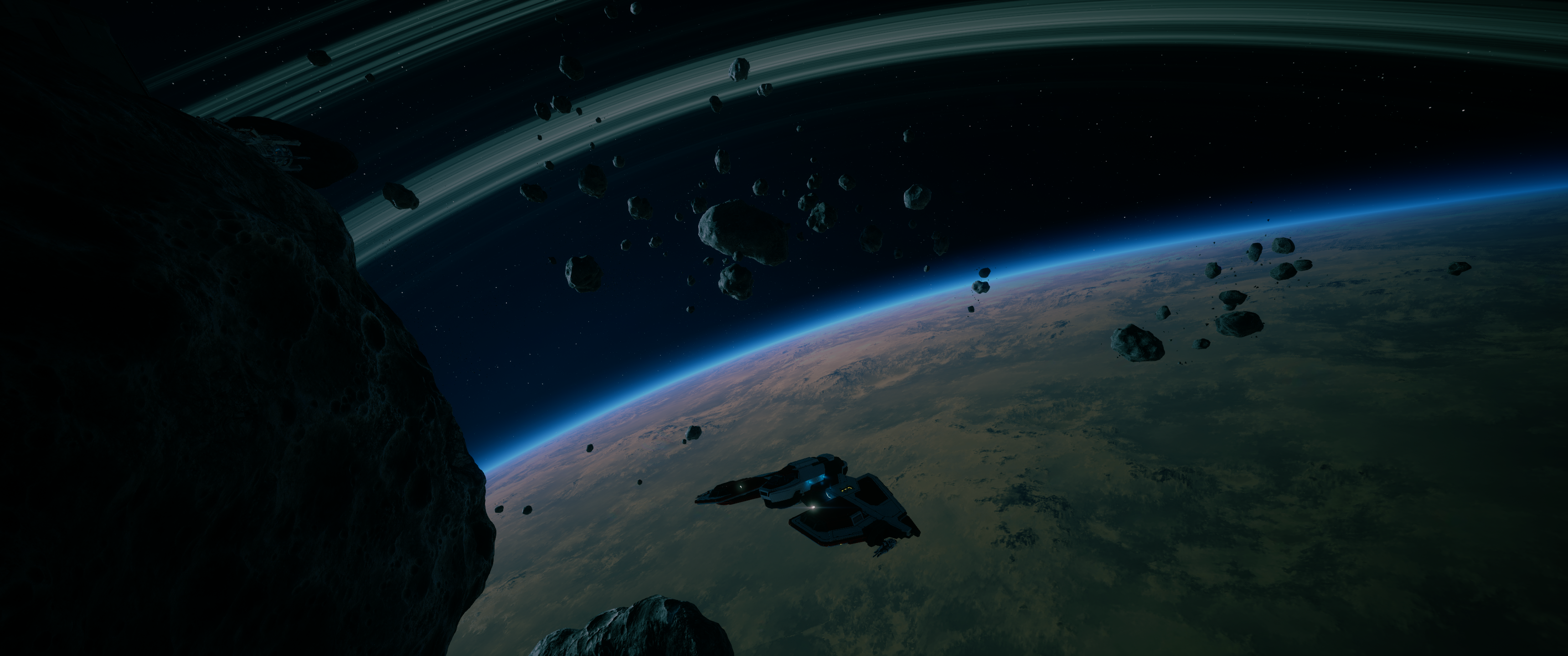
A ship in an asteroid field hovering over a ringed planet
I initially thought Everspace 2‘slack of replayability would be a problem. It lacks a skill tree or other ARPG elements that specialize your character. No advancement or story choice blocks off content. ARPGs have traditionally used these to encourage players to create different characters to replay content differently.
However, being able to quickly switch out a new ship or experiment with new weapons or modules means experimentation or change is refreshingly easy. Meanwhile, the perk and challenge systems provide attainable alternative goals that offer useful benefits instead of gatekeeping high-level content from less dedicated players.
Ultimately, Everspace 2 is a game that knows what it wants to be. It doubles down on that explore -> shoot -> loot -> craft game loop. If you enjoy that loop, and you will find out quickly or via the free demo, the game promises hours of the same. Otherwise, you will bounce off Everspace 2 hard.
Everspace 2 also knows what it does not want to be. It is single-player and offline, eschewing the complex code, gameplay loops and community management required for multiplayer or online play. It focuses on quality over quantity, providing a few well-developed star systems to explore. There is no piracy, salvage, political simulation or other distractions.
It took me about 60 hours to complete the main quest, including most side quests and challenges. As with most RPGs, you could complete it in under half that time, but you would miss the best content. Meanwhile, the developers continue expanding and enhancing the game, showing a welcome love and attention to detail. If only all ARPGs were this good.
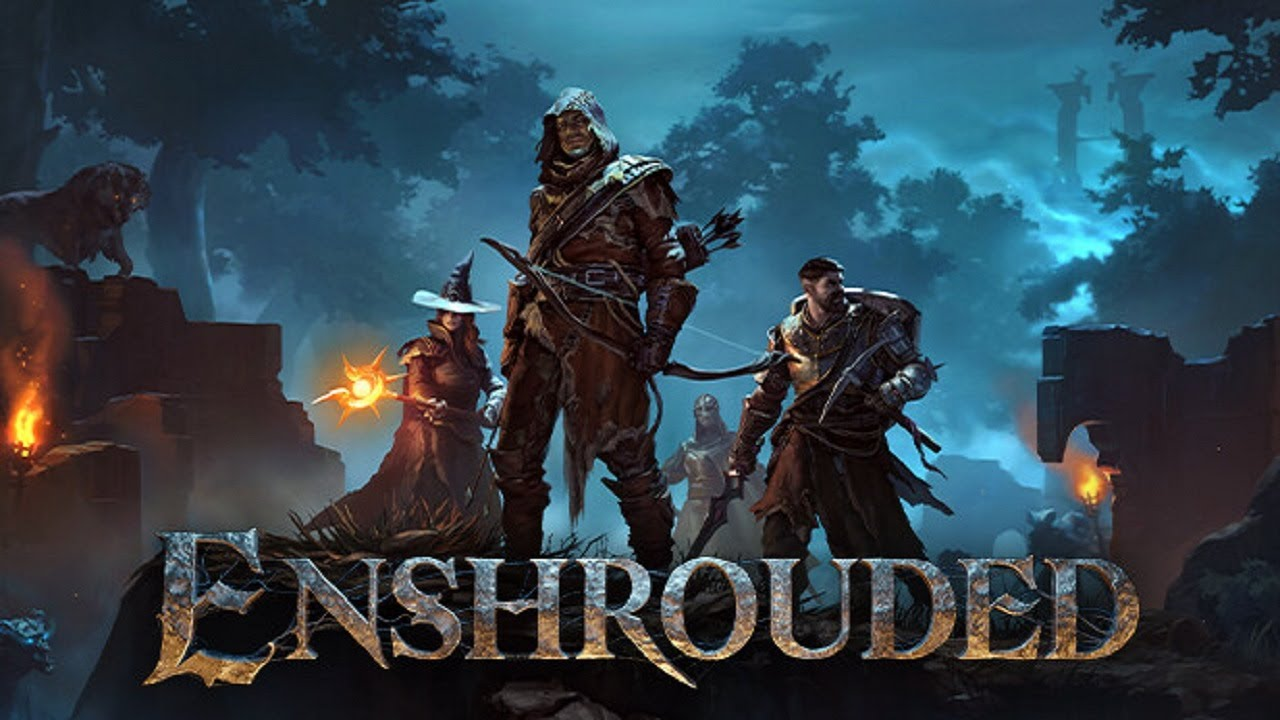
Enshrouded is a new early access, cooperative, survival crafting game from Keen Games. You play a “flameborn”, a magically enhanced human in a post-apocalyptic fantasy world. The “shroud”, a deadly mist, has covered parts of the world, filling them with alien and dangerous inhabitants. Your job is to learn what happened and restore the world.
Mechanically, Enshrouded plays like other fantasy survival crafting games. You start with little but rags. You explore, find or mine materials, craft weapons and shelter, and fight enemies. There is plenty of lore to discover, mainly as glowing notes left in long abandoned places. You can craft a grappling hook and a glider aid in traversal. You can fast travel once you unlock the destinations, usually requiring light traversal and puzzle solving. There is no hunger or thirst meter – you are an immortal flameborn – but enemies are balanced to the buffs given by food and drink.
Enshrouded‘s combat is very Souls-like, at least for melee characters. Timing, parrying and dodging are critical, although the creatures are generally more forgiving than anything from From Software. Non-melee characters are easier to play. Magic operates like a bow and arrow, with a staff firing magic spells instead of arrows. There is a stealth system, allowing you to snipe enemies from afar or backstab them up close.
The quests and crafting are standard for the genre. Quests progressively take you further afield and push the lore. You can rescue other NPC flameborn survivors, who provide unique crafting recipes and quests. Completing quests and acquiring new materials provide new crafting recipes. Most crafting requires crafting stations, which takes time and encourages you to head out into the world while you wait.
Enshrouded‘s building is voxel-based. You place floors, walls and ceilings individually, mixing and matching the materials to taste. Aesthetically, crude stone or thatch rooves are easy to mass produce but intentionally look uneven and primitive. You can discover better-looking materials, which require more and rarer ingredients. Mechanically, buildings provide shelter, which gives a stamina buff. The rescued NPCs also need shelter to produce more complex recipes.
Enshrouded‘s character advancement options follow a skill tree model. It covers the usual archetypes from a “sword and board” (melee weapon and shield) tank to a two-handed barbarian, a mage, a healer and a stealthy assassin. You gain XP from killing enemies, completing quests and gathering resources. You gain skill points when you level up or fell a shroud root, mushroom-like growths that create the shroud. Skills cost different amounts depending on their utility. You can also respec cheaply, making exploring different builds easy.
More generally, the quality and amount of content in Enshrouded is excellent. Apart from a few enemies getting stuck in the terrain and the occasional visual glitch, the game was flawless. The panoramic vistas are lovely, and the eerie green, blue and yellow lights shining through the shroud at night give it an alien, unworldly feel. Enshrouded‘s skill tree hints at something wonderfully complex and bristling with undiscovered synergies, like Path of Exile, in the final game.
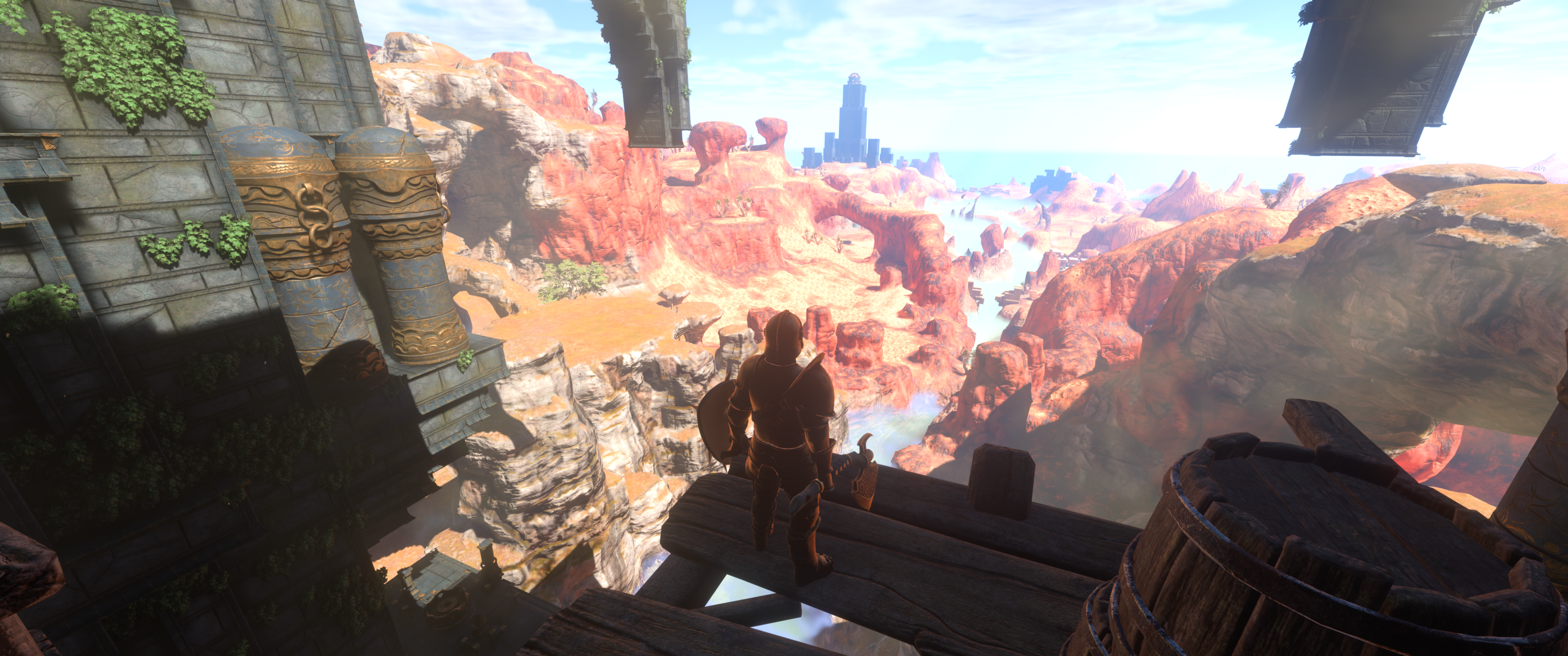
Yet another beautiful panorama, looking down from an ancient stone ruin into an enshrouded valley
Critiquing an early access game is arguably unfair. After all, Enshrouded is unfinished and has a long development road ahead. However, there is enough to hint at what it could be and where problems lie.
Enshrouded‘s biggest problem is there is little extrinsic reward for exploration. The hand-crafted map is enormous and dotted with areas to explore. However, quests will take you to most of the essential places and get the critical rewards. The tidbits of lore are flavourful but disjointed. Flame shrines give unique rewards, but I accumulated all I needed early on. There are too few enemy types and each has fixed behaviour, potentially leading to repetitious and unchallenging combat. I was swimming in bows, staves and wands but, as a melee build, I found the first useful non-quest item in a chest sixty hours into the game. By the time I reached the Kindlewastes, the last accessible area, I had lost the exploration buzz. Walking down the next unexplored path felt like a chore. This issue is a “must fix”, particularly with so much of the map still unavailable.
Enshrouded‘s late-game crafting requires too much effort for too little reward.I was happily defeating level 30 creatures wearing low-20s gear. The only crafting you need is unlocking higher “flame levels”, which opens up previously inaccessible shrouded areas. While you keep unlocking new crafting recipes, higher-level crafting requires more tedium: more ingredients, longer crafting time, and heading back to lower-level regions. Inventory management becomes tiresome. Planting and harvesting crops is convenient, but doing so plant by plant gets repetitive quickly.
There is little incentive to build Enshrouded‘s beautiful bases. With dozens of materials available and the developer’s apparent effort, it screams out for an in-game need to build more. Unfortunately, once you make a sufficiently large structure, usually at the starting location using basic materials, you can fast travel back to it whenever needed. Replacing fast travel with a point-to-point mechanism or requiring crops to be planted in their native biome might help.
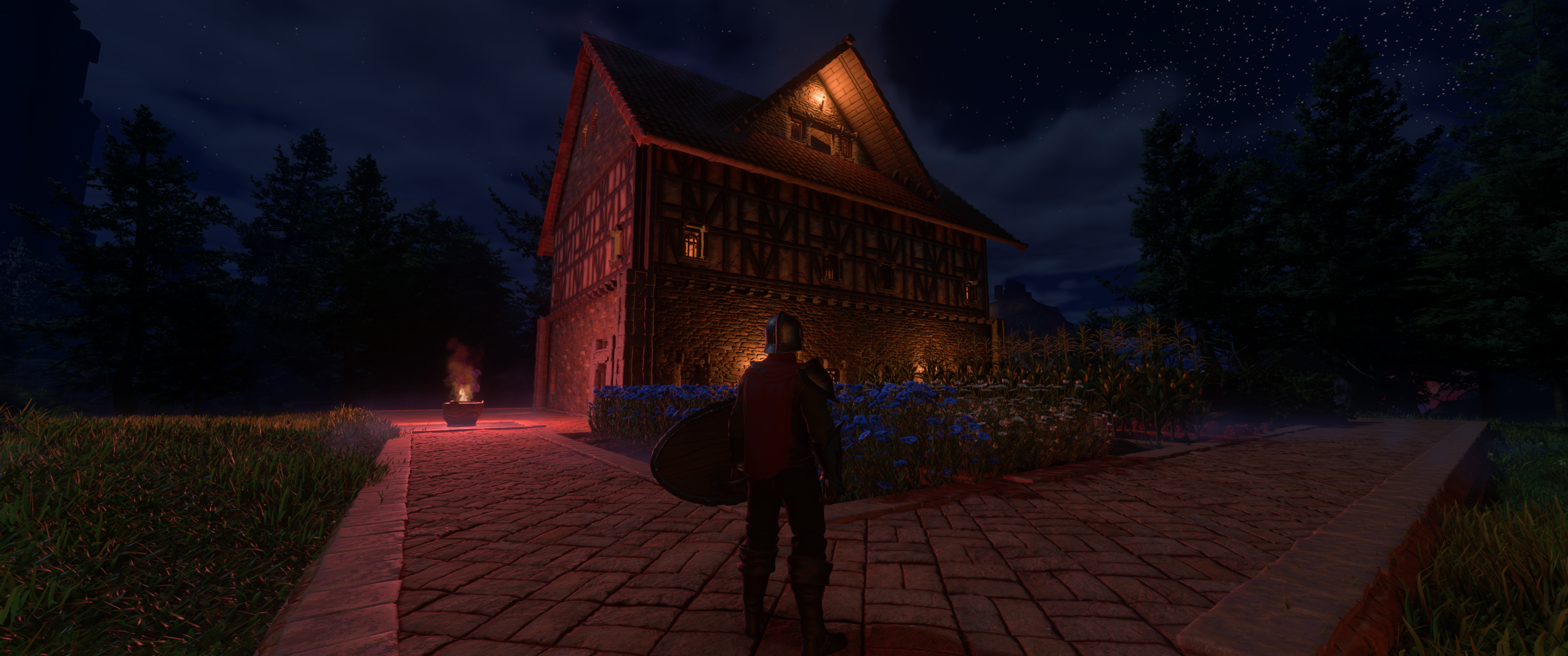
My modest abode at night, complete with garden.
Lastly, Enshrouded has a few balance issues. Melee characters are underpowered early on, and suitable upgrades are hard to find. Spell-casting and ranged characters are more powerful, easier to play and have more plentiful gear.
Enshrouded has the foundations for a great game. The quality and amount of content for an early access title are excellent and hint at a truly great game. The game has what it needs at the moment: solid foundations and exposure. Now Keen Games must refine Enshrouded‘s unique solution to the survival-crafting equation. As with pinnacles of the genre like Subnautica and Valheim, this will be a lengthy process. I hope Keen Games can take the time and resources to realise Enshrouded‘s potential.
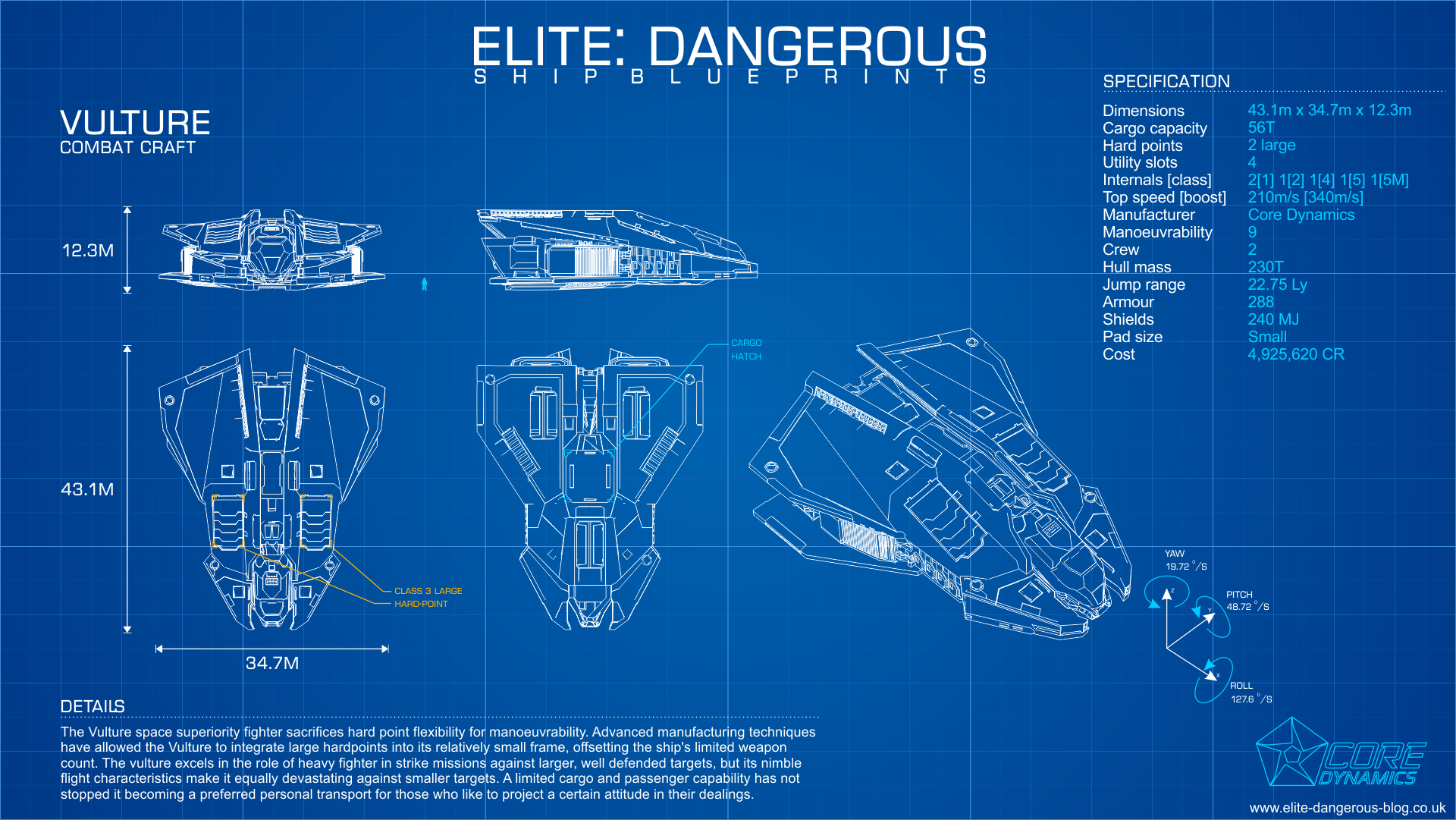
An Elite Dangerous ship build for more experienced players, effectively an end-game version of the Beginner PvE Combat Vulture Build.
Goals
The goals are:
Create a build that uses the Vulture effectively for late-game PvE combat, such as Hazadous Resource Extraction Sites, High Intensity Conflict Zones and Threat 7 Pirate Activity signal sources.
Use any module or engineering in the game to maximize effectiveness and the Vulture’s strengths.
Links: EDSY (have it open as you read the guide for easy reference)
As mentioned in my Beginner PvE Combat Vulture Build, the Vulture is a wonderful small ship to learn PvE combat. It is cheap, packs oversized weapons and teaches good skills like pip (power) management.
However, the Vulture is rarely seen during end-game combat. Large ships like the Federal Corvette and medium ones like the Fer-de-Lance and Chieftain tend to dominate. They have more firepower, better hull and shields, speed and/or agility.
No clever engineering or obscure modules will change this balance. However, the Vulture is far from useless. Some even see its disadvantages as a challenge. Killing NPC pirates in a fully engineered Federal Corvette is relatively easy. Doing so in a Vulture requires more skill.
Offence:
Intertial Impact: The Internal Impact experimental effect changes the damage from 100% thermal to 50% thermal and kinetic. This change means the Burst Lasers become effective against both shields and hull. However, it adds a 3% jitter, which is much larger than it sounds.
Efficient: Some people use the Short Range Blaser blueprint to maximize damage output but this drains the distributor quickly. Using Efficient means you can fire indefinitely with four pips to weapons.
Fixed: A small, nimble ship is the perfect platform for fixed weapons. The extra damage over gimballed weapons helps, as does the immunity to chaff or even needing to select your target.
FSD Interdictor: An FSD Interdictor is useful for interdicting assassination mission targets, wanted ships for bounty vouchers or even powerplay ships for merits. Swap for another Guardian Module or Hull Reinforcement Package otherwise.
Defence:
Resistance: This build focuses on high resistances for shields instead of raw strength. Unless you consistently fight plasma-armed enemies and cannot dodge the slow-moving projectiles, this focus gives a high effective strength with fast regeneration.
Fast Charge versus Lo-Draw: Like most ships using Fast Charge on a Bi-Weave Shield Generator, the Power Distributor cannot supply enough power with two pips in systems to rebuild the ship at the optimal rate. This build’s shields should drop rarely but, if they go down often, replace the Fast Charge experimental effect on the shield generator with Lo-Draw.
Reactive Surface Composite and Thermal Resistance: Reactive Surface Composite inverts the standard resistances for armour, making it strong against kinetic and explosive weapons but weak against thermal. To compensate, the build uses Thermal Resistant on one of the Hull Reinforcement Packages. This gives the build net positive resistances on the hull.
Guardian Shield and Module Reinforcements: Guardian Module Reinforcement Packages provide slightly more protection than Module Reinforcement Packages but cost some power. Swap for normal Module Reinforcement Packages if you do not have them unlocked. The Guardian Shield Reinforcement Package is the only non-utility module that buffs a shield.
Variations
Shieldless: A shieldless version (EDSY) reduces longevity but lets you put the system pips into engines for greater speed and agility. Consider it a challenge. Replace the Shield Generator and Shield Reinforcement Module with Guardian Module Reinforcement Packages and a Hull Reinforcement Package respectively. Replace the Shield Boosters with Shielded Point Defence and Chaff Launchers. Replace the Efficient blueprint on the Burst Lasers with Sturdy, giving them more protection and higher armour penetration. Sturdy costs more power but you have power to spare, even with an Armoured Thermal Spread Power Plant.
Anti-Thargoid Scout or Hunter: To create an AX version (EDSY), take the shieldless version and replace the burst lasers with Azimuth Enhanced AX Multi-Cannons. Fill the utility slots with Caustic Sink Luanchers and an Enhanced Xeno Scanner. Replace the FSD Interdictor with a 1A AMFU and the Guardian Module Reinforcement Packages with normal Module Reinforcement Packages to reduce power use and prevent a Glaive field from damaging them. Replace the Reactive Surface Composite with Military Grade Composite, because the additional resistances are unnecessary. Once again, other ships fulfil this role better but this build can hold its own.
Tactics
Finding targets: This build works best against wing-less large or less agile targets. Anacondas, Asps, Pythons and Type-10s are generally easy prey. Using fixed and jittery weapons against fast or agile targets, like Elite Vultures and Vipers, is doable but frustrating.
Point blank: Get as close as possible to enemy ships, preferably above or below where their surface area is maximized. Avoid jousting as it reduces time on target. Instead, circle strafe, pre-turn and landing gear-turn to track ships as they pass by. Hold down fire. Even with only two pips to weapons, exhausting the distributor or overheating will take minutes.
Power (pip) management: Two pips in systems and four in weapons are usually sufficient. Temporarily shift pips into engines to boost or run down fleeing ships. Ironically, power management is easier in this build than in the beginner version. An Overcharged Monstered Power Plant gives more than enough power. A Charge Enhanced Power Distributor gets it to where it needs to be.
Note: I originally wrote this before Frontier’s 31 January stream, which revealed surprisingly pleasant news. I considered rewriting this post for a few days. However, I decided to post it as is and then write an update later.
Frontier Developments PLC (or Frontier), the developer of Elite Dangerous (or Elite), recently published its interim 2024 financial reports. I have played Elite for thousands of hours. Considering the lacklustre Odyssey expansion launched two years ago, Elite‘s vague roadmap, and Frontier’s economic woes, I was interested in what this said about Elite‘s future.
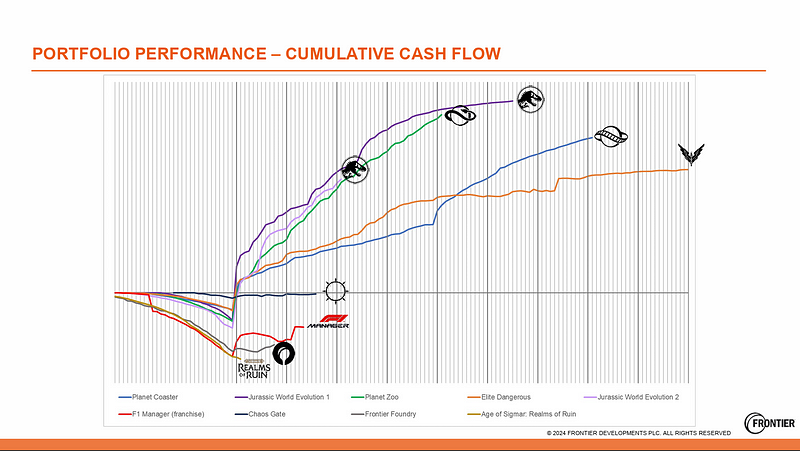
Two slides from the financial report summarize Elite‘s situation well. The first is the “Cumulative Revenue” graph, shown below. This graph shows Elite favourably, earning the second-highest cumulative revenue of all Frontier’s Intellectual Properties (IPs).
However, the “Cumulative Cash Flow” graph tells a less rosy story. Elite has earned the least of Frontier’s big IPs. Elite‘s current (right-most) line is almost flat, meaning its income roughly matches its costs.
Given Frontier’s financial troubles, what does this mean for the future of Elite? The critical question is, “What are Frontier’s goals?” If Frontier wants to keep Elite as a “pet project”, they need not do anything different. Frontier can continue maintaining the game, likely entertaining the hardcore players for years. Frontier and Elite are synonymous, and Elite should continue as long as it does not lose money.
Unfortunately, Frontier needs its IPs to generate income. David Braben, Frontier’s founder and previous CEO, may love Elite. However, Frontier is a business, not a charity. Their investors, including the Chinese game giant Tencent, rue the declining share price. The relative success of Star Citizen, No Man’s Sky and similar IPs of the same age and genre must weigh heavily.
While, technically, it may have been the correct decision, Frontier’s decision not to support consoles likely had a significant financial impact. Frontier had invested heavily in Elite‘s console support before ceasing it without realizing any revenue. As shown in the Cumulative Revenue graph above, releases on other platforms boosted all IPs significantly.
Frontier may also be using Elite to hide costs. Frontier shares many development resources, such as the game engine, audio, marketing and community relations. Frontier may disproportionately attribute costs to Elite to bolster other IPs. However, given the lack of evidence and specifics, I am ignoring this.
Elite makes most of its money from the initial purchase or selling ARX, its cosmetics currency. Therefore, Frontier must attract new players or convince existing players to purchase cosmetics like ship paint jobs.
Unfortunately, the “Cumulative Cash Flow” graph indicates Frontier failed. Not in creating a good game – that is another discussion – but in creating a game that generates significant revenue.
One way to generate revenue is to improve gameplay. Frontier needs to identify new foci that engage players. For example, Eve Online wants to focus on “conflict, identity, and community” per Eve Online‘s 2024 roadmap. Elite needs beginner-friendly gameplay with less “grind” (repetition). However, gameplay changes are another discussion, as mentioned above.
Another way to generate revenue is through hype and promise. Star Citizen is a prime example. Players “pledge” thousands of dollars for new ships to be released years from now, if ever. Players happily shrug off poor performance and reliability. Elite has lost this over the years. Better marketing and community relations could help, but Frontier needs that inspiring vision or dream.
An alternate could be changing the business model. The game designers may have created the ideal Elite but for a different monetization model.
For example, Elite could go “free to play”. A free version may allow players access to specific star systems or ships, requiring a purchase to unlock the full game. However, this is unlikely. Elite has a famously steep learning curve and lacks a clear story or path, meaning a low conversion rate to paying customers.
Elite could shift to a monthly or yearly fee, like Eve Online. This shift would increase revenue but would likely drive most players away. Many players drift into and out of Elite, while others enjoy it precisely because it is free after the initial purchase.
Elite could alleviate the grind. For example, it could offer blocks of engineering materials for ARX or increase the materials gathered. Another possibility is buying Federation or Imperial rank to unlock ships and gain access to systems like Sol. Warframe and other “free to play” games have similar offerings. Many enjoy Elite but are time-poor or only enjoy some game loops. Unfortunately, this is getting close to “pay to win”. It can frustrate or alienate those who put in the effort.
Frontier could generate more revenue from a regular, smaller expansion model instead of the current “big bang” model. Eve Online and No Man’s Sky do this. The high development time and cost mean a misdirected or incomplete expansion, such as Odyssey, can endanger an IP’s financial viability. “Big bang” expansions are typically sold at a significant discount in regular sales.
Thinking more pessimistically, Frontier could sell Elite to another company. Daybreak Games, the owner of old MMORPGs like Everquest and Lord of the Rings Online, is one possible home. Pearl Abyss, the new owner of CCP games who make Eve Online, is another.
Selling Elite would give Frontier a much-needed cash injection. This injection could fund another creative management game or two, something Frontier has monetized more effectively.
However, a sale is unlikely. As stated above, Elite holds a special place at Frontier. It uses Frontier’s proprietary Cobra engine, unused outside of Frontier. Elite is still profitable, albeit marginally, so the price would be high. Thus, making a decent return on investment could be difficult.
Predictions are always tricky. We need more information on the development team’s size and capabilities, the quality of the code base, and Frontier’s plans. Frontier’s next stream on 31 January will also lay out plans for Elite, although this will likely be just a teaser for the upcoming update 18.
However, if I had to predict, little will happen beyond update 18 for 2024. If anything, Frontier will continue drip-feeding the irregular updates planned as part of Odyssey. Anything else that happens will be completing existing work.
This prediction may sound pessimistic. However, Frontier’s communications mention no new Elite content but plenty of content for other games. The recent restructuring has seen many senior members of the Elite team leave. Rebuilding and realigning afterwards will take time.
Reading between the lines, Frontier is moving Elite into the “too hard basket” for now. They want to focus on creative management simulations. They need revenue to correct their balance sheet and appease investors.
What would I like to see? I would love an inspiring and engaging “vision” for Elite. The hype around Odyssey drove huge player numbers and an undeniable anticipation. A focus on gameplay and marketing like that would be ideal. However, that requires creating a compelling vision, investing in marketing and community relations and commitment to see it through. These are improbable for a game in the “too hard basket”.
I would also love a “season” (like in Path of Exile or Diablo) or an “expedition” model (like in No Man’s Sky). These are separate versions of the game with interesting or exciting changes. Imagine Elite with a different economy, ships/modules, weapon balance or location/setting! Imagine replaying stories from Elite‘s lore!
Realistically, moving to smaller, cheaper, regular expansions will occur in 2025 or later. It deviates the least from current patterns, creates a constant revenue stream and reduces risk.
That said, it is remarkable that a game as old as Elite still makes money. Plenty of space games have come and gone over the years. Elite is still profitable and will be around for a while. However, in an industry dominated by hits, Elite may not be enough of a success to get the resources and attention it deserves.




 The Single Player