

Hello Games initially Kickstarted No Man’s Sky in 2016, promising a vibrant, life-filled universe to explore. Unfortunately, under-delivery led to an initial backlash, but Hello Games has since built it into a worthy and unique game.
No Man’s Sky is an exploration-focused, survival crafting game with space simulation elements, like Astroneer or Subnautica. You play as an unnamed “traveller” who wakes up on an alien planet with a damaged spacecraft and no memory. You initially explore, gather resources then craft things. Crafting first extends survival by refilling oxygen and recharging your exosuit’s components. Eventually, you repair your ship, construct bases and build vehicles to increase your exploration speed and range.
No Man’s Sky includes activities common to space simulation games like ground combat, space combat, piracy and trading. You can adopt, ride and breed pets. The brave can explore derelict freighters. Later in the game, you can also maintain a fleet and periodically send ships on distant missions, build and oversee a town or relax into daily quests for upgrades or cosmetic rewards.
No Man’s Sky provides quests to introduce players to new mechanics and provide context and purpose. The main quest line examines existentialism. However, unlike other survival crafting games, No Man’s Sky treats this solemn theme lightly. For example, the game lacks the conviction of Subnautica’s pacificism and environmentalism or Breathedge’s self-deprecating humour.
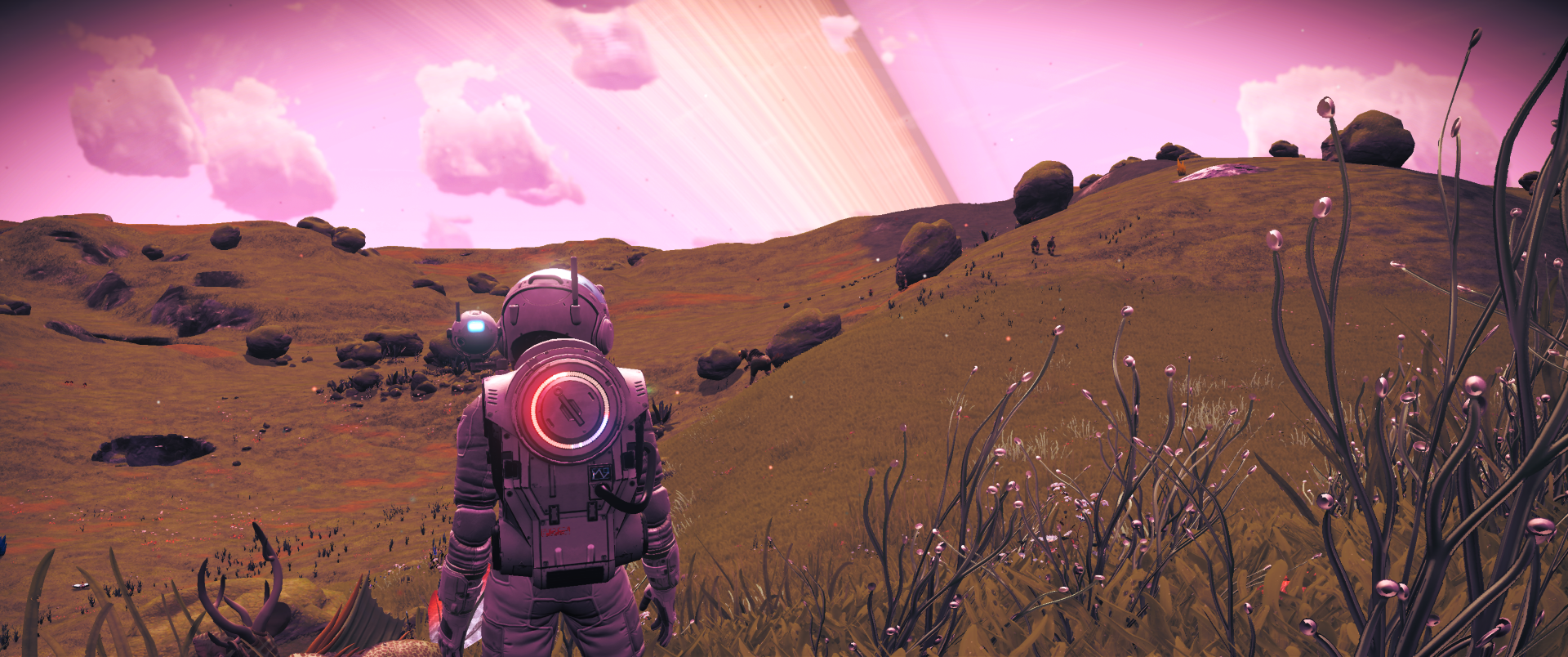
What sets No Man’s Sky apart is its massive procedurally generated universe containing quintillions of planets. Procedural generation is not new, but No Man’s Sky‘s scale and beauty are unique. Each planet has a biome (e.g. desert, marsh, paradise, volcanic), which determines the flora, fauna and geology populating it. Some planets have seas and caves, effectively different biomes on the same planet. The player earns credits by scanning specimens and gets a bonus for finding samples of all a planet’s fauna.
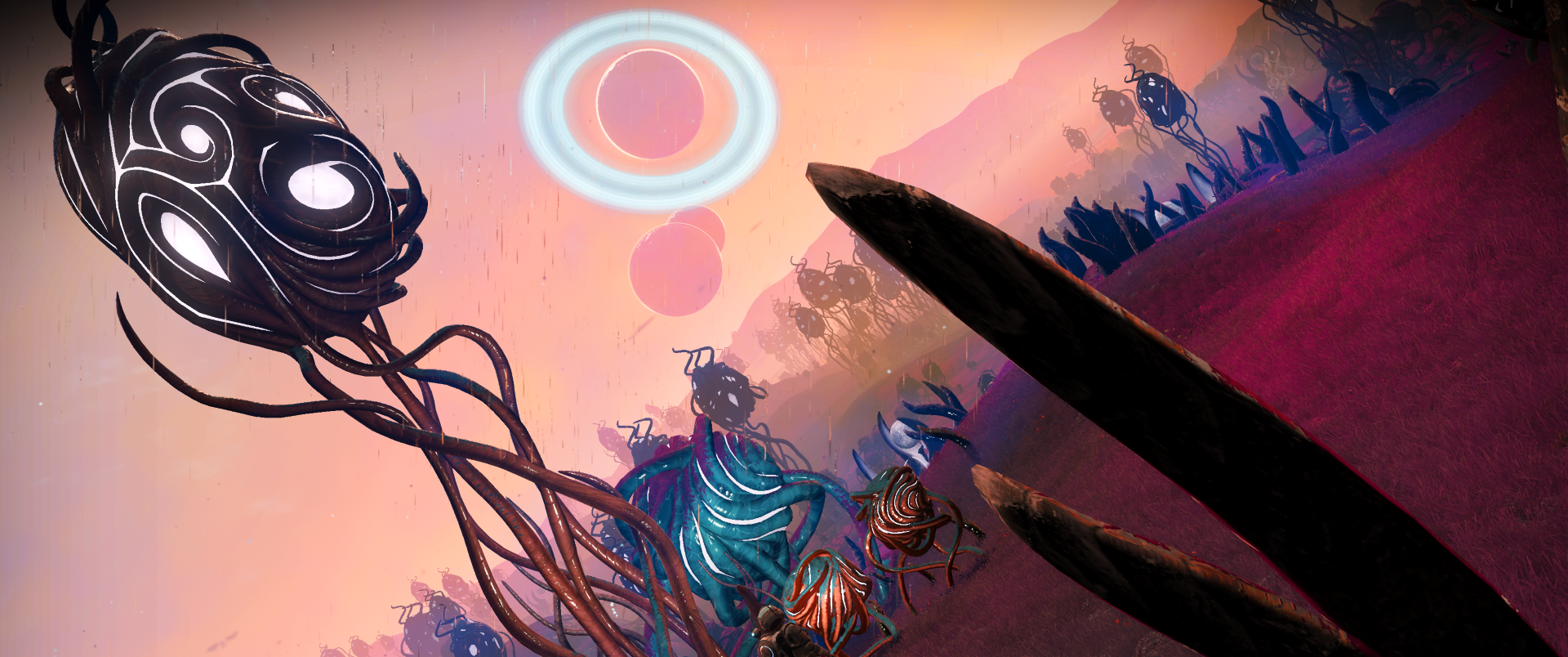
Graphically, No Man’s Sky is a love letter to 1970s- and 1980s-era science fiction art. Those artists portrayed landscapes with recognizable terrain and creatures with recognizable limbs but in alien colours or orientations. No Man’s Sky harks back to the endless potential and wonder these artists captured, looking at the universe through nostalgia-coloured glasses.

All players share the same universe. However, it is a vast universe, so the chance of meeting another player outside the Anomaly (the central quest hub) or your friend list is remote. PVP combat is by mutual consent only. You can play offline but lose the ability to claim credit for first discoveries or interact with other players.
No Man’s Sky favours accessibility over challenge. For example, its space flight and combat are arcade-like and lack the atmospheric handling of flight simulators or Newtonian handling of more realistic space simulators. Ships have different inherent strengths and are upgradable, but the process lacks the depth and specialization found in other games. No Man’s Sky‘s simplistic trading uses static economies and routes. Landing and docking are automated.
Realism is out the window. Procedural generation sometimes produces gravity-defying floating rocks or improbable creatures. Planets do not orbit their stars. They are often close enough for their gravities to cause horrendous damage and collisions. The game’s chemistry is more comparable to alchemy than real-world chemistry, allowing easy conversion of one element to another or liquid water at high or low temperatures.
Neither of these are oversights. No Man’s Sky does not want to be a gritty, “realistic” universe like in Elite Dangerous, Eve Online or Star Citizen. It is not the game for those looking for complex ship outfitting, pouring over spreadsheets maximizing trade profit, elaborate joystick and HOTAS setups or ruthless PVP.
Instead, Hello Games designed away anything distracting from the almost meditative play. They created a game where losing hours to the self-expressive joy of building bases or the “sense pleasure” of seeing the sunrise on yet another verdant or desolate world is easy. Internal consistency and beautifully varied landscapes are what matter.
While survival and permadeath modes are available to those looking for a greater challenge, No Man’s Sky also offers expeditions. These temporary game modes increase the difficulty and provide different main quests. They feel different enough to be novel without losing familiarity, keep experienced players engaged and give unique rewards.
The most significant criticism of No Man’s Sky is that, while Hello Games has worked hard in the last six years on survival and crafting mechanics, it is still a procedural generation engine looking for a game. The designers could have shrunk No Man’s Sky into several dozen unique planets spread across a few solar systems. This choice would expose all planet types while satisfying the limited curiosity of most players.
Meanwhile, No Man’s Sky wants to be a live-service game – an ongoing online entertainment service – but it lacks end game mechanics beyond intrinsic exploration or social interaction. It degenerates into daily or periodic quests once the shallow main quest line is complete. Some game loops also deteriorate into grinding. If you want to upgrade your freighter or find that perfect-looking ship, you must keep retrying until you fluke the right one.
However, despite offering no paid expansions, Hello Games continues to expand the game with new features, including regular expeditions. They do so more frequently than comparable games like Elite Dangerous or Star Citizen. Along with the more casual appeal, these draw in a large and growing audience that loves No Man’s Sky.
The name No Man’s Sky is a play on “No Man’s Land”, the unexplored part of old maps where no kingdom or empire holds sway. No Man’s Sky presents a universe full of the unknown, ready for players to explore but much safer than the early European explorers found it.
Those looking to satiate curiosity and meditative “sense pleasure” from exploration and self-expression from building bases will enjoy No Man’s Sky. You can finish the main quest in a few tens of hours, but the game will capture your imagination for much longer.
No Man’s Sky‘s low challenge also appeals to a broader audience and may help introduce new players to the space simulation genre. It is a welcome change to one often dominated by hardcore players and niche games.


 The Single Player