Star Wars Jedi: Survivor (or Jedi: Survivor) is a science-fiction adventure RPG developed by Respawn Entertainment, the same company that created the prequel, Jedi: Fallen Order. Thankfully, Jedi: Survivor is a worthy sequel, improving on the prequel in every way.
You play Cal Kestis, a Jedi Knight, continuing his fight against the Empire. Retreating to the backwater planet Koboh after a mission on Coruscant goes horribly wrong, Cal stumbles upon a forgotten planet that could be a hidden refuge for those he holds dear.
At first glance, Jedi: Survivor appears mechanically similar to Journey to the Savage Planet, the previous game I played. Both are exploration traversal games set on alien planets, where you wander, discover new areas, fight foes and collect resources. You have the traversal mainstays like the double jump and a grappling hook. You gain upgrades as you progress, allowing you to access more areas, defeat stronger enemies and complete challenging timed events.
However, the similarity ends there. Journey to the Savage Planet is about fun with cartoonish violence, densely packed levels and self-aware humour. Jedi: Survivor is about mastery, both in combat and traversal.
Jedi: Survivor‘s combat is “Souls-like”. Enemies hit hard and often outnumber you. Success requires learning enemy abilities and correctly timing parries and dodges. Combat is challenging, meaning you will die frequently as you learn and experiment, but not punishing, assuming you unlock shortcuts to shorten the journey back from the respawn point.
Jedi: Survivor adds two new lightsaber stances to the versatile single-blade, fast dual-blade and defensive double-blade stances from Jedi: Fallen Order. The crossguard stance, inspired by Kylo Ren’s lightsaber, adds a slow but damaging greatsword. The blaster stance, as its name suggests, has Cal Kestis wielding a blaster and lightsaber, fulfilling Han Solo or Wild West gunslinger-style fantasies.
Jedi: Survivor is also about exploration, with big, broad maps filled with traversal puzzles, riding mounts and even a speeder bike sequence.
Jedi lend themselves well to this style of play. Ever since Luke’s first training scene on Dagobah in The Empire Strikes Back, Jedi have demonstrated themselves to be acrobatic and athletic. They often befriend local wildlife.
Structurally, Jedi: Survivor has peaks of action during intense, story-relevant scenes and boss fights, followed by more leisurely downtime. Players can spend these breaks exploring, collecting or bounty hunting. You can expand their very own cantina via recruiting NPCs, fishing (by interacting with an NPC that appears at water), finding music tracks for the DJ, collecting plant seeds to fill a garden or scanning defeated opponents to use in holotactics games. Companions sometimes join Cal for story-specific sequences, often opening new areas or teaching Cal new abilities.
Jedi: Survivor‘s storyline explores purpose, sacrifice, friendship and acceptance. The story is told mainly through cutscenes, conversations with the many supporting characters and force echoes, which reveal past events or conversations. While it deals with galactic-relevant events and drops a few familiar names, the story focuses mainly on its characters, creating a personal story that tugs at heartstrings.
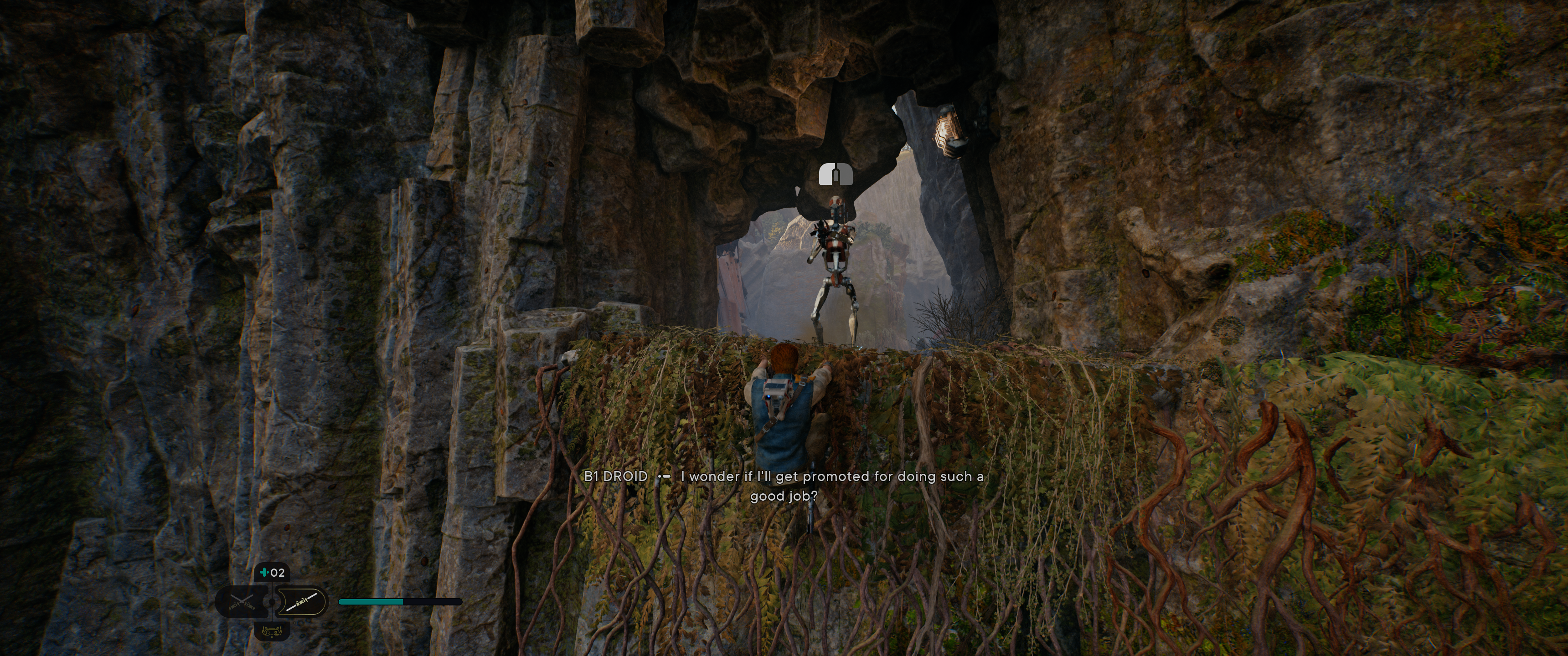
A B1 droid about to learn to fly
Just like in the movies, Jedi: Survivor has occasional bursts of humour, like the overheard banter between enemies, particularly the B1 droids introduced in the prequel movies. Struggling through tough fights to face Rick, the door technician, will bring a smirk to your face.
A now stubbled Cal even has a brush with romance, a taboo subject for Jedi, but handled tastefully and respectfully. It adds a little sexual tension, like in The Empire Strikes Back.
However, Jedi: Survivor‘s themes are only deep enough to motivate you, and not a genuine examination like in Cyberpunk 2077 or The Witcher series. While minor characters can sometimes point you to interesting parts of the map, there are no true side missions or plot choices to add depth or consequence.
Jedi: Survivor is unmistakably a Star Wars game, and not just because it involves lightsaber-wielding Jedi using the force against the Empire and other instantly recognisable tropes. Jedi: Survivor continues the themes of droids as people and good fighting an asymmetric battle against a seemingly overwhelming evil. Cal’s ship, the Mantis, is a Millennium Falcon equivalent, a similarly delapidated but faithful steed carrying Cal and his pseudo-family from stage to stage.
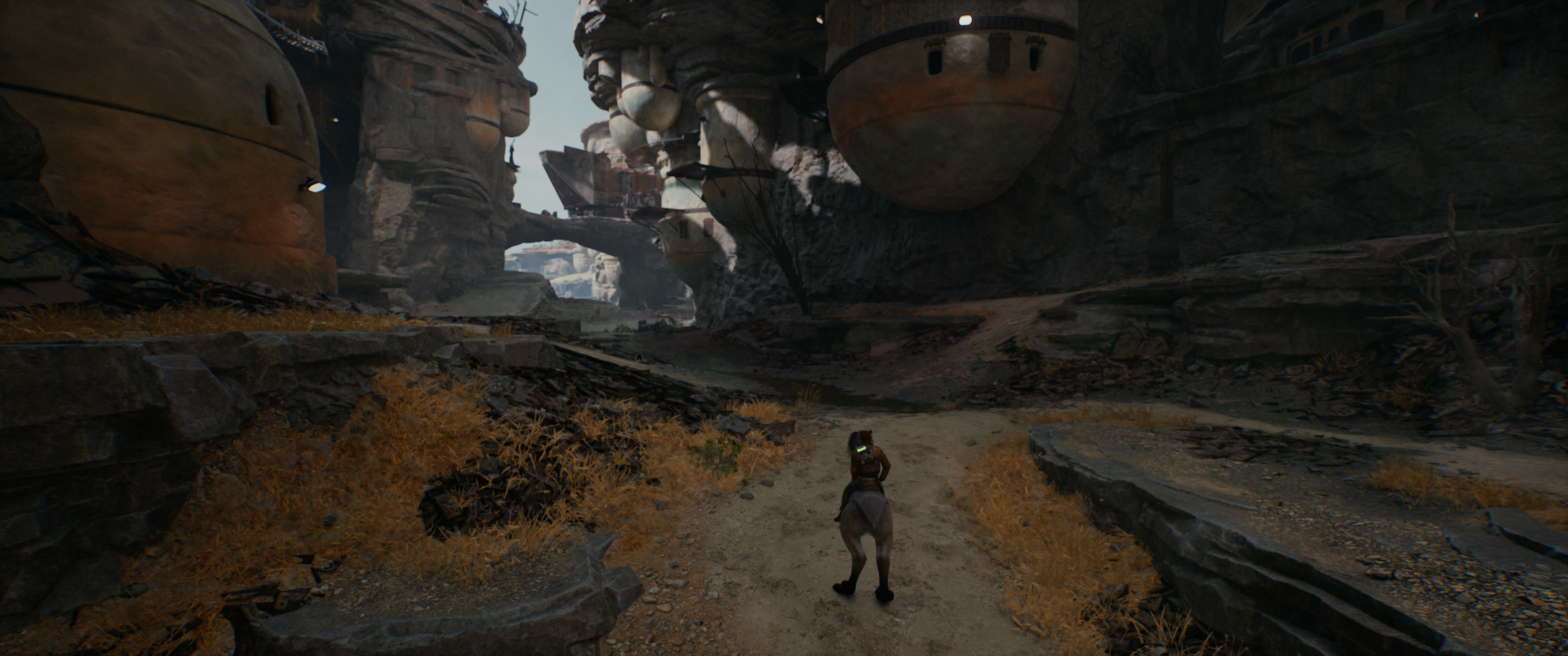
Cal views the path ahead, which juxtaposes the technological sandcrawler in the background with primitive ochre buildings
The game is faithful to Star Wars in its environment design. Most worlds you visit are technological backwaters, where primitive ochre and stone buildings are juxtaposed with automatic doors, artificial lighting and droids. Like the movies, Jedi: Fallen Order mixes the familiar with the alien or technologically different.
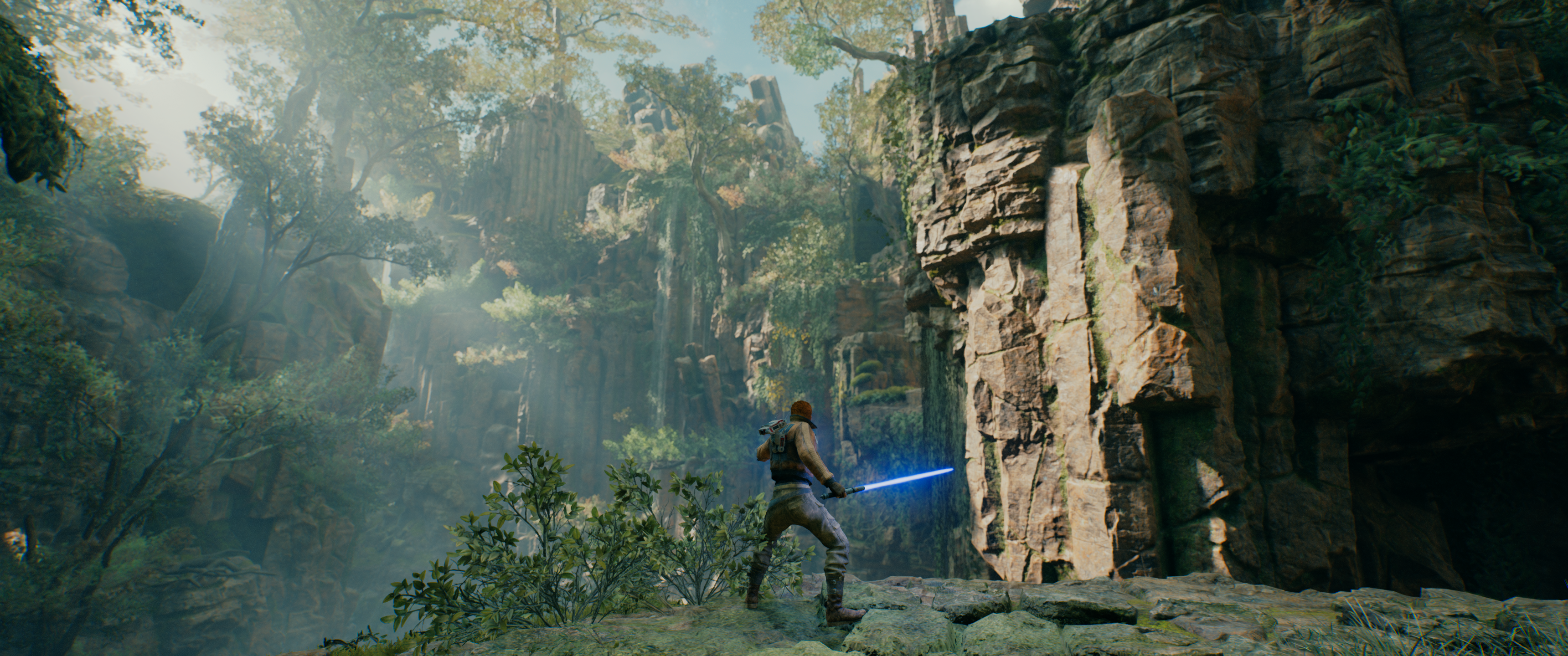
A lush, misty valley on Koboh, showing sandstone cliffs and gentle sunbeams
The colour palettes are muted pastels. Gone are the brilliant greens of Kashyyk and the purples of Dathomir in the first game. Instead, there are the reds of Dune-like Jedha, the greys of Coruscant and Californian scrub-like Koboh. These palettes give the game a realistic feel and make each location clearly unique.
Jedi: Survivor has Star Wars‘ audio pedigree. Stephen Barton and Gordy Haab return from Jedi: Fallen Order to deliver an emotional, epic, orchestral soundtrack that evokes the best of John Williams. The distinctive lightsaber whoosh, blaster ping and AT-ST foot clang abound.
Like Jedi: Fallen Order, Jedi: Survivor respects Star Wars as an intellectual property and a genre. It is neither derivative nor uninteresting and avoids redefining elements for its own ends. NPCs, like Darth Vader, are used faithfully. Jedi are noble, humble and capable, not the flawed, inflexible strawmen presented in later works.
Cal is a young male Jedi with a droid sidekick like Luke Skywalker. However, Cal is motivated by survival and the desire to protect, rather than seeking adventure or saving his father. Cal’s later dabbles with the force’s dark side present it as seductively and terrifyingly powerful while implying Cal’s greatest challenges lie ahead.
This series has cemented itself as a worthy addition to Star Wars lore and canon. At about thirty hours to finish for a storyline-only playthrough, Jedi: Fallen Order is about double the length of Jedi: Survivor. Those looking for a challenging and faithful Star Wars RPG will relish it. I look forward to the inevitable sequel.
Journey to the Savage Planet is a science fiction adventure game developed by Typhoon Studios. Tasked by Kindred Aerospace, the fourth-best interstellar company, your job is to exploit a new planet in the name of capitalism, err, I mean, explore a planet for possible human habitation.
You play an unnamed astronaut, sent to an alien planet to catalog its features and inhabitants. You explore the landscape, scanning flora and fauna, while gathering resources. Back on your ship, these resources unlock upgrades. These upgrades provide additional mobility and options, which open up more areas and so on.
Journey to the Savage Planet includes some combat. However, it is not the game’s focus. Instead, combat is a series of puzzles to keep areas unique and challenging. The boss battles gate content, ensuring you have certain upgrades and know how to use them.
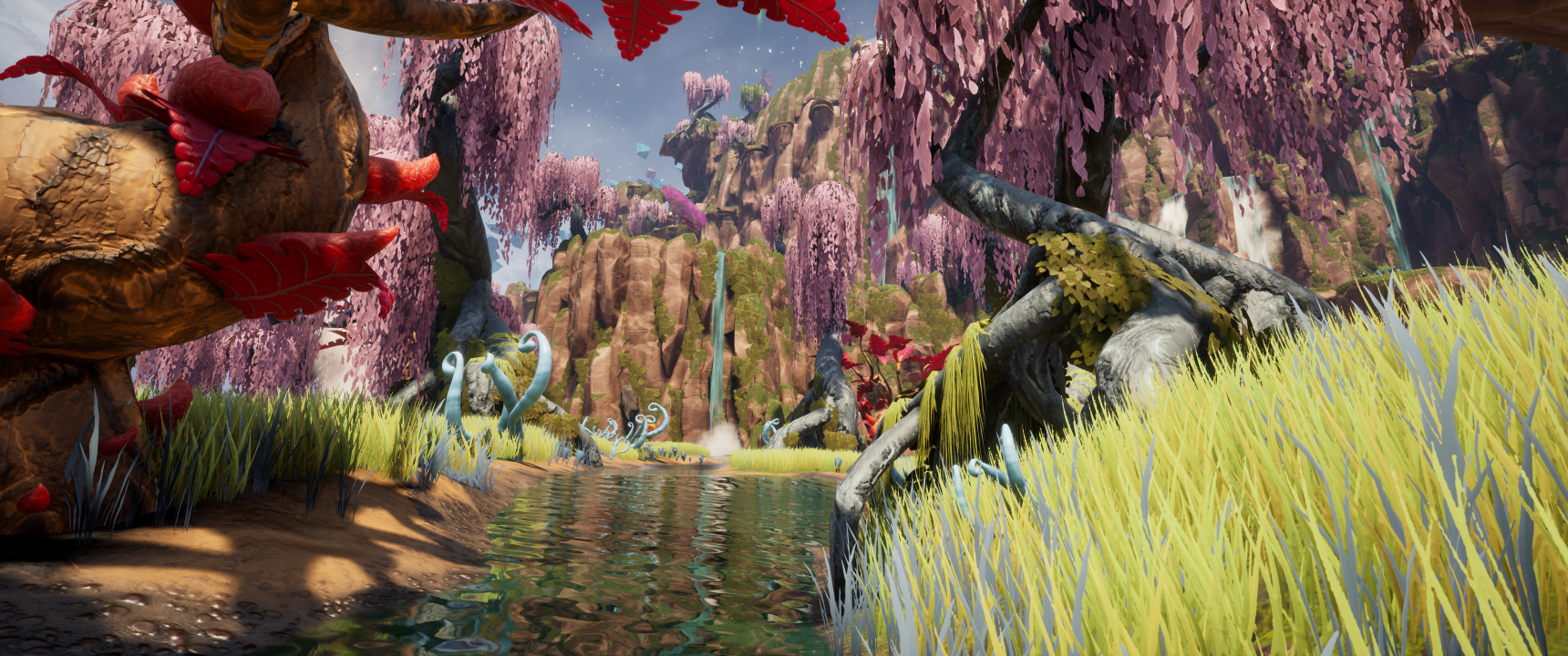
Lush, alien landscapes ripe for exploitation, err, exploration
The level design is also economical. While regions feel huge at first, explorable areas are actually compact and densely packed with secrets and interesting tidbits. Early regions have areas only accessible with later upgrades, encouraging players to revisit content with more experienced eyes. You unlock teleportation early, removing a lot of tiresome travel.
Journey to the Savage Planet offers co-op play, your in-game “meat buddy”, for assistance or more social play.
Mechanically, the above sounds like a standard 3D exploration/traversal game. This is true. The game gradually exposes you to progressively more difficult puzzles that build on previous experience, like any good puzzle game. Turorialisation is usually subtle, although the game sometimes shows applicable controls as a hint. Unlike more linear puzzle games, the game’s open world allows players to switch to a different puzzle or area and return later, along with freeform exploration.
However, Journey to the Savage Planet coats this well-implemented but otherwise unremarkable gameplay with a thick layer of absurd, satirical, anti-capitalist humour. Your ship bombards you with ads that use familiar tropes and techniques to peddle ridiculous products. Periodic messages from the self-serving and insincere Kindred CEO echo the worst of an egotistical cult of personality. He savours sushi on his private jet while you eat ooze-like grob on your decrepit spacecraft. Even the feigned encouragement from your shipboard computer is sarcastic.
The humorous context gives purpose while downplaying negative aspects. It is hard to take your character’s death seriously if your CEO and ship’s computer do not. Killing and exploiting the wildlife is OK because it is in the name of “science”.
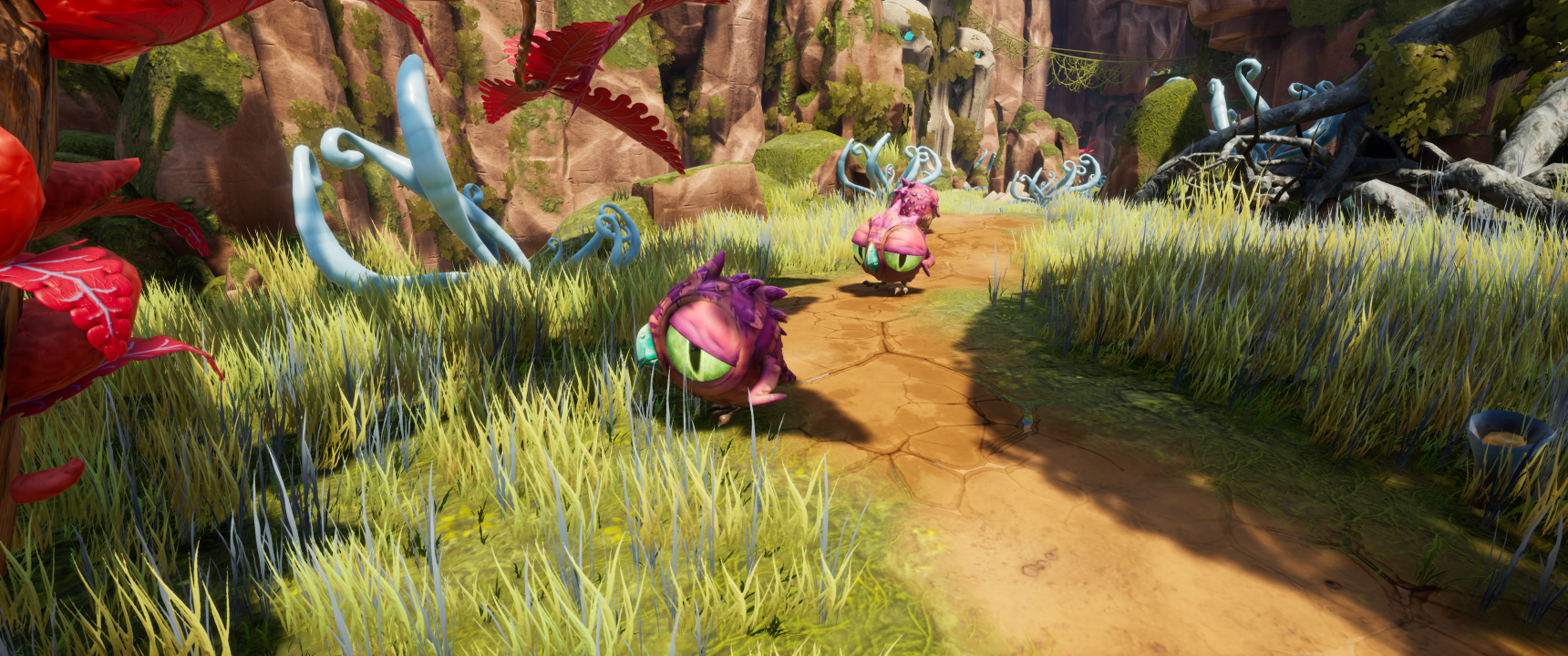
Dopey-eyed pufferbirds hopping around
Journey to the Savage Planet‘s bright, saturated and cartoonish art style, creature design, and sound effects reinforce this. The cute, ball-like pufferbirds, for example, have large, anime-like eyes and emit high-pitched cheeps. Many-headed baboushkas scream comically as they dash around. Feeding aliens grob makes them fart collectable resources.
This art style also ensures plants, creatures and terrain features are recognisable, easy to differentiate, yet clearly alien. This style will not date as graphics capabilities improve and adapts well to lower fidelity devices.
The soundtrack is roots rock, heavy with guitars and stringed instruments. It gives the game a playful, blue collar, “Wild West” feel. I would have liked more variety between tracks, though, as it can become repetitive.
While there are challenging moments and your character will die often, Journey to the Savage Planet is not difficult. A new upgrade, using a previously overlooked environmental feature or rethinking the approach is usually the answer.
Even the various MacGuffins, such as orange goo to increase your health/stamina or alien alloy for upgrades, can eventually be detected using your scanner. These scanner upgrades replace a frustrating game of finding the obscure nooks and crannies with the fun traversal puzzles. You know where the desired objects are. You just need to find out how to get there. I usually find completing collections tedious, but Journey to the Savage Planet had me happily doing so without initially realising it.
Journey to the Savage Planet‘s anti-plutocratic and pro-environmental message becomes less subtle later in the game, particularly as you approach the last boss. It taps into the anti-“tech bro”, “save the planet” zeitgeist.
However, the game’s message takes a backseat to the fun, avoiding lectures and keeping things light. The game hides its message under an obvious corporate caricature. It avoids imposing moral quandaries or showing the heart-tugging broader effects on society, as in games with similar themes such as Cyberpunk 2077 or The Outer Worlds.
Journey to the Savage Planet takes around fifteen to twenty hours to complete and about five extra hours to find all the collectables. It will appeal to those looking for a light-hearted exploration and traversal puzzle game. However, those looking for genuine challenge or put off by satirical, cartoonish humour should look elsewhere. Many puzzles emphasise the vertical, giving sweaty palms for those afraid of heights, too.
Everspace 2 is a space fight simulator with 3D movement focusing heavily on combat, exploration and puzzles. Rockfish Games, the developer, describes Everspace 2 as a “space shooter” with “RPG elements” on its Steam page. That is untrue. Everspace 2 is an action role playing game (ARPG) like Diablo or Path of Exile. And it is terrific.
You play Adam Roslin, an ex-military fighter pilot working for an uncaring and manipulative corporation. After a routine mission goes wrong, you are captured by outlaws and escape to a long abandoned base. You and your fellow escapees then rebuild and prepare for a heist that could set you all free.
Flying your ship in Everspace 2 is a joy. The controls are less detailed than those of more complex space simulators like Elite Dangerous. Still, such an outwardly arcade-like game offers a surprising degree of control. Dodging enemy fire, circling capital ships, and navigating maze-like tunnels all feel fluid and natural.
The combat is vibrant, frantic and engaging. Like most ARPGs, you usually fight swarms of weaker enemies, each with different weapons, defences, and abilities. This structure provides constant variety and changing tactics. Your relative strength also fuels the requisite power fantasy.
A warm red star and a blue nebula shine through an asteroid field
Locations also contain puzzles, providing cerebral but slower-paced play. As you fly around, your sensors can detect and track nearby loot, mineral deposits or other points of interest. Your ship has a tractor beam that you can use to pick up and move things around, such as removing debris from a passage or picking up a battery to slot it into a socket elsewhere. These usually unlock doors or containers of potential ship upgrades.
Everspace 2 tells its main story through cut scenes showing hand-drawn images with voice-overs. While low-budget, this style works well for a game focused on flying spaceships. The main quest has excellent pacing while introducing more about the universe and its inhabitants.
There are plenty of side quests and activities, too. As with many RPGs, they are often the most interesting, flesh out the world and introduce unique NPCs. Chasing rogue AIs, rescuing trapped miners, or appeasing crime lords are all on the cards. Racing tracks and rifts filled with difficult enemies satiate those seeking a challenge.
Mechanically, Everspace 2 is a testament to game balance. Everything, including your character, gear, and enemies, is geared to a level. Level differences are more pronounced than in other games. Foes more than a few levels above you are deadly. Those a few levels beneath you will be merely speed bumps. Everspace 2 periodically increases the level of enemies to keep the challenge consistent.
A ringed planet seen from the surface of a desert planet
Aesthetically, Everspace 2 is beautiful. Each location is a postcard, with asteroids, massive space stations, aging wrecks, vertigo-inducing icebergs and/or vibrant nebulae. Many are varied and original, like an iceberg in a solar flare or a megafauna skeleton, evoking wonder and appreciation. Each star system also has its distinct look, making them feel unique.
The electronica soundtrack is also on point, supporting the sci-fi feel. The zen-like cruising pieces contrast with the exciting, upbeat combat ones.
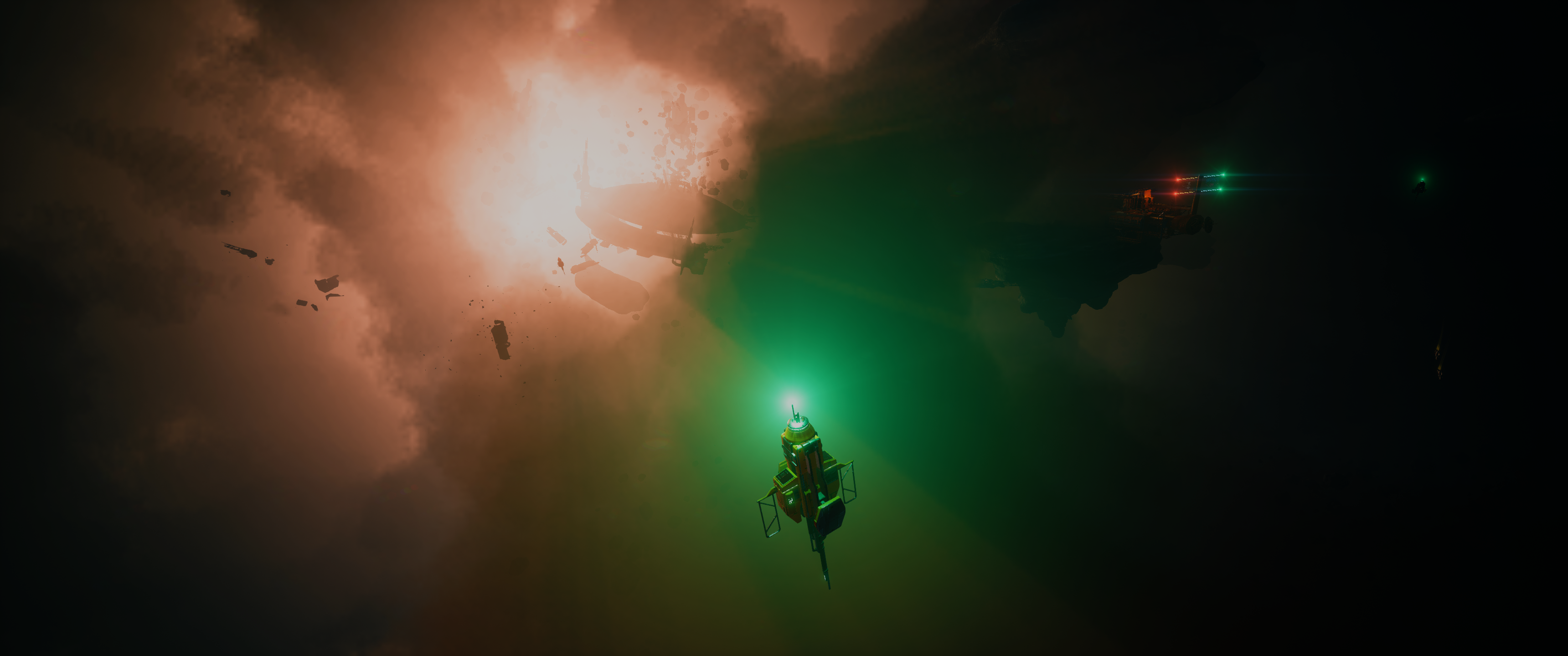
A green beacon in the middle of a dark gas cloud
However, Everspace 2 is not perfect. My biggest gripe is with the writing in the main storyline. No one expects deep or complex writing from an ARPG, but this does not excuse poor writing.
The characters need more substance. Ben and Delia are just cardboard cutouts and deserve motivation and agency. Maddock becomes a contrived, grumpy omni-antagonist. Combining some supporting characters, like Ben and Tareem, would have enhanced both. Everspace 2 also unnecessarily sexualizes a female supporting character at one point.
Similarly, the early main story has too much “I need you to do this, but I am not going to tell you why for at least two cut scenes.” It feels unnecessarily opaque and confrontational. The game also removes the player’s agency at a few key moments, railroading you.
My other gripe is with loot management. Most of the copious loot enemies drop is trash you sell or disassemble for crafting components. The rare upgrade is fun, and Everspace 2‘s crafting system means you will always have suitable weapons, modules or consumables.
However, the constant gear drops and level churn mean periodically yanking yourself out of the fun combat and puzzle game loops to clear your inventory. Loot management is a broader problem with ARPGs’ variable intermittent reward structure, but it is still a problem.
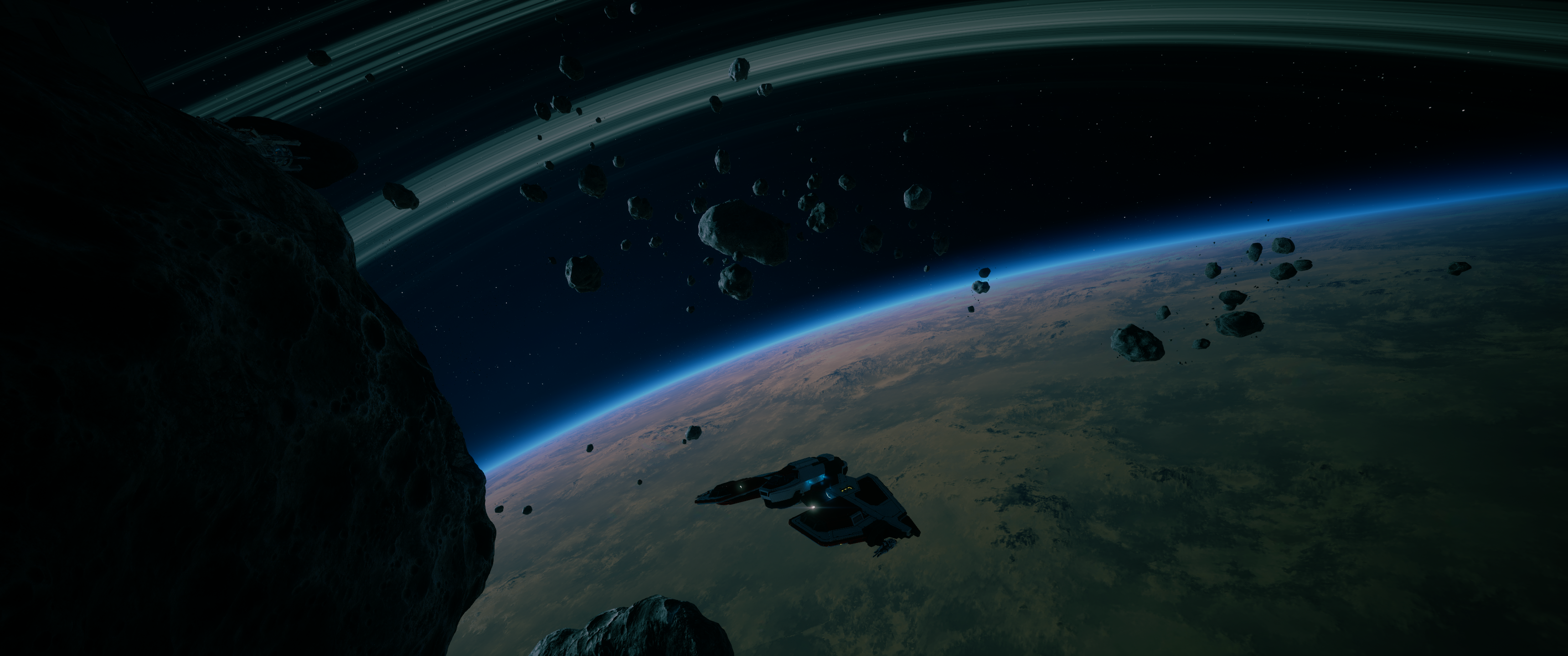
A ship in an asteroid field hovering over a ringed planet
I initially thought Everspace 2‘slack of replayability would be a problem. It lacks a skill tree or other ARPG elements that specialize your character. No advancement or story choice blocks off content. ARPGs have traditionally used these to encourage players to create different characters to replay content differently.
However, being able to quickly switch out a new ship or experiment with new weapons or modules means experimentation or change is refreshingly easy. Meanwhile, the perk and challenge systems provide attainable alternative goals that offer useful benefits instead of gatekeeping high-level content from less dedicated players.
Ultimately, Everspace 2 is a game that knows what it wants to be. It doubles down on that explore -> shoot -> loot -> craft game loop. If you enjoy that loop, and you will find out quickly or via the free demo, the game promises hours of the same. Otherwise, you will bounce off Everspace 2 hard.
Everspace 2 also knows what it does not want to be. It is single-player and offline, eschewing the complex code, gameplay loops and community management required for multiplayer or online play. It focuses on quality over quantity, providing a few well-developed star systems to explore. There is no piracy, salvage, political simulation or other distractions.
It took me about 60 hours to complete the main quest, including most side quests and challenges. As with most RPGs, you could complete it in under half that time, but you would miss the best content. Meanwhile, the developers continue expanding and enhancing the game, showing a welcome love and attention to detail. If only all ARPGs were this good.
Have you ever watched a movie or TV show and wanted to pause and marvel at a scene? It may be beautiful, showing off an artful mix of colour and design. It may be complex, requiring time to appreciate the detail. It may capture a moment that creates strong feelings or thoughts.
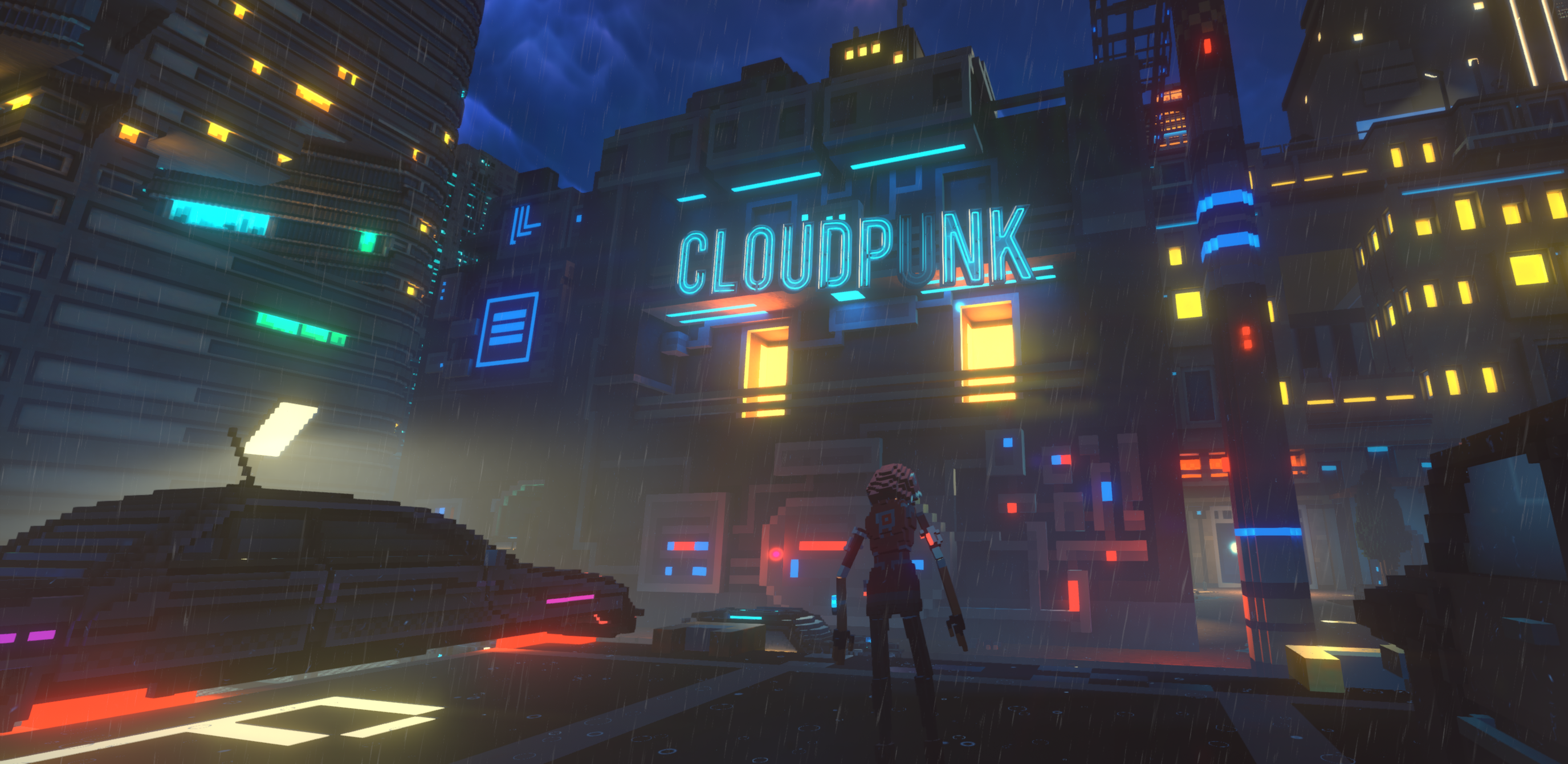
I love taking screenshots in video games. Not all video game graphics are lifelike or realistic, but even retro or pixel graphics have their beauty, such as the screenshot from Cloudpunk below. The definition of “realistic” also decays as each new generation of hardware increases fidelity.
Even Cloudpunk‘s voxel-based graphics are beautiful
Why take screenshots? I enjoy it. Arranging a good scene and admiring it as a screenshot is fun. This admiration is called “sense-pleasure”, a term coined in the original Mechanics-Dynamics-Aesthetics game design framework. Some game developers have screenshot competitions and communities. Winning is fun, as is sharing a common interest. Trying to take good screenshots also allows me to appreciate the effort developers put into games, looking at games and visual media through different eyes.
Taking good screenshots is simple: play games, take lots of screenshots, review them, decide which ones are the best, try to get more of those, and repeat.
That leaves two questions. The first is “Which games should I take screenshots from?” The second is “What makes a screenshot good?”
The answer to the first question is also simple: play whatever games you enjoy. That said, some platforms, such as PCs, and game types, like 3D open-world games, are more conducive to taking beautiful screenshots. High-end PCs have higher resolutions and are capable of better graphics. The developers of 3D open-world or similarly expansive games often create visually appealing worlds.
Some graphics capabilities require special attention. Virtual Reality (VR) and Augmented Reality (AR) are more of an experience, something a static screenshot cannot capture. Screenshots from High Dynamic Range (HDR) displays are often too bright, at least in non-HDR file formats.
Screenshots of glitches, memes or schadenfreude are often spontaneous. These can be fun. They have their place. However, these tend to be unpredictable and their popularity fleeting.
Answering the second question, “What makes a screenshot good,” is more difficult. Someone with art training could write volumes on what makes a good painting or scene. However, some general advice I found helpful follows.
The human eye is usually drawn to specific places when playing a game. Players have fractions of a second to decode a busy scene and determine what to do next. The game designer wants to emphasize where to go next or the boss’s weak points.
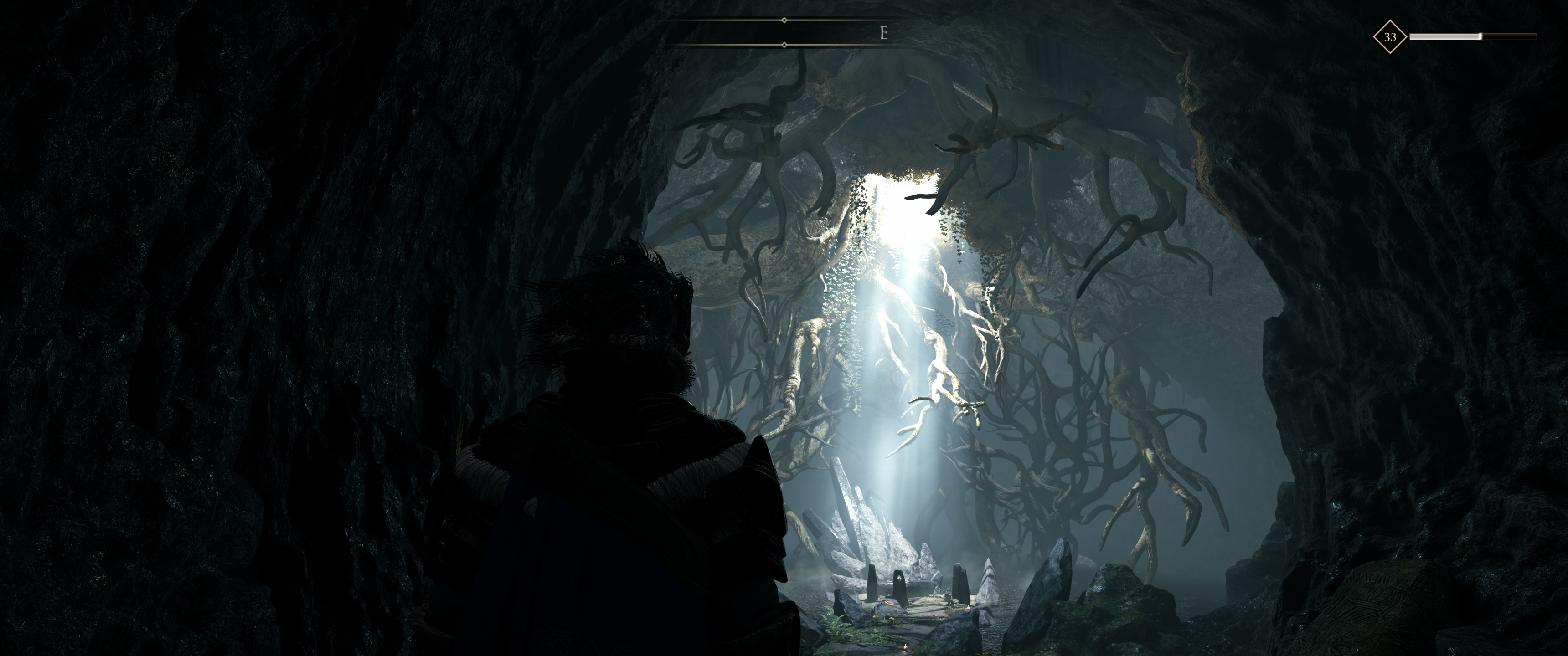
An underground cave from Greedfall
The above screenshot from Greedfall shows how the developer can unsubtly force the eye to focus somewhere. The light filtering from above among the dangling roots directs the player while hinting at this place’s history and significance.
However, the human eye can take its time to appreciate a screenshot. Treat each screenshot as a diorama. People view a screenshot holistically, like a painting. Arrange interesting things around the image or, if there is a single focus, ensure it is unique or intriguing enough to hold attention.
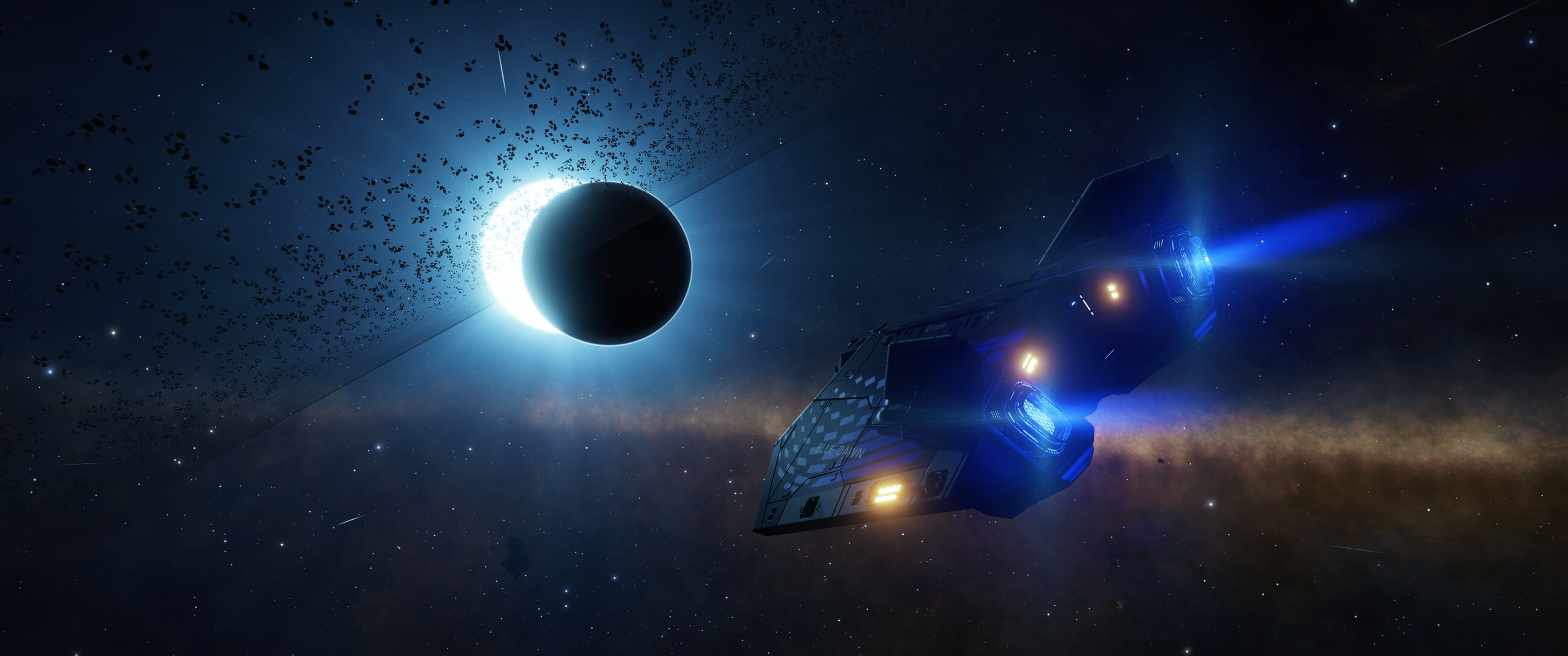
An Asp Explorer (spaceship) from Elite Dangerous
This screenshot shows a beautiful fusion of elements. The blue exhaust from the Asp Explorer (spaceship) heading towards the ringed planet matches the light of the eclipsed blue-white star. The edge of the Milky Way galaxy shows behind. This fills the image, meaning there is something interesting to look at everywhere.
Night City from Cyperpunk 2077
This screenshot shows the busy Night City skyline from Cyperpunk 2077. There is so much detail that it takes time to parse. What initially could pass for any modern metropolis is quickly dashed by the ascending holograms and unfamiliar advertising.
A Krait Phantom (spaceship) flying between a planet and its moon in Elite Dangerous
Another example from Elite Dangerous is above. Elite Dangerous‘ planet generation is fantastically detailed, and the colour contrast reflecting off the Krait Phantom’s mirrored hull looks wonderful. The distortion from the engine exhaust gives it that extra touch of realism and adds momentum.
Looking at the planet’s star through its rings in Elite Dangerous
While stark and beautiful, the lack of something interesting in the foreground in the above image gives the feeling something is missing or incomplete.
The best screenshots are not always from the most action-filled or detailed scenes. Screenshots omit many elements of game interaction, reminding us of what the screenshot lacks. There is no movement or action. There is no music, sound effects or story. The hardware sometimes limits the graphical fidelity. A screenshot can expose low polygon models and blurred textures.
An alien machine from Elite Dangerous
If you have a central focus, viewing it from a slight angle gives it a more natural appearance. It shows more detail from the side or top. The above screenshot shows the misty, creepy, organic, Gieger-esque internals of a thargoid base from Elite Dangerous. The details of the back pillar would otherwise be obscured if the shot was front-on.
The best screenshots tell a story or evoke emotion without context.
A Scorpion (buggy) exploring a thargoid spire site in Elite Dangerous
For example, zooming back from the Scorpion (buggy) and placing it below the camera’s centre in the screenshot above draws the eye towards the towering thargoid spire above it. The contrasting light between the green cloud to the right and the blue star to the left pleases the eye. This screenshot evokes a sense of alienness, wonder and being alone.
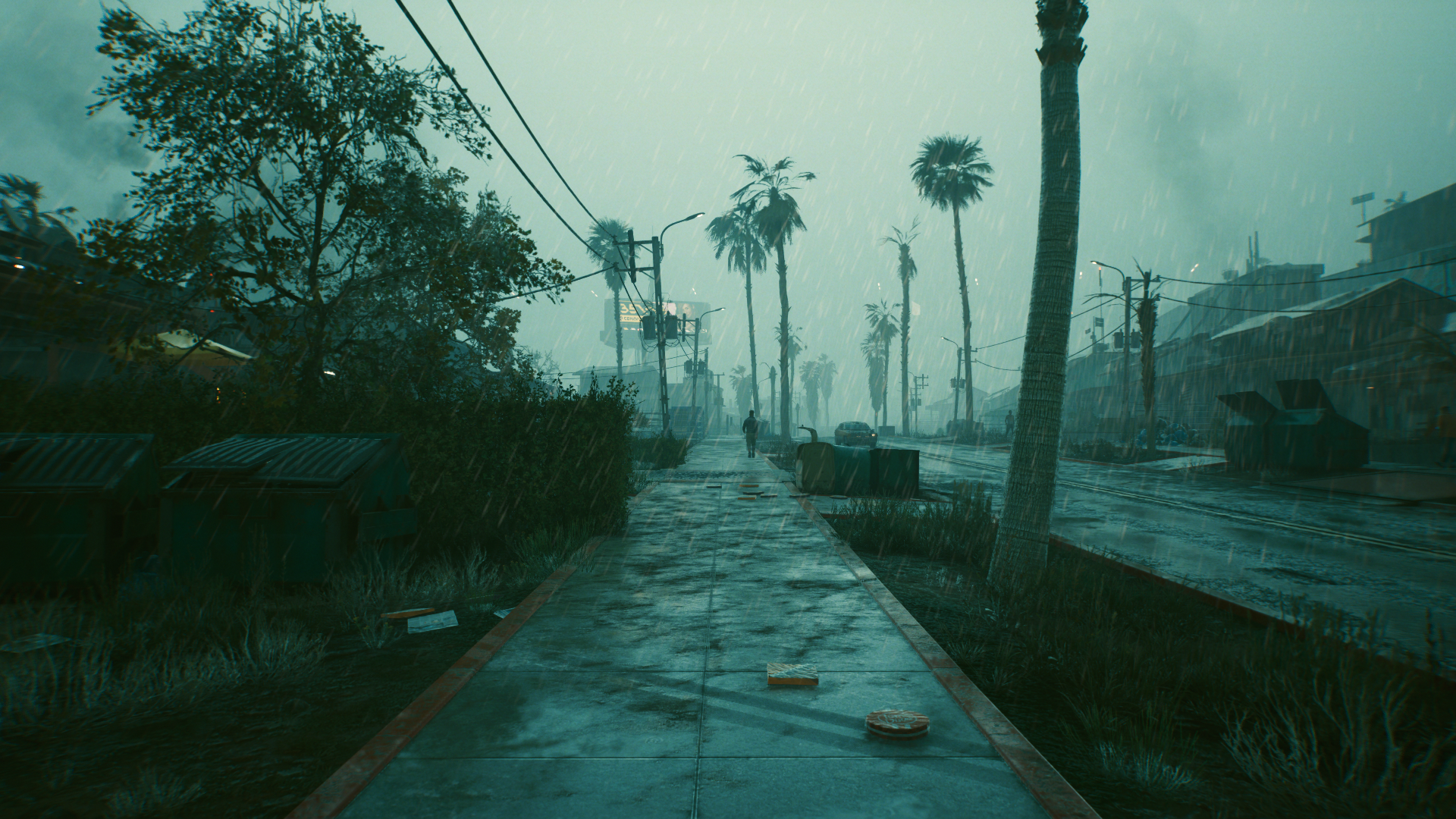
A rain scene from Cyberpunk 2077
Plenty of games have rain. However, the mist, almost monochromatic palette and subtle reflection in the puddles above capture a dreary oppression better than any other I had seen. The dirty footpath and cluttered scene emphasize the worst parts of urban life.
Avoid busy or unclear scenes. The dozens of spell effects hurled at a boss in an MMORPG raid can be impressive. However, parsing the scene can be difficult. 3D scenes rendered in wide aspect ratios, such as 16:9 or 16:10, distort around the edges. Avoid putting essential details there.
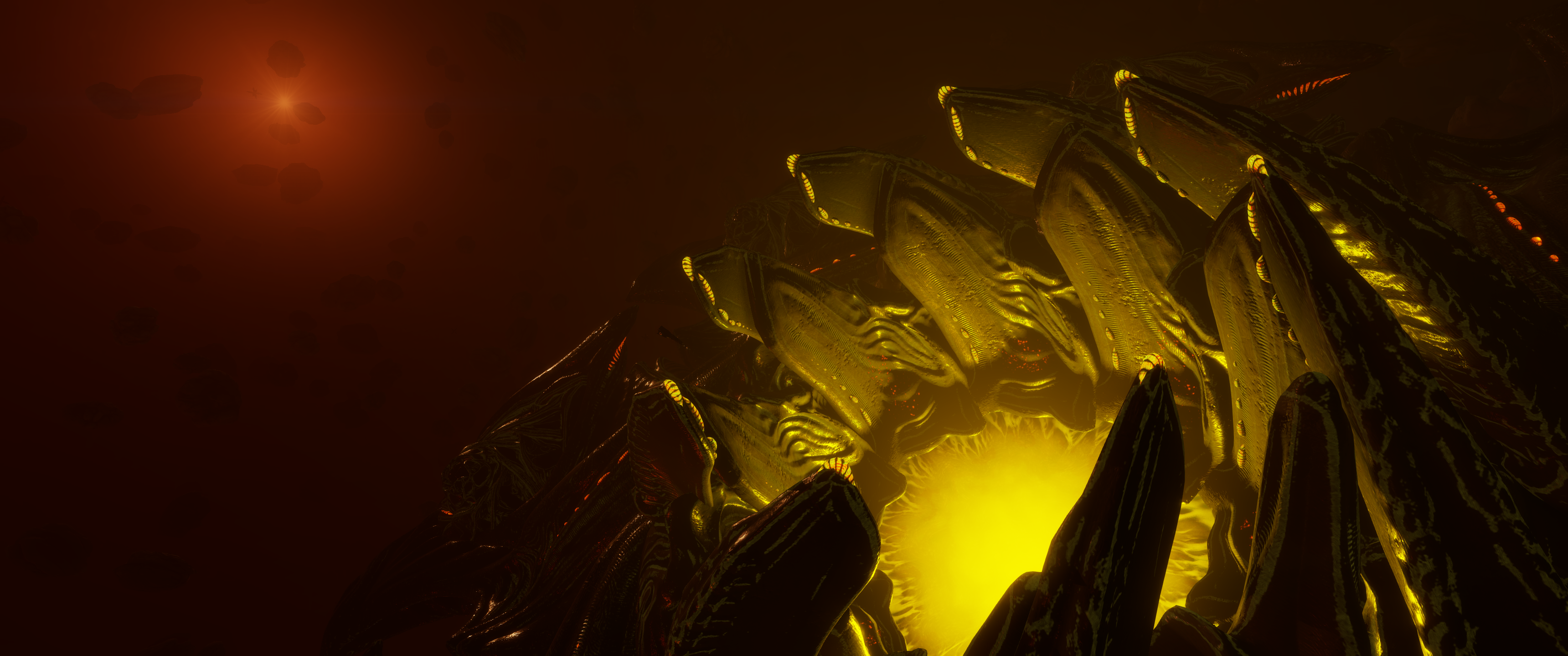
Lighting and colours pose unique challenges and opportunities. Overly dark or light scenes can be hard to discern. Contrasting light can be beautiful, as shown in the dull red of the star against the alien structure’s yellow below. Monochromatic scenes can be stark.
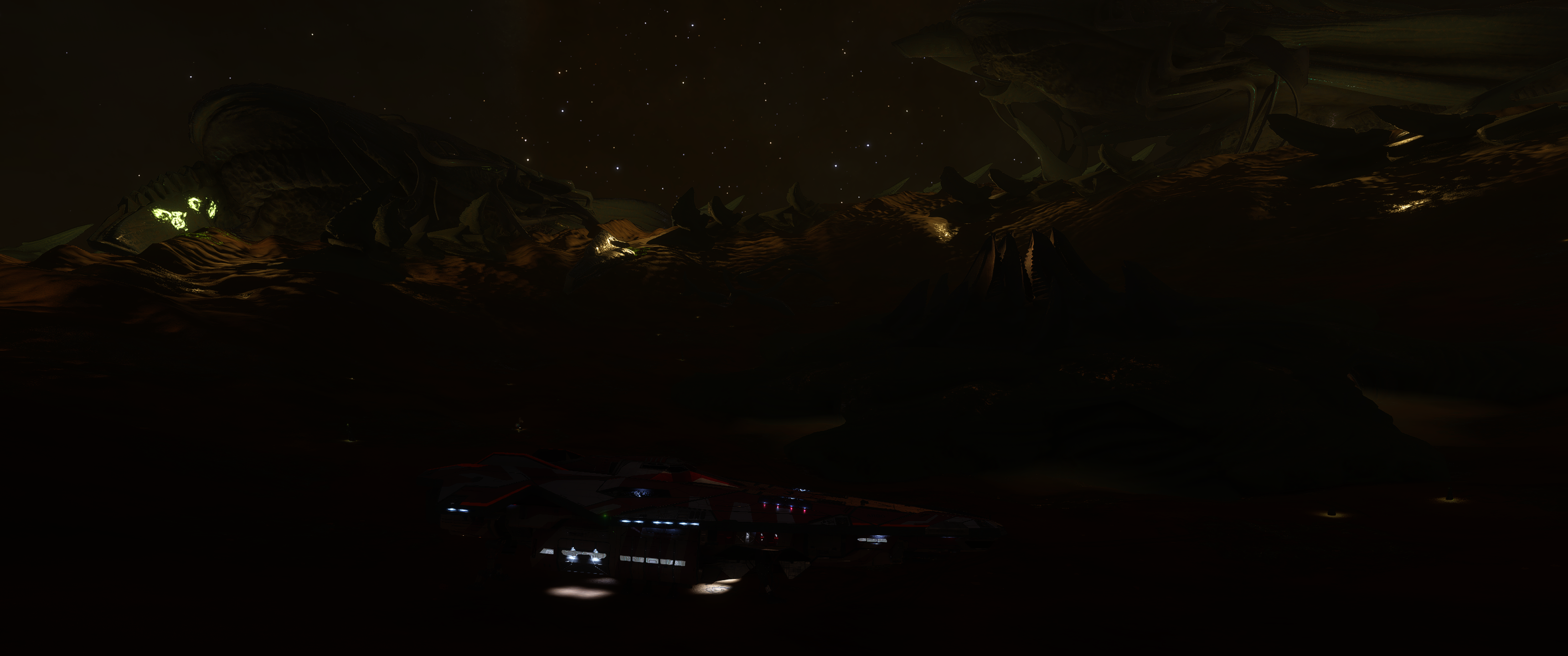
A thargoid titan from Elite DangerousA dark HDR screenshot from Elite Dangerous
While the scene above has a lot of detail, it is too dark. This is a good example of an HDR scene losing too much contrast when rendered in standard displays.
Disable or remove any “heads-up display”, voice chat overlays or similar UI elements. They often distract from the scene unless they are the focus (“I survived at 1% health!”).
Modern games may have photo modes that temporarily use more screenshot-friendly graphics settings and give more camera control. Use these when you can. Controlling the camera angle or adding effects, such as vignettes or filters, can add a lot.
An alien world from No Man’s Sky
Tilting the camera turns the already alien world from No Man’s Sky, above, into something disorienting. The slight vignette helps focus the attention on the centre and adds depth.
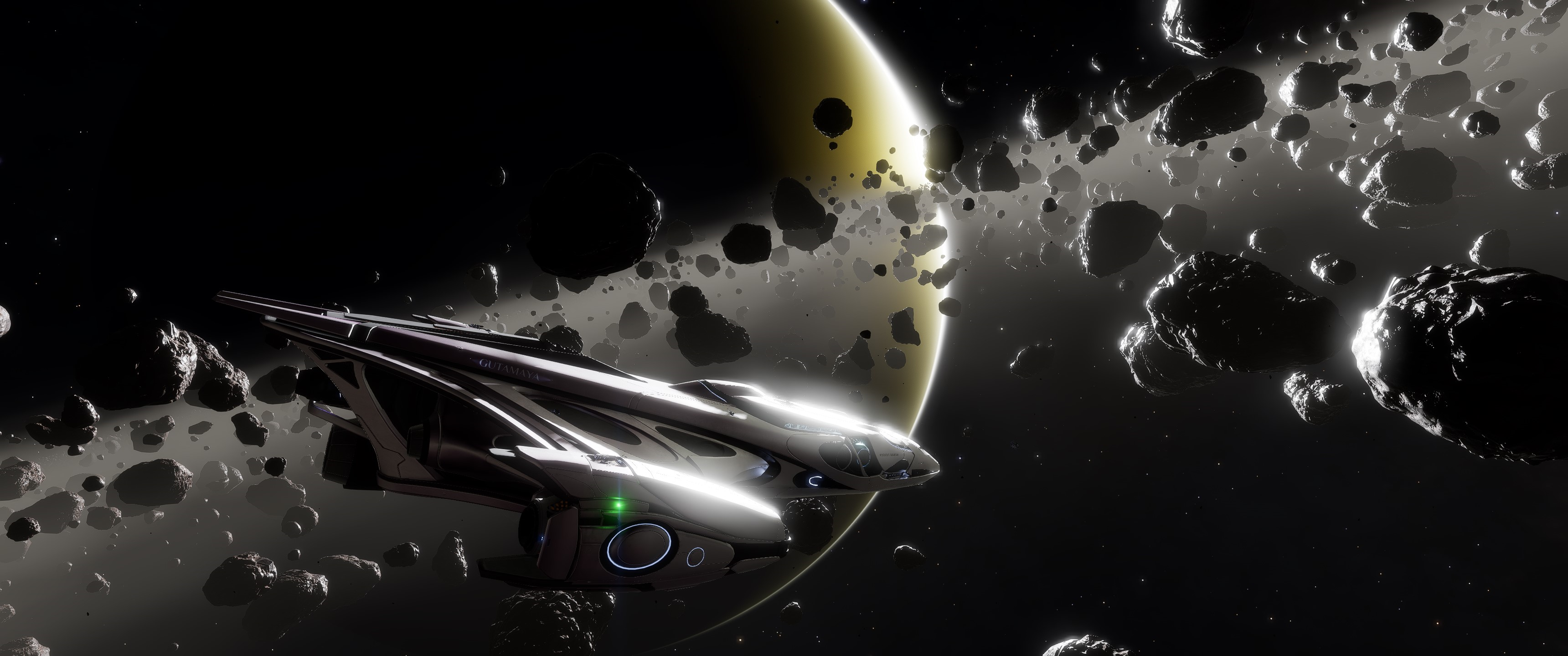
An Imperial Cutter (spaceship) amongst a gas giant’s ring in Elite DangerousLooking through asteroids toward a faint, distant star in Elite DangerousA thargoid interceptor at a barnacle site in Elite Dangerous
Effects like bloom, light rays, reflection or lens flare turn a scene into something magical, as shown above. If I ever want new backgrounds for my computer’s desktop, Elite Dangerous is a wonderful way of generating them. Unfortunately, players may have to turn effects off to improve frame rates or to run games on low-end graphics hardware.
A traveler admiring the nighttime bioluminescent display from No Man’s SkyA traveler admiring an eclipse on No Man’s Sky
Sometimes, careful timing and placement are key. This can be as simple as waiting until night in the first screenshot above or finding a lens-flared eclipse’s exact moment and angle in the second.
Be careful of symbolism and logos in games. While these can be meaningful and emotive in games, they often lose context outside that game. Worse, games sometimes use real-world symbols that can offend.
Avoid modifying screenshots after taking them. Highlight the game developers’ artistry, not Adobe Photoshop skills. Modifications are often prohibited if you want to enter screenshots in competitions. However, each game and community will have its own rules.
Many games have “vista moments”, where the player leaves a cramped, narrow area and enters a broader, almost agoraphobia-inducing wider world. If you are looking to start taking screenshots, finding these is a great place to start. The developers often make these look stunning.
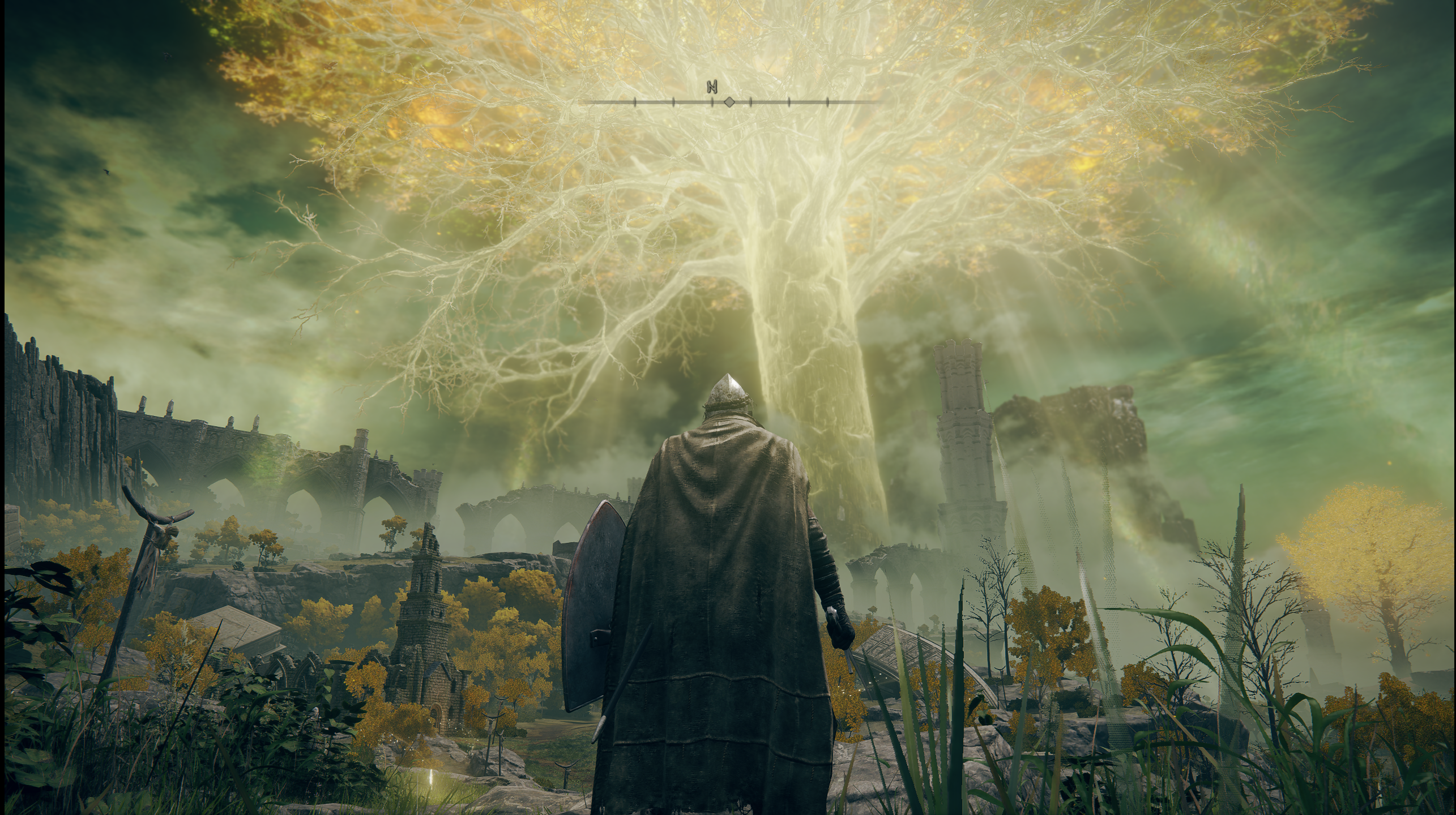
Your first view of the Erdtree in Elden Ring
Your first view of the Erdtree in Elden Ring is a wonderful example of a panoramic “vista moment”, as shown above.
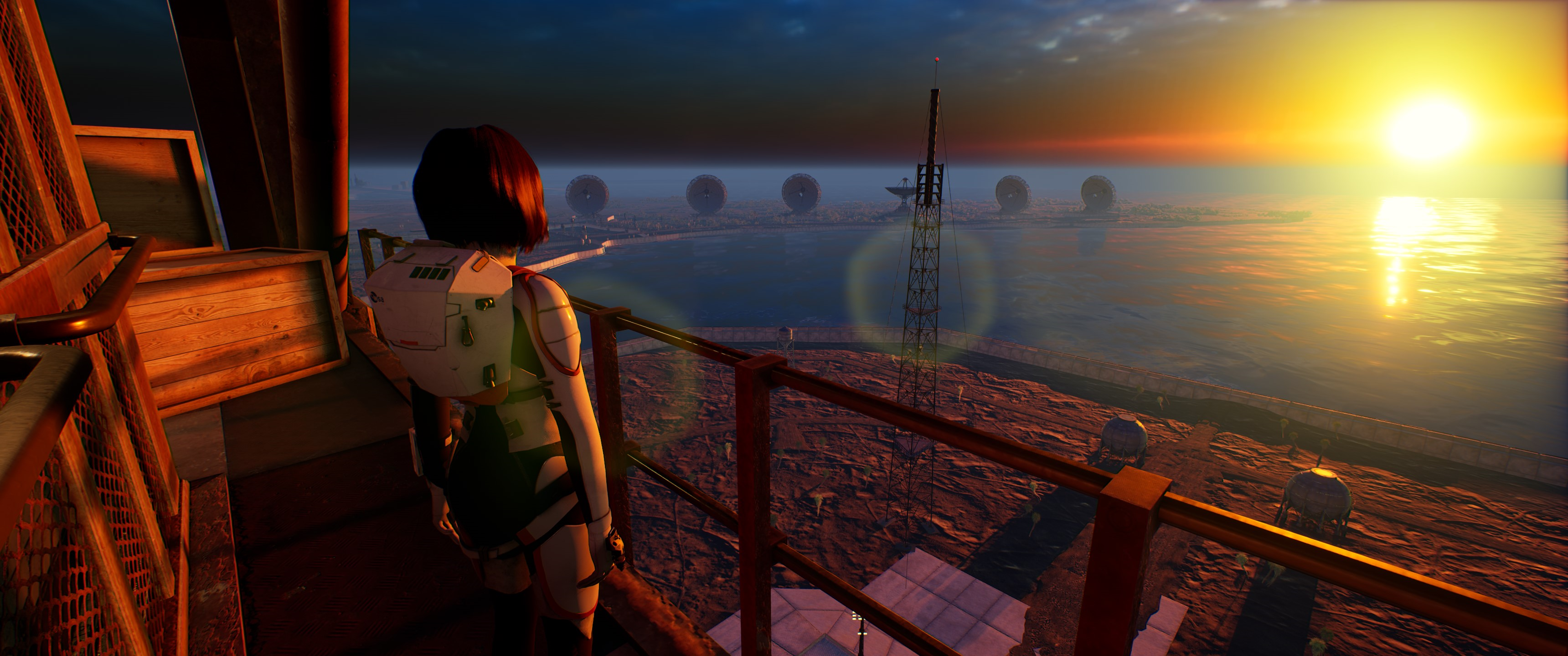
Looking over the water at dusk in Deliver Us Mars
The above scene showing the sun reflecting off the water is a wonderful change from the cramped corridors preceding it. In a setting where the Earth’s environment is collapsing, this reminds you what you are trying to save.
Graphics are arguably the most essential part of video games. While it is possible not to have any significant graphics, e.g. The Vale, video game developers spend much time and resources getting things right that players may only see for a few moments. Taking screenshots both helps share these moments and appreciate the effort and artistry that goes into video game development.
Moonring is a top-down, turn-based, retro, fantasy role playing game (RPG) developed by Fluttermind Games. It is the work of a small indy team led by one of the designers of the first Fable game. It is also free.
In Moonring, you play an unnamed protagonist in the eternally shadowy world of Caldera with little early guidance or direction.
Mechanically, you move your character around the world using up, down, left, or right. Moving onto items picks them up. Bumping into enemies attacks them. Bumping into doors opens them. Bumping into allies starts a conversation. Moonring highlights keywords or phrases when you speak to NPCs. You type them in to converse further.
Using these, you piece together what to do. Your deceased father left instructions to continue unravelling a mystery. These involve a tutorialised exploration of your small farming community and then leaving to explore further.
As implied above, playing Moonring needs effort. No quest log or marker is pointing you in the right direction. No dialog tree reminds you what to say. The game helps a little. It captures notes with pertinent information and sometimes puts locations on the map. However, the player deduces what to do.
As you explore and converse, you learn that Caldera plunged into darkness centuries ago. Five moons appeared, each associated with a god. Unlike most, you have not had a god-enthralling dream. As one of the dreamless, is your destiny to become the new Archon and rule Caldera?
You also discover Moonring‘s mechanics are more complex than they appear. The game has a complex stealth system. You can make ranged attacks. Status effects overlap in interesting ways, such as water dousing fire. Ability’s energy costs change as different moons wax and wane.
Moonring has rogue-like elements. Saves are automatic, and there is a single save slot. You cannot save scum. The game generates dungeons when first entered. Dying punts you back to the dungeon’s start, losing your progress. The game randomises potion ingredients in each playthrough.
Moonring can be frustrating. I often felt stuck and had to review old notes or wander until I stumbled into something useful. I died to the end boss of a seven-level dungeon multiple times, having to repeat the whole thing each time.
However, the eureka moments when things clicked, or I finally beat a boss, were exhilarating. Sometimes, it is as simple as finding the one villager with a vital clue or bumping the right wall to open that secret door. Sometimes, it was new tactics and gear inspired by earlier failures.
These highs and lows are like those in the late 1980s RPGs that inspired Moonring. Moonring’s pixel graphics even use the old 16-colour EGA palette; the audio is reminiscent of the old IBM PC speaker, and the music is MIDI-like. There is even an optional blur mode to make the graphics look like an old, interlaced, cathode ray tube monitor.
However, there are conveniences and improvements found in modern games. As mentioned, Moonring takes notes for you. While Moonring intentionally does not explain its mechanics, the game has basic help. When crafting potions, Moonring tells you the potion that ingredients will create. The game explains new status effects each time.
Moonring treats advancement differently from most RPGs. Moonring does not reward killing creatures, discovering new areas, or completing quests. Instead, you earn devotion to one of the five gods. You spend it to gain god-themed abilities and raise that god’s attribute, which makes new items usable.
You earn devotion by using a rare item or fulfilling deity-specific tasks. These tasks can be as simple as a pilgrimage to their holy city or as complex as recovering a sacred relic. The tasks tie into each god’s themes. A god of strength may reward killing many enemies. A god of knowledge may reward discovering ancient artifacts.
This advancement system encourages exploration and discovery, which is the heart of Moonring. This is not just of the map but of mechanics, conversations, crafting, equipment types and even status effects. The game encourages stealth or working around problems. Grinding or clearing out every creature on the level is rarely rewarding.
How else will you discover whether becoming the new Archon is the only way to complete the game? How do I afford a ship deed at that price? Is there more to the fog-like amber? There is no magic system, right?
Moonring will appeal to those who played early RPGs or want a quirky, sometimes frustrating game. You can finish the game in about 10 hours, but most playthroughs will take much longer. It will not appeal to many. However, Moonring shows love and nostalgia for an RPG style long surpassed. Being free is just icing on the cake.
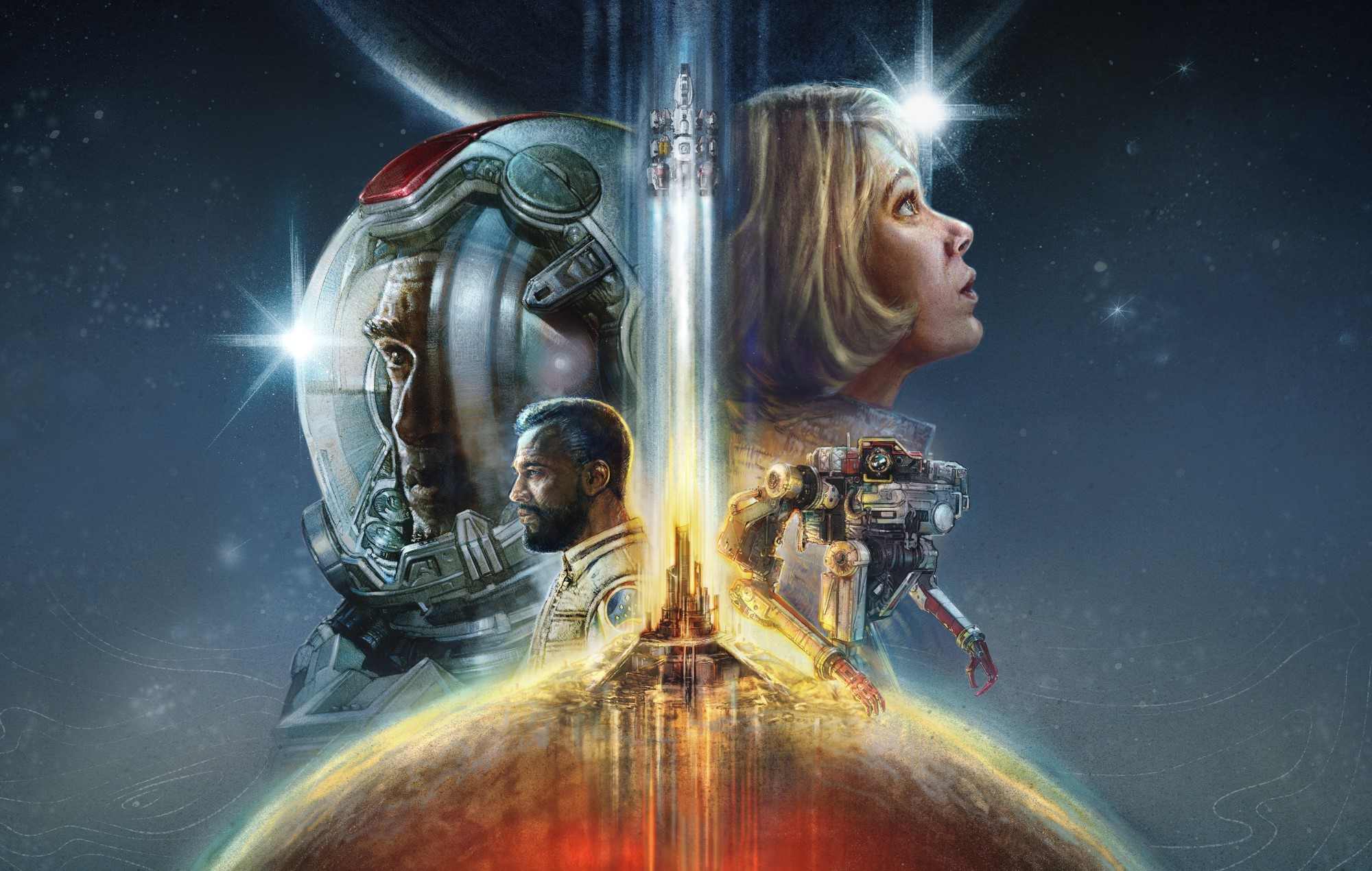
Starfield is the latest action role playing game (RPG) from Bethesda, the developers of Skyrim and Fallout.
Starfield, the first new RPG setting from Bethesda in a long time, is set in 2330. The Earth’s magnetosphere dissipated over a century earlier, rendering it lifeless. Thankfully, humanity mastered faster-than-light travel via the gravity drive. They rapidly evacuated to the star systems near Earth, deserting old nations and building new institutions.
You start Starfield as a lowly asteroid miner, listening to your coworker’s banter. You unearth a seemingly alien artifact that gives you strange visions. After an attack by space pirates, you are inducted into a quaint, exploration-focused organization called Constellation and whisked off onto an adventure.
Structurally, Starfield has a similar “in media res” style introduction to Skyrim. It quickly teaches you the basic mechanics, gives you a short fight to get the blood pumping, establishes you as the “chosen one”, sets you on the main quest, and then gets out of the way. Much of the exposition happens later.
Starfield‘s strength is the breadth, if not depth, of game loops. Its gameplay is fun, but only exploration is remarkable. The combat is standard first person shooter fare, although melee could be more varied. The stealth mechanics are good but not up to Deus Ex or Cyberpunk 2077. Bethesda nailed the sci-fi feel of lock picking, but once you understand it, less player skill is required than in Skyrim. Your scanner is helpful for exploration, identifying enemies, or satiating hoarding instincts by finding things to pick up.
The gameplay is repetitive but not grindy. You do not need to repeat boring activities to enable more enjoyable gameplay. Sufficient variety in the quests and randomly generated or placed content prevents boredom. Once you exhaust the scripted quests, Starfield offers randomly generated versions to pass the time or continue adventuring. Alternatively, land on a planet and start exploring.
Starfield‘s main quest line is suitably epic and galaxy-spanning, providing mystery and motivation. It draws you above the drama occurring elsewhere in the settled systems. However, this distance means the main quest line loses some emotional grounding and gravitas. Starfield‘s setting and side quests provide the most content, variety and potential like most RPGs.
Starfield contains many visually and thematically diverse places. After leaving the dusty, decrepit asteroid mine and a short detour, you first visit the city of New Atlantis. It is the capital of the United Colonies. Visually, it resembles the citadel from the Mass Effect series: clean, bright, organic curves, open spaces with water and greenery integrated seamlessly with technology.
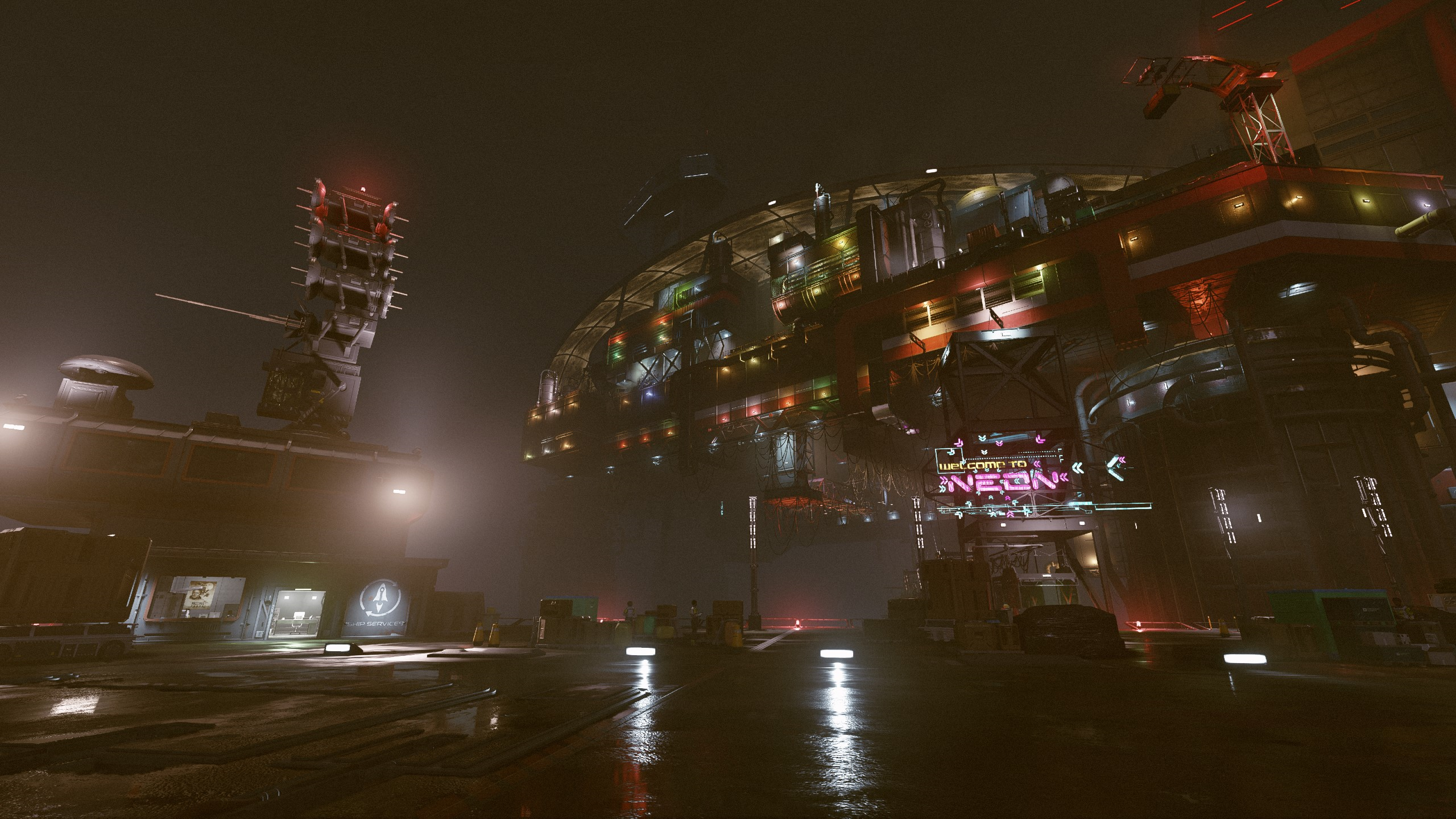
New Atlantis contrasts with other places like Akila City, the capital of the Freestar Collective. Its mud roads and stone buildings make it feel like the Wild West in space, complete with a bank robbery. As its name suggests, Neon is a cyberpunk (the genre) style metropolis on a rain-drenched water world. It is where to indulge in less savoury activities, like gang warfare, corporate espionage, or elicit substances.
Neon’s exterior in all its multicoloured glory.
Exploration is integral to Starfield, being the primary mission of Constellation. Mechanically, it is similar to No Mans Sky or Elite Dangerous. However, Starfield does it better. Starfield supports multiple biomes per planet, adding variety. Starfield is about exploring a known, finite universe, not the near-infinite set of random ones no one else will ever visit. Planet surfaces intersperse improbably frequent natural phenomena and enemy-filled bases to break up the gameplay. You can improve your exploration skills, like increasing scanner range, sprinting further, or learning more about scanned species.
A misty sunset with trees in the foreground and mountains in the background.
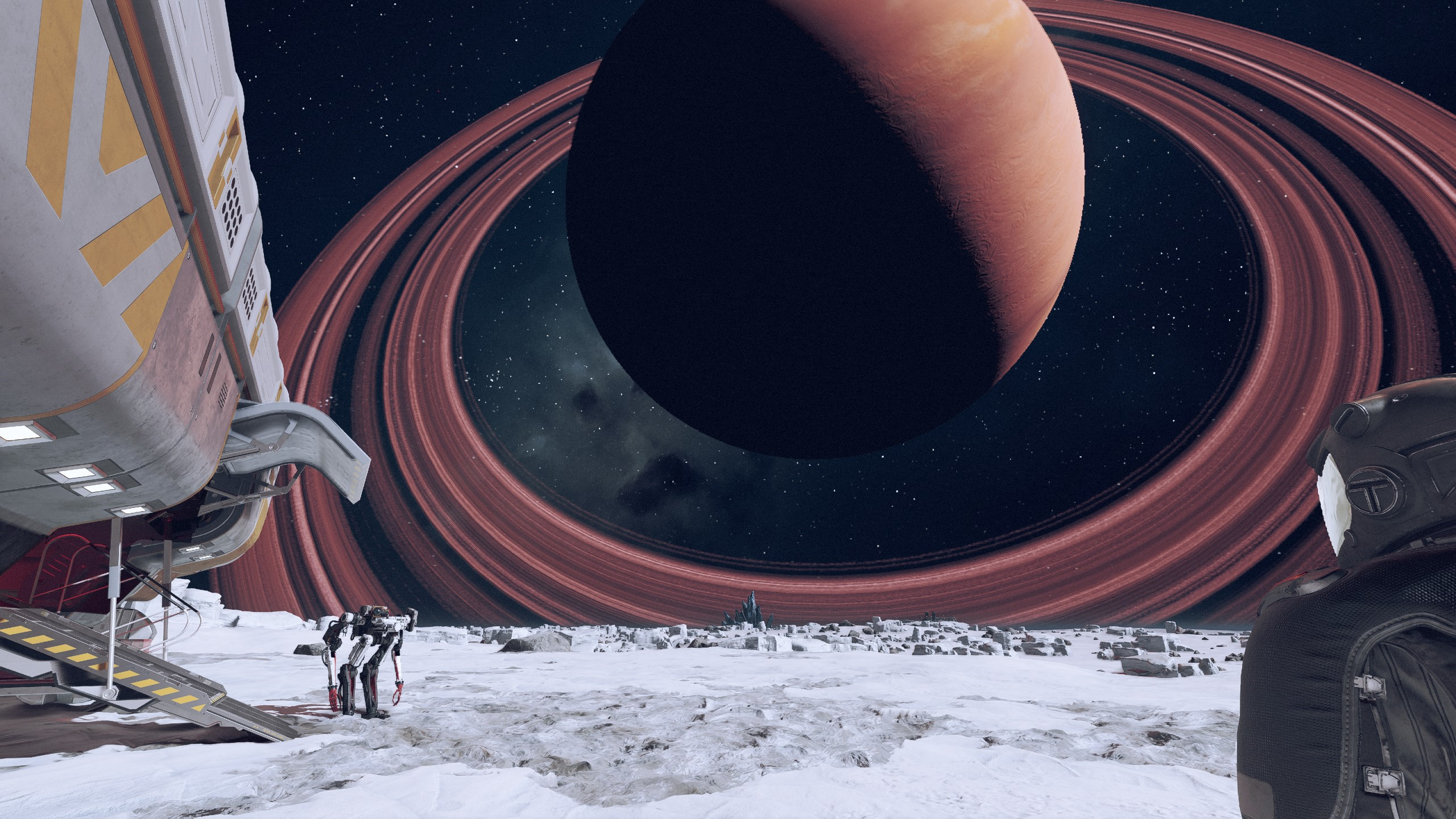
Starfield is visually better than games like No Mans Sky and Elite Dangerous, and “sense pleasure” is integral to exploration. Not just because Starfield is newer. While all generate terrain procedurally, most of everything else in Starfield is hand-crafted. Starfield‘s alien flora and fauna are more plausible, not just a random assortment of limbs. Think Star Wars, where humanity is not at the top of the food chain. Starfield‘s designers often placed moons and planets to create picturesque views, like ringed planets filling the sky. Starfield also has weather, like dreamy mist-filled sunrises, savage dust storms, or dreary rain.
A beautiful ringed planet viewed from a moon.
You need a starship to explore. Your starting ship, the Frontier, is a masterful example of worldbuilding. From the venting gas from its landing thrusters, whose exhaust is ignited by sparks like modern rockets, to its white, vaguely aerodynamic shape reminiscent of the space shuttle, it anchors the setting to a believable near future.
Unfortunately, you pilot your ship rarely. It is either in space, docked or landed. Docking and landing are automated. Flying between planets or systems is “fast travel”, using a short cutscene.
Approaching the starstation “The Eye”.
Starfield has ship combat, but it is arcade-like and closer to No Mans Sky than Elite Dangerous. It devolves into building ships with better shields and weapons. Manoeuvring is all but useless. The camera views block too much with either the cockpit or your ship’s back. Power management is awkward, particularly in the heat of battle. Macros would be helpful. The targeting mode loses any situational awareness.
However, once you master the clunky interface, the shipbuilder is a beautiful avenue for self-expression. Like the Galactic Civilization franchise, you customize and assemble ships using modular components. In a clever touch of worldbuilding, different vendors’ modules have different styles, such as the blocky, angular Deimos or Taiyo’s almost organic curves.
You can also walk around your ship, board enemy ships and add crafting stations and containers. However, to prevent punishing those with large ships, you can board into or leave directly from the cockpit. Elite Dangerous‘s designers should take note.
The back of a Stroud-Ekland cockpit.
Starfield allows building outposts on different planets to store excess equipment, gather resources, craft materials, and refuel ships flying past. You can also create trade links to automate the transfer of materials between them. Starfield almost rivals factory games like Satisfactory with its web of materials and resources.
However, the capacity of even the largest storage buildings needs to increase. A lot. No Mans Sky offers more variety, including positioning individual walls, roof and floor tiles.
In terms of companions, there are dozens that you can hire or find around the galaxy. Of these, four companions have unique quest lines. Each quest line companion follows roughly the same moral compass: generally good and favouring exploration. Although not my thing, this limits the potential for less noble playstyles.
Some want Vasco, your robot companion, to have a quest line and opportunity for growth or change. However, with the world currently enraptured by the potential and danger of AI, seeing a robot follow its programming is a welcome piece of sanity.
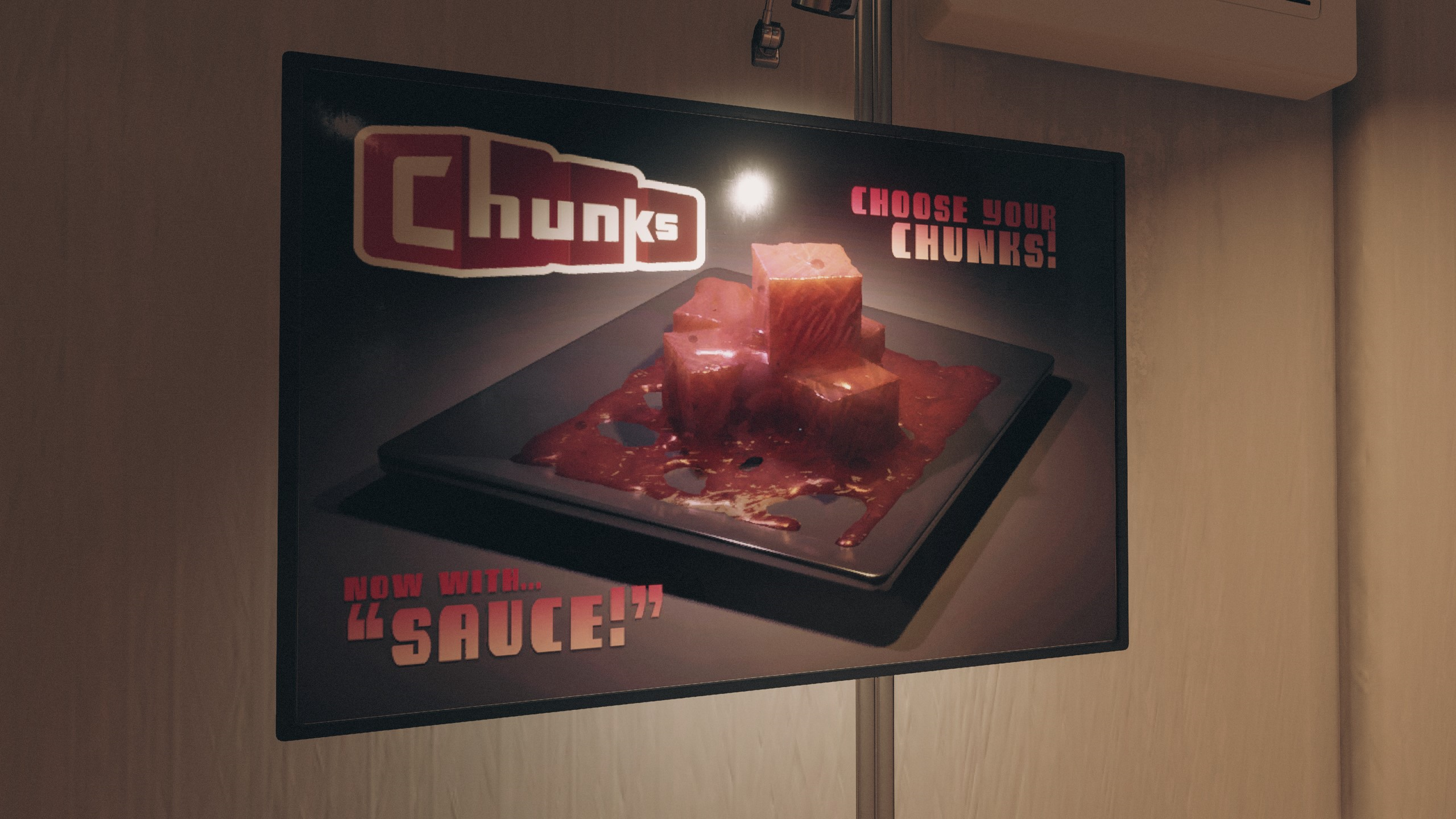
Thankfully, Starfield does not take itself too seriously. Catching up with your parents in an alien petting zoo or watching them pretend they did not try illicit substances is touching and amusing. Various “inspirational” posters line the walls of shady secret research labs. Chunks, the ubiquitous cubic fast food of the 24th century, “meet all minimal nutritional requirements”. Vasco has some innocent but cuttingly insightful wit. Your adoring fan’s flattery never gets old.
Hmmm. Appetizing.
Starfield‘s music is orchestral, reminiscent of Star Wars or Star Trek. Most tracks are slow and use periodic gradual crescendos to emphasize the wonder and grandeur of Starfield‘s universe. The soundtrack is composed to support a game with lots of voice dialog and critical sound queues, such as in combat. It does not call attention to itself. For example, the restrained, almost mournful menu theme is the opposite of Skyrim‘s rousing call to action. Rather than assaulting the player with aggressive emotion, Starfield‘s version hints that the player has to come to the game (or music), not vice versa.
My main criticism of Starfield is not that it is too easy, at least on “normal” difficulty. I may have played many Bethesda RPGs, but even “hard” provided little challenge. Assuming you do not intentionally engage in challenging content, there is little pressure to specialize your character’s skills, ship, outposts or use consumables for temporary buffs. These become more role playing opportunities.
My main criticism is also not that Starfield is the usual Bethesda RPG oxymoron. Starfield empowers you, creating a feel-good power fantasy where you are important and can make galaxy-affecting changes. However, as the conveniences in your favour accumulate, like free ship fuel or unkillable companions, immersion and suspension of disbelief get harder. Starfields‘ roots in points-based mechanics mean large level differences between you and your target can create unrealistic bullet sponges.
I do not mind that, despite Starfield having the best facial and hair animation of any Bethesda RPG, it still falls into that uncanny valley. NPCs wander aimlessly and still get stuck in walls occasionally.
My main criticism of Starfield is an absent central or recurring theme. For example, in a world where AIs are more intelligent and capable than humans, and the powerful are unshackled from laws and ethics, Cyberpunk 2077 examines humanity. The Fallout series deals with the difficulties of survival and that the best choices are often hard or impossible. The Witcher series shows that, when monsters walk among humans, humans are sometimes the most monstrous of all. The Nier series deals with loss.
In fairness, a game does not need to be profound to be good. Making action movies or games requires skill. Bethesda more than demonstrated it with careful level design, regular mixing of gameplay modes, managing tension, and catering to familiar sci-fi tropes and fantasies. The usual meme-worthy glitches are thankfully absent. The greater attention to quality after Cyberpunk 2077‘s problematic launch is apparent.
Instead, Starfield is pure, fun sci-fi escapism. It is a series of concurrent action movies. RPGs are defined by how well they let you play out fantasies. Starfield delivers on that.
For example, the Vanguard quest line plays like a rerun of Starship Troopers. The Ryujin quest line is a sci-fi James Bond or Mission Impossible coupled with corporate espionage and intrigue. Completing the Mantis quest allows you to play as a space Batman. The Sysdef/Crimson Fleet quest line has palpable tension as you play a double agent, playing criminals and the law against each other. Join the Rangers and play as a space cowboy.
A “Neil Armstrong moment” standing on the surface of Luna, the moon, looking toward the Sun.
Starfield is unoriginal. Almost everything in the game is “heavily inspired” by something else. That is OK. Successful RPGs help players fulfil fantasies by immersing players in familiar tropes. Where Skyrim opened the fantasy genre to a broader audience, Starfield attempts to do the same with science fiction.
That said, I was disappointed there were not more overt references to other movies, shows or games. Many will pick the few references to Skyrim‘s sweet rolls and Meridia quests. Yes, there was some well-known voice talent from Star Trek: Deep Space 9 and a subtle reference to the 1986 Transformers movie. Cyberpunk 2077 did this comparatively better.
Without strong themes and notwithstanding a few minor nods to modern sensibilities like same-sex relationships, there is little to offend or demand too much of its players. Perhaps Bethesda wanted to play it safe and avoid controversy.
However, Bethesda missed the opportunity to do something more. So many quests touch on real-world themes. For example, the war between the United Colonies and the Freestar Collective that ended 20 years before the game’s start still has lasting social and economic impacts. The United Colonies has to deal with the compromises and the demands strict order creates. The Freestar Collective juggles freedom with the criminal behaviour it facilitates. The Rangers’ quest line deals with the place of veterans in a postwar society. Meanwhile, the wealthy flatter themselves on luxury space cruises.
DLC or the modding community may fill the gap. Like Skyrim and Fallout, Starfield is as much a gaming platform as a game. Much of the work establishes content for future expansion or use. Outposts and shipbuilding, for example, go far beyond what Starfield currently needs. The Va’ruun, relegated to mysterious bogeymen, have much potential.
If you enjoyed Fallout or Skyrim or like science fiction games, you have probably already played or plan to play Starfield. You can race through key quests in 30 hours, but the complete experience takes at least 100 more. Starfield is fun, emphasizes exploration and knows its target audience well. However, the lack of anything original, introspective or thought-provoking may limit its long-term impact on the gaming landscape. Playing Starfield is like eating Chunks. It tastes good and you want more but the nutrition is questionable.
The Unfinished Swan is a first-person exploration and traversal game developed by Giant Sparrow, the same developer that created What Remains of Edith Finch. The Unfinished Swan is not new, having released in 2012 on PlayStation 3 and then on PC in 2020, but I only now got around to playing it.
You play as Monroe, a newly orphaned boy, inheriting from his mother a single painting depicting an unfinished swan. One night the swan leaps out of the painting. Monroe follows it, embarking on a magical journey through a surreal, dream-like world.
The Unfinished Swan‘s world is initially wholly white. However, Monroe can hurl paint drops onto it, revealing details like walls and furniture. The game’s world is a blank canvas that only solidifies when painted. For example, what was formless white is suddenly a black frog that leaps into a nearby pond.
As the game progresses, it introduces new mechanics, such as the physics-defying, AntiChamber-like puzzles; buttons and levers to activate ladders and bridges; or hurling water to encourage the growth of climbable vines. You can also find hidden balloons that unlock upgrades and additional material.
The game slowly reveals a fairytale-like story through narration, about or from the world’s prodigious but eccentric king, and storyboards, complete with child-friendly line art. The music is also ethereal, consisting of glockenspiels and light strings, reminiscent of Tchaikovsky’s Dance of the Sugar Plum Fairy.
Thematically, The Unfinished Swan views grief and impermanence through a child’s imagination. The normally mischievous act of splattering paint allows Monroe to find certainty, meaning and agency where there is none. The shared act of painting links Monroe with his mother. Metaphors have power.
The Unfinished Swan is also moving because, by seeing the world through Monroe’s eyes, we can experience things both superficially, as he does, and with an adult’s experience and context. Implication and inference also have power.
Despite its age, The Unfinished Swan still holds its own as novel and thought-provoking. It is short, taking under four hours to complete, and wraps up its story positively but with restraint. Those looking for something contemplative and unusual will enjoy it.
Outside the Cloudpunk office in-game, with the neon “U” dimmed
Cloudpunk,developed by Ion Lands, is a third person, story-based exploration game set in a future, dystopian city. It has a distinctive voxel art style that is both beautiful and distinct.
You control Rania, an out-of-work musician and recent migrant to the city of Nirvalis. Destitute and desperate, she signs up for Cloudpunk, a pseudo-legal company that delivers packages away from law enforcement’s often-corrupt eyes. Like the player, she knows how the world works but is new to Nirvalis, becoming a compelling point-of-view character.
The game takes place over a single long, rainy night shift. Most gameplay involves piloting Rania’s flying car, or “HOVA”, like the Delorean from the Back to the Future series. Occasionally you disembark and walk around the elevated streets, picking up or delivering packages and talking to other inhabitants.
However, you get the most out of Cloudpunk by taking the time to explore. Nirvalis’s verticality can be disorienting, and the HOVA’s controls can take some getting used to. Wandering reveals NPCs with interesting stories or discarded items you can sell. You can even decorate your flat.
This premise is excellent. It allows Cloudpunk to start on seemingly random deliveries, drip-feeding details about the world and its various strata. Delivering parts to someone doing illegal street racing? Check. Delivering food to the impoverished? Check. Delivering a pizza to an executive? Check. You just need to follow the rules: never miss a delivery or ask what is in the package.
However, Rania quickly gains some agency. Do you deliver a ticking package to the recipient, knowing it could be a bomb? Do you return a replaced HOVA part to the garage or sell it? While no choice branches the story, there are consequences.
This premise also allows for telling longer and broader stories. You visit some characters multiple times, slowly revealing their tales. Can you help a detective solve a case? What about unearthing more about Nirvalis’s history?
Outside the plot, Cloudpunk‘s voxel graphics are disarming but expressive, reminiscent of Minecraft. Volumetric lighting and lens flare render life-like graphics. You only notice the blockiness close to individuals or HOVAs, giving Cloudpunk a unique charm.
The city of Nirvalis is beautiful, even when rendered in voxels. The streams of HOVAs act like the city’s arteries, providing a relaxing, constant buzz and stream of lights. The Bladerunner-like neon signs and periodic audio advertisements for virtual holidays and insurance against computer viruses help make the world consistent and believable.
Cloudpunk‘s synthwave soundtrack is atmospheric, on-point for the genre and sets the mood well, such as the more meditative pieces when driving, the pressure of an urgent delivery or a club’s upbeat, drum-heavy dance track. The track names read like cyberpunk staples, like “Neon Rain”, “Sleepless City”, and “A Million Different Faces”. One important track is different, though.
Cloudpunk keeps the mood in a deliberate balance. Like in many cyberpunk stories, they wanted Nirvalis to be distant enough from the modern day to be disarming but close enough to be relevant.
On the one hand, there is depressing, omnipresent exploitation and inequality. Rapid gentrification means rents can rise by the hour, evicting people instantaneously. The ruthless and efficient debt corps practically enslave without remorse, if needed. It is easy to despair at the environmental damage and the crumbling city.
On the other, there are many lighter moments. Advertisements warn about the unlicensed playing of jazz or retro computer games. Gang members build children’s playgrounds to be subversive. Vendors sell cherry pies with “real” cherries. You could not taste the difference, anyway.
Canus, your AI canine assistant uploaded into your HOVA, also plays a vital role in setting the mood. Part researcher, part moral compass and isolation-busting companion, Canus’s naivety is endearing. The contrast with Rania’s world-weariness also subtly focuses the player’s attention on the moment’s moral quandary.
While full of cyberpunk tropes,it leverages them to reflect on important questions, not just as a lazy crutch. For example, how do we treat each other in a world where we value humans and intelligent AIs by their wealth? Can we learn to love those with whom we vehemently disagree? At its core, Cloudpunk is a game about heart. Nirvalis has never needed Rania, a Arabic name meaning queen, and her music more.
Cloudpunk takes about ten hours to finish, not outlasting its novelty. It will appeal to fans of the cyberpunk genre or those looking for something unusual, pensive and emotional.
Lilith holding Diablo’s skull next to the Diablo IV logo
The recent free “server slam” weekend was an excellent chance to experience a late beta version of the upcoming Diablo IV. After my Path of Exile foray, I wanted to see Blizzard’s forthcoming offering and how it compared.
Action Role Playing Games (ARPGs), a genre that the first Diablo practically founded, has come to be dominated by live service, “forever games” aimed at hardcore players. The story, characters, and world-building take a back seat to optimising character progression and end-game power, like in Diablo III and Path of Exile.
Diablo IV aims to put the “role playing game” back into “action role playing game”. Itdelivers Blizzard-standard fantastic cut scenes. It promises a long campaign with biblical, mysterious, dangerous antagonists and prophetic dread. Those wanting immersion in atmospheric and sometimes squeamish gothic horror will not be disappointed. Memorable and relatable characters are back. Saving the world (again) gets old. Saving someone you care about means more.
The success of Diablo IV will likely depend on how you measure it. The buzz created by a large existing player base, previous goodwill, social media-friendly cut scenes and copious beta programs will likely ensure significant initial sales.
However, Diablo IV‘s longevity and long-term player counts depend on appealing to the hardcore crowd. Those focused on the story will play through the campaign and then move on, perhaps revisiting occasionally. MAU (Monthly Active User) or DAU (Daily Active User) targets require people to keep playing (and paying).
Thankfully, Blizzard is trying to create a game that appeals to both story-driven casual and optimisation-driven hardcore audiences. The server slam demonstrated the appeal to the former. Unfortunately, the server slam’s level 20 cap makes judging late-game content, important to hardcore players, harder.
The potential is there. Diablo IV promises a huge paragon progression path after level 100 and seasons. Adventure mode allows players who have completed the campaign to bypass cut scenes and the main quest line for new characters.
However, Blizzard also needs to get the basics right. Many have written about Diablo IV‘s uneven class balance. Sorcerors were considered overpowered, barbarians underpowered, and necromancer pets were both at different times.
The classes shown in the server slam are unlikely to be their final versions. Balance adjustments will continue before and after the release. However, resource limitations and risk prevent the designers from changing much before the June release date.
Many other design changes since Diablo III are both good and bad. For example, automatic enemy scaling always ensures an appropriate challenge. This auto-scaling means players can advance through the content at their own pace. Yet, not having the opportunity to be over- or under-powered can reduce the feeling of achievement or challenge.
Diablo IV procedurally generates dungeons like most ARPGs, but the above-ground world is fixed. This decision allows incidental player interactions, whether cooperative, social or PvP, instead of just at hubs. However, these interactions may not be always welcome.
The designers then leveraged this fixed, open world to facilitate and reward exploration. They hid temporary events or dungeons in corners. The reputation mechanic rewards focusing on particular zones. This decision, at odds with recent ARPGs, appeals to the less mechanically-focused players. However, it forces mechanics-oriented players or speed runners to waste valuable time.
Some design decisions make mechanical sense but threaten to break immersion. Limiting healing potions to four helps the designers balance fights. It simplifies healing and inventory management for newer players. However, boss fights broadcasting when they will drop potions on their health bar seemed too convenient. Non-boss creatures dropped health potions like rain, too, which seemed excessive.
What I enjoyed most during the server slam were the little things. Revisiting Tristram, hearing its spine-tingling motif and being chased by the Butcher reminded me of the best bits of early Diablo games. The reveal of Inarius after ascending the long, ivory-coloured staircase was wonderful. I loved Sanctuary’s (literal and metaphorical) cold and unforgiving nature.
That probably puts me in the more story-driven audience, focused on the lore and the world. Diablo IV may not be a “forever game” for me. Diablo III‘s early focus on the auction house and repetition put me off. However, the server slam made me impatient to see Diablo IV‘s story unfold. I hope Blizzard realises the game’s potential for both audiences, not just me.
Sable is an exploration and light platforming game developed by Shedworks. You play the titular character during her “gliding”, a coming-of-age ritual. Sable leaves her tribe to explore the desolate desert world and its people to determine her future and satiate her wanderlust.
Sable is a game about exploration and curiosity. It is about discovering new areas and finding dusty corners. It is about uncovering the lore and history of the world. It is about Sable finding her future place in society.
Thankfully, Sable‘s world is intriguing and wonderful. Visually, the world’s deserts are beautiful and varied, from sterile flat salt fields to the Utah-like eroded towers of red sandstone. Zipping around on your hoverbike, a technological marvel teasing what you can discover about the world’s history, is fun and relaxing.
Mechanically, Sable relies on familiar game loops like fetch quests and collection challenges with optional fishing. The quests are interesting and unique, like climbing through a gigantic wyrm, collecting precarious lighting crystals or gathering beetle poo. Sable restrains itself, avoiding the blatant exploitation of people’s curiosity and completionist instincts in other games.
Two things make Sable stand out. The first is its distinctive and vibrant cell-shaded, cartoon-like art style. The solid blocks of colour and black outlines simplify the landscape and scenes, immediately drawing attention to points of interest. It also gives the world an unreality, reinforcing Sable and her journey as fable of self-discovery.
The second is that everyone wears masks, signifying their place in society. Sable starts with a child’s mask but earns new ones by completing others’ tasks. She chooses one to wear when she finishes her gliding.
Interestingly, Sable glosses over the depersonalisation that such a practice would bring. Sable can still recognise people and see smiles or other facial expressions beneath the masks. The game ignores possible commentary on Western society’s fixation with employment as identity or portraying fake versions of yourself.
Avoiding such commentary is a good decision. It would have been too heavy. Sable is self-driven and self-paced, placing little pressure on the player. There is no combat, death, failure state or even conflict.
This decision means Sable fits nicely into the “wholesome game” genre. It also means the game has a positive and uplifting vibe. The world is not scary. Something interesting could always be around the next corner.
One minor gripe is the game’s graphics default to thirty frames per second. Unfortunately, some animations, such as Sable’s running, are limited to that rate. This noticeably contrasts with swaying grass and wind effects that are not.
Sable‘s content also gets more obscure as it progresses. The game may be unchallenging, but you need to work hard, be very curious, or both to complete everything.
That said, Sable does not encourage or require you to do anything. There is no main questline or overarching story. Sable’s mask, and her future, is her decision to make. She can return after getting her first mask or take as long as she wants.
Instead, the focus is on how Sable’s meanderings transform her. Her conversations with her tribe mates at the end are very different to those at the start. As the menu theme’s lyrics say, Sable eventually returns to her tribe as someone else.
Sable is a game for those that enjoy self-guided exploration on multiple levels. It does not outlive its novelty at eight to twelve hours to complete. Those wanting something challenging, story-driven or longer may get bored. However, those looking for something introspective, meditative, uplifting, and positive will enjoy it.















 The Single Player