Cobra Mk III On-Foot Support Build

Goals

Create a ship to:

  1. Get the commander to/from on-foot missions introduced with Odyssey. This requirement includes transporting an SRV (for mission support or raw material gathering) and a Detailed Surface Scanner (for finding points of interest).
  2. Endure a sustained assault from on-foot enemies. This requirement ensures you can complete mission goals rather than rushing back to defend your ship.
  3. Land at every surface settlement, outpost or station, effectively requiring a small ship. 
  4. Provide fire support to kill scavengers and other ground enemies.
  5. Have a fast boost speed. The build should reach supercruise distance quickly for material farming or escaping hostile ships.
  6. Have a reasonable jump range and a Fuel Scoop for travelling to on-foot engineers or distant missions.

Build

Cobra Mk III Blueprint by CMDR-Arithon (https://swat-portal.com/forum/gallery/image/9445-cobra-mk-3/)

Links: EDSY and Coriolis (have your preferred one open as you read the guide for easy reference)

An iconic Elite Dangerous ship, the Cobra Mk III tends to get left behind once bigger or more specialized ships are available. However, its small size, ample optional internal space and speed make it ideal.

If you lack a Diamondback Explorer, this build’s reasonable jump range (30 LY, more with the double engineered 4A FSD), high supercruise manoeuvrability, and ability to land anywhere make it a good “taxi” build. 

Defence:

  1. Prismatic Shields: This build will not need shields until it desperately needs them. A Prismatic Shield with Reinforced and Hi-Cap boosted with Guardian Shield Reinforcement Packages provides the highest protection. Engineered Shield Boosters counteract the usual shield thermal weakness. These give just under 1000 absolute shield strength, a behemoth for its size.
  2. Overcharged Power Plant: This build uses the Overcharged blueprint on the Power Plant to power the Prismatic Shields and, even then, only if many modules are unpowered when deploying hardpoints. Power priority management is essential.
  3. Heat: This build uses the Thermal Spead experimental effect on the Power Plant instead of Monstered to minimize heat when fuel scooping. However, avoiding overheating still requires care.
  4. Minimize weight: This is not a combat ship. While it uses a single 2D Hull Reinforcement package, Lightweight Alloy bulkheads maximize its speed.

Offence:

  1. Ground attack: The Advanced Missile Racks can provide area explosive damage when your ground mission area is swarming with scavengers or guards. The Cobra Mk III’s two medium hardpoints are surprisingly far apart, compared to a human scale, but usable. No experimental effects are consequential, but Flow Control can help with the power deficit.
  2. Beam Lasers: The beam lasers are helpful against skimmers or SRVs but little else. Grade 1 Long Range is all that is required to keep you out of range, but Efficient is also an option. No experimental effects are consequential, but Flow Control can help with the power deficit.

Utility:

  1. Double SRV bay: This can transport both a Scarab and a Scorpion or two of your favourite kind of SRV. Dropping down to a 2G does not give any significant advantage.
  2. Advanced Docking Computer: Odyssey added the ability to auto-land on planet surfaces. This module allows easy landing when distracted or on uneven terrain near surface points of interest.

Variants

  1. Attainability: This build is cheap at only around 12 million credits before any discount. Substituting a regular Shield Generator for the Prismatic Shield Generator and removing the Guardian Shield Reinforcement Package creates a build most commanders can attain.
  2. Collection missions: Swap one or both of the 2D Guardian Shield Reinforcement Packages for 2E Cargo Bays. While this build will never be an efficient cargo runner, you could use it for surface collection missions.
  3. Mines: Swap the 1E Beam Lasers for 1I Mine Launchers. These can rain mine “bombs” on surface targets. They are not as effective as missiles, but they can be fun.

Solo Tactics

  1. Flee: This build runs, not fights. Its prismatic shields protect it long enough for it to escape and, at 600+ m/s boost speed, this build will outrun almost everything. Most enemies will mass lock this build, so the high speed is welcome.
  2. Power (pip) management: Place four pips in systems and two in engines when landing to maximize shield protection. Otherwise, do the reverse to maximize boost frequency, speed and agility.

Wing or Team Tactics 

  1. Pairing: This build can transport two commanders to and from an on-foot mission location, providing each with an SRV.
  2. Rescue: This build can rescue an on-foot commander who has lost their ship or would otherwise wait for an Apex. Use missiles to kill any ground targets, land to pick the commander up, then boost to supercruise before enemy ships take down the shields.

Krait Mk II PvE Healing Build

An Elite Dangerous ship build.

Goals

Create a ship to:

  1. Support other ships by healing shields and hulls. Elite is a game with few niches, but engineering opens a few more.
  2. Heal teammates in Thargoid interceptor fights.
  3. Be a viable PvE combat ship when not healing.
  4. Require no unlockable modules, reputation or rank. 

Build

Krait Mk II blueprint by Martind Forlon (https://swat-portal.com/forum/gallery/image/9624-krait-mk-ii/)

Links: Coriolis or EDSY (have your preferred one open as you read the guide for easy reference)

While it sits beneath the firepower and shields of the Fer-de-Lance or Mamba, the Krait Mk II’s huge class 7 Power Distributor and copious optional internal module space make it ideal for less combat-specific roles like healing. It is faster and more manoeuvrable than the Python, and the Python’s extra class six slot matters little for this use.

To heal:

  1. Power Distributor: The Power Distributor is probably the most critical module for healing ships. It is essentially three large capacitors, one for systems (including shields), engines and weapons. The larger the weapon capacitor, the longer weapons can fire. Hence this build uses Weapon Focused (blueprint) with Super Capacitors (an experimental effect that increases the recharge rate).
  2. Regenerative Sequence on Large Lasers: This build has beam lasers, all with Regenerative Sequence. Instead of damaging teammates’ shields, this experimental effect heals them by the weapon’s damage output. It damages hulls and other targets’ shields. 
  3. Efficient Large Lasers: This build uses the Efficient blueprint. This blueprint significantly reduces their power requirements and heat production while giving a slight damage increase.
  4. Healing: The power distributor and beam weapon engineering create a ship that can fire all five lasers at a target for 24 seconds, assuming four pips to weapons and a full capacitor. At 800 m or less range, this heals or does almost 100 damage per second. 
  5. Repair limpet controller: Limpets launched by a Repair Limpet Controller heal hull damage. The limpets are slow, flying around 250 m/s, so the teammate may have to slow or stop for the limpet to catch up. Between fights is the best time to use them. Unfortunately, they cannot repair module damage or canopies. Teammates will have to use AMFUs for that. Do not forget your limpets!

Defensively, this build is pretty standard:

  1. Lo-Draw Shield: The shield has Lo-Draw rather than Fast Charge. Fast Charge draws too much power, resulting in a slower shield recharge than Lo-Draw.

Variants

The same variations with the Mamba apply here, such as replacing Module Reinforcement Packages with the guardian versions, Prismatic Shields and cost reduction. 

  1. Alternative laser experimental effect: Another option is Concordant Sequence, which increases shield regeneration to ten times its usual value for ten seconds. However, this is less effective on ships with Prismatic Shields due to Prismatic Shields’ low regeneration rate. If you regularly wing with ships that do not use Prismatic Shields, replace the experimental effect on one of the Medium Lasers with Concordant Sequence. The Concordant Sequence buff is unrelated to the weapon’s damage and does not stack, so use the smallest weapon possible.
  2. Alternative laser blueprint: Long Range instead of Efficient will allow healing over long distances. It can help a spread-out team. However, the increased distributor draw and heat generation mean you cannot fire for nearly as long.
  3. Anti-xeno healing: Replace the Repair Limpet Controller or 5D Hull Reinforcement with a Decontamination Controller. Replace the 4E Cargo Rack with a 4E Corrosion Resistant Cargo Rack if you want to pick up Thargoid hearts. If healing larger ships like Federal Corvettes and Imperial Cutters, swap the gimballed lasers for fixed for higher heal or damage rates.
  4. Fighter: Equip a fighter hanger for more firepower, particularly one with plasma weapons for better hull damage. A fighter also provides an alternate target when engaging wings of smaller ships. It may cause lag or “rubber-banding” when in a team but is useful when soloing.

Solo Tactics

  1. Close combat: As the damage fall-off of a large laser is only 800m, you need to get close to get the full damage. Throttle up if the target is over 1.5 km away to get close, then throttle back into the blue when they do so you can turn faster to maximise time on target. Use pre-turning or “landing gear turns” if needed.
  2. Favour smaller ships: Your beam lasers, being purely thermal damage and having moderate Armour Piercing values, will be most effective against medium and smaller ships. Vaporing small ships and fighters with this build is fun. If you must fight larger ships, target sensitive modules like Power Plants to avoid drawn-out fights.
  3. Longevity: Without ammunition, the limiting factor to combat with this build is hull damage. Engaging medium or light targets means you can fight indefinitely.
  4. Power (Pip) management: Put two pips in systems and four pips on weapons to maximise the laser firing duration. You will need three or four pips in shields to avoid draining the system capacitor after they drop.

Team or Wing Tactics

  1. Healing: Keep an eye on your teammates’ shields and top them up when needed. Unengineered or lighter ships will require more attention. Use a hotkey to select the teammate, get their location from your radar, put pips to engines, turn toward them and throttle up. Do not fly directly at them because you may run into them. Put pips into weapons to heal for longer. 
  2. Anti-Thargoid interceptor healing: Ensure you are in a team with the tanks or those you want to heal. Keep the weapon distributor topped up and ready to heal a teammate through a lightning attack. Four pips are required when healing against a thargoid interceptor’s lightning attack. Outrun caustic missiles or use a decontamination limpet on yourself when needed. If you get attacked by a thargoid interceptor, fly to the nearest tank and hide behind them while the tank regains the interceptor’s attention.
  3. Anti-shield: As mentioned above, five beam lasers are an unbalanced weapon loadout. Having to get close to targets also risks drawing attention. Therefore, focus on shielded targets, particularly those using Shield Cell Banks, then fire sparingly on hulls. Focusing keeps your weapon capacitor charged for healing or the next shielded target.

Mamba PvE Combat Build

A departure from my normal reviews, this post and the next few will focus on interesting Elite Dangerous ship builds, as requested by my squadron mates. Please indulge me.

Goals

Build a ship with the following aims:

  1. General-purpose, engineered PvE combat ship.
  2. Require no unlockable modules, reputation or rank. 
  3. Effective against all targets, from small, nimble fighters to lumbering Anacondas. 
  4. Effective in any non-Thargoid combat, from a Navigation Beacon to a Pirate Attack.
  5. A fuel scoop to access remote combat community goals or engineers.

Build

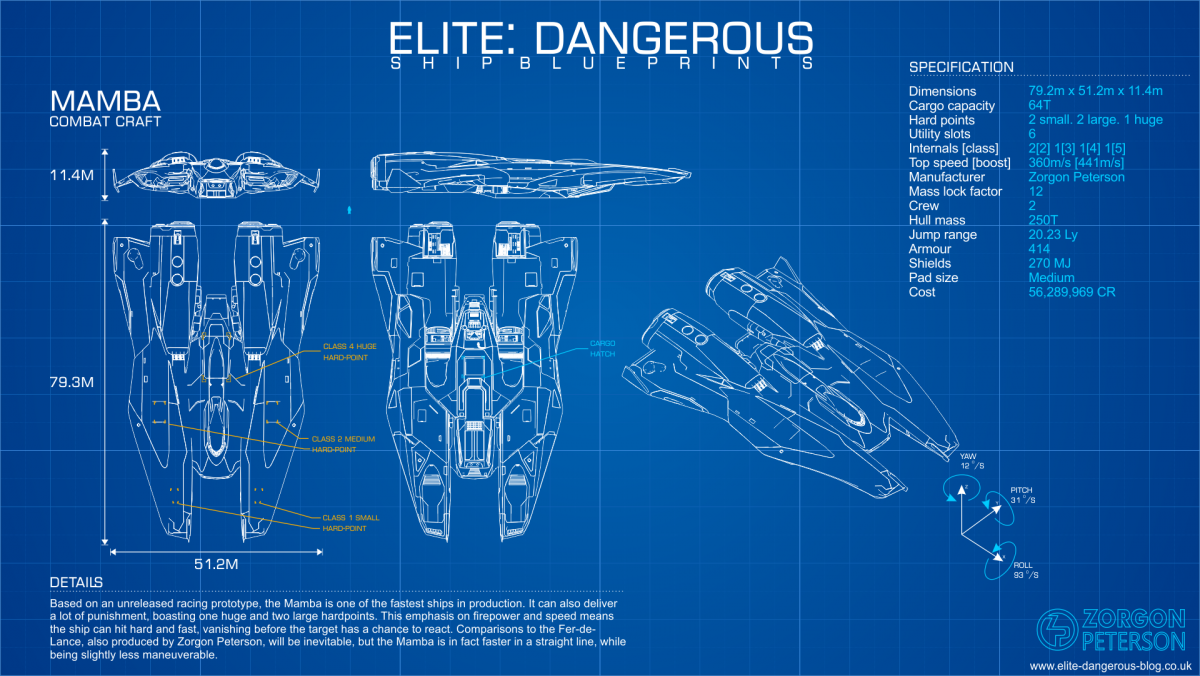
Elite Dangerous Mamba ship blueprint
Elite Dangerous Mamba ship blueprint by Martind Forlon (https://swat-portal.com/forum/gallery/image/9816-mamba/)

Links: Coriolis and EDSY (have your preferred one open as you read the guide for easy reference)

The Mamba combines the firepower of a Fer-de-Lance, the modest manoeuvrability of a Krait Mk II and an Eagle’s speed on arguably Elite’s best-looking ship. It requires no reputation or rank unlock. I also have a soft spot for playing less popular ships.

Offensively, this build relies on the tried-and-true lasers and multicannons formula:

  1. Gimballed weapons: Perhaps obvious but gimballed weapons are the ideal trade-off between damage and accuracy. It makes it easier to hit small or fast-moving targets, frees you up to manoeuvre more freely and makes hitting modules on larger ships easier.
  2. Huge hardpoint: This build’s Huge Multicannon has Overcharged (blueprint) with Oversized (experimental effect), giving a 70% damage increase. Simple but effective.
  3. Large hardpoints: The large beam lasers have Long Range with Thermal Vent. Long Range means the beam lasers can hit targets up to 3.6 km away with no damage loss. Otherwise, lasers’ damage starts to drop at 800m. The Thermal Vent experimental effect decreases instead of increasing heat on a hit, eliminating heat issues. 
  4. Avoid over-engineering: The large beam lasers only have grade 1 Long Range. Higher grades have diminishing returns due to gimballed weapons’ increasing inaccuracy at range. Engineering everything to grade 5 is not always the best solution.
  5. Small hardpoints: Compared to the other hardpoints on a Mamba, the small hardpoints are there to apply experimental effects instead of doing damage. This build uses Emissive and Corrosive. Neither effect stacks. Both are available on Small Multicannons. This build uses the High Capacity blueprint to double their ammunition capacity, almost matching the firing time of the Huge Multicannon. Unfortunately, Small Multicannons churn through ammunition quickly. Corrosive also decreases the ammunition capacity by twenty percent.
  6. Emissive experimental effect: Emissive increases gimballed weapons’ accuracy against that target for a few seconds. This accuracy increase is most evident when the target’s heat drops, like when using a heat sink.
  7. Amour piercing and hardness: When a weapon hits a ship, the weapon’s “Armour Piercing” is compared to the ship’s “Armour Hardness”. When the Armour Piercing is lower than Armour Hardness, some of the damage is diverted to the ship’s “Armour” value until “Armour” ablates to zero. Larger ships generally have higher Armour Hardness and Armor values. Larger weapons also tend to have higher Armour Piercing values. That is why large ships are harder to damage with small weapons. That is also why most builds put high Armour Piercing weapons in the largest hardpoint slots, like the Huge Multicannon in this build.
  8. Corrosive experimental effect: Corrosive reduces a ship’s Armour Hardness value for a few seconds. This allows this build’s weapons to do more damage to heavier ships’ hulls. Even the Huge Multicannon benefits against ships with the hardest armour (Fer-de-Lance, Mamba, Imperial Cutter, Federal Corvette and Type-10 Defender).
  9. Sensors: The 4A Sensors with Long Range are essential. The best weapons are only effective if you can find suitable targets in large Conflict Zones, Resource Extraction Sites or Navigation Beacons.

Defensively and ignoring speed, this build relies on Bi-weave shields and strong armour:

  1. Bi-weave shields: Bi-weave shields sacrifice raw strength for a fast rebuild (recharge from nothing to 50%) and regenerate (50% to 100%). This build emphasizes the recharge speed using Reinforced (increase strength) and Fast Charge (increase regeneration rate). You can engage weak to moderate targets without pause. 
  2. Shield boosters: The shield boosters use two Heavy Duty (increase strength), two Thermal Resistance (counter shield’s innate weakness against thermal weapons like lasers) and one Resistance Augmented blueprint. This build is resistance-heavy, further emphasizing the recharge rate without losing too much to resistance’s diminishing returns. 
  3. Armour: This build uses Reactive Surface Composite with Heavy Duty and Deep Plating, both increasing strength. Reactive Surface Composite inverts the usual strengths and weaknesses of armour, resisting explosive (missiles) and kinetic (multicannons) damage but weakening against thermal damage (lasers).
  4. Hull and module reinforcement: This weakness against thermal damage is corrected with Thermal Resistant engineering on the 4D Hull Reinforcement Package. The 2D Module Reinforcement Package protects against module damage when weapons breach the hull and potentially damage the core internal modules.
  5. Power priorities: Power priorities are not required for this build but keep core internals and Shields operating if the Power Plant is ever significantly damaged.

Variations

  1. Guardian modules: Replace the Module Reinforcement Package with a Guardian Module Reinforcement Package if you have access to that module. It has slightly better module protection.
  2. Cost: If cost or rebuy is a factor, replace the Reactive Surface Composite with Military Grade Composite. Adjust the engineering on Hull Reinforcement Packages accordingly. A Mamba’s Reactive Surface Composite costs around 120 million credits before any discount, over half the initial purchase cost. This ratio is the same for most ships, so this advice is helpful for any build.
  3. Prismatic Shields: If you prefer Prismatic Shields, replace the 5C Bi-Weave Shield Generator with a 5A Prismatic Shield Generator with Reinforced and Hi-Cap. You will need to replace the engineering on the Power Plant with Overcharged grade 2 or higher to ensure sufficient power.

Solo Tactics

This build works fine for simple “point and shoot” but you can do a lot more with it:

  1. “Circle Strafe” tactic: The ideal tactic is circle-strafing the target, keeping a 1 to 1.5 km distance. Fly toward the target at 50% throttle, thrust down while gently turning the nose up. It can be difficult initially, but practice helps. Dodge slow, unguided munitions like plasma accelerator shots and non-seeker missiles using lateral or vertical thrusters.
  2. “Reverski” tactic: Fly to long range, match the speed of an enemy, toggle flight assist off, turn toward the target, and then blast away with impunity. This tactic is cheesy but effective against slow targets. Unless the target has long range weapons, you will do more damage than they will.
  3. Pursuit and fleeing: If you need to chase down a fleeing enemy or disengage, put four pips in engines and two in shields, then boost. While faster ships are possible, such as some Imperial Clipper or small ship builds, none will match this build’s shields or firepower. 
  4. Weapon use: Use lasers on shields or chaffing targets, then everything against ships’ hulls. Avoiding multicannons on shields conserves ammunition. Corrosive only works when hitting a ship’s hull.
  5. Power (Pip) management: Put two pips in systems and four pips on weapons to permanently keep at least one Large Laser firing. A Mamba is fast and manoeuvrable enough to generally not need pips in engines when engaged. Boosting tends to overshoot the target. Just keep the SYS capacitor topped up and the throttle in the blue. 
  6. Large target tactics: Get closer to large, lumbering targets. You can circle strafe faster than they can turn when close, staying out of their firing arcs. Target sensitive modules like Power Plants.
  7. Small target tactics: Combat with smaller, faster ships will often revert to jousting. Use your Long Range weapons to damage them for most of the attack run, then pre-turn or “landing gear turn” to maximize time on target as they fly past.
  8. Chaff sparingly: Chaff when facing an enemy wing because sufficient fire will exceed the Bi-Weave Shield Generator’s regeneration rate. While this build has strong armour, sustained explosive damage on the hull will start to render hardpoints inoperable (when their integrity drops below 80%).
  9. Hardpoint placement: All of a Mamba’s weapons are on top of the ship. Pitch the nose down slightly when engaging a target. This preempts a ship diving underneath the Mamba. It also keeps the target visible through the Mamba’s copious canopy.

Wing or Team Tactics

  1. “Pulling” role: Use the Long Range, A-rated sensors to find suitable targets, boost to them, “tag” targets with the Large Lasers, and then flee back to the wing. The enemies will follow, allowing better-shielded ships to engage and draw enemy attention. Time the pull to keep a constant stream of enemies engaged.
  2. “Tanking” role: Even without heavier ships in the wing, the Mamba is still in the top tier of combat ships and more than capable of tanking (getting enemy attention and taking the damage).
  3. “Rescue” role: Put pips into engines, then boost to a wingmate in trouble. Draw the attention of enemy ships by doing lots of damage when closest to the target.
  4. Experimental effects: After everyone engages, the Corrosive and Emissive experimental effects on the small multicannons buff everyone’s damage output, not just this ship. However, they do not stack, so consider other experimental effects if you frequently wing with others that use them.

“Reclamation” Review

Reclamation cover, showing the elite logo superimposed over an earth-like planet.

Reclamation is a military science fiction novel set in the galaxy from the computer game Elite Dangerous. It follows Kahina Loren, the unfavoured daughter of an Imperial senator. A coup thrusts her out of her cloistered world into a storm of competing political and economic interests. 

Drew Wager wastes no prose. The book moves quickly, only dwelling enough on any topic to push the reader forward. Character roles and motivations are quickly apparent. Description and background are minimal but vivid.

The book demands little from its reader. Other than the context setting, nothing relevant happens outside the reader’s attention or in retrospect. The reader always knows as much or more than the characters. 

Reclamation is faithful to its source material, the Elite Dangerous lore and universe, while not confusing or overloading newcomers. The game’s archetypical ships appear, as do Coriolis starports, frameshift drives and the Federation and Empire. Much of the plot involves flying in and fighting these ships, just like in the game.

Reclamation also helps fill that yearning void in Elite Dangerous around lore. Elite hints at so much but shuns story-driven content in favour of letting players tell their own. 

Reclamation is light on themes and subtext. There is some eventual recognition that violence is less effective than diplomacy. Those looking for introspection or dialog other than to hurtle the plot forward will be disappointed. 

Characters develop little and are unnuanced. Kahina, the protagonist, is part anti-hero and part reader surrogate until some rushed character development at the book’s end. The supporting characters are shallow and functional, mainly helping the protagonist progress.

However, I enjoyed the conversations between diplomats and patrons, each dripping with insincerity and occasionally wit. It allowed Drew Wagar to be more subtle, contrasting them with the rest of the cast.

The book is a fast but light read, accessible to many. In the small but crowded military science fiction genre, it holds its own, focusing on an action-filled and weaving plot. Elite Dangerous players looking for lore will enjoy Reclamation, as will anyone looking for a novel version of an action movie. Someone looking for something more profound or character development should look elsewhere.

“Elite Dangerous Odyssey” Review

Elite Dangerous Odyssey image showing armed, suited commanders on a planet surface with an Anaconda and Cobra Mk II (space ships) flying above them

I had mixed feelings when Frontier Development released the Odyssey expansion for Elite Dangerous. On the one hand, new content and improved graphics could breathe life into Elite Dangerous and take it in a new direction. However, the on-foot play could dilute the core premise of flying spaceships. The inevitable launch bugs could also cause a player backlash. Both turned out to be true.

Odyssey introduced the ability to finally leave your ship and walk on planets or in space stations, what some call “space legs”. It added two new ranks to progress: Mercenary (on-foot combat) and exobiology (scanning plant-like organisms on alien worlds). Suits and guns appeared alongside ships as the things to upgrade and engineer. Settlements, small planetary outposts, became mission locations. Surface conflict zones hinted at mixing ship and ground combat.

The problem with the above description is that, while accurate, it is ambiguous. For example, the above could turn Elite Dangerous into a universe simulator, where ships become tools rather than classes. However, Frontier provided something more modest, much to many players’ disappointment.

For example, many players were looking forward to walking around inside their ships. Frontier mentioned this early in Elite Dangerous‘s development as a long-term goal. Unfortunately, Odyssey lacks this. Many feel “teleporting” to your pilot seat from outside your ship breaks immersion. While that is true, I cannot think of anything I would sacrifice in Odyssey to add ship interiors given Frontier’s finite resources.

The new Exobiology rank added thousands of new types of plant-like alien life to find and scan. It adds additional play loops to exploration and more reason to land on planets. However, it could have been more than scan three organisms more than a few hundred metres apart.

I liked the better world-building in Odyssey. Elite Dangerous largely eschews lore to let players write their own stories. However, Odyssey’s in-game advertising and bar music emphasize things that make Elite’s galaxy unique, like the various companies that produce ships and weapons or the rare commodities players can trade. The new engineers are not just tools for progression, each having personalities and visually interesting planets.

One of the most polarizing aspects of Odyssey is the new graphics engine. The new planet graphics are gorgeous, turning Horizon’s (the previous expansion’s) beige into coloured hues and blocky barrenness into beautiful vistas. Anyone playing Elite Dangerous for sense pleasure, like many explorers, found a galaxy worth re-exploring just for the visuals.

However, the new graphics engine led to other problems, particularly in Odyssey’s new settlements. PCs that happily played Horizons on maximum settings were suddenly humbled. While Frontier is working hard to improve performance, fixing it is a long-term effort.

Odyssey’s FPS combat is polarizing. For example, some weapons are more effective against shielded opponents than non-shielded opponents and vice versa. While an Elite Dangerous staple, constantly swapping weapons frustrated many.

Some felt that high-end suits were too resilient, requiring too much damage to take down. However, while engineered suits help, you are hardly impregnable. The resilience forced a tactical- rather than twitch-based playstyle.

Many speculate Frontier released the expansion too early, possibly due to financial commitments. The poor reception and low quality were enough for Frontier to delay Odyssey’s release on consoles (PS and Xbox).

Whereas many blast Odyssey with hyperbole- and expletive-ridden rants, I take a long-term perspective. No Elite Dangerous release has been bug-free. No online game release, either. Frontier has also improved communication with a player-voted issue list and more “meet the developer” sessions. 

Odyssey is not perfect. I was frustrated by the poor performance and felt exobiology was underdeveloped. However, I enjoyed the new content. The visuals are spectacular, particularly the local star casting its rays through a coloured atmosphere. On-foot conflict zones capture FPSs’ frenetic pace while still being characteristically Elite. 

Odyssey demonstrates why many AAA FPS games have nine-figure budgets. It is hard to make an FPS with a bespoke engine (Frontier’s Cobra engine) and a setting whose scale precludes pregenerated optimizations. 

Handling player expectations is harder. As mentioned above, the promise of “space legs” conjured desires for exploring ship interiors and a Star Citizen-like experience. Many players also looked at the work required to complete the new ranks and engineer suits and decided to seek their space game thrills elsewhere.

Elite Dangerous is a relatively old game, and the wonder has faded for many. Some players yearn for unexplored mechanics and settings. Novelty has a strong gravity, even to the unreliable and incomplete Star Citizen with its dubious funding practices.

My main criticism of Odyssey is the lack of content. After a few hundred hours, most players had sufficiently engineered on-foot gear and Elite ranks in Mercenary and Exobiology. For a game that prides itself on complexity and self-discovery, even the popular Elite Dangerous Youtubers ran out of Odyssey content after a few months. Idleness breeds discontent, as they say.

Take engineering as an example. Unlocking engineers from Horizons, the previous Elite Dangerous expansion, required players to experience the game’s breadth. You had to travel far into deep space, mine, sell stolen cargo at black markets, trade rare commodities and fight. This requirement was a great example of exposing players to neglected parts of the game while leveraging existing game loops to provide new gameplay.

I suspect Frontier wanted to do something similar for the new on-foot engineers in Odyssey. However, the required content did not exist. Instead, unlocking many on-foot engineers requires a frustrating grind. Players need to repeat tasks for hours, like logging out then back in at the same location, hoping for rare materials to spawn. 

Moreover, Odyssey relies on having a strong “middle game”, specifically randomly generated on-foot missions, settlement assaults and conflict zones for replayability. From Frontier’s perspective, this maximizes the number of players using the new features. However, even fun game loops lose their appeal after hundreds or thousands of hours.

Instead, Elite Dangerous needs more “late game” content. For example, something akin to Thargoid combat with a higher difficulty level, a social aspect, and correspondingly better rewards. Such content keeps the experienced players engaged and is aspirational for new players.

Such content will likely not arrive soon. Until Odyssey releases for consoles, Frontier appears focused on performance and stability. That makes sense, given every new Odyssey-only feature added incites more resentment in console players.

Meanwhile, Frontier includes “hero” features in each monthly patch, like on-foot emotes and a new surface vehicle. They promised fleet carrier interiors for early 2022. These are all welcome. However, none will add more than a few hours of new content. They continue to emphasize “middle game” content, reusing what is already there. Perhaps new ships or on-foot Thargoid combat are coming later.

Is Odyssey “good” or “worth buying”? These are the wrong questions to ask. I have enjoyed the new content and am glad I bought it. Yes, there are performance issues and bugs. However, Frontier will have to fix these to get the revenue from the console release. 

Is Odyssey the best FPS game available? No. Many specialist FPS games offer deeper or more varied FPS play. Odyssey, like Elite as a whole, is a victim of its breadth and shallowness, becoming unintentionally comparable with specialist games that do niches better. 

However, Odyssey’s FPS is fun, distinctly Elite Dangerous and integrates well with Elite’s other game loops. New features will likely be Odyssey only. Odyssey is the best choice if you want more of the same but better. 

Odyssey takes Elite Dangerous in a new direction. Like Horizons, Odyssey starts a journey and is not the end. If you want something with a different vision, Odyssey will only constantly remind you of that. 

“Eve Online” versus “Elite Dangerous” Comparison

Eve Online image

As a long-time player of Elite Dangerous, Eve Online had always intrigued me. Being almost 20 years old, Eve Online is known for massive PvP battles and intrigue, ganking and its player-driven economy. I wanted to experience Eve Online to understand its design philosophy and re-examine Elite Dangerous with different eyes.

The goal was to only highlight the fundamental differences in design, intention, and appeal between Elite Dangerous and Eve Online. A detailed comparison would fill volumes. Developers also evolve mechanics and features so a detailed comparison would also quickly date.

Elite Dangerous is more intimate than Eve Online. Flying a ship in Elite Dangerous is like flying a modern-day fighter. Many use a HOTAS (hands-on thrust and stick) and enjoy the sensation of flight. Eve Online uses more abstract, high-level commands, such as fly to this navigation point, with a keyboard and mouse. Elite Dangerous has a first-person camera view. Eve Online uses a usually zoomed out third-person camera view to get a better tactical perspective.

Combat in Elite Dangerous involves manoeuvring the opponent into your weapon sights, lining up a shot and firing at the correct time. It occurs at a range of a few kilometres. Combat in Eve Online is more tactical, with the game aiming for you, and battlefields can span hundreds of kilometres.

Graphically, Elite Dangerous’ textures, models and effects are more detailed then Eve Online because you see them up close. Elite Dangerous‘ sound design is brilliant and immersive, with each ship having distinct sounds. Elite Dangerous is even more immersive in VR, which Eve Online does not support.

Eve Online focuses more on player-interaction. While both are MMOs, Elite Dangerous involves smaller groups of players and ships than Eve Online. While both have large squadrons (Elite Dangerous) or corporations (Eve Online), Eve Online has more tools for managing large corporations like alliances, inter-corporation war and in-game calendars. Eve Online’s corporate tax system sequesters a portion of each member’s income to support combined activities or reimburse members. Many play Elite Dangerous in solo mode, sharing the same galaxy but not interacting with players.

An Elite Dangerous player can exploit or ignore the in-game politics and universe around them. Eve Online players are the politics and universe, including building and destroying space stations. Before introducing Triglavians in Eve Online, the only endgame was large scale PvP. Elite Dangerous’ endgame is mainly PvE, including a detailed simulation of galactic politics called the “background simulation”.

Eve Online has a much more complex economy and industry than Elite Dangerous. You cannot construct or purchase ships or components from players in Elite Dangerous, the opposite of Eve Online. Building a ship from the blueprints you researched and from the ore you mined in Eve Online is a great feeling. At least, it is until you realize how uneconomical it is compared to specialist players.

Mining in Elite Dangerous is more involved than Eve Online, requiring prospecting individual asteroids and gathering the released ore fragments, but only translates time into credits. Mining in Eve Online is simpler, coining the phrase “AFK mining”, but provides the raw material for the broader economy and has specialist ships and skills.

Elite Dangerous is more forgiving. Non-consensual PvP is a fact of life in Eve Online – I lost more ships in my first two weeks of Eve Online to ganking than in thousands of hours of Elite Dangerous. Elite Dangerous, by comparison, has player groups like the “Fuel Rats”, who altruistically deliver fuel to players whose ships ran out of fuel. If you lose a ship in Elite Dangerous, you pay a rebuy price of 5% of the ship’s total cost and respawn in a fitted, engineered ship matching your original. If you lose a ship in Eve Online, you get back a smaller portion of the cost then must manually purchase and fit a replacement.

Eve Online comes from an earlier game design mindset where challenge and setback were necessary to contrast achievements and progress. Eve Online’s age also shows in its UI, reminiscent of Everquest, with many information-heavy windows. Elite Dangerous’ UI is less cluttered and simpler, partially driven by Elite Dangerous’ console support, but deals with less information than Eve Online. Elite Dangerous replaces Eve Online‘s sometimes ambiguous warning buzzes and tones with an unambiguous and science fiction-style cockpit voice assistant.

While both games provide tutorials, both require experimentation, help from third parties or patience to learn and master. Various tools and websites support both games, supplementing the game UIs.

Mechanically, a significant difference between the two is Eve Online’s skill system. Elite Dangerous allows any pilot to fly any ship, assuming they have sufficient credits and reputation. However, Eve Online’s skills both determine what the pilot can do and how effective they are.

Eve Online’s skill system means players can specialize in a role or type of ship. For example, one player may specialize in missile weapons and one race’s destroyers. Another may specialize in laser weapons and a different race’s cruisers. Another may specialize in mining ships and industry. This system means there is no “one size fits best” ship or fit, unlike Elite Dangerous. It creates niches and encourages cooperation. Skills are easy to learn but hard to master, so experimenting or role switching is still possible.

However, the only in-game way to increase skills is time. Skill points accumulate at a constant rate, even when not playing. The player’s actions neither predispose nor increase the rate of accumulation. Long-time players benefit, even if absent. Eve Online’s developers get a revenue stream through new players purchasing skill boosts.

This contrast highlights the different revenue models. You pay for the Elite Dangerous game upfront then, optionally, cosmetic upgrades. Eve Online has a limited free mode but frequently nags to upgrade to a monthly subscription. You can earn enough in-game currency to upgrade to the paid tier. However, it is only possible in the late game and requires a significant time investment.

Another key mechanical difference is exploration. Exploration in Elite Dangerous consists of flying to unexplored star systems, scanning then selling the cartographic data. Players have discovered less than one percent of Elite Dangerous’ over 100 billion star systems in a 1:1 model of the Milky Way galaxy. In-game photography is common, particularly when players find beautiful rings or other stellar vistas. You can land on planets and experience a “Neil Armstrong moment” as you walk on them.

Exploration in Eve Online consists of scanning known star systems for points of interest that do not appear in regular scans. These points of interest could be wormholes, hidden bases, wrecks (destroyed ships) or players not at warp. The latter is an important part of PvP in Eve Online compared to Elite Dangerous – other players can easily find you and attack you. Players can salvage wrecks for crafting components. Wormholes lead to unmapped star systems with a higher risk/reward.

These different approaches reinforce and support existing gameplay. Elite Dangerous’ exploration spreads the players out and encourages more individual play. Eve Online’s exploration supports PvP or industry.

Eve Online is influenced by the Homeworld series and Warhammer 40K with the larger fleet battles, constructing huge engines of war and trade, and emphasis on rediscovering ancient or abandoned technology. Elite Dangerous owes more to Freelancer or the Wing Commander series – a single pilot surviving and thriving in a space “wild west”. Both games have extensive lore that serves mainly to give context to the current world. Neither game is story-based or examines themes.

I liked Eve Online’s “try before you buy” model by playing an Alpha (unpaid) for a while then upgrading to Omega (subscription) temporarily with a starter kit. Elite Dangerous has a high upfront cost. However, once purchased, Elite Dangerous lacks any “pay to win” mechanics or nagging.

I also liked Eve Online’s complex industry and economy, which has no equivalent in Elite Dangerous. It opens whole new play styles, earning the moniker “spreadsheets in space” from its depth and complexity.

However, Eve Online’s Darwinian environment was frustrating. The solution, and a tenet of Eve Online, is cooperation. Whereas Elite Dangerous leans toward meditative soloing and slow constant progression, Eve Online is more tribal and brings together communities to play and progress with and against other players.

Eve Online and Elite Dangerous scratch different itches. Both games have withstood the test of time and flourish, despite a few bumps with Elite Dangerous’ recent expansion.

“Elite Dangerous” Review

Elite Dangerous promotional image

Elite Dangerous is a space trading, exploration and combat simulator released in December 2014 and regularly updated since then. Based on the 1984 Elite that seemingly crammed a galaxy into 64KB, Elite Dangerous expands this to a massively multiplayer online (MMO) game with modern graphics and gameplay.

You play a pilot flying a single spacecraft. You start with a small fighter, then work your way up via combat, exploring, trading, mining, ferrying passengers and completing missions to earn larger, better or more specialized ships. The Horizon expansion adds landing on planets, driving a ground vehicle and limited multi-crew. The upcoming Odyssey expansion adds “space legs”, allowing pilots to leave their vehicles and walk around space stations and some planet surfaces.

Elite Dangerous is set in the Milky Way galaxy. All of it. As you zoom out on the galaxy map for the first time, its sheer enormity becomes apparent. The game is set a bit after the year 3300, where humanity has colonized “the bubble” around 150 lightyears from Earth, encompassing over 20,000 inhabited star systems. However, 400 billion stars are accessible, backed by hard science, where possible, and procedural generation, otherwise. Looking at the sky and realizing you can travel to most visible stars is a humbling experience.

Life in the Milky Way is not static. Like many space trading games, an economic and political simulation underpins Elite Dangerous. Perform enough missions for your favourite faction or fight along one side in a war and see the borders shift and economies wax and wane. Although more as a backdrop to weekly in-game events than a narrative, there are also ongoing events and lore.

While the original Elite’s graphics were appropriate for their time, it left a lot to the imagination. Elite Dangerous’s renders planets, nebulae, gas clouds, asteroids and other stellar objects beautifully. It has spawned a whole stellar cartography and photography community.

Stations’, settlements’ and ships’ beautiful graphics have an industrial, semi-realistic aesthetic. Space stations are gorgeously detailed, with triangular reinforcement struts, flashing warning lights and BladeRunner-like holographic advertising. Ships’ thrusters fire realistically as they manoeuvre. Lasers rake glowings arcs of molten yellow-orange metal on ships’ hulls.

The sound design is also exemplary. Ships have distinctive sounds. You can hear the subtle creaks and vibrations as a ship decelerates into a planet’s atmosphere or the shudders and groans as a landing pad retracts into a space station. Closing your eyes as you dock with a station reveals many small sound effects that add so much.

Unlike many games, Elite Dangerous’ soundtrack is more atmospheric and ambient than inspiring and memorable. One notable exception is the rousing orchestral choral theme for a capital ship jumping into a conflict zone. It is reminiscent of John Williams’s scores to any of the Star Wars films. Another exception is Straus’s “Blue Danube”. It plays whenever auto-docking and is a nod to the similar scene in 2001: A Space Odyssey and the original Elite.

While I play with neither, Elite Dangerous is considered one of the premier examples of virtual reality (VR) and using a HOTAS (Hands-On Thrust and Stick). Using both apparently creates an immersive experience few games can match.

I usually choose single-player games (note the blog’s name) with more apparent stories or themes. At first glance, Elite Dangerous does not fit that mould.

Instead, Elite Dangerous is an example of great game design. Despite some lingering bugs, Elite Dangerous consists of many different games strung together. At the lowest level are the simple mechanics like targeting, shooting and manoeuvring. The game combines these into dynamics like combat, exploration and trading. Above them, you have more abstract and strategic activities like advancement, supporting in-game factions or galactic superpowers. It reminds me of how Paradox Interactive, the developer of games like Crusader Kings and Europa: Universalis, builds games.

This breadth allows players to construct their own goals. One goal could be working toward an expensive or reputation-locked ship. Another could be travelling to the edges of the galaxy. Many choose to focus on the combat, whether it be against NPC opponents or other players.

While Elite Dangerous is an MMO, you can still play solo or with small groups of friends. I spent my first several weeks solo, but I still rarely interacted with a human even after “graduating” to open play. Almost all content is soloable. Even PvE content seemingly made for cooperation, like fighting aliens introduced in the recent expansion, is frequently soloed.

That does not mean players are absent. While the game economies and politics are not player-centric like in Eve Online, there are many thriving squadrons and player groups, both for good and bad. PVP-focused players frequent star systems where others congregate, praying on the weak. By comparison, the “Fuel Rats” is a group of volunteer players who help those that have run out of fuel.

Meanwhile, Elite Dangerous’s greatest strength and biggest weakness is its demand for self-discovery. While there are some tutorials, players must learn most of the game’s mechanics themselves, either through player-generated content or trial and error. Even seemingly basic things like landing a spacecraft are difficult for first-time players. This demand attracts some but repulses many.

Elite Dangerous delivers a form of retro-futuristic nostalgia. The crackly radio transmissions you overhear are reminiscent of the attenuated analogue radio used during the moon landing. Spacecraft fly like World War II or Korean era fighters, at least until you turn off “flight assist”. All text in the user interface is uppercase like early computers.

With a few exceptions like faster than light travel, Elite Dangerous is about a realistic simulation of the future as you can find. In its future, artificial gravity does not exist, meaning spinning space stations or. Physics rules spaceflight and spaceship modifications. Make it heavier and your spacecraft will be slower and less manoeuvrable. Space is big. Travelling, even with a faster than light drive, takes time.

Elite Dangerous is a game for serious space fans willing to invest time learning the game. It is also for those comfortable setting their path. Those looking for something thematic or more casual will find it unfulfilling.

Why did I play this game? I remember watching Carl Sagan’s Cosmos as a young child. He talked of a ship of the imagination, allowing you to travel to only dreamt places. Elite Dangerous provides that. I felt the joyous wonder when I first jumped into a system, seeing the kineticism of hurtling toward a star when decelerating. I felt it when I saw my first black hole and the light lensing around it. I felt it seeing starlight reflecting off an alien gas giant at sunrise, illuminating a ring of asteroids. Elite Dangerous is for those happy to head to the “second star to the right and straight on ‘til morning”.