AX Healing Krait Mk II Build

An Elite Dangerous ship build that heals shielded “tank” ships when fighting Thargoid interceptors in wings or teams.

This arrangement is similar to how MMORPGs structure groups. The “tanks”, usually Imperial Cutters or Federal Corvettes with Prismatic Shields, try to draw the interceptor’s fire by staying close, hot and dishing out damage. Healers try to keep the tanks’ shields up, particularly when hit by an interceptor’s lightning attack. Dedicated anti-swarm and anti-scout ships handle the thargon swarms and scouts. The rest try to draw damage using more traditional anti-xeno builds and tactics.

This post assumes you are familiar with Thargoid interceptor combat.

Goals

Create a ship to:

  1. Heal tanks’ shields. This requires the Regenerative Sequence experimental effect on Beam Lasers.
  2. Remove the caustic debuff from tanks. This requires a Decontamination Limpet Controller and a Cargo Rack for limpets.
  3. Reach tanks. Beam lasers and limpets are only effective within a kilometre or so. This build needs the speed and agility to reach them.
  4. Survive around hostile thargoids, including thargon swarms and scouts. This requires strong shields, strong hull and removing your own caustic debuff.

Build

Krait Mk II blueprint by CMDR-Arithon (https://swat-portal.com/forum/gallery/image/9624-krait-mk-ii/)

Link: EDSY (have it open as you read about the build for easy reference)

Healing is a fun way to contribute while giving a different set of challenges. Elite Dangerous rarely creates opportunities for different roles within a team. A healer’s focus is on enabling others to be more effective.

Other ships, notably the Anaconda, can provide more raw healing power because they have more hard points and a larger power distributor. However, the Krait Mk II is faster and more agile, helping you get to more mobile tanks when needed or be more forgiving when you are out of position.

Healing:

  1. Healing Beams: Efficient Beam Lasers with the Regeneration Sequence experimental effect are the best way to regenerate allies’ shields. The Regeneration Sequence experimental effect restores a team- or wingmate’s shields instead of damaging them. Efficient means you can fire the lasers for as long as possible, healing to heal through an interceptor’s lightning attack. The Concordant Sequence experimental effect increases the regeneration rate of the shield for ten seconds. However, the buff does not stack and tanks’ prismatic shields often have a slow regeneration rate.
  2. Fixed Weapons: Tanks are usually large, slow-moving targets. Fixed weapons give enough extra damage/healing to make them worth it.
  3. Power Distributor: An interceptor’s lightning attack will drain a tank’s shield quickly, particularly if it temporarily disables the tank’s Power Distributor. A Weapon Focused Power Distributor, four pips weapons and a full capacitor allow you to keep restoring the shields for 30+ seconds.
  4. Decontamination: A Decontamination Limpet Controller and copious Cargo Racks for limpets means you can help remove the caustic debuff from tanks or, if attention permits, other allies. However, this can be challenging. Scouts, thargon swarms and interceptors often shoot off attached limpets. Limpets are also slow, and even a slow Federal Corvette can outrun a limpet. Cooperation with the tank is required. In a pinch, decon limpets can repair hull, including your own.
  5. Tagging: Remember to shoot the interceptor a few times for a second. Otherwise, you will not get any combat bonds when it dies.

Defence

  1. Shields: Many AX pilots prefer to go shieldless. However, given nearby tanks should be keeping the interceptor’s attention and scouts, thargon swarms or other interceptors may be nearby, strong shields soak up most of the damage that should be coming this ship’s way. If the shield drops, consider a reboot/repair to quickly restore it to 50%.
  2. Caustic Sink Launcher: Given the difficulty of heating up with a shield and Efficient Beam Lasers along with the prominence of caustic clouds and missiles, a Caustic Sink Launcher helps keep the healer focused on the tank’s health and not its own.
  3. Absolute Damage: Guardians do absolute damage so maximize raw shield and hull strength where possible.
  4. No Guardian Modules: A Glaive’s anti-guardian module field will not worry this build.
  5. No Shutdown Field Neutralizer: Most tanks have a Shutdown Field Neutralizer that will protect you. If not, swap one of the Shield Boosters for it.

Tactics

  1. Team structure: Ensure you are in a wing or team with the tanks. Otherwise, your Regeneration Sequence Beam Lasers will damage their shields, not heal them. It also helps you easily locate your tanks by looking at the blue points on your radar.
  2. Positioning: Keep the tanks within one kilometre and between the interceptor and you. Beam Lasers are most effective within 800 m. This position also reduces the chance the interceptor will target you.
  3. Pip management: The default choice is two pips in systems and four in weapons. You will occasionally need to put pips into engines to boost away from caustic missiles or catch up to a distant tank.
  4. Anti-Interceptor Shield: If your team is struggling against an interceptor, firing five beam weapons against its shield will bring it down quickly. However, this will bring you in range of its lightning attack and will put you on its target list for caustic missiles. Target the shield with care.
  5. Anti-scout: Destroying scouts is challenging but surprisingly doable if you can get up close. It can keep you occupied while waiting for interceptors to jump in.

Dolphin On-Foot Support Build

An Elite Dangerous ship build.

Goals

Like the Cobra Mk III On-Foot Support Build, this ship build’s goals are:

  1. Get the commander to/from on-foot missions introduced with Odyssey. This requirement includes transporting an SRV (for mission support or raw material gathering) and a Detailed Surface Scanner (for finding points of interest).
  2. Endure a sustained assault from on-foot enemies. This requirement ensures you can complete mission goals rather than rushing back to defend your ship.
  3. Land at every surface settlement, outpost or station, effectively requiring a small ship. 
  4. Provide fire support to kill scavengers and other ground enemies. As these are too small to target with most ship-mounted weapons, this effectively means missiles or mines.
  5. Have a fast boost speed. The build should reach supercruise distance quickly for material farming or escaping hostile ships.
  6. Have a reasonable jump range and a Fuel Scoop for travelling to on-foot engineers or distant missions.

Build

Dolphin Blueprint by CMDR-Arithon (https://swat-portal.com/forum/gallery/image/9486-dolphin/)

Link: EDSY (have it open as you read for easy reference)

When I first approached the problem of getting my commander to on-foot missions, the Cobra Mk III seemed to be the perfect choice. I still had the one I used early in my commander’s career. Its versatility and repurposing a ship I loved made it an attractive choice.

However, I recently unlocked all the on-foot engineers on a second or alternate (alt) account. I took it as an opportunity to try different things, including different ships. The Dolphin proved to be surprisingly effective at this role compared to my Cobra Mk III On-Foot Support build:

FeatureCobra Mk IIIDolphinComment
Jump Range30.58 LY33.93 LY
Pitch/Roll/Yaw (seconds for a complete turn)3.4/1.2/124.0/1.1/5.3Dolphin has better yaw, making flying more natural and attacking ground targets easier.
Boost605 m/s591 m/s
Raw Shield Strength625 MJ681 MJ
Hull Strength6651001
Fuel Scoop Size45Faster fuel scooping.
Thrusting Heat40%31%Easier fuel scooping.
Comparison of Cobra Mk III and Dolphin builds

Where the Cobra Mk III was superior, it was not relevant. For example, the Dolphin has only two small hard points compared to the Cobra’s two medium and two small. However, the Dolphin’s two small hard points have better convergence, making hitting small ground targets like on-foot scavengers easier. The Dolphin’s lower ammunition capacity is rarely a constraint.

The Dolphin has more flexibility and utility. The Dolphin’s extra utility slot frees up internal module slots that the Cobra Mk III needs for Guardian Shield Reinforcement Packages. The Dolphin could even use a size five Prismatic Shield Generator, although this makes power management challenging.

The only real difference is aesthetics. Some people dislike the Dolphin’s more organic shape and the wheezing sound of its boost. The Cobra Mk III looks and sounds more like an Elite Dangerous ship should.

Defence:

  1. Prismatic Shields and Overchanged Power Plant: Most of the defensive measures are the same as with the Cobra Mk III. Strong prismatic shields protect it when attacked by scavengers or pirates. The Power Plant is Overcharged so it can service the power-hungry shields.
  2. Strong Hull: Unlike the Cobra Mk III, this ship can afford strong hull protection. It has the internal slots for Hull and Module Reinforcement Packages. Its size five Thrusters can maintain a fast speed with the extra weight.

Offence:

  1. Ground Attack: The Advanced Missile Racks provide explosive area damage against on-foot scavengers or guards. The Dolphin’s hard points are close, making targeting easier, and the fast yaw means moving sideways faster to change targets or to dodge incoming projectiles.

Utility:

  1. Double SRV bay: This can transport both a Scarab and a Scorpion or two of your favourite kind of SRV. Dropping down to a 2G does not give any significant advantage. Coupled with the Cargo Rack, you could use this build for surface missions.
  2. Advanced Docking Computer: Odyssey added the ability to auto-land on planet surfaces. This module allows easy landing when distracted or on uneven terrain near surface points of interest.

Solo Tactics

  1. Flee: This build runs, not fights. Its prismatic shields protect it long enough for it to escape. This build will outrun almost everything with its almost 600+ m/s boost speed. Most enemies will mass lock this build, so the high speed is welcome.
  2. Power (pip) management: Place four pips in systems and two in engines when landing to maximize shield protection. Otherwise, do the reverse to maximize boost frequency, speed and agility.

Wing or Team Tactics

  1. Pairing: This build can transport two commanders to and from an on-foot mission location, providing each with an SRV.
  2. Rescue: This build can rescue an on-foot commander who has lost their ship or would otherwise wait for an Apex. Use missiles to kill any ground targets, land to pick up the commander, and then boost to supercruise before enemy ships take down the shields.

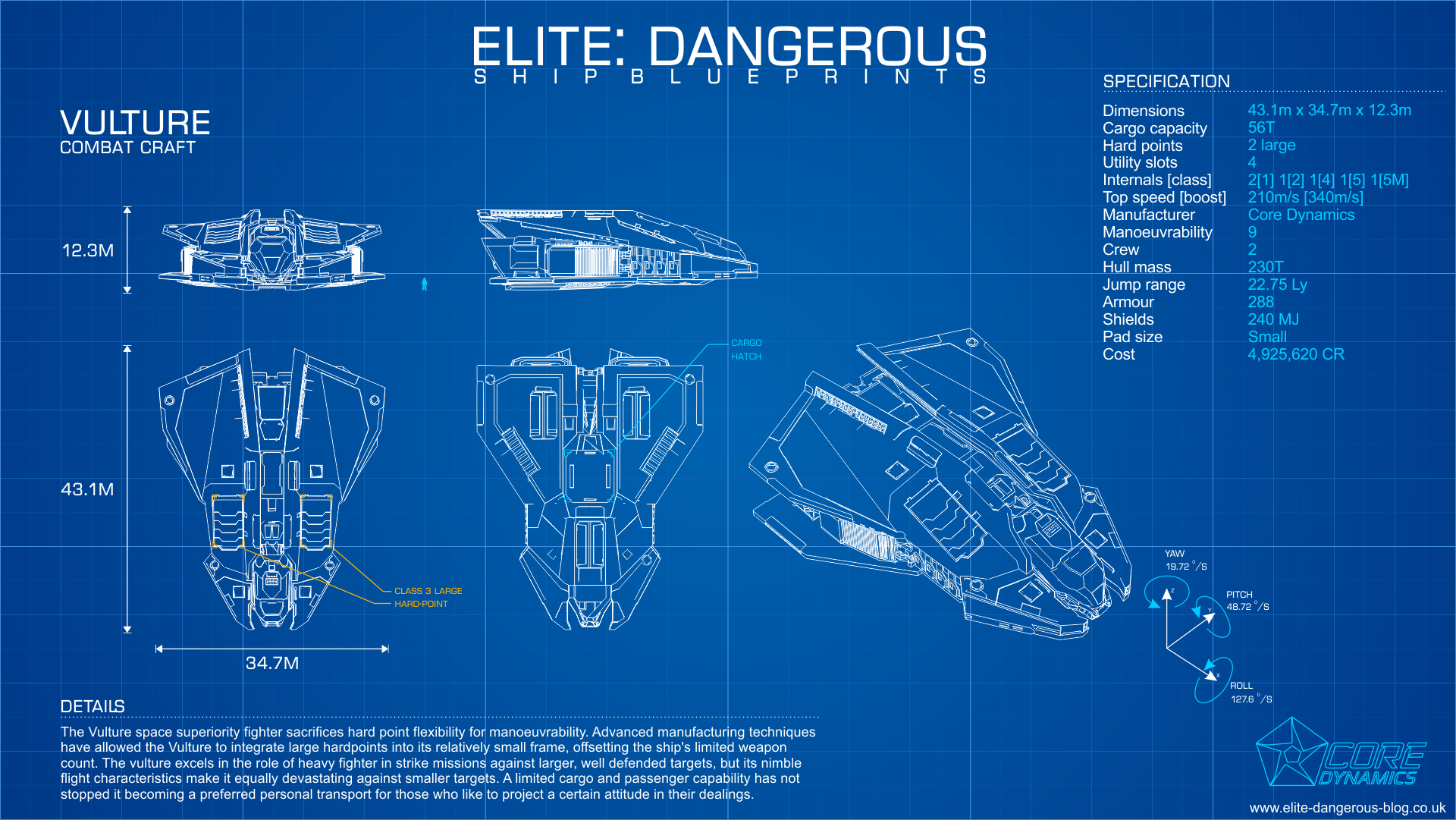
PvE Combat Vulture Build

An Elite Dangerous ship build for more experienced players, effectively an end-game version of the Beginner PvE Combat Vulture Build.

Goals

The goals are:

  1. Create a build that uses the Vulture effectively for late-game PvE combat, such as Hazadous Resource Extraction Sites, High Intensity Conflict Zones and Threat 7 Pirate Activity signal sources.
  2. Use any module or engineering in the game to maximize effectiveness and the Vulture’s strengths.

Build

Vulture Blueprint by CMDR-Arithon (https://swat-portal.com/forum/gallery/image/9464-vulture/)

Links: EDSY (have it open as you read the guide for easy reference)

As mentioned in my Beginner PvE Combat Vulture Build, the Vulture is a wonderful small ship to learn PvE combat. It is cheap, packs oversized weapons and teaches good skills like pip (power) management.

However, the Vulture is rarely seen during end-game combat. Large ships like the Federal Corvette and medium ones like the Fer-de-Lance and Chieftain tend to dominate. They have more firepower, better hull and shields, speed and/or agility.

No clever engineering or obscure modules will change this balance. However, the Vulture is far from useless. Some even see its disadvantages as a challenge. Killing NPC pirates in a fully engineered Federal Corvette is relatively easy. Doing so in a Vulture requires more skill.

Offence:

  1. Intertial Impact: The Internal Impact experimental effect changes the damage from 100% thermal to 50% thermal and kinetic. This change means the Burst Lasers become effective against both shields and hull. However, it adds a 3% jitter, which is much larger than it sounds.
  2. Efficient: Some people use the Short Range Blaser blueprint to maximize damage output but this drains the distributor quickly. Using Efficient means you can fire indefinitely with four pips to weapons.
  3. Fixed: A small, nimble ship is the perfect platform for fixed weapons. The extra damage over gimballed weapons helps, as does the immunity to chaff or even needing to select your target.
  4. FSD Interdictor: An FSD Interdictor is useful for interdicting assassination mission targets, wanted ships for bounty vouchers or even powerplay ships for merits. Swap for another Guardian Module or Hull Reinforcement Package otherwise.

Defence:

  1. Resistance: This build focuses on high resistances for shields instead of raw strength. Unless you consistently fight plasma-armed enemies and cannot dodge the slow-moving projectiles, this focus gives a high effective strength with fast regeneration.
  2. Fast Charge versus Lo-Draw: Like most ships using Fast Charge on a Bi-Weave Shield Generator, the Power Distributor cannot supply enough power with two pips in systems to rebuild the ship at the optimal rate. This build’s shields should drop rarely but, if they go down often, replace the Fast Charge experimental effect on the shield generator with Lo-Draw.
  3. Reactive Surface Composite and Thermal Resistance: Reactive Surface Composite inverts the standard resistances for armour, making it strong against kinetic and explosive weapons but weak against thermal. To compensate, the build uses Thermal Resistant on one of the Hull Reinforcement Packages. This gives the build net positive resistances on the hull.
  4. Guardian Shield and Module Reinforcements: Guardian Module Reinforcement Packages provide slightly more protection than Module Reinforcement Packages but cost some power. Swap for normal Module Reinforcement Packages if you do not have them unlocked. The Guardian Shield Reinforcement Package is the only non-utility module that buffs a shield.

Variations

  1. Shieldless: A shieldless version (EDSY) reduces longevity but lets you put the system pips into engines for greater speed and agility. Consider it a challenge. Replace the Shield Generator and Shield Reinforcement Module with Guardian Module Reinforcement Packages and a Hull Reinforcement Package respectively. Replace the Shield Boosters with Shielded Point Defence and Chaff Launchers. Replace the Efficient blueprint on the Burst Lasers with Sturdy, giving them more protection and higher armour penetration. Sturdy costs more power but you have power to spare, even with an Armoured Thermal Spread Power Plant.
  2. Anti-Thargoid Scout or Hunter: To create an AX version (EDSY), take the shieldless version and replace the burst lasers with Azimuth Enhanced AX Multi-Cannons. Fill the utility slots with Caustic Sink Luanchers and an Enhanced Xeno Scanner. Replace the FSD Interdictor with a 1A AMFU and the Guardian Module Reinforcement Packages with normal Module Reinforcement Packages to reduce power use and prevent a Glaive field from damaging them. Replace the Reactive Surface Composite with Military Grade Composite, because the additional resistances are unnecessary. Once again, other ships fulfil this role better but this build can hold its own.

Tactics

  1. Finding targets: This build works best against wing-less large or less agile targets. Anacondas, Asps, Pythons and Type-10s are generally easy prey. Using fixed and jittery weapons against fast or agile targets, like Elite Vultures and Vipers, is doable but frustrating.
  2. Point blank: Get as close as possible to enemy ships, preferably above or below where their surface area is maximized. Avoid jousting as it reduces time on target. Instead, circle strafe, pre-turn and landing gear-turn to track ships as they pass by. Hold down fire. Even with only two pips to weapons, exhausting the distributor or overheating will take minutes.
  3. Power (pip) management: Two pips in systems and four in weapons are usually sufficient. Temporarily shift pips into engines to boost or run down fleeing ships. Ironically, power management is easier in this build than in the beginner version. An Overcharged Monstered Power Plant gives more than enough power. A Charge Enhanced Power Distributor gets it to where it needs to be.

The Art of Video Game Screenshots

Have you ever watched a movie or TV show and wanted to pause and marvel at a scene? It may be beautiful, showing off an artful mix of colour and design. It may be complex, requiring time to appreciate the detail. It may capture a moment that creates strong feelings or thoughts.

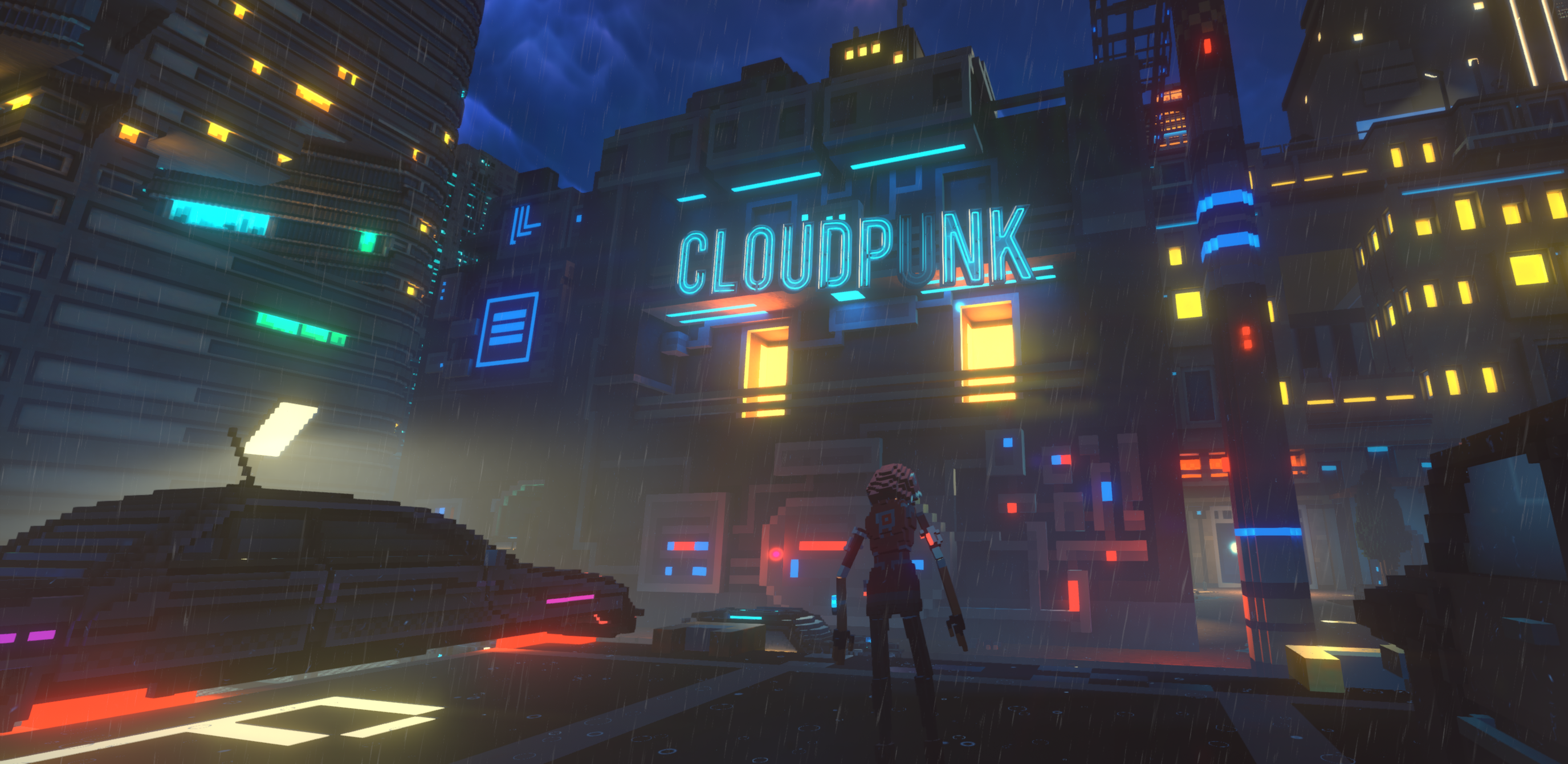
I love taking screenshots in video games. Not all video game graphics are lifelike or realistic, but even retro or pixel graphics have their beauty, such as the screenshot from Cloudpunk below. The definition of “realistic” also decays as each new generation of hardware increases fidelity.

Even Cloudpunk‘s voxel-based graphics are beautiful

Why take screenshots? I enjoy it. Arranging a good scene and admiring it as a screenshot is fun. This admiration is called “sense-pleasure”, a term coined in the original Mechanics-Dynamics-Aesthetics game design framework. Some game developers have screenshot competitions and communities. Winning is fun, as is sharing a common interest. Trying to take good screenshots also allows me to appreciate the effort developers put into games, looking at games and visual media through different eyes.

Taking good screenshots is simple: play games, take lots of screenshots, review them, decide which ones are the best, try to get more of those, and repeat.

That leaves two questions. The first is “Which games should I take screenshots from?” The second is “What makes a screenshot good?”

The answer to the first question is also simple: play whatever games you enjoy. That said, some platforms, such as PCs, and game types, like 3D open-world games, are more conducive to taking beautiful screenshots. High-end PCs have higher resolutions and are capable of better graphics. The developers of 3D open-world or similarly expansive games often create visually appealing worlds. 

Some graphics capabilities require special attention. Virtual Reality (VR) and Augmented Reality (AR) are more of an experience, something a static screenshot cannot capture. Screenshots from High Dynamic Range (HDR) displays are often too bright, at least in non-HDR file formats.

Screenshots of glitches, memes or schadenfreude are often spontaneous. These can be fun. They have their place. However, these tend to be unpredictable and their popularity fleeting.

Answering the second question, “What makes a screenshot good,” is more difficult. Someone with art training could write volumes on what makes a good painting or scene. However, some general advice I found helpful follows.

The human eye is usually drawn to specific places when playing a game. Players have fractions of a second to decode a busy scene and determine what to do next. The game designer wants to emphasize where to go next or the boss’s weak points.

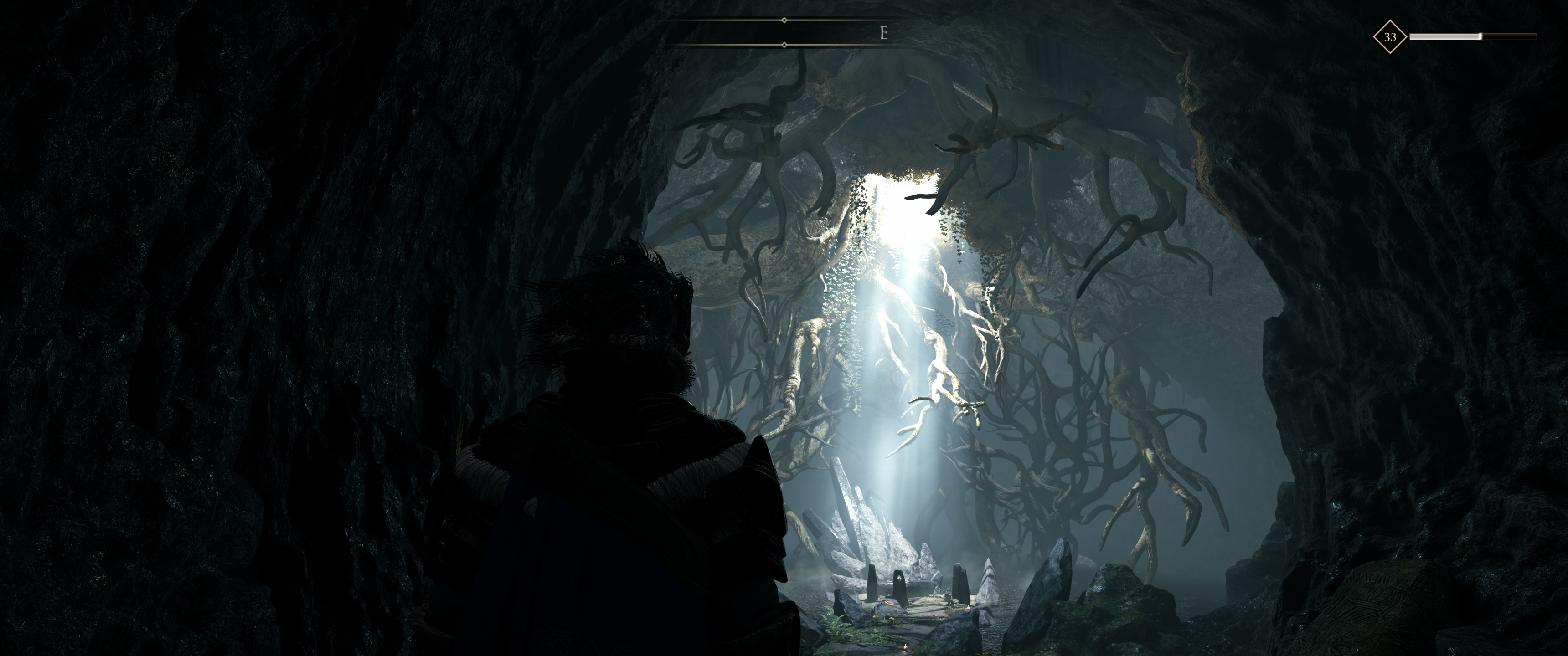
An underground cave from Greedfall

The above screenshot from Greedfall shows how the developer can unsubtly force the eye to focus somewhere. The light filtering from above among the dangling roots directs the player while hinting at this place’s history and significance.

However, the human eye can take its time to appreciate a screenshot. Treat each screenshot as a diorama. People view a screenshot holistically, like a painting. Arrange interesting things around the image or, if there is a single focus, ensure it is unique or intriguing enough to hold attention.

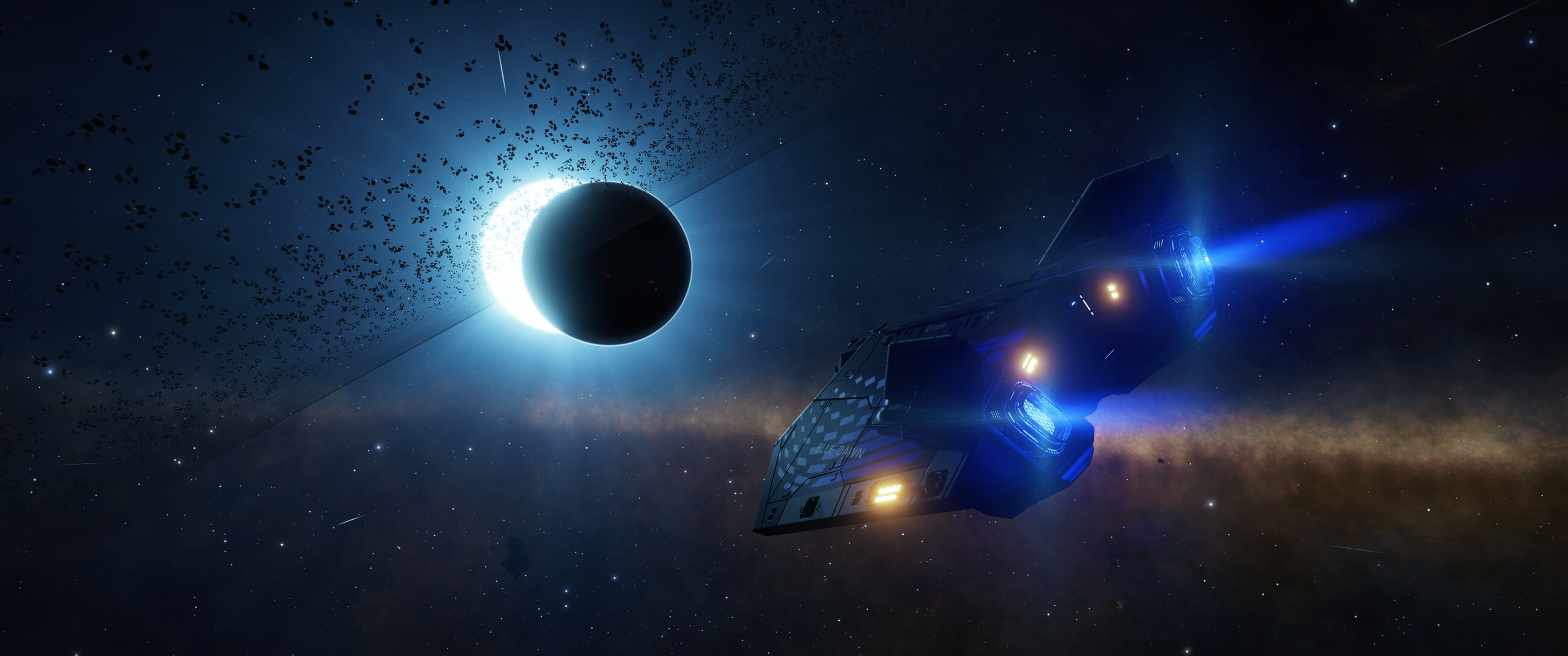
An Asp Explorer (spaceship) from Elite Dangerous

This screenshot shows a beautiful fusion of elements. The blue exhaust from the Asp Explorer (spaceship) heading towards the ringed planet matches the light of the eclipsed blue-white star. The edge of the Milky Way galaxy shows behind. This fills the image, meaning there is something interesting to look at everywhere.

Night City from Cyperpunk 2077

This screenshot shows the busy Night City skyline from Cyperpunk 2077. There is so much detail that it takes time to parse. What initially could pass for any modern metropolis is quickly dashed by the ascending holograms and unfamiliar advertising.

A Krait Phantom (spaceship) flying between a planet and its moon in Elite Dangerous

Another example from Elite Dangerous is above. Elite Dangerous‘ planet generation is fantastically detailed, and the colour contrast reflecting off the Krait Phantom’s mirrored hull looks wonderful. The distortion from the engine exhaust gives it that extra touch of realism and adds momentum.

Looking at the planet’s star through its rings in Elite Dangerous

While stark and beautiful, the lack of something interesting in the foreground in the above image gives the feeling something is missing or incomplete.

The best screenshots are not always from the most action-filled or detailed scenes. Screenshots omit many elements of game interaction, reminding us of what the screenshot lacks. There is no movement or action. There is no music, sound effects or story. The hardware sometimes limits the graphical fidelity. A screenshot can expose low polygon models and blurred textures.

An alien machine from Elite Dangerous

If you have a central focus, viewing it from a slight angle gives it a more natural appearance. It shows more detail from the side or top. The above screenshot shows the misty, creepy, organic, Gieger-esque internals of a thargoid base from Elite Dangerous. The details of the back pillar would otherwise be obscured if the shot was front-on.

The best screenshots tell a story or evoke emotion without context.

A Scorpion (buggy) exploring a thargoid spire site in Elite Dangerous

For example, zooming back from the Scorpion (buggy) and placing it below the camera’s centre in the screenshot above draws the eye towards the towering thargoid spire above it. The contrasting light between the green cloud to the right and the blue star to the left pleases the eye. This screenshot evokes a sense of alienness, wonder and being alone.

A rain scene from Cyberpunk 2077

Plenty of games have rain. However, the mist, almost monochromatic palette and subtle reflection in the puddles above capture a dreary oppression better than any other I had seen. The dirty footpath and cluttered scene emphasize the worst parts of urban life.

Avoid busy or unclear scenes. The dozens of spell effects hurled at a boss in an MMORPG raid can be impressive. However, parsing the scene can be difficult. 3D scenes rendered in wide aspect ratios, such as 16:9 or 16:10, distort around the edges. Avoid putting essential details there.

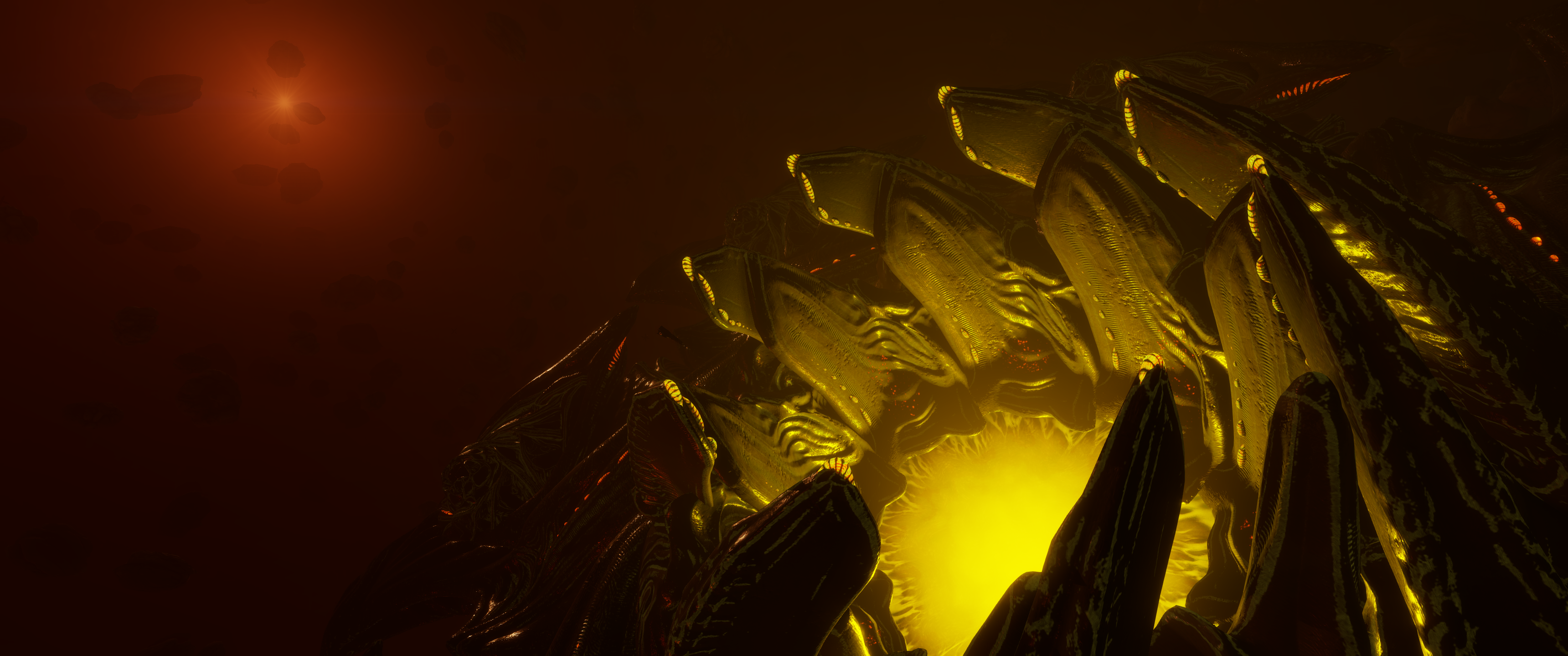
Lighting and colours pose unique challenges and opportunities. Overly dark or light scenes can be hard to discern. Contrasting light can be beautiful, as shown in the dull red of the star against the alien structure’s yellow below. Monochromatic scenes can be stark.

A thargoid titan from Elite Dangerous
A dark HDR screenshot from Elite Dangerous

While the scene above has a lot of detail, it is too dark. This is a good example of an HDR scene losing too much contrast when rendered in standard displays.

Disable or remove any “heads-up display”, voice chat overlays or similar UI elements. They often distract from the scene unless they are the focus (“I survived at 1% health!”).

Modern games may have photo modes that temporarily use more screenshot-friendly graphics settings and give more camera control. Use these when you can. Controlling the camera angle or adding effects, such as vignettes or filters, can add a lot.

An alien world from No Man’s Sky

Tilting the camera turns the already alien world from No Man’s Sky, above, into something disorienting. The slight vignette helps focus the attention on the centre and adds depth.

An Imperial Cutter (spaceship) amongst a gas giant’s ring in Elite Dangerous
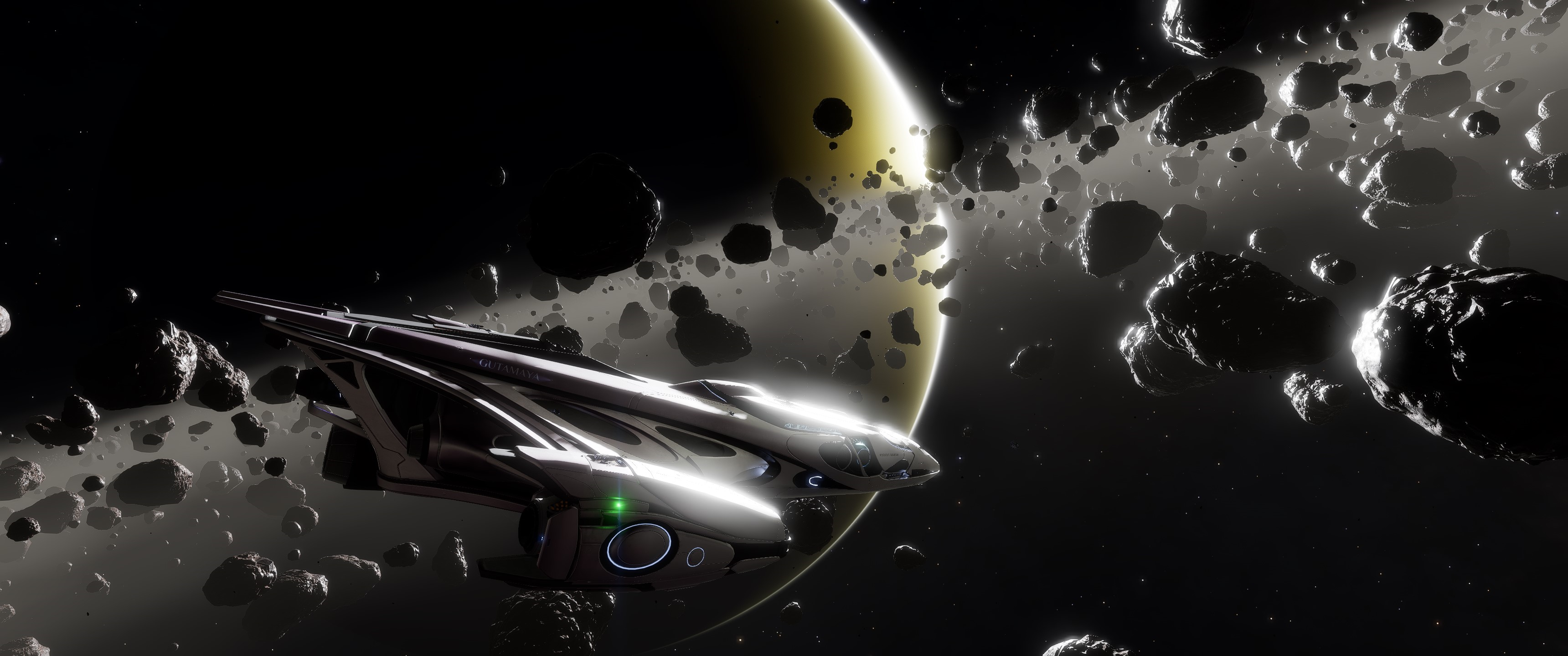
Looking through asteroids toward a faint, distant star in Elite Dangerous
A thargoid interceptor at a barnacle site in Elite Dangerous

Effects like bloom, light rays, reflection or lens flare turn a scene into something magical, as shown above. If I ever want new backgrounds for my computer’s desktop, Elite Dangerous is a wonderful way of generating them. Unfortunately, players may have to turn effects off to improve frame rates or to run games on low-end graphics hardware.

A traveler admiring the nighttime bioluminescent display from No Man’s Sky
A traveler admiring an eclipse on No Man’s Sky

Sometimes, careful timing and placement are key. This can be as simple as waiting until night in the first screenshot above or finding a lens-flared eclipse’s exact moment and angle in the second.

Be careful of symbolism and logos in games. While these can be meaningful and emotive in games, they often lose context outside that game. Worse, games sometimes use real-world symbols that can offend.

Avoid modifying screenshots after taking them. Highlight the game developers’ artistry, not Adobe Photoshop skills. Modifications are often prohibited if you want to enter screenshots in competitions. However, each game and community will have its own rules.

Many games have “vista moments”, where the player leaves a cramped, narrow area and enters a broader, almost agoraphobia-inducing wider world. If you are looking to start taking screenshots, finding these is a great place to start. The developers often make these look stunning.

Your first view of the Erdtree in Elden Ring

Your first view of the Erdtree in Elden Ring is a wonderful example of a panoramic “vista moment”, as shown above.

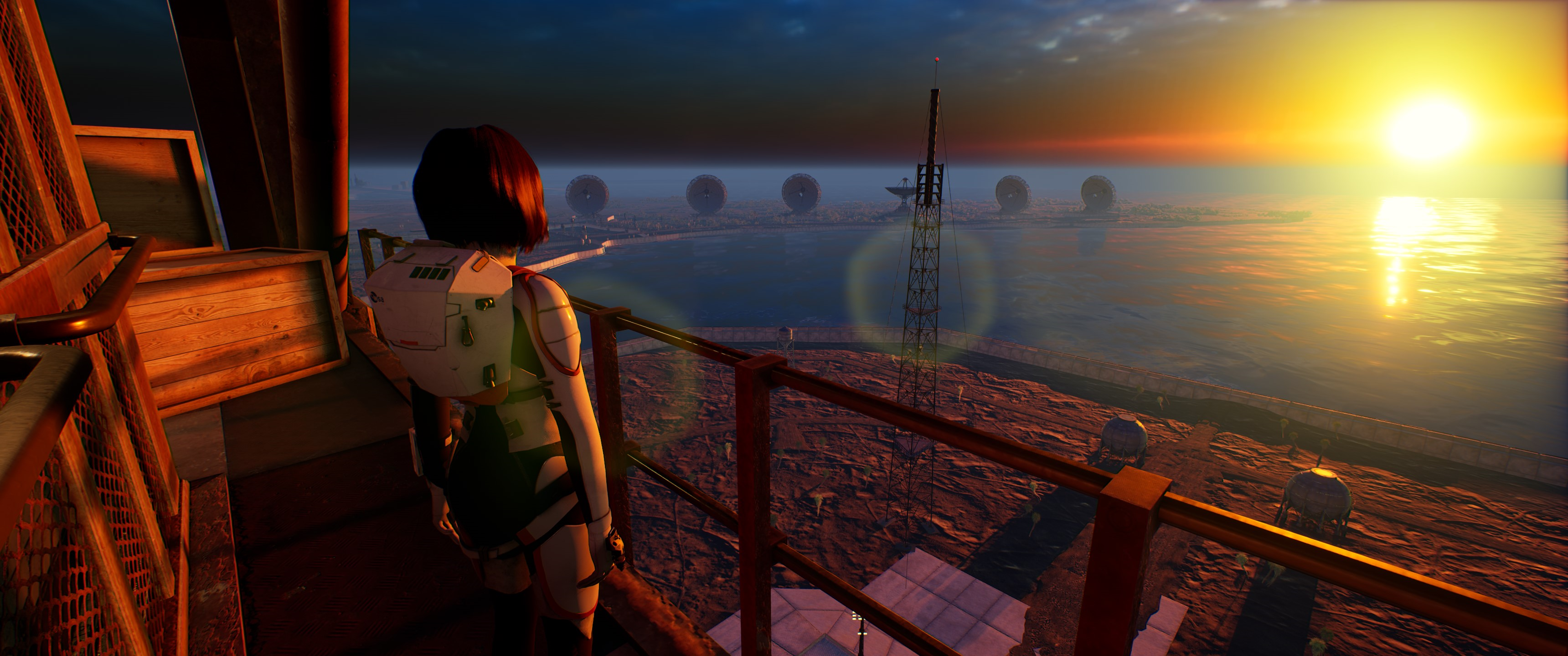
Looking over the water at dusk in Deliver Us Mars

The above scene showing the sun reflecting off the water is a wonderful change from the cramped corridors preceding it. In a setting where the Earth’s environment is collapsing, this reminds you what you are trying to save.

Graphics are arguably the most essential part of video games. While it is possible not to have any significant graphics, e.g. The Vale, video game developers spend much time and resources getting things right that players may only see for a few moments. Taking screenshots both helps share these moments and appreciate the effort and artistry that goes into video game development.

Does the 31 January Stream Change Elite’s Outlook?

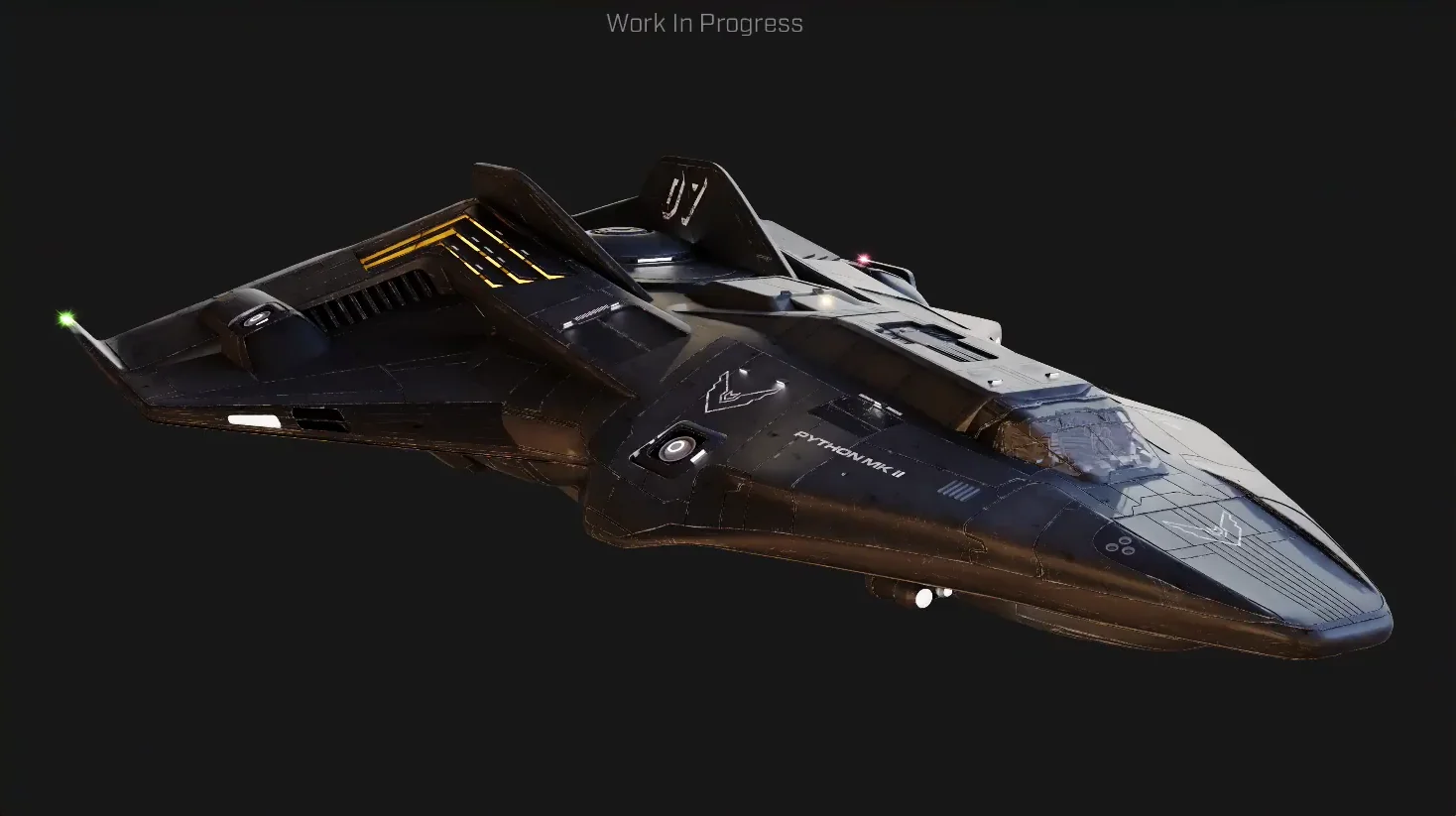
Mockup of the Python Mk II

Frontier’s stream on 31 January changed the landscape for Elite Dangerous players. Accustomed to Frontier drip-feeding content, no credible roadmap, and poor financial results, Elite‘s players had resigned themselves to being comfortable with table scraps. Did this stream signal a change?

Frontier has traditionally been famously vague, uncommitted and underwhelming. For example, a “new feature overhaul” was first discussed in 2022 for 2023 and is still undelivered. The content Frontier did release, such as the thargoid titans and spire sites, was visually spectacular. However, it lacked the long-term game loops required from a live service game. 

By contrast, the pleasantly succinct 31 January stream announced four things: a culmination of the thargoid war, a revamp to PowerPlay, an undisclosed major new feature and new ships. The new partnership with Dead Good Media for PR is producing good results.

This announcement exceeded reasonable expectations. It surpassed mine. However, that was not the biggest surprise.

While players have enjoyed the Thargoid War, Elite has always interweaved multiple game loops. Culminating the war allows people to get back to other things. 

Galnet, Elite‘s in-game newsfeed, has strongly hinted at a PowerPlay revamp. PowerPlay, Elite’s macro-political simulation, has devolved into passive-aggressive cargo healing. A rework is welcome.

Delivering four new ships was terrific news. New ships allow players to customize and experiment, re-experiencing existing content through a different lens. Frontier last released new ships in 2018. Five years without new ships is a long time when Elite is essentially a spaceflight simulator. 

The mockup of the Python Mk II, shown above, looks cool. It engages players’ imagination. The new canards, short tail fins and wing tips make it look sleek and modern. Frontier has taken a page from Star Citizen‘s playbook.  

However, the biggest surprise is Frontier’s implied renewed focus on Elite. As my previous post said, most expected Frontier to put Elite into maintenance mode. 

It is essential not to get too excited, though. For example, the PowerPlay revamp and the new feature are not new; Frontier just reannounced them. They have been years in the making. They may get pushed back again or, when delivered, be underwhelming.

From a business model perspective, the promise of new ships is the most lucrative. ARX sales for cosmetics will help the bottom line. Many ex-Elite players are interested in returning to play new ships. Whether it or any of the other announced features brings in new players is yet to be seen.

As my previous post said, games sell on potential and goodwill. Elite has lacked both for some time. Frontier has created an opportunity to hint at a vision or dream. However, it now has to deliver engaging content in a reasonable time frame. If so, Elite may return to the glory days of old. If not, this opportunity was Frontier’s to lose.

Does Elite Dangerous Use the Wrong Business Model?

Note: I originally wrote this before Frontier’s 31 January stream, which revealed surprisingly pleasant news. I considered rewriting this post for a few days. However, I decided to post it as is and then write an update later.

Frontier Developments PLC (or Frontier), the developer of Elite Dangerous (or Elite), recently published its interim 2024 financial reports. I have played Elite for thousands of hours. Considering the lacklustre Odyssey expansion launched two years ago, Elite‘s vague roadmap, and Frontier’s economic woes, I was interested in what this said about Elite‘s future.

Two slides from the financial report summarize Elite‘s situation well. The first is the “Cumulative Revenue” graph, shown below. This graph shows Elite favourably, earning the second-highest cumulative revenue of all Frontier’s Intellectual Properties (IPs).

Frontier's Cumulative Revenue Graph from Interim FY24 Reports

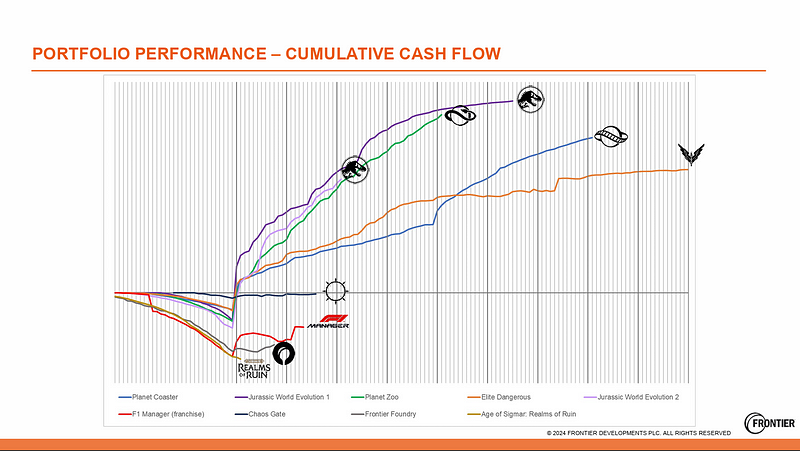
However, the “Cumulative Cash Flow” graph tells a less rosy story. Elite has earned the least of Frontier’s big IPs. Elite‘s current (right-most) line is almost flat, meaning its income roughly matches its costs.

Frontier's Cumulative Cash Flow Graph from Interim FY24 Reports

Given Frontier’s financial troubles, what does this mean for the future of Elite? The critical question is, “What are Frontier’s goals?” If Frontier wants to keep Elite as a “pet project”, they need not do anything different. Frontier can continue maintaining the game, likely entertaining the hardcore players for years. Frontier and Elite are synonymous, and Elite should continue as long as it does not lose money. 

Unfortunately, Frontier needs its IPs to generate income. David Braben, Frontier’s founder and previous CEO, may love Elite. However, Frontier is a business, not a charity. Their investors, including the Chinese game giant Tencent, rue the declining share price. The relative success of Star CitizenNo Man’s Sky and similar IPs of the same age and genre must weigh heavily. 

While, technically, it may have been the correct decision, Frontier’s decision not to support consoles likely had a significant financial impact. Frontier had invested heavily in Elite‘s console support before ceasing it without realizing any revenue. As shown in the Cumulative Revenue graph above, releases on other platforms boosted all IPs significantly.

Frontier may also be using Elite to hide costs. Frontier shares many development resources, such as the game engine, audio, marketing and community relations. Frontier may disproportionately attribute costs to Elite to bolster other IPs. However, given the lack of evidence and specifics, I am ignoring this.

Elite makes most of its money from the initial purchase or selling ARX, its cosmetics currency. Therefore, Frontier must attract new players or convince existing players to purchase cosmetics like ship paint jobs. 

Unfortunately, the “Cumulative Cash Flow” graph indicates Frontier failed. Not in creating a good game – that is another discussion – but in creating a game that generates significant revenue. 

One way to generate revenue is to improve gameplay. Frontier needs to identify new foci that engage players. For example, Eve Online wants to focus on “conflict, identity, and community” per Eve Online‘s 2024 roadmapElite needs beginner-friendly gameplay with less “grind” (repetition). However, gameplay changes are another discussion, as mentioned above. 

Another way to generate revenue is through hype and promise. Star Citizen is a prime example. Players “pledge” thousands of dollars for new ships to be released years from now, if ever. Players happily shrug off poor performance and reliability. Elite has lost this over the years. Better marketing and community relations could help, but Frontier needs that inspiring vision or dream.

An alternate could be changing the business model. The game designers may have created the ideal Elite but for a different monetization model.

For example, Elite could go “free to play”. A free version may allow players access to specific star systems or ships, requiring a purchase to unlock the full game. However, this is unlikely. Elite has a famously steep learning curve and lacks a clear story or path, meaning a low conversion rate to paying customers.

Elite could shift to a monthly or yearly fee, like Eve Online. This shift would increase revenue but would likely drive most players away. Many players drift into and out of Elite, while others enjoy it precisely because it is free after the initial purchase.

Elite could alleviate the grind. For example, it could offer blocks of engineering materials for ARX or increase the materials gathered. Another possibility is buying Federation or Imperial rank to unlock ships and gain access to systems like Sol. Warframe and other “free to play” games have similar offerings. Many enjoy Elite but are time-poor or only enjoy some game loops. Unfortunately, this is getting close to “pay to win”. It can frustrate or alienate those who put in the effort.

Frontier could generate more revenue from a regular, smaller expansion model instead of the current “big bang” model. Eve Online and No Man’s Sky do this. The high development time and cost mean a misdirected or incomplete expansion, such as Odyssey, can endanger an IP’s financial viability. “Big bang” expansions are typically sold at a significant discount in regular sales. 

Thinking more pessimistically, Frontier could sell Elite to another company. Daybreak Games, the owner of old MMORPGs like Everquest and Lord of the Rings Online, is one possible home. Pearl Abyss, the new owner of CCP games who make Eve Online, is another. 

Selling Elite would give Frontier a much-needed cash injection. This injection could fund another creative management game or two, something Frontier has monetized more effectively. 

However, a sale is unlikely. As stated above, Elite holds a special place at Frontier. It uses Frontier’s proprietary Cobra engine, unused outside of Frontier. Elite is still profitable, albeit marginally, so the price would be high. Thus, making a decent return on investment could be difficult. 

Predictions are always tricky. We need more information on the development team’s size and capabilities, the quality of the code base, and Frontier’s plans. Frontier’s next stream on 31 January will also lay out plans for Elite, although this will likely be just a teaser for the upcoming update 18.

However, if I had to predict, little will happen beyond update 18 for 2024. If anything, Frontier will continue drip-feeding the irregular updates planned as part of Odyssey. Anything else that happens will be completing existing work. 

This prediction may sound pessimistic. However, Frontier’s communications mention no new Elite content but plenty of content for other games. The recent restructuring has seen many senior members of the Elite team leave. Rebuilding and realigning afterwards will take time.

Reading between the lines, Frontier is moving Elite into the “too hard basket” for now. They want to focus on creative management simulations. They need revenue to correct their balance sheet and appease investors.

What would I like to see? I would love an inspiring and engaging “vision” for Elite. The hype around Odyssey drove huge player numbers and an undeniable anticipation. A focus on gameplay and marketing like that would be ideal. However, that requires creating a compelling vision, investing in marketing and community relations and commitment to see it through. These are improbable for a game in the “too hard basket”.

I would also love a “season” (like in Path of Exile or Diablo) or an “expedition” model (like in No Man’s Sky). These are separate versions of the game with interesting or exciting changes. Imagine Elite with a different economy, ships/modules, weapon balance or location/setting! Imagine replaying stories from Elite‘s lore!

Realistically, moving to smaller, cheaper, regular expansions will occur in 2025 or later. It deviates the least from current patterns, creates a constant revenue stream and reduces risk.

That said, it is remarkable that a game as old as Elite still makes money. Plenty of space games have come and gone over the years. Elite is still profitable and will be around for a while. However, in an industry dominated by hits, Elite may not be enough of a success to get the resources and attention it deserves.

“Rebel Galaxy Outlaw” Review: A Homage to Privateer

Rebel Galaxy Outlaw Game Poster

Rebel Galaxy Outlaw is a single-player, space sandbox game developed by Double Damage Games. It was initially an Epic Store exclusive in 2019 and released on Steam and other platforms a year later.

Rebel Galaxy Outlaw is infamous for being the first Epic store exclusive. This decision led to review-bombing and bad press. However, this is unfair. The poor early reviews had little to do with the game itself.

Rebel Galaxy Outlaw is also not the best space sandbox game available. Elite Dangerous and its peers do just about every game loop better. However, Rebel Galaxy Outlaw never intends to compete at that level. Instead, it is cheap and developed by a small studio that lacks the resources of a AAA behemoth. It packs a lot into a small package.

You play as Juno Markev, an out-of-luck ex-space pirate. The opening cell-shaded cinematic shows her crashing on a planet after unsuccessfully confronting her husband’s killer. Juno calls in a favour to get a modest replacement. She then must juggle repaying her debts, upgrading her ship and unravelling her past.

Rebel Galaxy Outlaw‘s gameplay consists mainly of combat with some trading, piracy and asteroid mining. These earn credits to afford better ships and equipment. Experimenting and exploring are helpful but optional. They can reveal poorly explained mechanics, side quests, rare weapons, lucrative mining spots or beautiful nebulae. 

Unlike Elite Dangerous and similar games, Rebel Galaxy Outlaw has a light, grungy, blue collar, “space trucker” style. The default radio station plays heartland rock and advertises discount ammunition and cheap beer. All technology looks retro-futuristic, old and second-hand. Many star systems are named after working-class southern or central US states. The region of space is called Dodge, like the famous lawless US frontier town. You can play eight-ball pool or dice poker to unwind, the genre equivalent of fishing. 

Rebel Galaxy Outlaw is the prequel to Rebel Galaxy, Double Damage Game’s previous game. They share the setting and style. However, the games are different. Rebel Galaxy is about flying capital ships on a 2D plane fighting with broadside cannons. Rebel Galaxy Outlaw is about 3D fighter combat.

Instead, Rebel Galaxy Outlaw is a homage to Wing Commander: Privateer and Freelancer. While there is a central campaign and side missions, you can ignore them to explore, fight or trade as you see fit. You can unlock buddies to fight with you temporarily. You can side with the law, against it or both. 

Even the graphics look like upscaled MCGA, used in Wing Commander: Privateer. The cockpit and HUDs are blocky and favour the old EGA colours. The stars are square. The game renders debris as sprites. Ships have distinct silhouettes and blocks of bright colours. 

Rebel Galaxy Outlaw plays best on a controller. While not as precise as a keyboard and mouse, the vibration makes you feel every shudder of acceleration and weapon recoil. The game’s aim-assist helps, too.

To be fair, Rebel Galaxy Outlaw is not flawless. Encounter difficulty can vary considerably. Auto-saves are regular and reloads quick, but unexpected deaths can still be frustrating. One mission requires non-lethal takedown of enemies, but you must manually remove any turrets beforehand. It is easy to miss some side missions, like those in Eureka.

However, Rebel Galaxy Outlaw surprised me. I had a fun 40 hours or so. You can complete the campaign faster if you do the minimum. However, getting distracted and blazing your own trail is part of the point. Fans of space sandboxes, Wing Commander: Privateer or something light and stylized will enjoy themselves. Do not let the poor early reviews fool you. 

Beginner Anti-Xeno (AX) Krait Mk II

An Elite Dangerous ship platform supporting multiple builds aimed at those new to Thargoid combat.

A detailed explanation of Thargoids and Thargoid combat is beyond the scope of this post. The Anti-Xeno Initiative (AXI) wiki has the best documentation about them, tactics, and ship builds.

Goals

Create a ship to:

  1. Perform one or more roles when fighting Thargoid Interceptors, Thargon Swarms and Thargoid Scouts, such as those found in AX Conflict Zones.
  2. Be self-sufficient, including removing the damage over time debuff from caustic missiles and neutralizing Thargoid shutdown fields. This means the ship can be viable solo or in random groups.
  3. Require no unlockable modules, reputation or rank. This makes it easier to build for newer players.
  4. Outrun and outmaneuver most thargoid interceptors, scouts and caustic missiles. This is unlikely to include the Basilisk interceptor, whose maximum speed is 530 m/s, but should include all others.
  5. Land on a medium-sized pad. This ensures it can land at all outposts and stations, including ones under active Thargoid attack. Medium-sized ships’ purchase and rebuy prices are also generally lower than large-sized ships.

Build

Krait Mk II blueprint by CMDR-Arithon (https://swat-portal.com/forum/gallery/image/9624-krait-mk-ii/)

The new large gimballed Enhanced AX Multi-Cannon is the best AX weapon that does not require unlocking. This replaces the turreted version. Unfortunately, the limit of four AX weapons still applies. The Python and Krait Mk II both have three large hardpoints, the most for a medium ship, but the Krait Mk II is faster and more agile, making it the best medium-size AX ship for new commanders.

That said, many ships make viable anti-xeno or anti-thargoid builds. For example, the Alliance Chieftain is also effective but more so against interceptors than scouts. It is more manoeuvrable but has less hull integrity and shields.

These builds are also guidelines. Feel free to experiment but note this build’s goals and motivations.

While you can run AX builds without engineering, Thargoids are intentionally difficult opponents. Unengineered ships are harder to use. Having to repair frequently may leave your team without a needed role. Unlocking engineers and grinding for materials is time-consuming but worth it. You do not need to max out the engineering to be viable, grade 3 or 4 is sufficient, but more engineering means an easier fight.

General:

  1. Maximize Hull: All thargoid damage is phasing, meaning a portion bypasses shields. All thargoid damage is Caustic, meaning traditional resistances like thermal, kinetic and explosive are useless. The damage over time debuff from caustic missiles directly damages hull irrespective of shields. Therefore, while shields help, maximizing hull integrity is imperative to survivability.
  2. Caustic Debuff: Being hit by caustic missiles or entering a destroyed scout or interceptor’s cloud will put a caustic debuff on the ship. Either use a decontamination limpet or overheat to at least 120% to eliminate it. Use the AFMU during downtime to repair malfunctioning modules.
  3. Thargoid Shutdown Field: Interceptors create a pulse that temporarily shuts down ships when (1) they enter the instance or (2) on their last heart. Use the Shutdown Field Neutralizer to prevent you and nearby allies from being shut down.
  4. Finding Targets: AX Conflict Zones tend to spawn scouts at long ranges. Interceptors can travel far away from the centre of a conflict zone during combat. Therefore, A-rated sensors help find scouts or interceptors at extended ranges. AX builds focusing on Non Human SIgnal Sources can operate well with D-rated.
  5. Lo-Draw Shield: The shield has Lo-Draw rather than Fast Charge. Fast Charge draws too much power if the shields ever drop, meaning there will be no power for the Shutdown Field Neutralizer or Decontamination Limpet Controller. However, Lo-Draw slightly decreases the recharge rate.
  6. Speed and Agility: While not as fast as a Basilisk interceptor, this build can outrun other Thargoids, including caustic missiles.

Anti-Scout

Build: Coriolis (Coriolis does not support the enhanced AX multi-cannons yet, so those slots are shown as turretted) or EDSY. Have your preferred one open as you read the guide for easy reference.

You can purchase the Enhanced AX Multi-Cannons from any Sirius megaship.

  1. Weapons: Three large and one medium Enhanced AX Multi-Cannons form the foundation for scout killing. The enhanced versions have a high shot speed. The gimbal allows limited auto-aiming, minimizing missing due to scouts’ manoeuvrability. The Long Range beam laser helps “tag” scouts and interceptors at long range. The Thermal Vent experimental effect reduces heat when striking a target or increases it when missing, helping to burn off the caustic debuff.
  2. Setup: Assign the multi-cannons and laser to the primary fire button and the decontamination to the secondary fire button in the same fire group. Assign a key to the Shutdown Field Neutralizer. This build’s Power Plant and Power Distributor are more than sufficient, meaning pip micro-management is optional.
  3. Target Selection: Engage regenerators first (because these heal nearby scouts), berserkers (because they buff nearby scouts and cause them to fire caustic missiles), inciters (because they buff nearby scouts) and then marauders last. The Xeno Scanner identifies scouts and their health.
  4. Engaging: Engage scouts at a range of one to two kilometres. This is within the AX multi-cannon minimum range but not close enough for scouts’ agility to make them hard to target.
  5. Swarms and Interceptors: Get a hit or “tag” on an interceptor to share in the bonds for killing it but avoid them if you are dealing with scouts. For interceptors, ensure someone in the wing gets a scan so you can target hearts effectively. Avoid using AX multi-cannons against shields, which may trigger the interceptor’s caustic missiles.

Mixed Anti-Swarm and Anti-Scout

As Anti-Scout, above, but replace two of the Enhanced AX Multi-Cannons with Remote Release Flak Launchers. Put the Remote Release Flak Launchers in side hardpoints to maximize the area covered by exploding flak.

  1. Setup: Put the Remote Release Flak Launchers in one fire button, the Enhanced AX Mutli-Cannons and Laser in another and the Decontamination Limpet Controller in another in a separate fire group.
  2. Scanning: Using the Xeno Scanner identifies the interceptor type and allows targeting of exerted hearts for you and everyone in your team. Once you get used to visually identifying interceptors and their hearts, you can replace the Xeno Scanner with another shield booster.
  3. Target Selection: Thargon swarms are your priority because only Remote Release Flak Launchers can meaningfully damage them. Prioritize swarms attacking other team members or, failing that, larger swarms first. Otherwise, prioritise scouts as mentioned above, particularly those attacking team members.
  4. Interceptors: Get a hit or “tag” on an interceptor to share in the bonds but prioritize other targets. While scouts are a nuisance, a single hit can destroy a needed attached limpet or stop an ammunition synthesis.

Anti-Interceptor

As Anti-Scout, above, but equip four 2B Guardian Gauss Cannons (or the salvation versions) and one 2D Long Range Beam Laser with Thermal Vent. Unfortunately, Guardian Gauss Cannons require unlocking.

Once you get familiar with interceptor combat, experiment with other Guardian weapons. However, Guardian Gauss Cannons are the most effective against Thargoid interceptor hearts.

  1. Setup: Placing all four Guardian Gauss Cannons on a single fire button and the Beam Laser on the other. While Guardian Gauss Cannons can fire frequently, they will spike your heat. Use the Beam Laser liberally to minimize heat but be careful not to exhaust the weapon capacitor. Avoid using gauss and other weapons against Thargoid shields, because it may trigger the firing of caustic missiles.
  2. Alternate Setup: Put two adjacent Guardian Gauss Cannons and the Beam Laser in one fire button and the other two Guardian Gauss Cannons and the Beam Laser in the other fire button. This reduces the heat impact of firing all four gauss cannons at once. Grouping the gauss canons into smaller groups with good convergence can make heart sniping easier. Hold the fire button to keep the laser firing to reduce heat.
  3. Range: Guardian Gass Cannons are most effective at the 1 to 1.5 kilometre range. The cannons still do maximum damage, the angular motion of interceptors is minimized and the slight auto-aim feature of fixed weapons is most effective.
  4. Engaging: Stay at least one kilometre from the interceptor unless you use the Xeno Scanner. This helps your Gauss Cannon accuracy, keeps you out of range of the lighting attack and helps any dedicated tanks keep the interceptor’s focus. Also, avoid using Gauss Cannons on shields. They are not very effective and can trigger an interceptor’s caustic missiles.
  5. Scouts: Leave scouts for those with AX Multi-Cannons. Targeting scouts with fixed weapons is harder than against the larger, slower interceptors and gauss cannon ammunition is limited.

Variants

  1. Unlockable modules: Replace the Module Reinforcement Package with the Guardian version to increase module protection. The double-engineered 5A Frame Shift Drive purchased from a Human Technology broker will slightly increase jump range. Replace the 4E Cargo Rack with the corrosive-resistant version if you want to scoop up hearts.
  2. Shieldless: I do not recommend running this build shield-less unless you focus on interceptors. Cold orbiting does not work against scouts or Thargon swarms. Missiling Thargons will quickly disable or destroy hardpoints without a shield. However, to do so, replace the 6C Bi-Weave Shield Generator with a 5D Module Reinforcement Package and the two 0A Shield Boosters with Heat Sink Launchers with Ammo Capacity, preferably the double-engineered versions.

Passenger Rescue and Robigo Mines Python Build

An Elite Dangerous ship build for evacuating passengers in bulk from outposts or settlements that lack a large landing pad. This includes the Robigo Mines to Sothis loop for credits or engineering materials.

Goals

Like the large pad, Anaconda version and the small pad, Type-6 Transporter version, create a ship to:

  1. Carry as many passengers as possible while landing on a medium pad. Evacuating passengers are happy with economy class.
  2. Make the 150+ LY trip to a rescue ship as quickly as possible. This means maximizing the jump distance and range to do the trip without refuelling. Failing that, outfitting a fuel scoop.
  3. Escape a Thargoid hyperdiction or interdiction. This means both the protection and speed to escape.

Build

Anaconda Blueprint by CMDR-Arithon (https://swat-portal.com/forum/gallery/image/9457-python/)

Links: EDSY and Coriolis (have your preferred one open as you read the guide for easy reference)

A comparison of medium ship economy passenger capacity is given below.

Ship23456+Smallest Shield Slot SizeTotal Economy Passengers (Shielded)Total Economy Passengers (Shieldless)
Type-6 Transporter2122035256
Asp Explorer2201135660
Alliance Challenger2200246876
Federal Gunship2001247684
Krait Phantom1303139094
Krait Mk II121223110114
Python121233142146
Medium Ship Economy Passenger Capacity

The Python carries the most passengers in economy class cabins, mainly due to its three size six slots. The Python does so with a 150+ LY jump range without refuelling, making it the ideal medium-sized bulk passenger ship.

Passengers:

  1. Passengers: Running passengers is straightforward. I prefer missions that reward engineering materials, especially ones with fewer passengers for five class five materials. The Advanced Docking Computer helps when repeatedly docking.
  2. Jumping: Even a non-double engineered 5A Frame Shift Drive using Increased Range with Mass Manager is sufficient. It gives a range of over 200 LY. Along with a 2H Guardian Frame Shift Drive Booster, this build does not need a fuel scoop to reach a rescue ship.

Defence:

  1. Speed and agility: Using the Dirty blueprint with the Drag Drives experimental Thrusters minimizes the time in danger during Thargoid encounters. Given the low power requirements, this build also uses a slightly smaller Power Plant and Power Distributor to give it that edge. It can boost every five seconds with four pips to engines and two pips to shields.
  2. Shields: While Thargoid damage is phasing, a Prismatic Shield Generator provides the best protection. Substitute for a regular Shield Generator if you do not have access to Prismatic Shields. It, with Shield Boosters, provides enough protection to comfortably escape Thargoid encounters. Eschew resistances because all Thargoid damage is Caustic.
  3. Armour: Favour speed over hull integrity with Lightweight Alloy.
  4. Cold: The Power Plant uses Low Emissions and Thermal Spread to minimize heat. This reduces Thargoid weapon accuracy and means heat sinks keep the ship under 20% heat for longer.
  5. No weapons: This build runs from fights.

Variations

  1. Robigo Mines: The passenger route from the output Robigo Mines in Robigo to the tourist beacon in Sothis used to be an excellent money earner. While the more lucrative missions now disappear from the mission board after an hour or so, passenger missions can still earn credits and engineering materials. Replace the three 6E Economy Class Passenger Cabins with 6D Business Class Passenger Cabins because some Robigo missions require them. Replace the 2H Guardian Frame Shift Drive Booster and even the 3A Prismatic Shield Generator with economy class passenger cabins because they are unnecessary. Unlike evacuation missions, some Robigo missions can take as few as two passengers and you are far away from any combat.
  2. Maximize range: Replace a smaller passenger cabin with an A-rated fuel scoop. This build will not scoop quickly but the low heat means you can take your time.
  3. Anti-Scout: Equip several turreted enhanced AX multi-cannons and a 7A Power Plant. Bring the fight to any scouts that interdict you or that attack you around stations! This variation can be fun but removing caustic damage from missiles is difficult. This build’s engineering makes overheating slow.

Tactics

This build uses the same tactics as the large pad, Anaconda version.

Passenger Rescue or Evacuation Anaconda Build

An Elite Dangerous ship build for evacuating passengers in bulk from damaged stations (before the events of Update 14) or stations in Thargoid Invasion systems (after Update 14).

Goals

Create a ship to:

  1. Carry as many passengers as possible. Evacuating passengers are happy with economy class.
  2. Make the 150+ LY trip to a rescue ship as quickly as possible. This means maximizing the jump distance and range to do the trip without refuelling. Failing that, outfitting a fuel scoop.
  3. Escape a Thargoid hyperdiction or interdiction. This means both the protection and speed to escape.
  4. (Optional) Collect engineering materials and commodities floating inside or around burning stations. Alternatively, transport critically injured evacuees in escape pods.

Build

Anaconda Blueprint by CMDR-Arithon (https://swat-portal.com/forum/gallery/image/9472-anaconda/)

Links: EDSY and Coriolis (have your preferred one open as you read the guide for easy reference)

A comparison of large ship economy passenger capacity is given below.

Ship23456+Smallest Shield Slot SizeTotal Economy Passengers (Shielded)Total Economy Passengers (Shieldless)
Type-9 Heavy122145154170
Beluga Liner041245168184
Type-10 Defender122136106138
Anaconda103344194202
Federal Corvette012255196212
Imperial Cutter011255188204
Large Ship Economy Passenger Capacity

Given the largest passenger cabin is size 6, the Federal Corvette carries the most passengers in economy class cabins. However, the Anaconda is the second best when shielded and has almost a ten light year longer jump range with a similar build. The Imperial Cutter has a similarly crimped jump range, although its speed makes escaping mass locks easier. Therefore, the Anaconda is the best all-round choice.

Passengers and cargo:

  1. Passengers: Running passengers is straightforward. I prefer missions that reward engineering materials, especially ones with fewer passengers for five class five materials. The autodocking computer helps when repeatedly docking.
  2. Cargo: A small cargo rack and limpet controller can help collect floating engineering materials and commodities in damaged stations. You can pause inside a burning station, activate collector limpets and then use heat sinks to control your heat. Otherwise, it can help carry critically injured evacuees in escape pods from transport missions.
  3. Jumping: This build uses the double-engineered 6A Frame Shift Drive for maximum range. If you lack one, use Increased Range with Mass Manager. The 4A Fuel Scoop is small but sufficient. The build’s low heat means you can throttle to zero at the edge of a star’s exclusion zone without overheating.

Defence:

  1. Shields: While Thargoid damage is phasing, a Prismatic Shield Generator provides the best protection. Substitute for a regular Shield Generator if you do not have access to Prismatic Shields. It, with Shield Boosters, provides enough protection to survive several Thargoid encounters assuming you repair regularly.
  2. Armour: Favour speed over hull integrity with Lightweight Alloys, given the Anaconda already has a tough, strong hull.
  3. Speed and agility: While an Anaconda will never be able to outrun a Basilisk, maximizing the Dirty with Drag Drives engineering on the Thrusters minimizes the time in danger during Thargoid encounters. The Power Distributor engineering ensures it can boost every five seconds with four pips to engines and two to shields.
  4. Cold: Given the Anaconda’s massive size 8 power plant and minimal power requirements, engineering to minimize heat is appropriate. This reduces Thargoid weapon accuracy and makes fuel scooping easier.
  5. No weapons: This build runs from fights.

Variations

  1. Longer jump range: Replace the Cargo Rack with a Guardian FSD Booster. This reduces the jumps required to reach rescue ships.
  2. More passengers: Replace the Cargo Rack and Collector Limpet Controller with more economy-class passenger cabins for a small increase in passenger capacity. Remove the shields if you are happy to take some hull damage during Thargoid encounters.
  3. Anti-Scout: Equip several turreted enhanced AX multi-cannons in the large and huge hardpoints. Bring the fight to any scouts that interdict you or that attack you around stations! This variation can be fun but removing caustic damage from missiles is difficult. This build’s engineering makes overheating slow.

Tactics

  1. Surviving interdictions: Submit to interdictions, put four pips into engines, then boost every repeatedly. Scouts will be a pest until the FSD cools down. Basilisks will mass lock you, preventing you from low waking, but take up to 30 seconds to commence pursuit. That should be long enough to get the required five km to escape their mass lock. Use heat sinks liberally to keep your heat low and minimize thargoid accuracy.
  2. Surviving hyperdictions: Hyperdictions, even from Basilisks, are easier to survive than interdictions because their mass lock does not block high wakes. Boost, fire heat sinks, then high wake as soon as possible. Use the Shutdown Field Neutralizer when you get a message about the impending shutdown field.
  3. Run: This build runs from fights, notwithstanding the anti-scout variation above.