
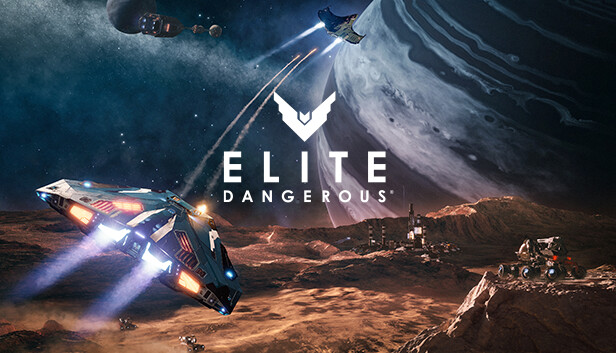
Elite Dangerous is a space trading, exploration and combat simulator released in December 2014 and regularly updated since then. Based on the 1984 Elite that seemingly crammed a galaxy into 64KB, Elite Dangerous expands this to a massively multiplayer online (MMO) game with modern graphics and gameplay.
You play a pilot flying a single spacecraft. You start with a small fighter, then work your way up via combat, exploring, trading, mining, ferrying passengers and completing missions to earn larger, better or more specialized ships. The Horizon expansion adds landing on planets, driving a ground vehicle and limited multi-crew. The upcoming Odyssey expansion adds “space legs”, allowing pilots to leave their vehicles and walk around space stations and some planet surfaces.
Elite Dangerous is set in the Milky Way galaxy. All of it. As you zoom out on the galaxy map for the first time, its sheer enormity becomes apparent. The game is set a bit after the year 3300, where humanity has colonized “the bubble” around 150 lightyears from Earth, encompassing over 20,000 inhabited star systems. However, 400 billion stars are accessible, backed by hard science, where possible, and procedural generation, otherwise. Looking at the sky and realizing you can travel to most visible stars is a humbling experience.
Life in the Milky Way is not static. Like many space trading games, an economic and political simulation underpins Elite Dangerous. Perform enough missions for your favourite faction or fight along one side in a war and see the borders shift and economies wax and wane. Although more as a backdrop to weekly in-game events than a narrative, there are also ongoing events and lore.
While the original Elite’s graphics were appropriate for their time, it left a lot to the imagination. Elite Dangerous’s renders planets, nebulae, gas clouds, asteroids and other stellar objects beautifully. It has spawned a whole stellar cartography and photography community.
Stations’, settlements’ and ships’ beautiful graphics have an industrial, semi-realistic aesthetic. Space stations are gorgeously detailed, with triangular reinforcement struts, flashing warning lights and BladeRunner-like holographic advertising. Ships’ thrusters fire realistically as they manoeuvre. Lasers rake glowings arcs of molten yellow-orange metal on ships’ hulls.
The sound design is also exemplary. Ships have distinctive sounds. You can hear the subtle creaks and vibrations as a ship decelerates into a planet’s atmosphere or the shudders and groans as a landing pad retracts into a space station. Closing your eyes as you dock with a station reveals many small sound effects that add so much.
Unlike many games, Elite Dangerous’ soundtrack is more atmospheric and ambient than inspiring and memorable. One notable exception is the rousing orchestral choral theme for a capital ship jumping into a conflict zone. It is reminiscent of John Williams’s scores to any of the Star Wars films. Another exception is Straus’s “Blue Danube”. It plays whenever auto-docking and is a nod to the similar scene in 2001: A Space Odyssey and the original Elite.
While I play with neither, Elite Dangerous is considered one of the premier examples of virtual reality (VR) and using a HOTAS (Hands-On Thrust and Stick). Using both apparently creates an immersive experience few games can match.
I usually choose single-player games (note the blog’s name) with more apparent stories or themes. At first glance, Elite Dangerous does not fit that mould.
Instead, Elite Dangerous is an example of great game design. Despite some lingering bugs, Elite Dangerous consists of many different games strung together. At the lowest level are the simple mechanics like targeting, shooting and manoeuvring. The game combines these into dynamics like combat, exploration and trading. Above them, you have more abstract and strategic activities like advancement, supporting in-game factions or galactic superpowers. It reminds me of how Paradox Interactive, the developer of games like Crusader Kings and Europa: Universalis, builds games.
This breadth allows players to construct their own goals. One goal could be working toward an expensive or reputation-locked ship. Another could be travelling to the edges of the galaxy. Many choose to focus on the combat, whether it be against NPC opponents or other players.
While Elite Dangerous is an MMO, you can still play solo or with small groups of friends. I spent my first several weeks solo, but I still rarely interacted with a human even after “graduating” to open play. Almost all content is soloable. Even PvE content seemingly made for cooperation, like fighting aliens introduced in the recent expansion, is frequently soloed.
That does not mean players are absent. While the game economies and politics are not player-centric like in Eve Online, there are many thriving squadrons and player groups, both for good and bad. PVP-focused players frequent star systems where others congregate, praying on the weak. By comparison, the “Fuel Rats” is a group of volunteer players who help those that have run out of fuel.
Meanwhile, Elite Dangerous’s greatest strength and biggest weakness is its demand for self-discovery. While there are some tutorials, players must learn most of the game’s mechanics themselves, either through player-generated content or trial and error. Even seemingly basic things like landing a spacecraft are difficult for first-time players. This demand attracts some but repulses many.
Elite Dangerous delivers a form of retro-futuristic nostalgia. The crackly radio transmissions you overhear are reminiscent of the attenuated analogue radio used during the moon landing. Spacecraft fly like World War II or Korean era fighters, at least until you turn off “flight assist”. All text in the user interface is uppercase like early computers.
With a few exceptions like faster than light travel, Elite Dangerous is about a realistic simulation of the future as you can find. In its future, artificial gravity does not exist, meaning spinning space stations or. Physics rules spaceflight and spaceship modifications. Make it heavier and your spacecraft will be slower and less manoeuvrable. Space is big. Travelling, even with a faster than light drive, takes time.
Elite Dangerous is a game for serious space fans willing to invest time learning the game. It is also for those comfortable setting their path. Those looking for something thematic or more casual will find it unfulfilling.
Why did I play this game? I remember watching Carl Sagan’s Cosmos as a young child. He talked of a ship of the imagination, allowing you to travel to only dreamt places. Elite Dangerous provides that. I felt the joyous wonder when I first jumped into a system, seeing the kineticism of hurtling toward a star when decelerating. I felt it when I saw my first black hole and the light lensing around it. I felt it seeing starlight reflecting off an alien gas giant at sunrise, illuminating a ring of asteroids. Elite Dangerous is for those happy to head to the “second star to the right and straight on ‘til morning”.
 The Single Player