“Deliver Us the Moon” Review

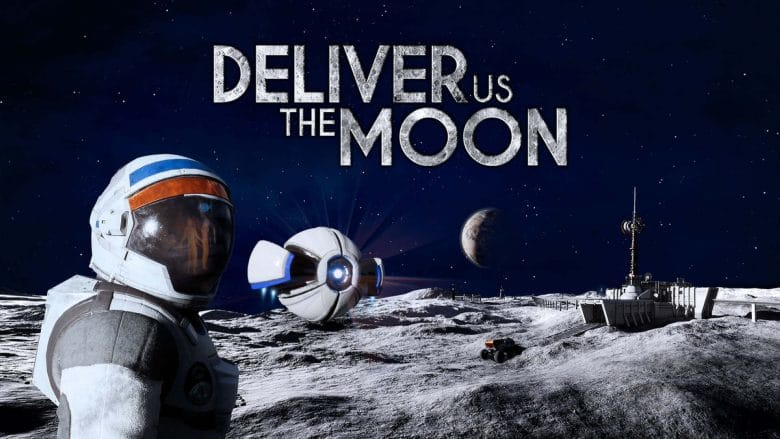
An astronaut and robot standing in front of a lunar landscape.

Deliver Us the Moon is a first-person interactive fiction game similar to Tacoma, Event[0], The Station or Stardrop. You play an astronaut blasting off an environmentally-devastated, near-future Earth to restore the energy transmission from the moon after it mysteriously shuts off. 

Deliver Us the Moon could be called a walking simulator, a genre uncharitably named for its simplicity and monotony. Like many walking simulators, much of Deliver Us the Moon involves the lone player exploring their immediate area, finding notable objects to scan or historical scenes to review then solving simple puzzles to unlock progress to the next area. There is no branching narrative or progression.

However, unlike some walking simulators, Deliver Us the Moon packs variety. It includes multiple mini-games like docking spaceships, driving moon rovers, repairing robots or aiming radar dishes. Its space scenes impart the feeling of weightlessness, potentially disorienting the player with “up” only denoted by the occasional sign, screen or seat. Limited oxygen makes scenes in space or on the lunar surface tense. Sometimes you lose yourself staring at the desolate but beautiful lunar surface. Sometimes you are just desperately surviving. It is more What Remains of Edith Finch than Dear Esther.

Like many interactive fiction games, Deliver Us the Moon is short, taking seven to eight hours to finish. However, given its weighty story, it feels about the right length. Its brevity and economy contrast with unending contemporary live service games. It also becomes more accessible – you complete it in a few gaming sessions.

The success of an interactive fiction game depends on how well it resonates with the player. The key is the adage, “Show, don’t tell”. Rather than telling you how you or some player surrogate acted or felt, it places you in that situation, drip-feeding you background and context. When the game finally asks you to care, it feels natural after surmounting challenges and discovering lore organically.

At first, Deliver Us the Moon‘s setting and premise may seem far-fetched. Climate change is a genuine problem. However, Deliver Us the Moon‘s world exhausts natural resources and desertifies sooner than even pessimistic climate projections. Extended stays in space or on the lunar surface require huge, Earth-side teams to support them. Given our understanding of physics, beaming sufficient energy from the moon to power the Earth is impractical.

However, Deliver Us the Moon is not a game about environmentalism, technology or space. Its puzzles are never hard enough to frustrate or block progress.

Deliver Us the Moon is about how personal connections drive us, such as protecting family or camaraderie. It is about how alienating disconnection can be, even when the world is a stake. Amidst space’s vastness, alienness and hostility, the small things matter.

Deliver Us the Moon will appeal to those who enjoy empathising with a good story and can relate to its themes. You will enjoy Deliver Us the Moon if you enjoyed Firewatch or Gone Home but want more interactivity, some tense moments or a science fiction setting. Like other interactive fiction games, those looking for something challenging, action-filled or longer should look elsewhere.

“Greedfall” Review: How Focusing on Strengths Creates a Great RPG

The silhouette of a tricone hat wearing, saber wielding figure overlooking a misty Celtic forest with a volcano in the background

Greedfall is a third-person, action role playing game set in a unique world reminiscent of colonial, magical-filled seventeenth century Europe. You, de Sadet, accompany your cousin to Teer Fradee, a newly discovered island. You act as an ambassador, investigator and troubleshooter to help him manage and expand the colony while dealing with other factions and native inhabitants. You also seek a cure for the Malichor, a disease ravaging the continent’s populace.

The standout aspect of Greedfall is its setting. Beyond the tricorne hats, flintlock pistols and galleons, colonial Europe is a time of contradictions. Great advances in science and technology promise much, but religious and social views evolve much slower. Greedfall embraces this contradiction instead of safely shying away from it. 

Greedfall‘s world contains several main factions. These include the Bridge Alliance, a mix of Arabia and India that pursues science above all else. It wars with the highly devout Theleme, which has clear influences of Spain and Italy. The Congregation of Merchants, de Sadet’s faction, is a pseudo-France, sitting politically between and trading with each. Teer Fradee is an England-like island populated by natives with a Celtic-inspired language. 

The setting and factions create a stage for Greedfall’s cutting commentary. The Bridge Alliance grapples with the ethics of its research, Theleme struggles with zealotry and the Congregation with bureaucracy. Watching Theleme’s Ordo Luminous slaughtering innocent people under the false accusation of heresy, the Bridge Alliance comparing human test subjects to lab rats, and wealthy merchants from the Congregation dismissing laws as obstacles bypassable by modest bribes are all confronting.

Greedfall is also clever and respects its inspiration. It depicts organized crime as intelligent and insidious, not something solved by defeating the nearest “bad guy”. The native inhabitants of Teer Fradee have different reactions to the newcomers. Some fight them. Some ignore Some trade with them. Some use them as pawns in their own political games. This pluralism creates interesting dynamics between the various tribes and factions.

Greedfall also knows that constructing emotional investment in characters and a setting takes time. It takes time to build relationships and drip-feed exposition. When the game finally asks you to care, it feels natural and not forced.

Many play RPGs for their tactical combat. You control persistent characters through multiple combat encounters who improve over time. The enjoyment comes from mastering the mechanics and overcoming the challenge.

Unfortunately, Greedfall does not deliver in-depth combat. It hints at a more action-oriented parry and riposte-style melee combat. However, at least when playing as a magic-wielding character, abilities like Stasis and Storm quickly relegate most fights to mere speed bumps — fun but probably not what the designers intended.

The exceptions are the fights against Nadiag (“guardians”). These add an unexpected, welcome, but initially frustrating challenge. When you first encounter one, none of the fights beforehand prepare you for discerning telegraphed attacks, careful positioning and resource management. 

A higher difficulty setting will likely flatten the difficulty curve or increase the challenge. A melee-oriented character might have been a different experience, too. However, those seeking a combat-oriented RPG should look elsewhere.

Between quests and fights, you spend much time exploring Greedfall‘s world. Teer Fradee is split into discrete areas, unlocked as you reach the edge of known ones. Crafting ingredients are spread liberally around the map. Alleys and scaffolding in cities reward the curious. 

Your character, de Sadet, is joined by several companions. Each hails from a different faction and fulfils a combat archetype. Each also has a unique quest line and can be romanced. You can have up to two at a time but can switch them when fast travelling or at camps. However, their perspective and hints are most useful, especially when taking a companion on their faction’s quests.

Non-combat skills, or talents, provide multiple ways to solve most quests. For example, you may rescue someone from prison by using your “lockpicking” talent to pick the lock, “intuition” to convince the jailor he should let the prisoner go or by using your “science” talent to brew and place an alchemical mixture to blow a hole in the wall. 

However, talents are all about early- and mid-game trade-offs. While some items, upgrades, and befriending companions help, you obtain talents slowly, and not every one is helpful in every situation. Otherwise, you may be forced into reputation decreasing threats or violence.

Graphically, Greedfall is no Cyberpunk 2077. It lacks ray tracing and DLSS. A 4K display resolution is unkind to some models and textures. Looking down on grass reveals three flat surfaces arranged like an asterisk.

However, for a non-AAA RPG initially released in 2019, Greedfall is still a pretty game. The game uses light/dark contrast heavily, such as the moment it takes to adjust to the dim lighting indoors or the pale shards of light illuminating caverns. I often stopped to admire the detailed rigging on the moored tall ships. Sunbeams shone down from the golden afternoon sun through the trees or buildings, shedding a warm red glow between the shadows or reflecting from puddles.

Greedfall‘s music is ambient and atmospheric. The encounter music with Teer Fradee’s native inhabitants focuses on percussive and woodwind instruments, giving a musical shorthand to help identify who and where you are. The voice casting is excellent, and only a few strange pronunciations using native accents mar the collective vocal performance.

Some have complained about Greedfall‘s glitches and bugs. Post-release patches may have fixed these, but I counted only a few in my playthrough. Most were low-resolution textures or an NPC struggling to walk around an obstacle – nothing significant or immersion-breaking.

Some have also complained about the lack of animations for minor events. Instead of an NPC drinking a potion or a magic seed growing into a tree, the game fades to black and then shows the result. I do not see this as significant. There needs to be sufficient cost benefit for a small studio to animate these.

For a non-AAA RPG, Greedfall focuses on its strengths to punch above its weight. Greedfall will not satisfy those seeking boundary-pushing graphics, a thumping soundtrack or consistently challenging combat, at least not at the normal difficulty level. However, the novel setting, meditative exploration and great quest design made my sixty hour playthrough thought-provoking and reflective.

“Dungeons & Dragons: Honor Among Thieves” is Finally a Good D&D Movie

"D&D Honor Among Thieves" movie logo

Dungeons & Dragons: Honor Among Thieves is a comedy and action fantasy movie based on Dungeons and Dragons (D&D), the tabletop role playing game. You follow Edgin and his adventuring band as they attempt to rescue Edgin’s daughter. They are betrayed, then drawn into something larger and more insidious that threatens the whole city of Neverwinter within the Forgotten Realms.

One challenge with bringing D&D to the screen is that D&D is a game system upon which different locations and characters are built and played. It is not a single place with known characters. Even the game’s themes vary with different settings, such as Dark Sun’s post-apocalyptic rebuilding, the pseudo-Middle Earth of Greyhawk and the intrigue-filled Forgotten Realms.

Another challenge is what makes D&D successful and enjoyable, like the many tabletop role playing games that followed it, is active participation. While there is a Dungeon Master that guides play, D&D is about cooperative storytelling and spontaneity over fixed character development arcs and well-developed plots. It is camaraderie. It is living popular tropes, not just passively consuming them.

By comparison, fantasy and science-fiction movies and novels usually adopt the setting to disarm the reader for some form of social commentary. For example, J. R. R. Tolkien’s The Hobbit was about conflict between the English upper, middle and lower classes. Robert E. Howard’s Conan warned against the evils of unrestrained technology. Characters develop and events occur to support that aim, all under the director’s or author’s strict guidance. 

Previous D&D movies and many novels failed because they took the settings or signature creatures, spells and classes from D&D and put them in heroic and epic but themeless fantasy stories. They inherited the disadvantages of both D&D and movies or novels without either’s advantages.

Thankfully, Honor Among Thieves learns from these mistakes and recent successes, like the Marvel franchise. It works for four reasons.

The first is respecting the soul of D&D. D&D is about heroic fantasy, where inspiring good and terrifying evil exist. Players raise sword and spell to defend those who cannot.  

However, the players or audience need to feel emotionally invested. It has to be personal. Without emotional grounding, gravitas becomes self-importance and the solemn becomes cringeworthy. Honor Among Thieves starts at the most basic, with a husband pining after his wife and daughter, routes through betrayal and only then ups the ante to something epic. The movie has heart.

The second reason is respecting D&D as a beloved, forty-year-old IP. Players will recognise iconic spells, classes and creatures. Those familiar with the Forgotten Realms setting will enjoy the references, from the overt, like Baldur’s Gate and the Harpers, to the subtle, like Selune’s Tears. The adventurers from the 1980s Dungeons and Dragons cartoon appear in the arena. There are not one but two dragons.

Honor Among Thieves feels like a D&D “campaign” or sequence of play sessions. It is long at around two hours but keeps the pace moving, jumping locations quickly without labouring. Locales include medieval cities, the Underdark and eponymous dungeons. The swerving plot gives the feeling of spontaneity and improvisation. The special effects and fight choreography are on point, giving each character a chance to shine. The final climactic battle demonstrates the power of the adventuring group at its satisfying culmination.

To be fair, Honor Among Thieves is not always faithful to the D&D rules. Paladins making Handle Animal skill checks and druids wild shaping into The Incredible Hulk-like owlbears will leave D&D rules lawyers shaking their heads. Under the guise of a relatable audience surrogate, the movie strips Edgin’s bard of his magic and combat prowess. However, these transgressions are minor and forgivable.

The third reason is not taking itself too seriously without being disrespectful. Often, an unexpected joke or an Instagram-worthy lousy dice roll can be a highlight of the session. Honor Among Thieves contains plenty of humour, from accidentally setting off traps, underestimating the literal wording of spells or the questionable tastes of intellect devourers. Without it, this movie would be a sequence of action-heavy fights having to one-up itself each time. It keeps the tone light.

For example, Xenk, the Paladin, could easily be overplayed to the point of ridicule. He literally and metaphorically does not swerve from his path of righteousness. However, his misunderstanding of irony is endearing. His aloofness opens room for forgiveness. He simultaneously contrasts the more chaotic nature of the rest of the party and inspires them toward greatness. Edgin, his adventuring band and the audience want to make fun of Xenk but cannot.

The fourth reason Honor Among Thieves works is its themes. Like Guardians of the Galaxy and The Avengers, it deals with family and self-realisation. You know the good guys are going to win. The question is how and whether they can overcome their relatable self-doubt and dysfunction to realise their potential. Seeing heroes struggle with the same fears as us brings the audience and players closer, humanising the heroes and subtly suggesting that we can all be heroic.

Honor Among Thieves is fun. It is fast and flashy enough to keep the audience’s attention and sassy enough to be credible without disrespecting D&D. You will enjoy Honor Among Thieves if you like the recent Marvel movies, heroic fantasy or play any tabletop role-playing game. If not, it will continually imply that you are missing something. Honor Among Thieves will not win any awards but is a solid cross-over that players have been waiting decades for.

“Sable” Review

Sable is an exploration and light platforming game developed by Shedworks. You play the titular character during her “gliding”, a coming-of-age ritual. Sable leaves her tribe to explore the desolate desert world and its people to determine her future and satiate her wanderlust.

Sable is a game about exploration and curiosity. It is about discovering new areas and finding dusty corners. It is about uncovering the lore and history of the world. It is about Sable finding her future place in society.

Thankfully, Sable‘s world is intriguing and wonderful. Visually, the world’s deserts are beautiful and varied, from sterile flat salt fields to the Utah-like eroded towers of red sandstone. Zipping around on your hoverbike, a technological marvel teasing what you can discover about the world’s history, is fun and relaxing.

Mechanically, Sable relies on familiar game loops like fetch quests and collection challenges with optional fishing. The quests are interesting and unique, like climbing through a gigantic wyrm, collecting precarious lighting crystals or gathering beetle poo. Sable restrains itself, avoiding the blatant exploitation of people’s curiosity and completionist instincts in other games.

Two things make Sable stand out. The first is its distinctive and vibrant cell-shaded, cartoon-like art style. The solid blocks of colour and black outlines simplify the landscape and scenes, immediately drawing attention to points of interest. It also gives the world an unreality, reinforcing Sable and her journey as fable of self-discovery.

The second is that everyone wears masks, signifying their place in society. Sable starts with a child’s mask but earns new ones by completing others’ tasks. She chooses one to wear when she finishes her gliding.

Interestingly, Sable glosses over the depersonalisation that such a practice would bring. Sable can still recognise people and see smiles or other facial expressions beneath the masks. The game ignores possible commentary on Western society’s fixation with employment as identity or portraying fake versions of yourself.

Avoiding such commentary is a good decision. It would have been too heavy. Sable is self-driven and self-paced, placing little pressure on the player. There is no combat, death, failure state or even conflict.

This decision means Sable fits nicely into the “wholesome game” genre. It also means the game has a positive and uplifting vibe. The world is not scary. Something interesting could always be around the next corner.

One minor gripe is the game’s graphics default to thirty frames per second. Unfortunately, some animations, such as Sable’s running, are limited to that rate. This noticeably contrasts with swaying grass and wind effects that are not.

Sable‘s content also gets more obscure as it progresses. The game may be unchallenging, but you need to work hard, be very curious, or both to complete everything.

That said, Sable does not encourage or require you to do anything. There is no main questline or overarching story. Sable’s mask, and her future, is her decision to make. She can return after getting her first mask or take as long as she wants.

Instead, the focus is on how Sable’s meanderings transform her. Her conversations with her tribe mates at the end are very different to those at the start. As the menu theme’s lyrics say, Sable eventually returns to her tribe as someone else.

Sable is a game for those that enjoy self-guided exploration on multiple levels. It does not outlive its novelty at eight to twelve hours to complete. Those wanting something challenging, story-driven or longer may get bored. However, those looking for something introspective, meditative, uplifting, and positive will enjoy it.

“Wednesday” Review

Many were curious when Netflix previewed Wednesday as a reboot of the 1960s black and white The Addams FamilyThe Addams Family poked fun at those who are different, subtly reinforcing American cultural superiority during globalism’s infancy. Recent versions softened this stance but reduced the central family to a travelling freak show. Would Wednesday repeat the same mistakes?

Wednesday begins as Wednesday Addams starts at a new boarding school, Nevermore Academy, after being expelled from yet another traditional American high school. Her parents, Gomez and Morticia, also went to Nevermore Academy. Their legacy threatens to smother Wednesday’s emerging identity under her parent’s shadow. Meanwhile, Wednesday struggles to define herself in a world that wants to force her into a mold. 

The first few episodes introduce the characters while entertaining the viewer with succinct and acerbic dialog, particularly from Wednesday herself. The main plot then starts to assert itself. A supernatural mystery threatens to overwhelm Nevermore Academy and the nearby town. Wednesday takes it upon herself to solve the mystery, guided by her psychic premonitions.

Jenna Ortega portrays the unblinking, monochrome titular character brilliantly. Wednesday outwardly revels in her isolation. She even convinces her nemesis that she cares little for others’ opinions. However, her black, frozen heart predictably melts after a visit from her uncle Fester, her feelings for Thing and young love.

Thing, Wednesday’s disembodied hand companion, is the most transformed character from the original The Addams Family, both by special effects and a new purpose. Thing moves from a recurring gag to the perfect companion and sidekick: loyal, competent, occasionally comedic but never taking the spotlight from Wednesday. 

Enid, Wednesday’s werewolf roommate, plays Wednesday’s foil. Enid represents everything that Wednesday is not: colourful, energetic, warm, forgiving, technically savvy and extroverted. This tug of war plays out in the not-so-subtle contrast of their shared dorm room between Enid’s rainbow and Wednesday’s gothic drabness.

Wednesday eschews almost all classroom scenes typical to the Harry Potter-like genre. Weems, the stoic, long-suffering headmistress played by Gwendoline Christie, vacillates between dominance, patience and political correctness. 

For original series fans, Wednesday subverts many tropes from The Addams Family, like snapping fingers twice or the adoring love between Morticia and Gomez. However, some merely lighten emotional moments and strengthen the bond between characters. Wednesday and Pugsley, her brother, casually fishing using hand grenades is a good example.

However, Wednesday has its frustrating flaws, too. Wednesday’s character sometimes veers into the Mary Sue trope. Her knowledge of macabre topics, archery or the cello is unmatched, dismissively besting others. Wednesday’s friends’ affection is unrequited and undeserved.

Wednesday also touches on the Chosen One trope. Her constant self-righteousness and lack of remorse grates. She would have been expelled and arrested for her actions in any other context. 

Wednesday will resonate with young adults. It deals with social status, love triangles, the struggle to find one’s identity, the bravado and self-righteousness of youth and the changing relationship with parents from a dependent child to a semi-independent teen.

Wednesday is unashamedly feminist. Women play most main roles. The series reduces Gomez from a 1960s-style family head to a love-struck doter. Pugsly is a pot-purri-eating weakling constantly needing Wednesday’s protection. However, the series loses little from doing so, and the new perspective is refreshing and fundamental to the story.

Underneath that, by moving the spotlight away from the Addams family and onto Nevermore Academy, Wednesday can examine diversity and inclusion. The ridicule of Nevermore’s student “freaks” by the nearby town’s “normies” will appeal to anyone bullied or victimized. 

The town’s financial dependence on Nevermore Academy forces an uneasy truce, preventing the resentment from escalating into open conflict. This arrangement gives more credibility and context while giving key characters more depth.

However, the series is sometimes one-sided. No one sympathizes with those Wednesday belittles or harms. The nearby townspeople are right to be wary, given the recent murders and Nevermore Academy’s students’ powers. 

Wednesday is aimed at a modern audience, who consider a show a competition between writers and viewers. The plot moves quickly, never dwelling on any scene or character more than necessary. It foreshadows enough for the audience to feel clever predicting the next event, only for the plot to swerve at the last moment.

Ultimately, the original series riffed on medieval or occult tropes for comedic effect. Wednesday uses a modern lens, crisp dialog and a fast-paced, economic plot to tell a different story. It appeals differently but successfully to both newer and older generations. However, the latter may find Wednesday a tad self-righteous and superficial.

“Love, Death and Robots” Season 3 Review: Thought-Provoking and Bite-sized

Love, Death and Robots

I finally watched the third season of Love, Death and Robots on Netflix. For those unfamiliar with it, Love, Death and Robots is an animated science fiction anthology with no binding theme or premise.

The first episode, “Three Robots: Exit Strategies”, continues the tales of the delightful robot trio from Season One’s “Three Robots”. However, this season’s episode plays its hand heavily and unsubtly, the focus moving from the charming characters to the ridiculousness of humanity’s extinction. It pulls few punches, targeting the US tech elite and redneck preppers alike.

Some episodes struck a darker tone. “Swarm” was the most unsettling. It surmises that “intelligence is not a winning survival trait”, a theme touched other powerful science fiction like Starship Troopers.

“Mason’s Rats” and “Kill Team Kill” embodied compassion and heart. The former deals with the horrors of war and the inability to see each other as human, adopting a slightly stylized art style. The latter’s highlight was the banter between squad members, showing a macho love and mutual respect that can be hard to portray.

“Bad Travelling” was my favourite episode, mixing a desaturated palette, the isolation of Renaissance-era sea travel and Cthulhu-esque horror. Its aesthetics and premise reminded me of the Arkane series of computer games, but its unpredictable plot and clever writing made it the most satisfying episode of the season.

“In Vaulted Halls Entombed” also deals with Cthulhu-style horror but reminds humanity that our weapons and exploits pale compared to nature. There is much we do not understand.

“Jabiro”, the last episode, has a more contemporary, mundane theme. It is a tragedy, depicting a “toxic relationship” between a mythical, gold-scaled siren infatuated with a deaf knight she cannot call to his death and the knight that wants her for her treasure. This episode is sometimes confusing and confronting, with jarringly and intimately close camera shots and no dialog.

The animation quality is superb. Most went with a hyper-realistic representation, demonstrating how far animation technology has come. The sound design and foley are also excellent.

One exception to the realistic style is the “Night of the Mini Dead”, which is a refreshing contrast to the others’ sombre tones. It combines long, wide camera shots with shallow focal depth and sped-up motion and audio to turn a tragedy into a comedy, showing how most issues we deem important are actually irrelevant.  

Another exception is “The Very Pulse of the Machine”, which uses a traditional, cell-shaded art style. This style suits its examination of consciousness. It feels more at home in a Beatles or David Bowie music video, where the line between the real and imagined is hard to discern.

I enjoy anthologies because they demand little from the viewer but an open mind. In a time when many series have vast narrative arcs and exhaustingly complex characters, anthologies episodes are short and easily consumed. You lose little if you watch episodes separately. 

Moreover, without the pressure to fill umpteen episodes, the need to one-up previous arcs or huge budgets, anthologies are usually concise and succinct. There is no padding, no side stories and no fluff. Each exists as a statement and monument in itself.

Love, Death and Robots continues to deliver thought-provoking, albeit niche, material. It will not appeal to those looking for traditional stories or anything longer than about twenty minutes. However, it remains refreshingly different – a choc chip in the cookie. 

“No Man’s Sky” Review

No Man’s Sky box art

Hello Games initially Kickstarted No Man’s Sky in 2016, promising a vibrant, life-filled universe to explore. Unfortunately, under-delivery led to an initial backlash, but Hello Games has since built it into a worthy and unique game.

No Man’s Sky is an exploration-focused, survival crafting game with space simulation elements, like Astroneer or Subnautica. You play as an unnamed “traveller” who wakes up on an alien planet with a damaged spacecraft and no memory. You initially explore, gather resources then craft things. Crafting first extends survival by refilling oxygen and recharging your exosuit’s components. Eventually, you repair your ship, construct bases and build vehicles to increase your exploration speed and range.

No Man’s Sky includes activities common to space simulation games like ground combat, space combat, piracy and trading. You can adopt, ride and breed pets. The brave can explore derelict freighters. Later in the game, you can also maintain a fleet and periodically send ships on distant missions, build and oversee a town or relax into daily quests for upgrades or cosmetic rewards.

No Man’s Sky provides quests to introduce players to new mechanics and provide context and purpose. The main quest line examines existentialism. However, unlike other survival crafting games, No Man’s Sky treats this solemn theme lightly. For example, the game lacks the conviction of Subnautica’s pacificism and environmentalism or Breathedge’s self-deprecating humour.

What sets No Man’s Sky apart is its massive procedurally generated universe containing quintillions of planets. Procedural generation is not new, but No Man’s Sky‘s scale and beauty are unique. Each planet has a biome (e.g. desert, marsh, paradise, volcanic), which determines the flora, fauna and geology populating it. Some planets have seas and caves, effectively different biomes on the same planet. The player earns credits by scanning specimens and gets a bonus for finding samples of all a planet’s fauna. 

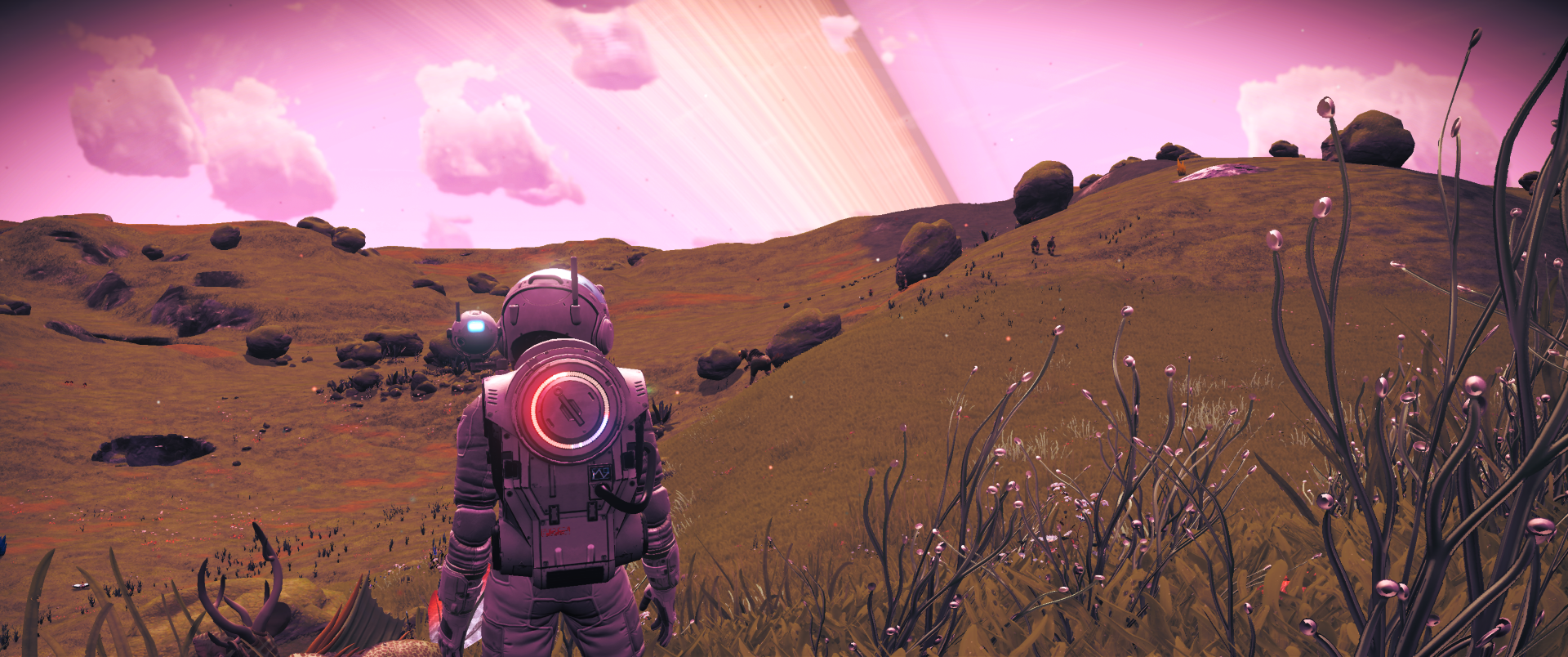
Graphically, No Man’s Sky is a love letter to 1970s- and 1980s-era science fiction art. Those artists portrayed landscapes with recognizable terrain and creatures with recognizable limbs but in alien colours or orientations. No Man’s Sky harks back to the endless potential and wonder these artists captured, looking at the universe through nostalgia-coloured glasses.

A ring over a paradise planet in No Man’s Sky. This screenshot shows the beauty that Hello Games promised in 2016 but took a few more years to deliver. Captured by the author.
No Man’s Sky uses bioluminescence not just to allow the player to see at night but to create beautiful grass seas with luminescent waves. Captured by the author.
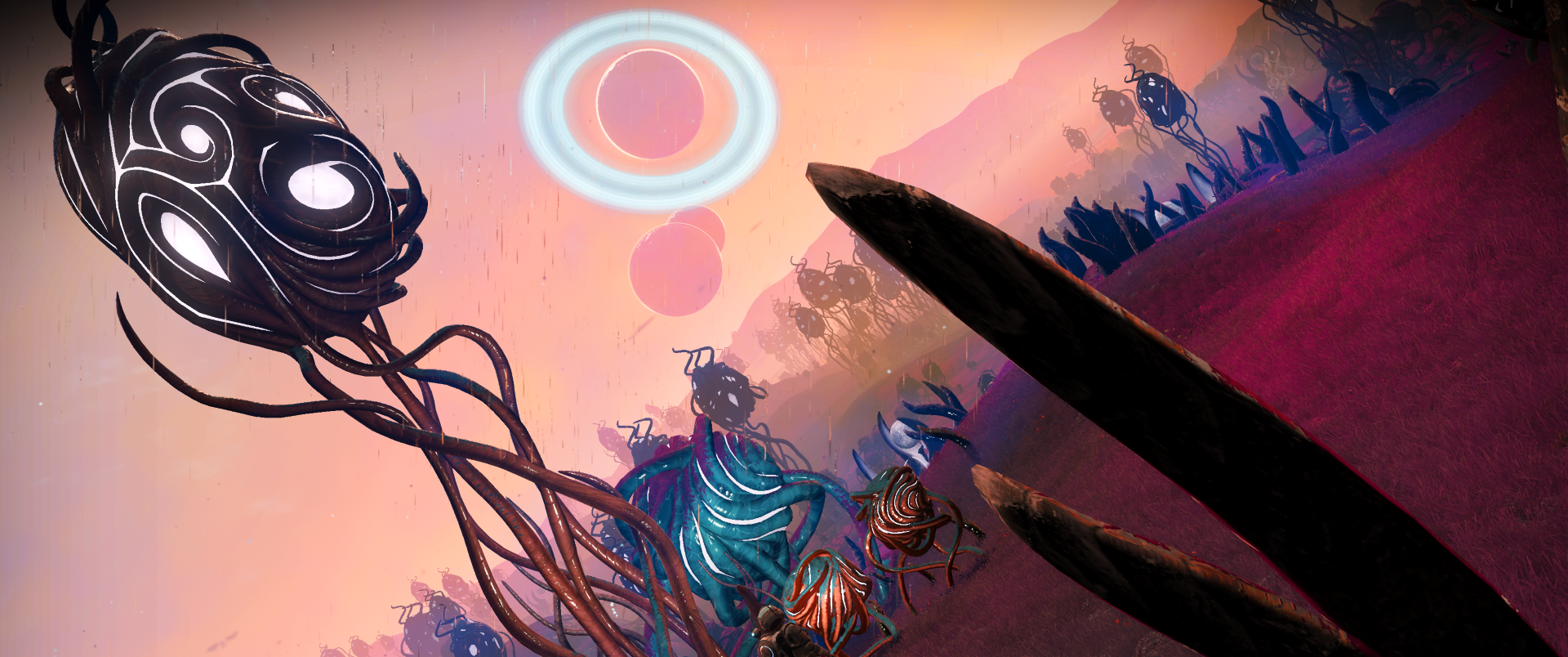
No Man’s Sky is also home to the bizarre, like the Giger-esque hive worlds. Some planets, like this one, use extreme palettes, emphasizing their alienness. Captured by the author.

All players share the same universe. However, it is a vast universe, so the chance of meeting another player outside the Anomaly (the central quest hub) or your friend list is remote. PVP combat is by mutual consent only. You can play offline but lose the ability to claim credit for first discoveries or interact with other players.

No Man’s Sky favours accessibility over challenge. For example, its space flight and combat are arcade-like and lack the atmospheric handling of flight simulators or Newtonian handling of more realistic space simulators. Ships have different inherent strengths and are upgradable, but the process lacks the depth and specialization found in other games. No Man’s Sky‘s simplistic trading uses static economies and routes. Landing and docking are automated.

Realism is out the window. Procedural generation sometimes produces gravity-defying floating rocks or improbable creatures. Planets do not orbit their stars. They are often close enough for their gravities to cause horrendous damage and collisions. The game’s chemistry is more comparable to alchemy than real-world chemistry, allowing easy conversion of one element to another or liquid water at high or low temperatures.

Neither of these are oversights. No Man’s Sky does not want to be a gritty, “realistic” universe like in Elite Dangerous, Eve Online or Star Citizen. It is not the game for those looking for complex ship outfitting, pouring over spreadsheets maximizing trade profit, elaborate joystick and HOTAS setups or ruthless PVP. 

Instead, Hello Games designed away anything distracting from the almost meditative play. They created a game where losing hours to the self-expressive joy of building bases or the “sense pleasure” of seeing the sunrise on yet another verdant or desolate world is easy. Internal consistency and beautifully varied landscapes are what matter.

While survival and permadeath modes are available to those looking for a greater challenge, No Man’s Sky also offers expeditions. These temporary game modes increase the difficulty and provide different main quests. They feel different enough to be novel without losing familiarity, keep experienced players engaged and give unique rewards.

The most significant criticism of No Man’s Sky is that, while Hello Games has worked hard in the last six years on survival and crafting mechanics, it is still a procedural generation engine looking for a game. The designers could have shrunk No Man’s Sky into several dozen unique planets spread across a few solar systems. This choice would expose all planet types while satisfying the limited curiosity of most players.

Meanwhile, No Man’s Sky wants to be a live-service game – an ongoing online entertainment service – but it lacks end game mechanics beyond intrinsic exploration or social interaction. It degenerates into daily or periodic quests once the shallow main quest line is complete. Some game loops also deteriorate into grinding. If you want to upgrade your freighter or find that perfect-looking ship, you must keep retrying until you fluke the right one. 

However, despite offering no paid expansions, Hello Games continues to expand the game with new features, including regular expeditions. They do so more frequently than comparable games like Elite Dangerous or Star Citizen. Along with the more casual appeal, these draw in a large and growing audience that loves No Man’s Sky

The name No Man’s Sky is a play on “No Man’s Land”, the unexplored part of old maps where no kingdom or empire holds sway. No Man’s Sky presents a universe full of the unknown, ready for players to explore but much safer than the early European explorers found it.

Those looking to satiate curiosity and meditative “sense pleasure” from exploration and self-expression from building bases will enjoy No Man’s Sky. You can finish the main quest in a few tens of hours, but the game will capture your imagination for much longer.

No Man’s Sky‘s low challenge also appeals to a broader audience and may help introduce new players to the space simulation genre. It is a welcome change to one often dominated by hardcore players and niche games. 

“Obi-Wan Kenobi” Review

Obi-Wan Kenobi is the latest Star Wars series streaming on Disney+ in their seemingly unending desire to explore the edges of Star Wars characters and canon. It follows the fan-favourite Obi-Wan Kenobi ten years after Revenge of the Sith, covering events between it and A New Hope.

The series starts with Obi-Wan watching over a young Luke Skywalker on Tatooine and a young Leia chaffing against the life of a princess on Alderaan. While Obi-Wan’s life appears necessarily humble to avoid drawing attention to Luke, Obi-Wan’s dreary routine is more a penance as he hides from his responsibilities and abandons others in distress. Still driven by revenge, Anakin Skywalker/Darth Vader orders his Sith inquisitors to kidnap Leia to draw Obi-Wan out from hiding. Bound by duty, Obi-Wan hesitantly embarks on a rescue.

The series focuses on two main characters: Obi-Wan Kenobi and Reva, one of the inquisitors. We know Obi-Wan, Darth Vader and Leia survive, so the drama focuses on interactions and character development.

Obi-Wan follows the well-trodden path of the “hero’s journey”. Initially reluctant, he battles his self-righteous guilt at Anakin’s downfall and the inquisitors. Obi-Wan rebuilds himself and reconnects with the Force while rescuing Leia and confronting his past, namely the scene-stealing Darth Vader.

Obi-Wan spends much time with the adolescent Leia, an unexpected but welcome introduction of naive kindness, childish stubbornness and adolescent bravado that blossoms into true courage and resolve at the series end. Her lines and acting are excellent, particularly the quiet, tender moments between her and Obi-Wan.

Reva has a more nuanced and subtle storyline. Initially, she is rebellious and attention-demanding like a whiney teenager, as a colleague put it. Reva’s defiant successes make her feared by the Jedi but ridiculed by her fellow inquisitors. 

Unfortunately, Obi-Wan Kenobi (the series) gets bogged down in its middle episodes. The series needed to either spend more time developing secondary characters and the setting or skip them. The Path, saving the now hunted Jedi, or Haja Estree, a lovable conman with a heart of gold, deserved more screen time, but perhaps these are for future series.

Similarly, the shaky camera focuses too close to the characters during action sequences like in the Fortress Inquistories and on Jabiim. It increases the emotional intensity but loses perspective and, therefore, cause and effect. People shooting blasters or waving lightsabers seemingly randomly is less compelling and credible.

However, the climactic lightsaber duels with Anakin Skywalker/Darth Vader are Star Wars at its best. The choreography is distinctly different from the stilted awkwardness of the original trilogy and the energetic and frantic fights of the second trilogy. 

Like the Japanese mythos that inspired it, lightsaber fights in Star Wars have always been personal battles of wisdom and focus, not just martial. The first duel between a timid, shattered Obi-Wan and vengeful Darth Vader shows Vader terrorizing, dominating and torturing. Darth Vader’s battle with Reva demonstrates how vastly he outmatches the tunnel-visioned Reva, toying with her like a cat with its prey. The flashback to the training fight between Anakin and Obi-Wan during Part V is a compelling allegory that Star Wars should use more.

The final confrontation is the series’ crux and emotional pay-off. Similar to the moment in Return of the Jedi where Luke refuses to fight Vader until Vader threatens Leia, Obi-Wan’s desire to protect finally empowers him.

The image of Anakin’s scarred but recognizable face beneath the shattered mask of Darth Vader, as he alternates between James Earl Jones’ distinctive voice as Darth Vader and the more human voice of Anakin, is horrifying and sympathetic. It personifies the battle within Vader that Anakin lost.

However, despite the satisfying gravitas, one wonders whether these events were better left to headcanon. Was this moment different to the one people expected or imagined? Does every character and moment in Star Wars need a different series and detailed explanation?

Similarly, much of Disney’s Star Wars seems to orbit the Skywalkers, fuelled partially by the current fixation on nostalgia. However, Star Wars has many more stories to tell. Reva, for example, presents a fascinating character for future development.

Many were ready to dismiss Obi-Wan Kenobi (the series). The need to unrealistically break the previously resilient Obi-Wan to give him character development, Reva’s annoying early character flaws and the slow middle threatened to render this series a profit-driven vanity project. However, the last two episodes provide the emotional punch, plot twists and satisfying albeit predictable resolution that the series and franchise deserve and fans craved. Hopefully, it will springboard new and varied stories set in the Star Wars universe.

“No Man’s Sky” Leviathan Expedition Review: The Surprising Success of Challenge

No Man’s Sky, the survival crafting game developed by Hello Games set in a colourful, massive and procedurally-generated universe, has been around for many years. It is long enough for many to have completed its main storyline and fully explored its mechanics.

However, this is where “expeditions” come in. An expedition is a free, temporary game mode with a new storyline with altered mechanics. It is like playing a modded version of the game but with full support from the developer and only available for a limited time.

The current and seventh expedition, “Leviathan”, has five phases, each comprising eight goals. Some goals are story-focused, usually travelling to a point on a planet or using a crafted item. Some are mechanical, like collecting rare items, acquiring a pet or clearing a derelict freighter. A few are community-based and repeatable, encouraging players to help everyone. 

Unlike the regular game, this expedition is rogue-like, meaning you start anew each time you die. You lose inventory, bases and upgrades. However, you can recover unlocked phases and goals, or “memories”, after restarting. Death is more a setback than a reset. 

Leviathan uses survival mechanics. It limits your item stack space per inventory slot. Base building components require more salvaged data to unlock.

Leviathan is challenging. Most quest planets have dangerous conditions, mountainous terrain and aggressive sentinels. Pirate attacks are frequent when flying. Thankfully, completed goals give you the needed tools, such as a Minotaur exosuit and weapon upgrades, but you need the knowledge to use them or risk returning to the expedition’s start.

Progression is faster. Completed phases give copious new slots and almost overpowered upgrades. For example, I had multiple +10,000% scan bonus upgrades, meaning I earned millions of units for scanning one planet’s fauna, flora and wildlife.

These rule changes and restrictions focus the player toward the expedition goals and core mechanics of exploration and travel, not on the ancillary mechanics like base building. It opposed my usual playstyle of relaxed exploration, gathering, hoarding and occasional quest advancement, but it was a refreshing tone shift once I twigged.

The increased challenge is unusual for No Man’s Sky. For example, you can dogfight by pressing two keys: brake and fire. However, this expedition’s difficulty works because the rogue-like death mechanics are otherwise impotent. The expedition is aimed at a limited audience, looking for trophies, and not the broader, more casual player base.

Leviathan’s storyline examines themes of existentialism and the cyclical nature of existence. Story has never been No Man’s Sky‘s focus. However, it integrates well into the mechanics, reinforcing each other, and is consistent with the regular version of No Man’s Sky‘s storyline.

Expeditions like Leviathan invigorate No Man’s Sky, giving players something familiar yet novel. I tried out new weapons and upgrades and cleared a derelict freighter for the first time. Starting again with experienced eyes, accelerated progression and a different purpose is motivating and fun. 

Beyond cosmetics, the reward for successful completion is a biological frigate for your freighter, the titular “Leviathan”. The community goals also encourage people to hang around, building a feeling of community.

No Man’s Sky‘s Leviathan expedition takes about fifteen hours to complete without external assistance, although a few goals may take longer if you are unlucky or unobservant. Old hands will find it rewarding. New players may find its challenges and rogue-like aspects unforgiving.

However, the best thing about expeditions is Hello Games’ continued experimentation, potentially leading to new game features. It also shows that Hello Games can keep delivering frequent, high-quality content for a six year old game without paid DLC. Like many of the No Man’s Sky‘s planets, Hello Games is almost unique. Let’s hope it stays that way.

Why “The Mandalorian” Eclipses “The Book of Boba Fett”

The Book of Boba Fett follows the titular bounty hunter after The Mandalorian‘s second season. While fans will enjoy the Star Wars references, the series fails to reach the same heights as its predecessor.

The early episodes simultaneously tell two stories of Boba Fett trying to assert his new position as Daimyo amidst the turbulent criminal underworld of Tatooine and his escape from the sarlacc following Return of the Jedi.

The former story in the early episodes is more character- and scene-setting, reminding the audience of Boba taking over the throne once held by Jabba the Hutt on Tatooine. He saves Fennec Shand, who becomes his henchman and trusted confidant, and sets up the battle for the city of Mos Espa as the series’ central conflict.

The second story in the early episodes is more interesting, portraying Boba Fett’s messianic transformation as he escapes the Sarlacc pit, loses his armour, is rescued by Tuskan raiders then finds that saving others leads to acceptance and community. Amidst flashbacks of this father abandoning him on Kaminoa, he transforms from the ruthless bounty hunter seen in the original movies to someone that wants to free “his people” from the criminal warlords that rule Tatooine.

Unfortunately, this transformation is unconvincing. Boba’s past antagonistic actions, such as capturing Han Solo, and unsympathetic stoicism make it a hard sell. Even the symbolism of Cad Bane’s death, representing the end of the bounty hunter in Boba, lacks any credible build-up from earlier episodes.

The Book of Boba Fett is at its best when political complexities confront Boba. The slimy Mayor hiring assassins to kill Boba, talking his way out of it then double-crossing Boba again shows credible intelligence and cunning. The Pykes’ betrayal shows how ruthless and uncaring Boba’s opponents are.

However, the series often oversimplifies complex issues, making their plot points less credible. While Star Wars‘ fights have always been metaphors, the series assumes a 1930’s Batman-style naivety that Boba Fett can solve crime and poverty by eliminating all the bad guys. Enemies shown mercy suddenly and unrealistically become unshakably loyal, like Gamorrean guards, Krrsantan and the hoverbikers.

The series squanders chances at character development or insightful conflict. For example, Fennec Shand could have genuinely chaffed against Boba’s new, more benevolent direction, embodying the contrast with the unforgiving ways of a bounty hunter. Boba’s enemies could have offered her a considerable incentive to betray him, driving tension to the decisive moment. Instead, the character serves merely as a competent fighter and source of exposition. 

The Book of Boba Fett compares unfavourably with its predecessor, The Mandalorian.

Djin-Darin, the main character from The Mandalorian, is more sympathetic than Boba Fett. Both are armoured orphans. However, Djin-Darin’s armour hid his mysterious identity, while Boba’s was merely a tool. Djin-Darin battled for acceptance against a seemingly unfair creed, a code of honour that Boba lacked.

Both series deal with the noble theme of protecting the less fortunate. The Mandalorian brought that to the cute and relatable Grogu, a triumph of character design that appealed to parental instincts and fans longing for more Yoda. The Book of Boba Fett dealt with protecting the more nebulous and poorly supported “my people”. Thankfully, it avoided the “white saviour” trope with the Tuskan tribe, albeit under tragic circumstances.

Each series borrowed inspiration from different genres. The Mandalorian was like a Western or Japanese samurai movie, with a lone, honourable gunman/samurai wandering from town to town fleeing a tragic past. The Book of Boba Fett felt almost more cyberpunk, examining economic and technological inequality amongst powerful, mysterious criminal cartels in an urban environment. 

The Book of Boba Fett‘s hoverbikers are good examples of cyberpunk impinging on the Star Wars universe. The bikers’ deliberate and overt augmentation and brightly coloured bikes feel pulled from cyberpunk. However, the bikes feel out of place amongst the grungy, rusting, third-hand technology seen elsewhere. Cybernetics has long been canon but it has been a metaphor for trauma, like Luke’s hand or Darth Vader’s suit.

Structurally, The Book of Boba Fett is an interlude between seasons two and three of The Mandalorian. The series finishes the Boba Fett subplot introduced in season two. The short but vital subplots reuniting Djin-Djarin and Grogu ensure The Mandalorian can continue as before. 

There are many obscure references for Star Wars fans. They will like the Tuskan anthropology, a Wookie wrenching an arm off a Trandoshan in a cantina, Bantha riding, a rampaging Rancor, more Hutts and Luke building his Jedi school.

The special effects are also fantastic, like in The Mandalorian. Luke’s lifelike recreation shows how far special effects have progressed from the later Star Wars movies. 

The Book of Boba Fett is a fun romp through Tatooine, riffing on the edges of Star Wars canon. However, the series tries to fit too much into a short season. More character development and extending more plots between different episodes would have given it the credibility, heart and sympathy that its predecessor enjoyed.