The Art of Video Game Screenshots

Have you ever watched a movie or TV show and wanted to pause and marvel at a scene? It may be beautiful, showing off an artful mix of colour and design. It may be complex, requiring time to appreciate the detail. It may capture a moment that creates strong feelings or thoughts.

I love taking screenshots in video games. Not all video game graphics are lifelike or realistic, but even retro or pixel graphics have their beauty, such as the screenshot from Cloudpunk below. The definition of “realistic” also decays as each new generation of hardware increases fidelity.
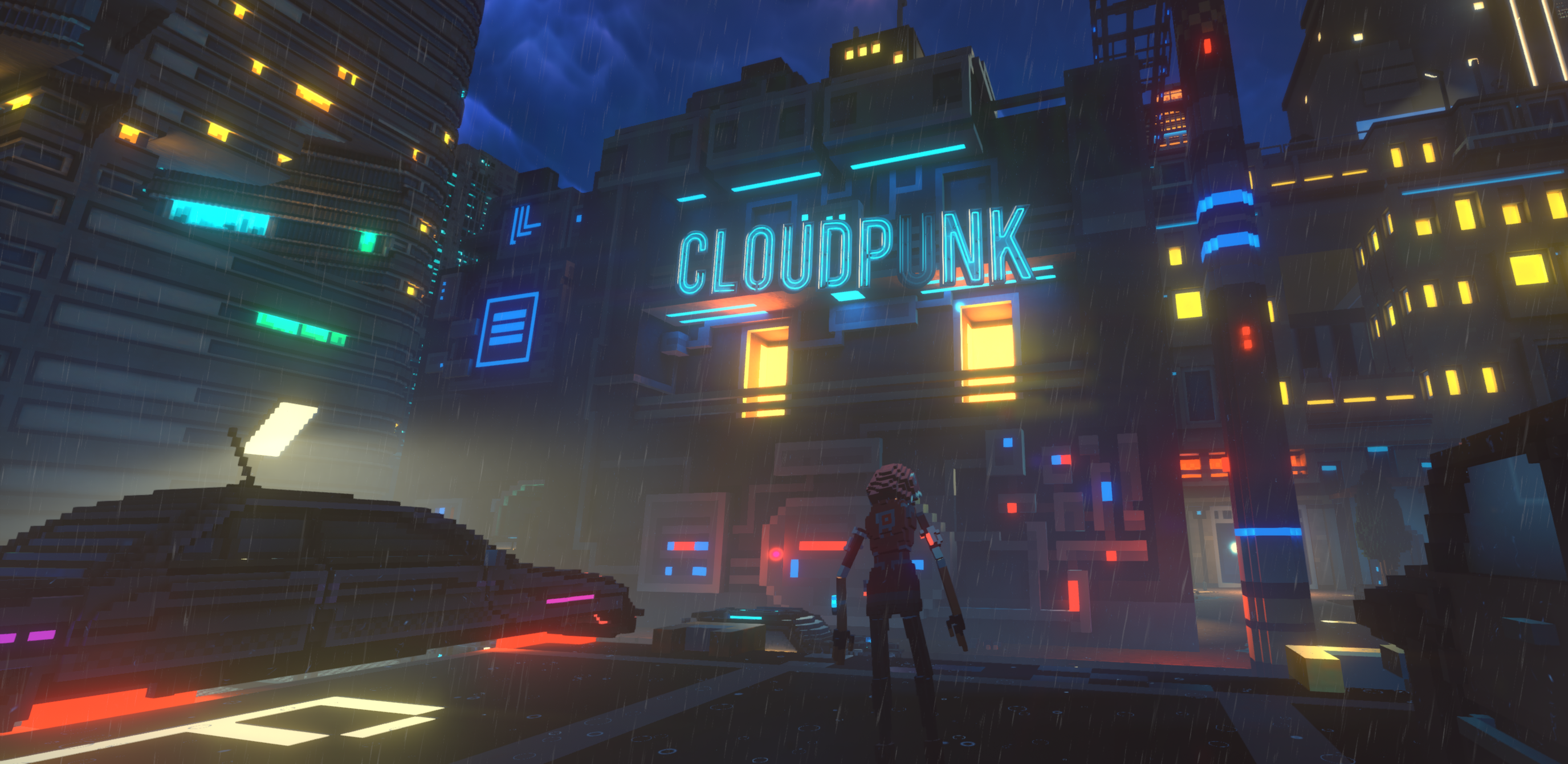
Even Cloudpunk‘s voxel-based graphics are beautiful

Why take screenshots? I enjoy it. Arranging a good scene and admiring it as a screenshot is fun. This admiration is called “sense-pleasure”, a term coined in the original Mechanics-Dynamics-Aesthetics game design framework. Some game developers have screenshot competitions and communities. Winning is fun, as is sharing a common interest. Trying to take good screenshots also allows me to appreciate the effort developers put into games, looking at games and visual media through different eyes.

Taking good screenshots is simple: play games, take lots of screenshots, review them, decide which ones are the best, try to get more of those, and repeat.

That leaves two questions. The first is “Which games should I take screenshots from?” The second is “What makes a screenshot good?”

The answer to the first question is also simple: play whatever games you enjoy. That said, some platforms, such as PCs, and game types, like 3D open-world games, are more conducive to taking beautiful screenshots. High-end PCs have higher resolutions and are capable of better graphics. The developers of 3D open-world or similarly expansive games often create visually appealing worlds. 

Some graphics capabilities require special attention. Virtual Reality (VR) and Augmented Reality (AR) are more of an experience, something a static screenshot cannot capture. Screenshots from High Dynamic Range (HDR) displays are often too bright, at least in non-HDR file formats.

Screenshots of glitches, memes or schadenfreude are often spontaneous. These can be fun. They have their place. However, these tend to be unpredictable and their popularity fleeting.

Answering the second question, “What makes a screenshot good,” is more difficult. Someone with art training could write volumes on what makes a good painting or scene. However, some general advice I found helpful follows.

The human eye is usually drawn to specific places when playing a game. Players have fractions of a second to decode a busy scene and determine what to do next. The game designer wants to emphasize where to go next or the boss’s weak points.
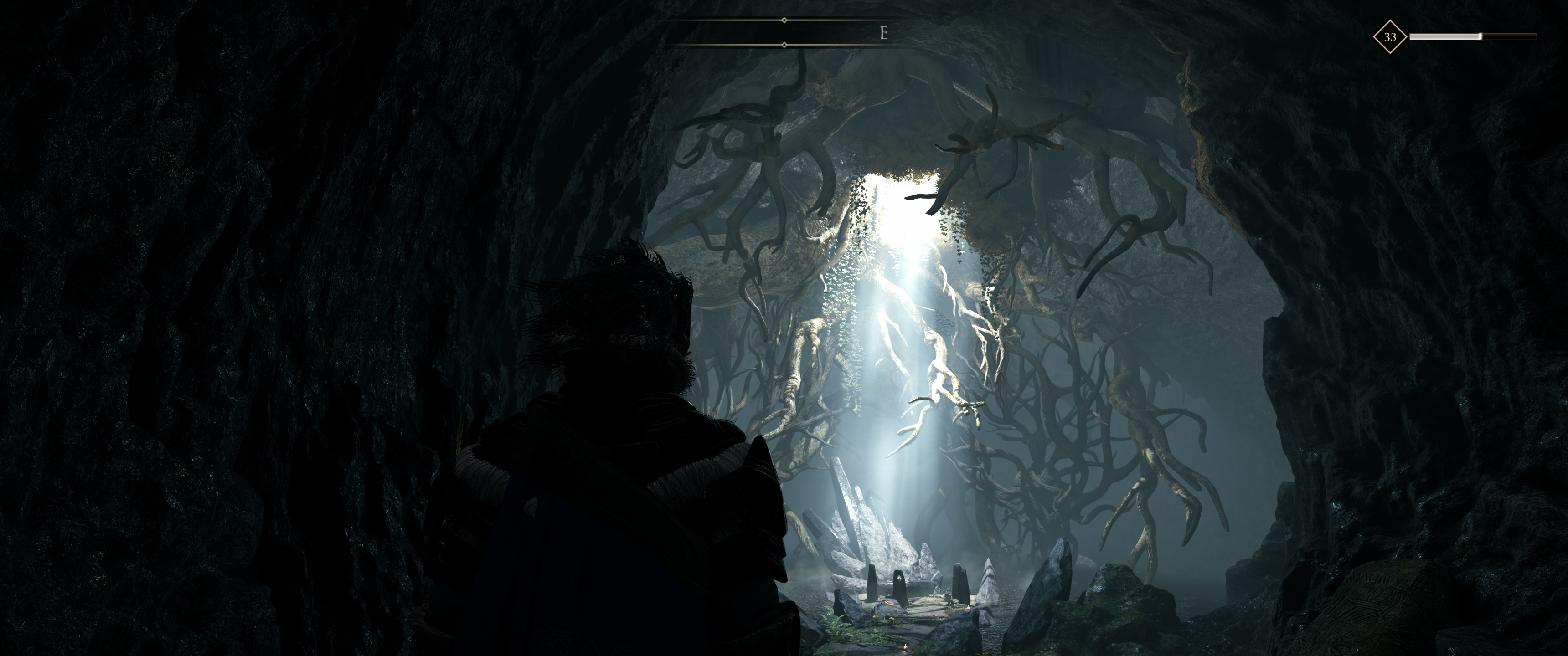
An underground cave from Greedfall

The above screenshot from Greedfall shows how the developer can unsubtly force the eye to focus somewhere. The light filtering from above among the dangling roots directs the player while hinting at this place’s history and significance.

However, the human eye can take its time to appreciate a screenshot. Treat each screenshot as a diorama. People view a screenshot holistically, like a painting. Arrange interesting things around the image or, if there is a single focus, ensure it is unique or intriguing enough to hold attention.
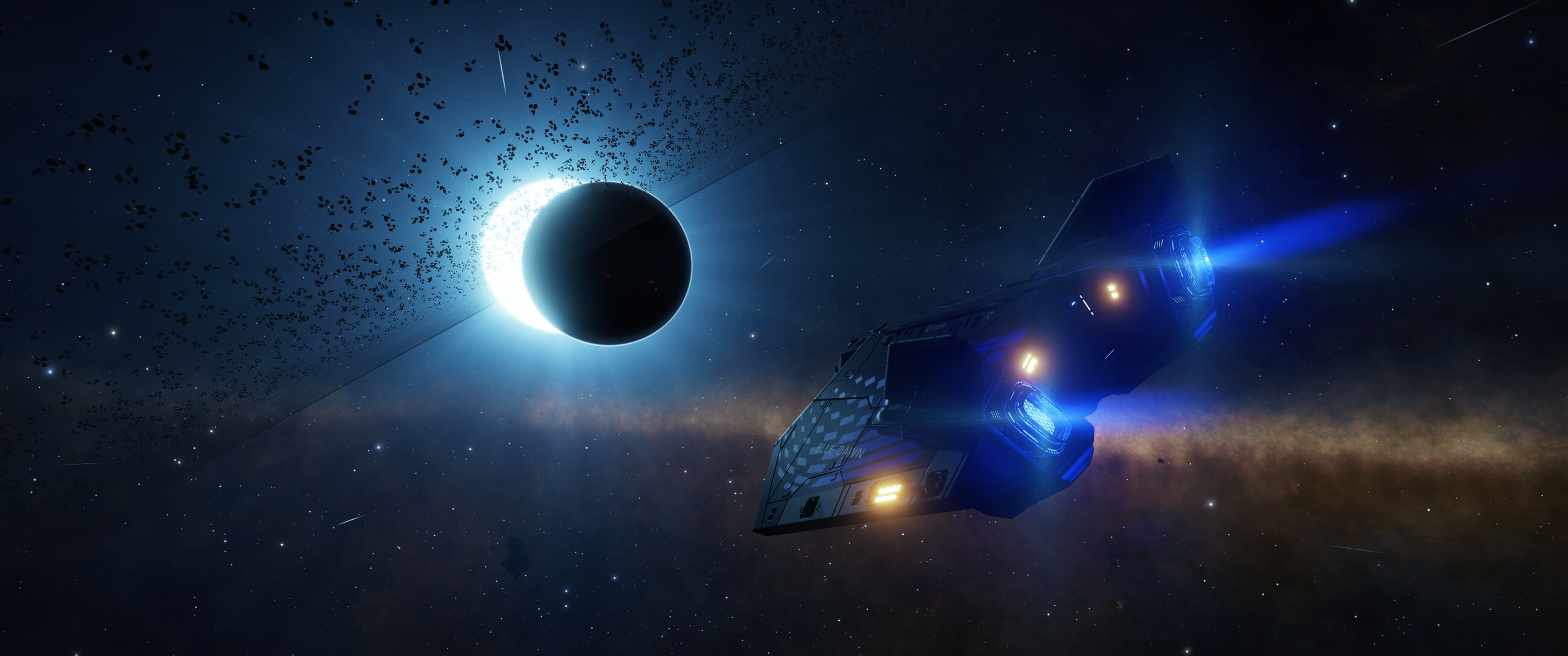
An Asp Explorer (spaceship) from Elite Dangerous

This screenshot shows a beautiful fusion of elements. The blue exhaust from the Asp Explorer (spaceship) heading towards the ringed planet matches the light of the eclipsed blue-white star. The edge of the Milky Way galaxy shows behind. This fills the image, meaning there is something interesting to look at everywhere.

Night City from Cyperpunk 2077

This screenshot shows the busy Night City skyline from Cyperpunk 2077. There is so much detail that it takes time to parse. What initially could pass for any modern metropolis is quickly dashed by the ascending holograms and unfamiliar advertising.

A Krait Phantom (spaceship) flying between a planet and its moon in Elite Dangerous

Another example from Elite Dangerous is above. Elite Dangerous‘ planet generation is fantastically detailed, and the colour contrast reflecting off the Krait Phantom’s mirrored hull looks wonderful. The distortion from the engine exhaust gives it that extra touch of realism and adds momentum.

Looking at the planet’s star through its rings in Elite Dangerous

While stark and beautiful, the lack of something interesting in the foreground in the above image gives the feeling something is missing or incomplete.

The best screenshots are not always from the most action-filled or detailed scenes. Screenshots omit many elements of game interaction, reminding us of what the screenshot lacks. There is no movement or action. There is no music, sound effects or story. The hardware sometimes limits the graphical fidelity. A screenshot can expose low polygon models and blurred textures.

An alien machine from Elite Dangerous

If you have a central focus, viewing it from a slight angle gives it a more natural appearance. It shows more detail from the side or top. The above screenshot shows the misty, creepy, organic, Gieger-esque internals of a thargoid base from Elite Dangerous. The details of the back pillar would otherwise be obscured if the shot was front-on.

The best screenshots tell a story or evoke emotion without context.

A Scorpion (buggy) exploring a thargoid spire site in Elite Dangerous

For example, zooming back from the Scorpion (buggy) and placing it below the camera’s centre in the screenshot above draws the eye towards the towering thargoid spire above it. The contrasting light between the green cloud to the right and the blue star to the left pleases the eye. This screenshot evokes a sense of alienness, wonder and being alone.
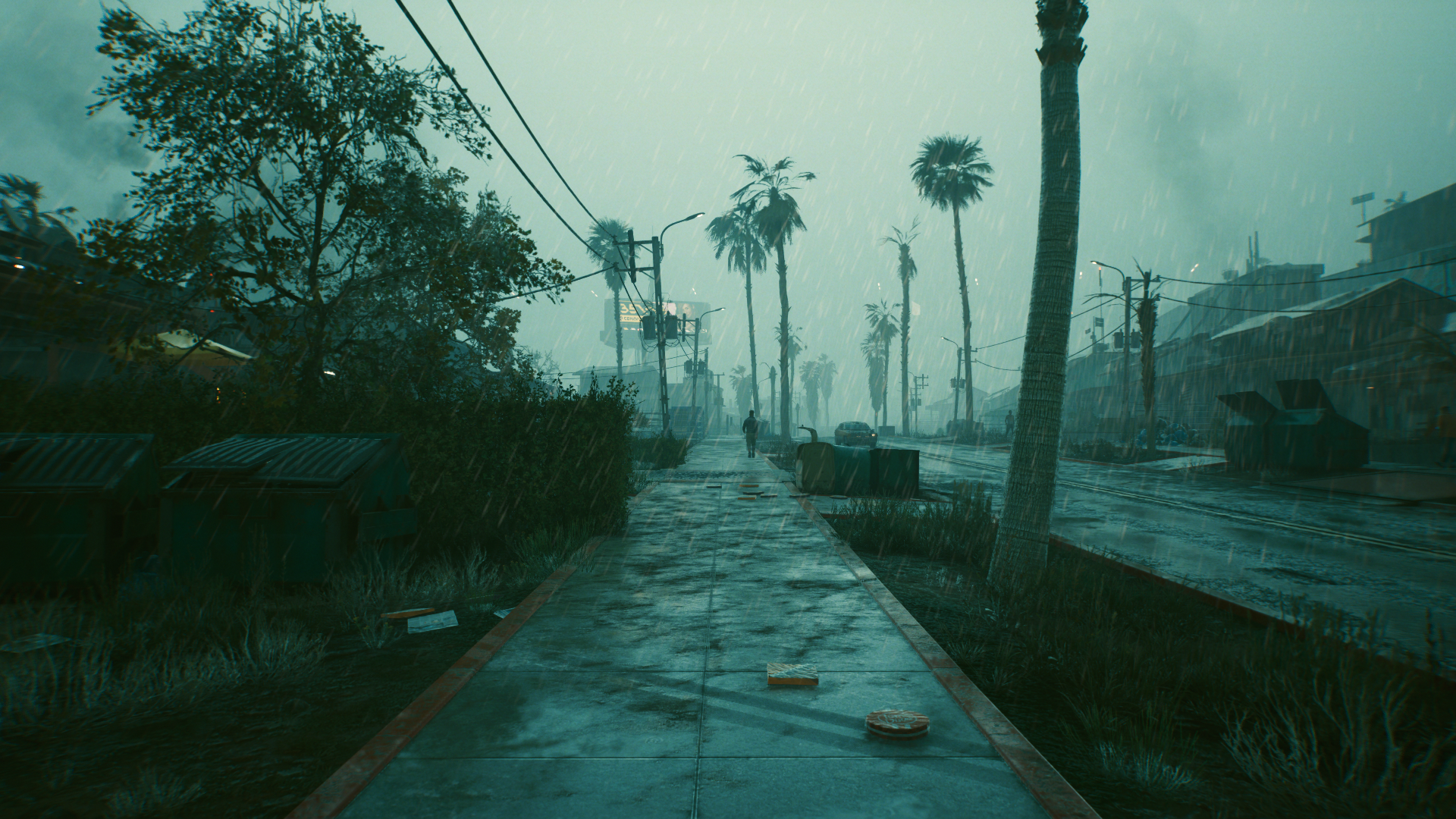
A rain scene from Cyberpunk 2077

Plenty of games have rain. However, the mist, almost monochromatic palette and subtle reflection in the puddles above capture a dreary oppression better than any other I had seen. The dirty footpath and cluttered scene emphasize the worst parts of urban life.

Avoid busy or unclear scenes. The dozens of spell effects hurled at a boss in an MMORPG raid can be impressive. However, parsing the scene can be difficult. 3D scenes rendered in wide aspect ratios, such as 16:9 or 16:10, distort around the edges. Avoid putting essential details there.

Lighting and colours pose unique challenges and opportunities. Overly dark or light scenes can be hard to discern. Contrasting light can be beautiful, as shown in the dull red of the star against the alien structure’s yellow below. Monochromatic scenes can be stark.
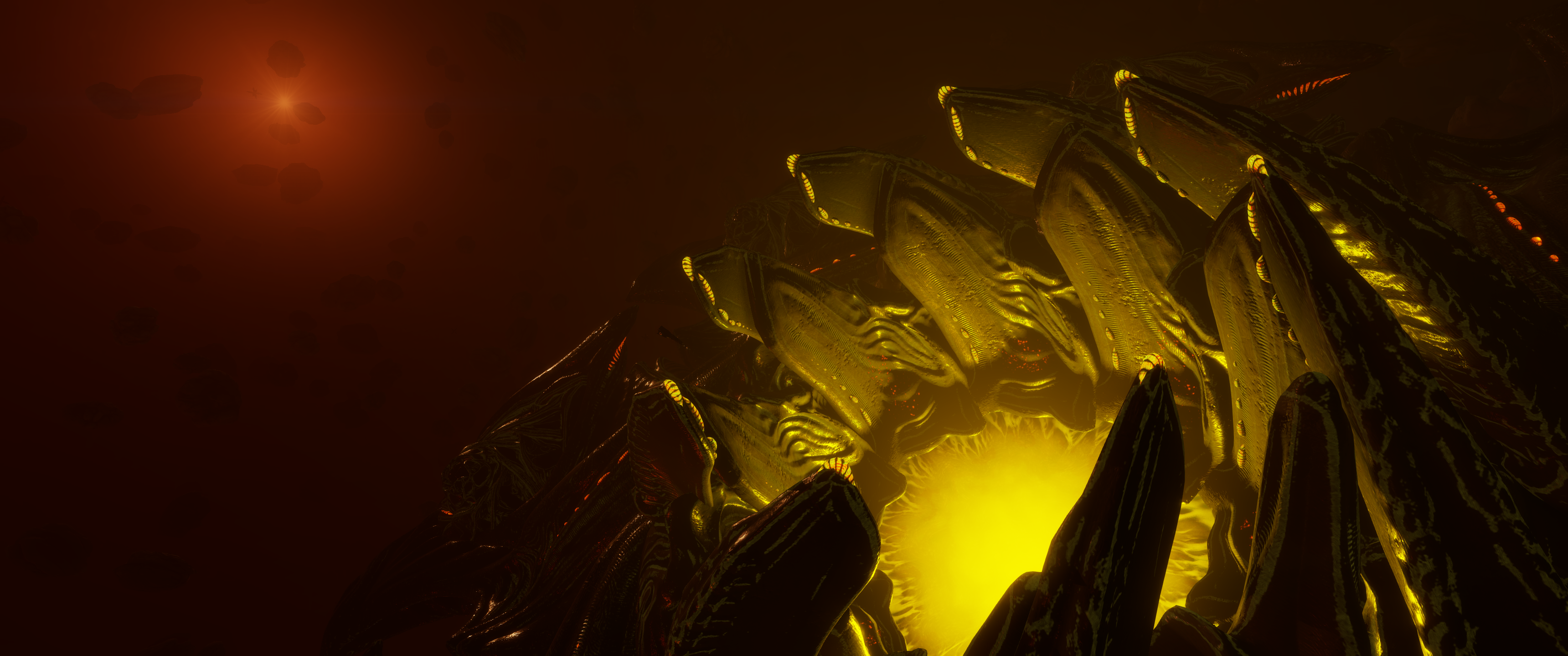
A thargoid titan from Elite Dangerous
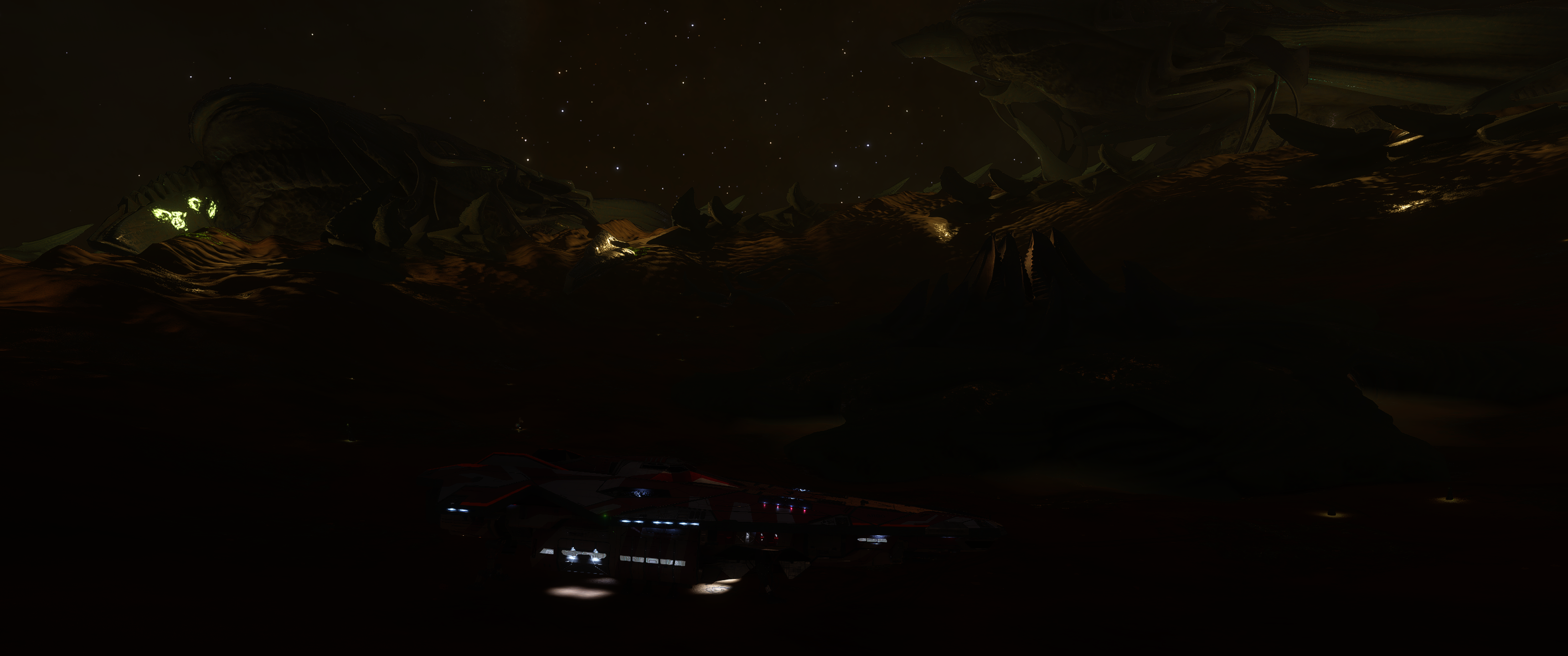
A dark HDR screenshot from Elite Dangerous

While the scene above has a lot of detail, it is too dark. This is a good example of an HDR scene losing too much contrast when rendered in standard displays.

Disable or remove any “heads-up display”, voice chat overlays or similar UI elements. They often distract from the scene unless they are the focus (“I survived at 1% health!”).

Modern games may have photo modes that temporarily use more screenshot-friendly graphics settings and give more camera control. Use these when you can. Controlling the camera angle or adding effects, such as vignettes or filters, can add a lot.

An alien world from No Man’s Sky

Tilting the camera turns the already alien world from No Man’s Sky, above, into something disorienting. The slight vignette helps focus the attention on the centre and adds depth.
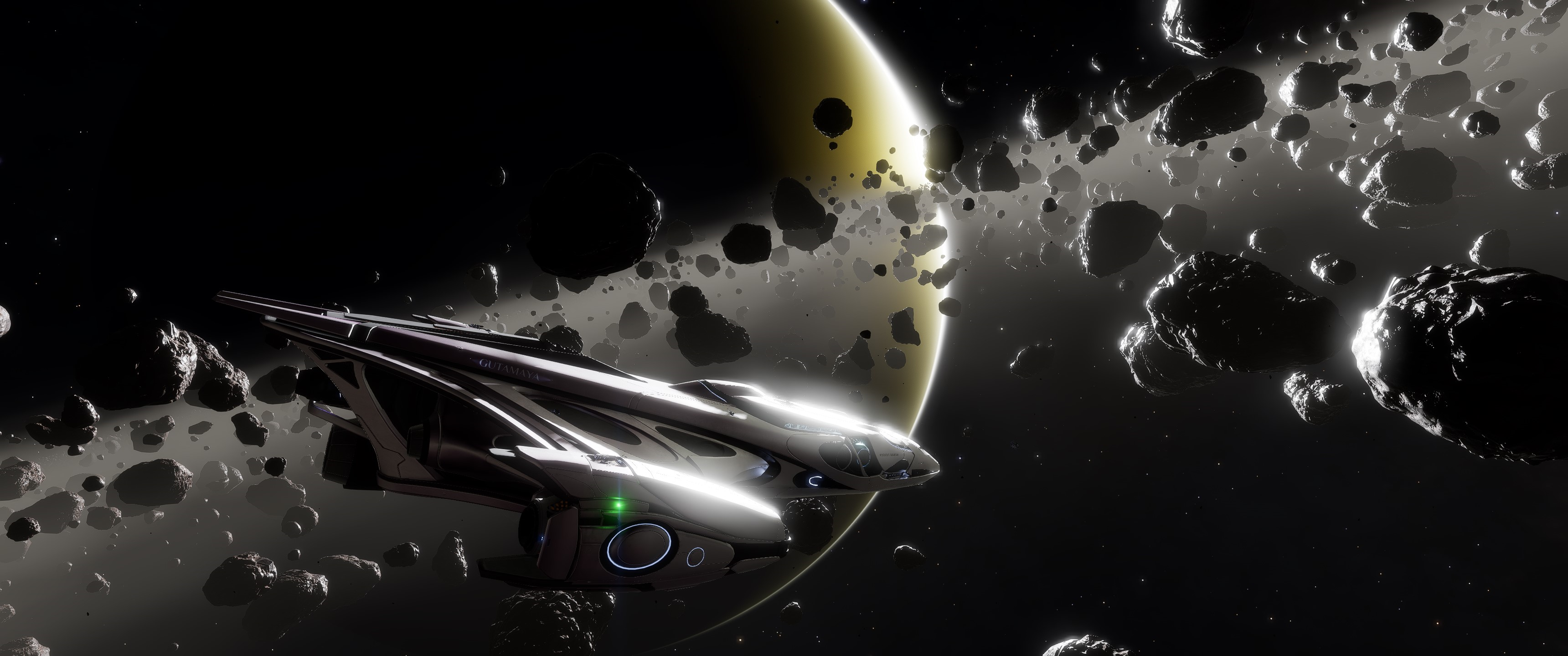
An Imperial Cutter (spaceship) amongst a gas giant’s ring in Elite Dangerous
Looking through asteroids toward a faint, distant star in Elite Dangerous
A thargoid interceptor at a barnacle site in Elite Dangerous

Effects like bloom, light rays, reflection or lens flare turn a scene into something magical, as shown above. If I ever want new backgrounds for my computer’s desktop, Elite Dangerous is a wonderful way of generating them. Unfortunately, players may have to turn effects off to improve frame rates or to run games on low-end graphics hardware.

A traveler admiring the nighttime bioluminescent display from No Man’s Sky
A traveler admiring an eclipse on No Man’s Sky

Sometimes, careful timing and placement are key. This can be as simple as waiting until night in the first screenshot above or finding a lens-flared eclipse’s exact moment and angle in the second.

Be careful of symbolism and logos in games. While these can be meaningful and emotive in games, they often lose context outside that game. Worse, games sometimes use real-world symbols that can offend.

Avoid modifying screenshots after taking them. Highlight the game developers’ artistry, not Adobe Photoshop skills. Modifications are often prohibited if you want to enter screenshots in competitions. However, each game and community will have its own rules.

Many games have “vista moments”, where the player leaves a cramped, narrow area and enters a broader, almost agoraphobia-inducing wider world. If you are looking to start taking screenshots, finding these is a great place to start. The developers often make these look stunning.
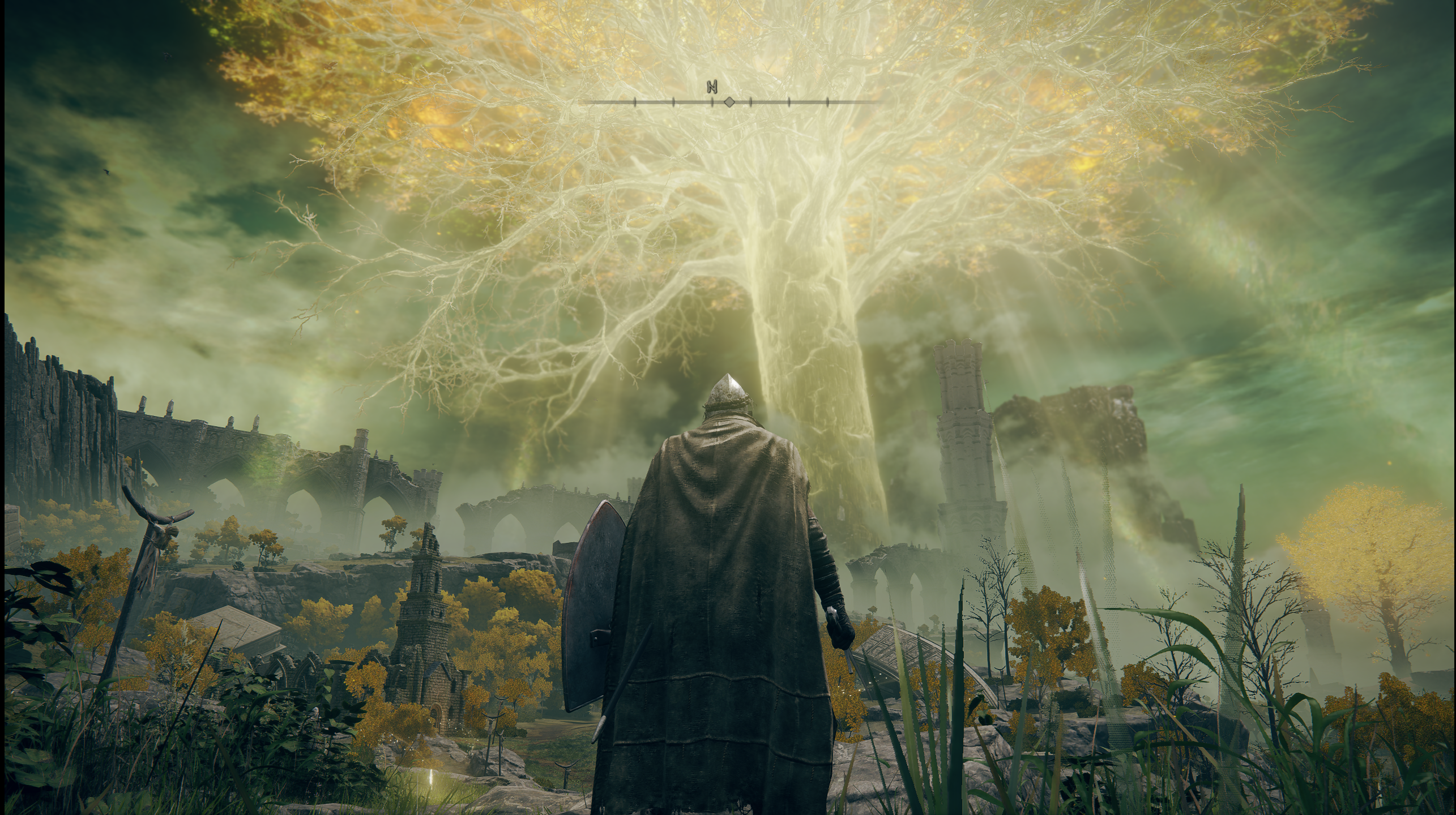
Your first view of the Erdtree in Elden Ring

Your first view of the Erdtree in Elden Ring is a wonderful example of a panoramic “vista moment”, as shown above.
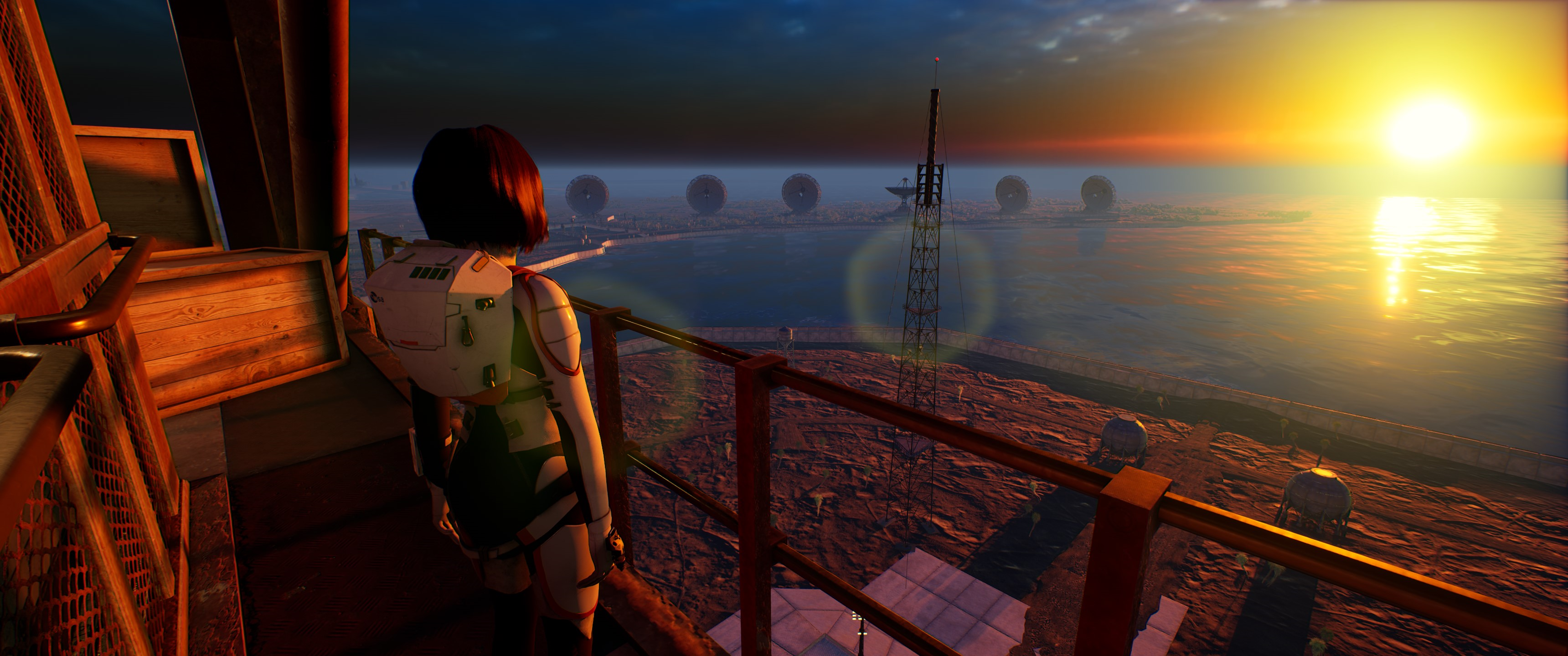
Looking over the water at dusk in Deliver Us Mars

The above scene showing the sun reflecting off the water is a wonderful change from the cramped corridors preceding it. In a setting where the Earth’s environment is collapsing, this reminds you what you are trying to save.

Graphics are arguably the most essential part of video games. While it is possible not to have any significant graphics, e.g. The Vale, video game developers spend much time and resources getting things right that players may only see for a few moments. Taking screenshots both helps share these moments and appreciate the effort and artistry that goes into video game development.

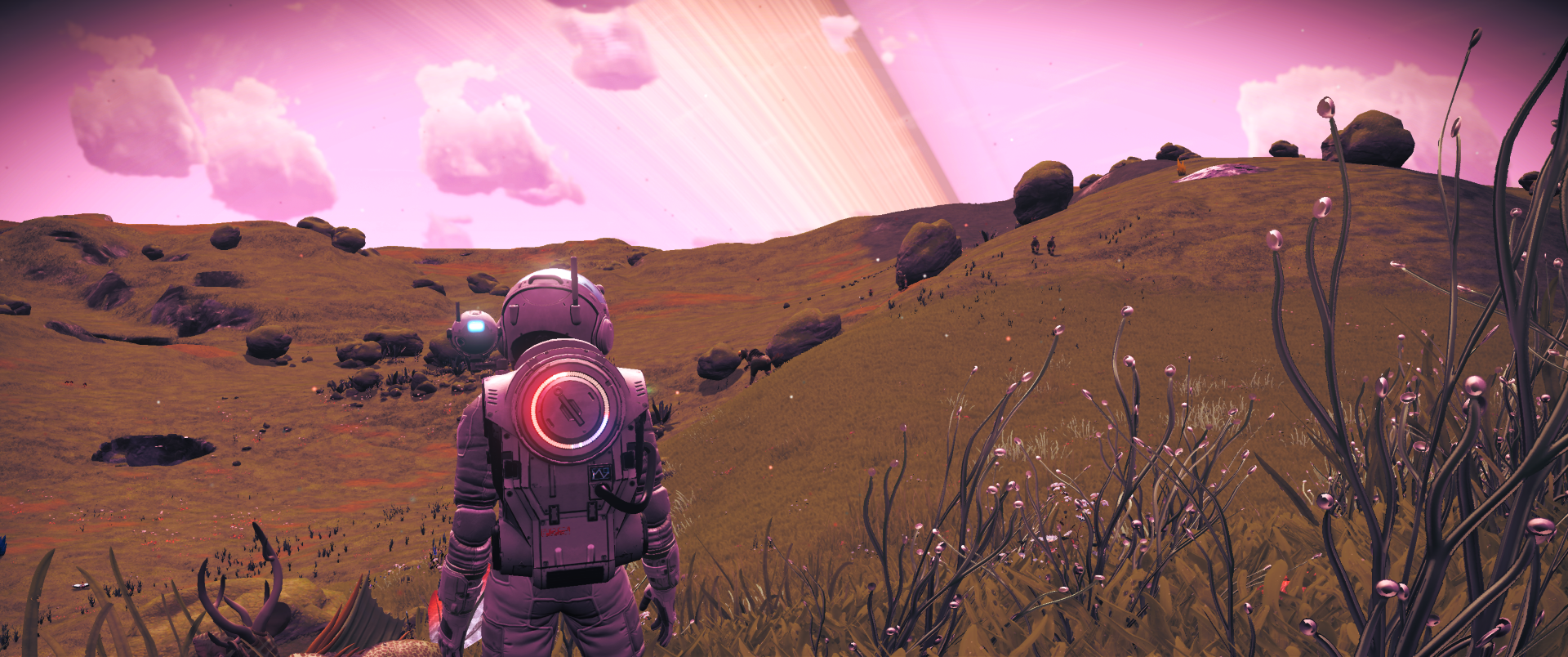
“No Man’s Sky” Review

No Man’s Sky box art

Hello Games initially Kickstarted No Man’s Sky in 2016, promising a vibrant, life-filled universe to explore. Unfortunately, under-delivery led to an initial backlash, but Hello Games has since built it into a worthy and unique game.

No Man’s Sky is an exploration-focused, survival crafting game with space simulation elements, like Astroneer or Subnautica. You play as an unnamed “traveller” who wakes up on an alien planet with a damaged spacecraft and no memory. You initially explore, gather resources then craft things. Crafting first extends survival by refilling oxygen and recharging your exosuit’s components. Eventually, you repair your ship, construct bases and build vehicles to increase your exploration speed and range.

No Man’s Sky includes activities common to space simulation games like ground combat, space combat, piracy and trading. You can adopt, ride and breed pets. The brave can explore derelict freighters. Later in the game, you can also maintain a fleet and periodically send ships on distant missions, build and oversee a town or relax into daily quests for upgrades or cosmetic rewards.

No Man’s Sky provides quests to introduce players to new mechanics and provide context and purpose. The main quest line examines existentialism. However, unlike other survival crafting games, No Man’s Sky treats this solemn theme lightly. For example, the game lacks the conviction of Subnautica’s pacificism and environmentalism or Breathedge’s self-deprecating humour.

What sets No Man’s Sky apart is its massive procedurally generated universe containing quintillions of planets. Procedural generation is not new, but No Man’s Sky‘s scale and beauty are unique. Each planet has a biome (e.g. desert, marsh, paradise, volcanic), which determines the flora, fauna and geology populating it. Some planets have seas and caves, effectively different biomes on the same planet. The player earns credits by scanning specimens and gets a bonus for finding samples of all a planet’s fauna. 

Graphically, No Man’s Sky is a love letter to 1970s- and 1980s-era science fiction art. Those artists portrayed landscapes with recognizable terrain and creatures with recognizable limbs but in alien colours or orientations. No Man’s Sky harks back to the endless potential and wonder these artists captured, looking at the universe through nostalgia-coloured glasses.

A ring over a paradise planet in No Man’s Sky. This screenshot shows the beauty that Hello Games promised in 2016 but took a few more years to deliver. Captured by the author.
No Man’s Sky uses bioluminescence not just to allow the player to see at night but to create beautiful grass seas with luminescent waves. Captured by the author.
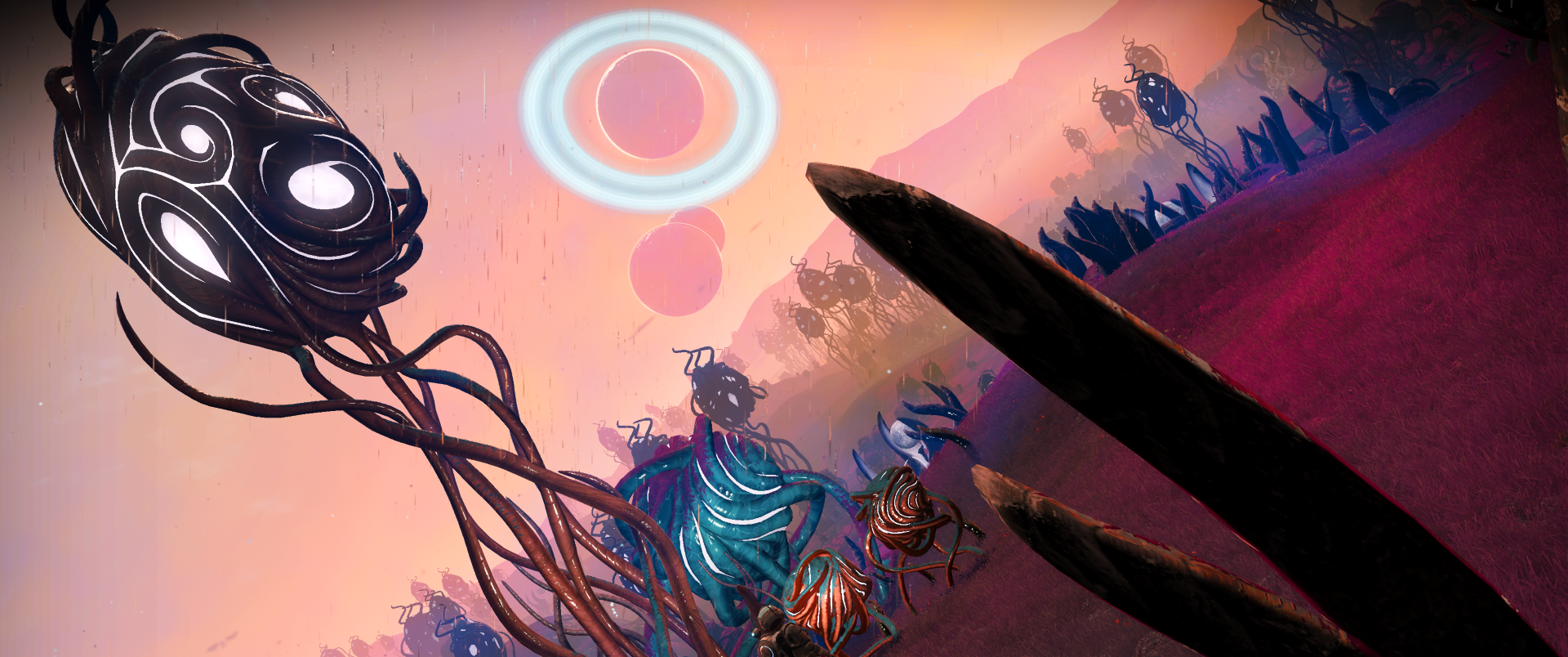
No Man’s Sky is also home to the bizarre, like the Giger-esque hive worlds. Some planets, like this one, use extreme palettes, emphasizing their alienness. Captured by the author.

All players share the same universe. However, it is a vast universe, so the chance of meeting another player outside the Anomaly (the central quest hub) or your friend list is remote. PVP combat is by mutual consent only. You can play offline but lose the ability to claim credit for first discoveries or interact with other players.

No Man’s Sky favours accessibility over challenge. For example, its space flight and combat are arcade-like and lack the atmospheric handling of flight simulators or Newtonian handling of more realistic space simulators. Ships have different inherent strengths and are upgradable, but the process lacks the depth and specialization found in other games. No Man’s Sky‘s simplistic trading uses static economies and routes. Landing and docking are automated.

Realism is out the window. Procedural generation sometimes produces gravity-defying floating rocks or improbable creatures. Planets do not orbit their stars. They are often close enough for their gravities to cause horrendous damage and collisions. The game’s chemistry is more comparable to alchemy than real-world chemistry, allowing easy conversion of one element to another or liquid water at high or low temperatures.

Neither of these are oversights. No Man’s Sky does not want to be a gritty, “realistic” universe like in Elite Dangerous, Eve Online or Star Citizen. It is not the game for those looking for complex ship outfitting, pouring over spreadsheets maximizing trade profit, elaborate joystick and HOTAS setups or ruthless PVP. 

Instead, Hello Games designed away anything distracting from the almost meditative play. They created a game where losing hours to the self-expressive joy of building bases or the “sense pleasure” of seeing the sunrise on yet another verdant or desolate world is easy. Internal consistency and beautifully varied landscapes are what matter.

While survival and permadeath modes are available to those looking for a greater challenge, No Man’s Sky also offers expeditions. These temporary game modes increase the difficulty and provide different main quests. They feel different enough to be novel without losing familiarity, keep experienced players engaged and give unique rewards.

The most significant criticism of No Man’s Sky is that, while Hello Games has worked hard in the last six years on survival and crafting mechanics, it is still a procedural generation engine looking for a game. The designers could have shrunk No Man’s Sky into several dozen unique planets spread across a few solar systems. This choice would expose all planet types while satisfying the limited curiosity of most players.

Meanwhile, No Man’s Sky wants to be a live-service game – an ongoing online entertainment service – but it lacks end game mechanics beyond intrinsic exploration or social interaction. It degenerates into daily or periodic quests once the shallow main quest line is complete. Some game loops also deteriorate into grinding. If you want to upgrade your freighter or find that perfect-looking ship, you must keep retrying until you fluke the right one. 

However, despite offering no paid expansions, Hello Games continues to expand the game with new features, including regular expeditions. They do so more frequently than comparable games like Elite Dangerous or Star Citizen. Along with the more casual appeal, these draw in a large and growing audience that loves No Man’s Sky

The name No Man’s Sky is a play on “No Man’s Land”, the unexplored part of old maps where no kingdom or empire holds sway. No Man’s Sky presents a universe full of the unknown, ready for players to explore but much safer than the early European explorers found it.

Those looking to satiate curiosity and meditative “sense pleasure” from exploration and self-expression from building bases will enjoy No Man’s Sky. You can finish the main quest in a few tens of hours, but the game will capture your imagination for much longer.

No Man’s Sky‘s low challenge also appeals to a broader audience and may help introduce new players to the space simulation genre. It is a welcome change to one often dominated by hardcore players and niche games. 

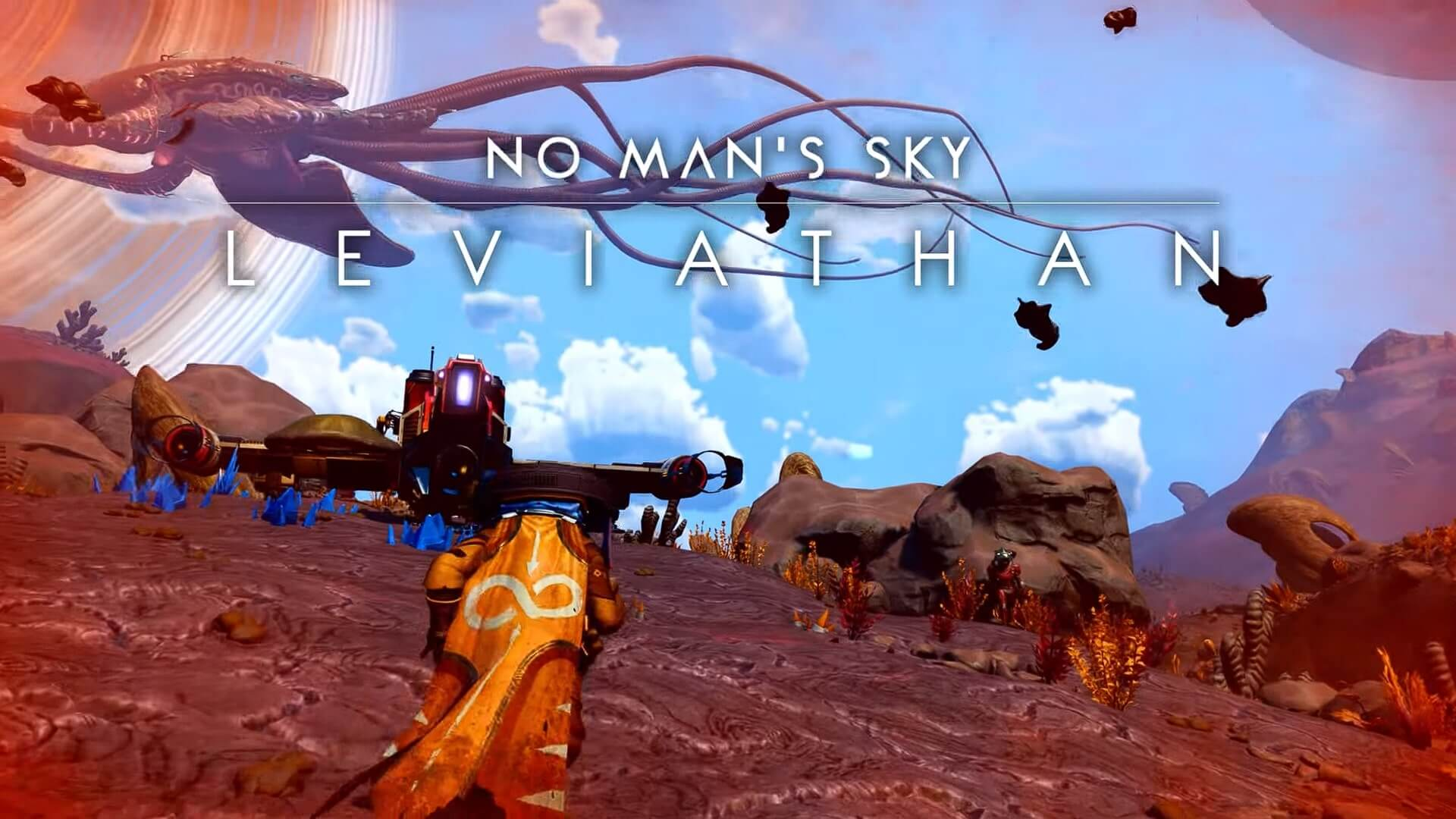
“No Man’s Sky” Leviathan Expedition Review: The Surprising Success of Challenge

No Man’s Sky, the survival crafting game developed by Hello Games set in a colourful, massive and procedurally-generated universe, has been around for many years. It is long enough for many to have completed its main storyline and fully explored its mechanics.

However, this is where “expeditions” come in. An expedition is a free, temporary game mode with a new storyline with altered mechanics. It is like playing a modded version of the game but with full support from the developer and only available for a limited time.

The current and seventh expedition, “Leviathan”, has five phases, each comprising eight goals. Some goals are story-focused, usually travelling to a point on a planet or using a crafted item. Some are mechanical, like collecting rare items, acquiring a pet or clearing a derelict freighter. A few are community-based and repeatable, encouraging players to help everyone. 

Unlike the regular game, this expedition is rogue-like, meaning you start anew each time you die. You lose inventory, bases and upgrades. However, you can recover unlocked phases and goals, or “memories”, after restarting. Death is more a setback than a reset. 

Leviathan uses survival mechanics. It limits your item stack space per inventory slot. Base building components require more salvaged data to unlock.

Leviathan is challenging. Most quest planets have dangerous conditions, mountainous terrain and aggressive sentinels. Pirate attacks are frequent when flying. Thankfully, completed goals give you the needed tools, such as a Minotaur exosuit and weapon upgrades, but you need the knowledge to use them or risk returning to the expedition’s start.

Progression is faster. Completed phases give copious new slots and almost overpowered upgrades. For example, I had multiple +10,000% scan bonus upgrades, meaning I earned millions of units for scanning one planet’s fauna, flora and wildlife.

These rule changes and restrictions focus the player toward the expedition goals and core mechanics of exploration and travel, not on the ancillary mechanics like base building. It opposed my usual playstyle of relaxed exploration, gathering, hoarding and occasional quest advancement, but it was a refreshing tone shift once I twigged.

The increased challenge is unusual for No Man’s Sky. For example, you can dogfight by pressing two keys: brake and fire. However, this expedition’s difficulty works because the rogue-like death mechanics are otherwise impotent. The expedition is aimed at a limited audience, looking for trophies, and not the broader, more casual player base.

Leviathan’s storyline examines themes of existentialism and the cyclical nature of existence. Story has never been No Man’s Sky‘s focus. However, it integrates well into the mechanics, reinforcing each other, and is consistent with the regular version of No Man’s Sky‘s storyline.

Expeditions like Leviathan invigorate No Man’s Sky, giving players something familiar yet novel. I tried out new weapons and upgrades and cleared a derelict freighter for the first time. Starting again with experienced eyes, accelerated progression and a different purpose is motivating and fun. 

Beyond cosmetics, the reward for successful completion is a biological frigate for your freighter, the titular “Leviathan”. The community goals also encourage people to hang around, building a feeling of community.

No Man’s Sky‘s Leviathan expedition takes about fifteen hours to complete without external assistance, although a few goals may take longer if you are unlucky or unobservant. Old hands will find it rewarding. New players may find its challenges and rogue-like aspects unforgiving.

However, the best thing about expeditions is Hello Games’ continued experimentation, potentially leading to new game features. It also shows that Hello Games can keep delivering frequent, high-quality content for a six year old game without paid DLC. Like many of the No Man’s Sky‘s planets, Hello Games is almost unique. Let’s hope it stays that way.