Krait Mk II PvE Healing Build

An Elite Dangerous ship build.

Goals

Create a ship to:

  1. Support other ships by healing shields and hulls. Elite is a game with few niches, but engineering opens a few more.
  2. Heal teammates in Thargoid interceptor fights.
  3. Be a viable PvE combat ship when not healing.
  4. Require no unlockable modules, reputation or rank. 

Build

Krait Mk II blueprint by Martind Forlon (https://swat-portal.com/forum/gallery/image/9624-krait-mk-ii/)

Links: Coriolis or EDSY (have your preferred one open as you read the guide for easy reference)

While it sits beneath the firepower and shields of the Fer-de-Lance or Mamba, the Krait Mk II’s huge class 7 Power Distributor and copious optional internal module space make it ideal for less combat-specific roles like healing. It is faster and more manoeuvrable than the Python, and the Python’s extra class six slot matters little for this use.

To heal:

  1. Power Distributor: The Power Distributor is probably the most critical module for healing ships. It is essentially three large capacitors, one for systems (including shields), engines and weapons. The larger the weapon capacitor, the longer weapons can fire. Hence this build uses Weapon Focused (blueprint) with Super Capacitors (an experimental effect that increases the recharge rate).
  2. Regenerative Sequence on Large Lasers: This build has beam lasers, all with Regenerative Sequence. Instead of damaging teammates’ shields, this experimental effect heals them by the weapon’s damage output. It damages hulls and other targets’ shields. 
  3. Efficient Large Lasers: This build uses the Efficient blueprint. This blueprint significantly reduces their power requirements and heat production while giving a slight damage increase.
  4. Healing: The power distributor and beam weapon engineering create a ship that can fire all five lasers at a target for 24 seconds, assuming four pips to weapons and a full capacitor. At 800 m or less range, this heals or does almost 100 damage per second. 
  5. Repair limpet controller: Limpets launched by a Repair Limpet Controller heal hull damage. The limpets are slow, flying around 250 m/s, so the teammate may have to slow or stop for the limpet to catch up. Between fights is the best time to use them. Unfortunately, they cannot repair module damage or canopies. Teammates will have to use AMFUs for that. Do not forget your limpets!

Defensively, this build is pretty standard:

  1. Lo-Draw Shield: The shield has Lo-Draw rather than Fast Charge. Fast Charge draws too much power, resulting in a slower shield recharge than Lo-Draw.

Variants

The same variations with the Mamba apply here, such as replacing Module Reinforcement Packages with the guardian versions, Prismatic Shields and cost reduction. 

  1. Alternative laser experimental effect: Another option is Concordant Sequence, which increases shield regeneration to ten times its usual value for ten seconds. However, this is less effective on ships with Prismatic Shields due to Prismatic Shields’ low regeneration rate. If you regularly wing with ships that do not use Prismatic Shields, replace the experimental effect on one of the Medium Lasers with Concordant Sequence. The Concordant Sequence buff is unrelated to the weapon’s damage and does not stack, so use the smallest weapon possible.
  2. Alternative laser blueprint: Long Range instead of Efficient will allow healing over long distances. It can help a spread-out team. However, the increased distributor draw and heat generation mean you cannot fire for nearly as long.
  3. Anti-xeno healing: Replace the Repair Limpet Controller or 5D Hull Reinforcement with a Decontamination Controller. Replace the 4E Cargo Rack with a 4E Corrosion Resistant Cargo Rack if you want to pick up Thargoid hearts. If healing larger ships like Federal Corvettes and Imperial Cutters, swap the gimballed lasers for fixed for higher heal or damage rates.
  4. Fighter: Equip a fighter hanger for more firepower, particularly one with plasma weapons for better hull damage. A fighter also provides an alternate target when engaging wings of smaller ships. It may cause lag or “rubber-banding” when in a team but is useful when soloing.

Solo Tactics

  1. Close combat: As the damage fall-off of a large laser is only 800m, you need to get close to get the full damage. Throttle up if the target is over 1.5 km away to get close, then throttle back into the blue when they do so you can turn faster to maximise time on target. Use pre-turning or “landing gear turns” if needed.
  2. Favour smaller ships: Your beam lasers, being purely thermal damage and having moderate Armour Piercing values, will be most effective against medium and smaller ships. Vaporing small ships and fighters with this build is fun. If you must fight larger ships, target sensitive modules like Power Plants to avoid drawn-out fights.
  3. Longevity: Without ammunition, the limiting factor to combat with this build is hull damage. Engaging medium or light targets means you can fight indefinitely.
  4. Power (Pip) management: Put two pips in systems and four pips on weapons to maximise the laser firing duration. You will need three or four pips in shields to avoid draining the system capacitor after they drop.

Team or Wing Tactics

  1. Healing: Keep an eye on your teammates’ shields and top them up when needed. Unengineered or lighter ships will require more attention. Use a hotkey to select the teammate, get their location from your radar, put pips to engines, turn toward them and throttle up. Do not fly directly at them because you may run into them. Put pips into weapons to heal for longer. 
  2. Anti-Thargoid interceptor healing: Ensure you are in a team with the tanks or those you want to heal. Keep the weapon distributor topped up and ready to heal a teammate through a lightning attack. Four pips are required when healing against a thargoid interceptor’s lightning attack. Outrun caustic missiles or use a decontamination limpet on yourself when needed. If you get attacked by a thargoid interceptor, fly to the nearest tank and hide behind them while the tank regains the interceptor’s attention.
  3. Anti-shield: As mentioned above, five beam lasers are an unbalanced weapon loadout. Having to get close to targets also risks drawing attention. Therefore, focus on shielded targets, particularly those using Shield Cell Banks, then fire sparingly on hulls. Focusing keeps your weapon capacitor charged for healing or the next shielded target.
Mamba PvE Combat Build

A departure from my normal reviews, this post and the next few will focus on interesting Elite Dangerous ship builds, as requested by my squadron mates. Please indulge me.

Goals

Build a ship with the following aims:

  1. General-purpose, engineered PvE combat ship.
  2. Require no unlockable modules, reputation or rank. 
  3. Effective against all targets, from small, nimble fighters to lumbering Anacondas. 
  4. Effective in any non-Thargoid combat, from a Navigation Beacon to a Pirate Attack.
  5. A fuel scoop to access remote combat community goals or engineers.

Build

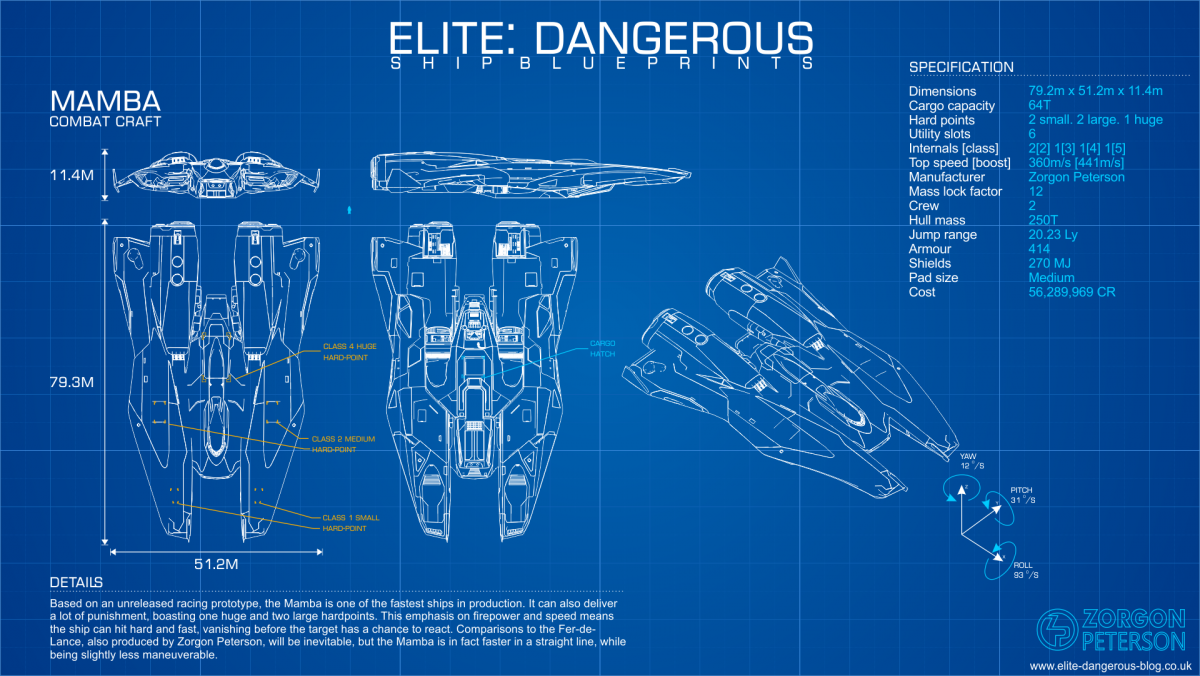
Elite Dangerous Mamba ship blueprint
Elite Dangerous Mamba ship blueprint by Martind Forlon (https://swat-portal.com/forum/gallery/image/9816-mamba/)

Links: Coriolis and EDSY (have your preferred one open as you read the guide for easy reference)

The Mamba combines the firepower of a Fer-de-Lance, the modest manoeuvrability of a Krait Mk II and an Eagle’s speed on arguably Elite’s best-looking ship. It requires no reputation or rank unlock. I also have a soft spot for playing less popular ships.

Offensively, this build relies on the tried-and-true lasers and multicannons formula:

  1. Gimballed weapons: Perhaps obvious but gimballed weapons are the ideal trade-off between damage and accuracy. It makes it easier to hit small or fast-moving targets, frees you up to manoeuvre more freely and makes hitting modules on larger ships easier.
  2. Huge hardpoint: This build’s Huge Multicannon has Overcharged (blueprint) with Oversized (experimental effect), giving a 70% damage increase. Simple but effective.
  3. Large hardpoints: The large beam lasers have Long Range with Thermal Vent. Long Range means the beam lasers can hit targets up to 3.6 km away with no damage loss. Otherwise, lasers’ damage starts to drop at 800m. The Thermal Vent experimental effect decreases instead of increasing heat on a hit, eliminating heat issues. 
  4. Avoid over-engineering: The large beam lasers only have grade 1 Long Range. Higher grades have diminishing returns due to gimballed weapons’ increasing inaccuracy at range. Engineering everything to grade 5 is not always the best solution.
  5. Small hardpoints: Compared to the other hardpoints on a Mamba, the small hardpoints are there to apply experimental effects instead of doing damage. This build uses Emissive and Corrosive. Neither effect stacks. Both are available on Small Multicannons. This build uses the High Capacity blueprint to double their ammunition capacity, almost matching the firing time of the Huge Multicannon. Unfortunately, Small Multicannons churn through ammunition quickly. Corrosive also decreases the ammunition capacity by twenty percent.
  6. Emissive experimental effect: Emissive increases gimballed weapons’ accuracy against that target for a few seconds. This accuracy increase is most evident when the target’s heat drops, like when using a heat sink.
  7. Amour piercing and hardness: When a weapon hits a ship, the weapon’s “Armour Piercing” is compared to the ship’s “Armour Hardness”. When the Armour Piercing is lower than Armour Hardness, some of the damage is diverted to the ship’s “Armour” value until “Armour” ablates to zero. Larger ships generally have higher Armour Hardness and Armor values. Larger weapons also tend to have higher Armour Piercing values. That is why large ships are harder to damage with small weapons. That is also why most builds put high Armour Piercing weapons in the largest hardpoint slots, like the Huge Multicannon in this build.
  8. Corrosive experimental effect: Corrosive reduces a ship’s Armour Hardness value for a few seconds. This allows this build’s weapons to do more damage to heavier ships’ hulls. Even the Huge Multicannon benefits against ships with the hardest armour (Fer-de-Lance, Mamba, Imperial Cutter, Federal Corvette and Type-10 Defender).
  9. Sensors: The 4A Sensors with Long Range are essential. The best weapons are only effective if you can find suitable targets in large Conflict Zones, Resource Extraction Sites or Navigation Beacons.

Defensively and ignoring speed, this build relies on Bi-weave shields and strong armour:

  1. Bi-weave shields: Bi-weave shields sacrifice raw strength for a fast rebuild (recharge from nothing to 50%) and regenerate (50% to 100%). This build emphasizes the recharge speed using Reinforced (increase strength) and Fast Charge (increase regeneration rate). You can engage weak to moderate targets without pause. 
  2. Shield boosters: The shield boosters use two Heavy Duty (increase strength), two Thermal Resistance (counter shield’s innate weakness against thermal weapons like lasers) and one Resistance Augmented blueprint. This build is resistance-heavy, further emphasizing the recharge rate without losing too much to resistance’s diminishing returns. 
  3. Armour: This build uses Reactive Surface Composite with Heavy Duty and Deep Plating, both increasing strength. Reactive Surface Composite inverts the usual strengths and weaknesses of armour, resisting explosive (missiles) and kinetic (multicannons) damage but weakening against thermal damage (lasers).
  4. Hull and module reinforcement: This weakness against thermal damage is corrected with Thermal Resistant engineering on the 4D Hull Reinforcement Package. The 2D Module Reinforcement Package protects against module damage when weapons breach the hull and potentially damage the core internal modules.
  5. Power priorities: Power priorities are not required for this build but keep core internals and Shields operating if the Power Plant is ever significantly damaged.

Variations

  1. Guardian modules: Replace the Module Reinforcement Package with a Guardian Module Reinforcement Package if you have access to that module. It has slightly better module protection.
  2. Cost: If cost or rebuy is a factor, replace the Reactive Surface Composite with Military Grade Composite. Adjust the engineering on Hull Reinforcement Packages accordingly. A Mamba’s Reactive Surface Composite costs around 120 million credits before any discount, over half the initial purchase cost. This ratio is the same for most ships, so this advice is helpful for any build.
  3. Prismatic Shields: If you prefer Prismatic Shields, replace the 5C Bi-Weave Shield Generator with a 5A Prismatic Shield Generator with Reinforced and Hi-Cap. You will need to replace the engineering on the Power Plant with Overcharged grade 2 or higher to ensure sufficient power.

Solo Tactics

This build works fine for simple “point and shoot” but you can do a lot more with it:

  1. “Circle Strafe” tactic: The ideal tactic is circle-strafing the target, keeping a 1 to 1.5 km distance. Fly toward the target at 50% throttle, thrust down while gently turning the nose up. It can be difficult initially, but practice helps. Dodge slow, unguided munitions like plasma accelerator shots and non-seeker missiles using lateral or vertical thrusters.
  2. “Reverski” tactic: Fly to long range, match the speed of an enemy, toggle flight assist off, turn toward the target, and then blast away with impunity. This tactic is cheesy but effective against slow targets. Unless the target has long range weapons, you will do more damage than they will.
  3. Pursuit and fleeing: If you need to chase down a fleeing enemy or disengage, put four pips in engines and two in shields, then boost. While faster ships are possible, such as some Imperial Clipper or small ship builds, none will match this build’s shields or firepower. 
  4. Weapon use: Use lasers on shields or chaffing targets, then everything against ships’ hulls. Avoiding multicannons on shields conserves ammunition. Corrosive only works when hitting a ship’s hull.
  5. Power (Pip) management: Put two pips in systems and four pips on weapons to permanently keep at least one Large Laser firing. A Mamba is fast and manoeuvrable enough to generally not need pips in engines when engaged. Boosting tends to overshoot the target. Just keep the SYS capacitor topped up and the throttle in the blue. 
  6. Large target tactics: Get closer to large, lumbering targets. You can circle strafe faster than they can turn when close, staying out of their firing arcs. Target sensitive modules like Power Plants.
  7. Small target tactics: Combat with smaller, faster ships will often revert to jousting. Use your Long Range weapons to damage them for most of the attack run, then pre-turn or “landing gear turn” to maximize time on target as they fly past.
  8. Chaff sparingly: Chaff when facing an enemy wing because sufficient fire will exceed the Bi-Weave Shield Generator’s regeneration rate. While this build has strong armour, sustained explosive damage on the hull will start to render hardpoints inoperable (when their integrity drops below 80%).
  9. Hardpoint placement: All of a Mamba’s weapons are on top of the ship. Pitch the nose down slightly when engaging a target. This preempts a ship diving underneath the Mamba. It also keeps the target visible through the Mamba’s copious canopy.

Wing or Team Tactics

  1. “Pulling” role: Use the Long Range, A-rated sensors to find suitable targets, boost to them, “tag” targets with the Large Lasers, and then flee back to the wing. The enemies will follow, allowing better-shielded ships to engage and draw enemy attention. Time the pull to keep a constant stream of enemies engaged.
  2. “Tanking” role: Even without heavier ships in the wing, the Mamba is still in the top tier of combat ships and more than capable of tanking (getting enemy attention and taking the damage).
  3. “Rescue” role: Put pips into engines, then boost to a wingmate in trouble. Draw the attention of enemy ships by doing lots of damage when closest to the target.
  4. Experimental effects: After everyone engages, the Corrosive and Emissive experimental effects on the small multicannons buff everyone’s damage output, not just this ship. However, they do not stack, so consider other experimental effects if you frequently wing with others that use them.