Unknown's avatar

About Anthony Langsworth

I am a self-motivated, adaptable, outcome-focused enterprise and solution architect that gravitates toward technical leadership roles. I am adept at building relationships and translating between business and technology practices. My experience covers architecture, management, security and software development roles over 20 years, from multiple startups to global technology companies. I am a frequent innovator with many patents; maintain many architecture, agile and security certifications and contribute to open source software.

“Journey to the Savage Planet” Review: Exploration in the Name of Exploitation

Journey to the Savage Planet is a science fiction adventure game developed by Typhoon Studios. Tasked by Kindred Aerospace, the fourth-best interstellar company, your job is to exploit a new planet in the name of capitalism, err, I mean, explore a planet for possible human habitation.

You play an unnamed astronaut, sent to an alien planet to catalog its features and inhabitants. You explore the landscape, scanning flora and fauna, while gathering resources. Back on your ship, these resources unlock upgrades. These upgrades provide additional mobility and options, which open up more areas and so on.

Journey to the Savage Planet includes some combat. However, it is not the game’s focus. Instead, combat is a series of puzzles to keep areas unique and challenging. The boss battles gate content, ensuring you have certain upgrades and know how to use them.

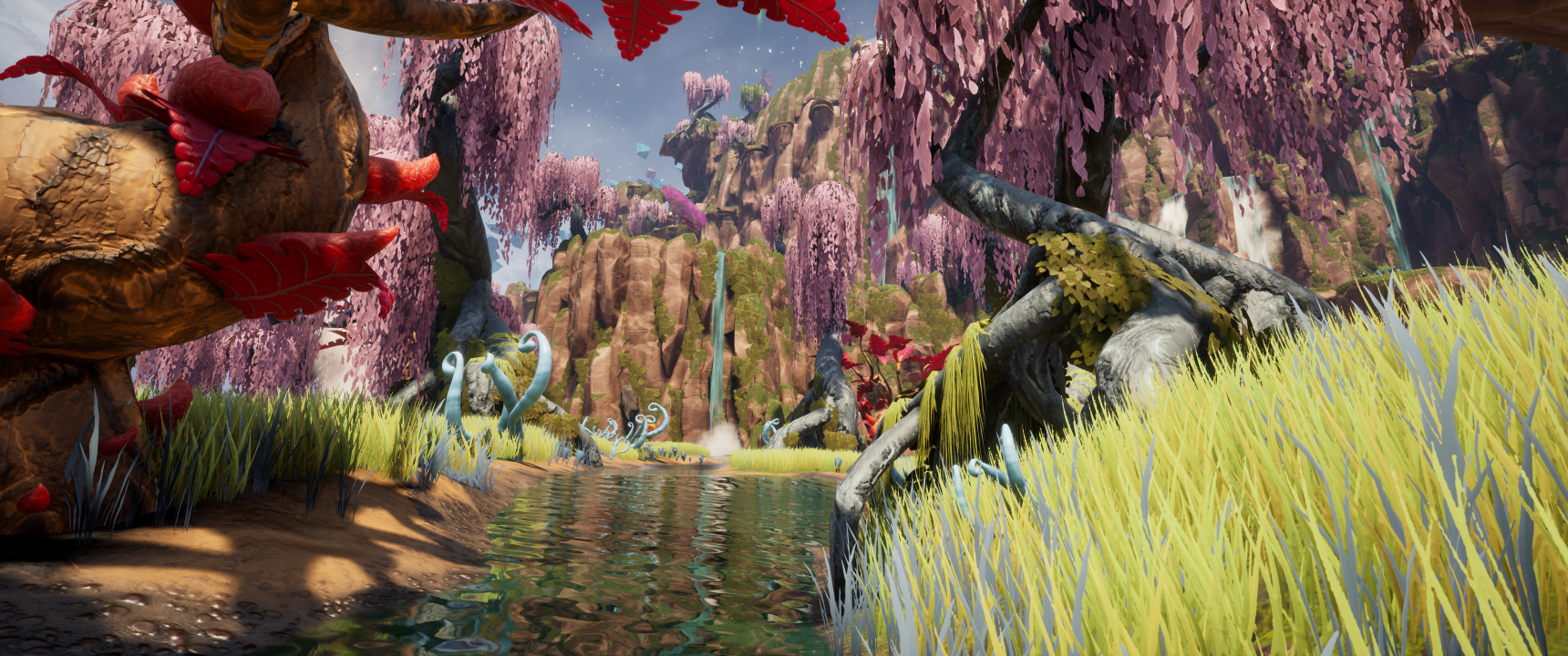
Lush, alien landscapes ripe for exploitation, err, exploration

The level design is also economical. While regions feel huge at first, explorable areas are actually compact and densely packed with secrets and interesting tidbits. Early regions have areas only accessible with later upgrades, encouraging players to revisit content with more experienced eyes. You unlock teleportation early, removing a lot of tiresome travel.

Journey to the Savage Planet offers co-op play, your in-game “meat buddy”, for assistance or more social play.

Mechanically, the above sounds like a standard 3D exploration/traversal game. This is true. The game gradually exposes you to progressively more difficult puzzles that build on previous experience, like any good puzzle game. Turorialisation is usually subtle, although the game sometimes shows applicable controls as a hint. Unlike more linear puzzle games, the game’s open world allows players to switch to a different puzzle or area and return later, along with freeform exploration.

However, Journey to the Savage Planet coats this well-implemented but otherwise unremarkable gameplay with a thick layer of absurd, satirical, anti-capitalist humour. Your ship bombards you with ads that use familiar tropes and techniques to peddle ridiculous products. Periodic messages from the self-serving and insincere Kindred CEO echo the worst of an egotistical cult of personality. He savours sushi on his private jet while you eat ooze-like grob on your decrepit spacecraft. Even the feigned encouragement from your shipboard computer is sarcastic.

The humorous context gives purpose while downplaying negative aspects. It is hard to take your character’s death seriously if your CEO and ship’s computer do not. Killing and exploiting the wildlife is OK because it is in the name of “science”.

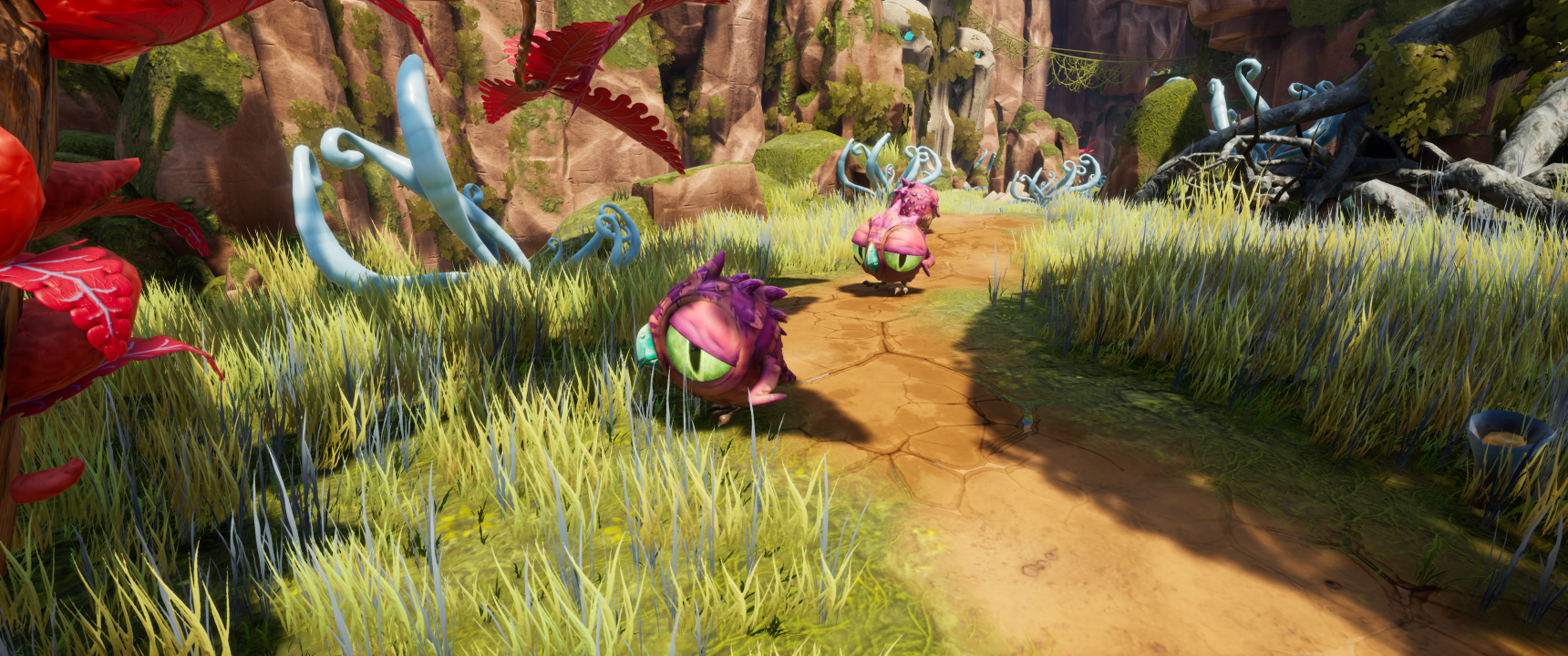
Dopey Pufferbirds hopping around their business in a lush, alien forest.
Dopey-eyed pufferbirds hopping around

Journey to the Savage Planet‘s bright, saturated and cartoonish art style, creature design, and sound effects reinforce this. The cute, ball-like pufferbirds, for example, have large, anime-like eyes and emit high-pitched cheeps. Many-headed baboushkas scream comically as they dash around. Feeding aliens grob makes them fart collectable resources.

This art style also ensures plants, creatures and terrain features are recognisable, easy to differentiate, yet clearly alien. This style will not date as graphics capabilities improve and adapts well to lower fidelity devices.

The soundtrack is roots rock, heavy with guitars and stringed instruments. It gives the game a playful, blue collar, “Wild West” feel. I would have liked more variety between tracks, though, as it can become repetitive.

While there are challenging moments and your character will die often, Journey to the Savage Planet is not difficult. A new upgrade, using a previously overlooked environmental feature or rethinking the approach is usually the answer.

Even the various MacGuffins, such as orange goo to increase your health/stamina or alien alloy for upgrades, can eventually be detected using your scanner. These scanner upgrades replace a frustrating game of finding the obscure nooks and crannies with the fun traversal puzzles. You know where the desired objects are. You just need to find out how to get there. I usually find completing collections tedious, but Journey to the Savage Planet had me happily doing so without initially realising it.

Journey to the Savage Planet‘s anti-plutocratic and pro-environmental message becomes less subtle later in the game, particularly as you approach the last boss. It taps into the anti-“tech bro”, “save the planet” zeitgeist.

However, the game’s message takes a backseat to the fun, avoiding lectures and keeping things light. The game hides its message under an obvious corporate caricature. It avoids imposing moral quandaries or showing the heart-tugging broader effects on society, as in games with similar themes such as Cyberpunk 2077 or The Outer Worlds.

Journey to the Savage Planet takes around fifteen to twenty hours to complete and about five extra hours to find all the collectables. It will appeal to those looking for a light-hearted exploration and traversal puzzle game. However, those looking for genuine challenge or put off by satirical, cartoonish humour should look elsewhere. Many puzzles emphasise the vertical, giving sweaty palms for those afraid of heights, too.

“Universe for Sale” Review: Zig Zagging through Spirituality

Universe for Sale is a science fiction “point and click” visual novel with a distinct, hand-drawn art style. It was developed by Tmesis Studio and published by Akupara Games.

Universe for Sale follows Master and, later, Lila. Master is an ascetic monk from the Cult of Detachment. The Cult believes that physically separating parts of their body also detaches negative emotions or experiences. By the time we first meet Master, he is little more than a skeleton with ears. He wakes up each day, having slept on the ground in the market, and seeks out Lila.

Lila is more human, although her hair consists of blue-green tentacles after an accident where she lost her father. She wakes each day to sell custom universes in the market or use the proceeds to decorate her home. At least, she did until Master came along.

Universe for Sale‘s gameplay consists of walking around, exploring, conversing with different people, interacting with objects, and completing minigames. Most minigames are straightforward, although some, like the Lila creating universes, can take some experimentation. The minigames’ purpose is immersion, not challenge or mastery.

Master stands in a dark basement of the church. Behind him, stands a bookcase full of confiscated artifacts.
Assorted knick-knacks, with a few pop culture references for the keen-eyed

Universe for Sale’s setting, the colony, is a wonderful fusion of fantasy and technology, hanging precipitously in the upper atmosphere of Jupiter. Powered by rusting windmills and protected from acid rain with hydrophobic fabric sheets, every scene reveals more about how such a fantastical world exists and functions.

The hand-drawn art style, apart from minimizing development costs, keeps the tone light by avoiding squalor and “cartoonifying” Cult members with detached body parts. It also allows for easy exaggeration of features, making the various characters larger than life.

The colony’s inhabitants push the boundaries of humanity, from intelligent orangutans to robots. Neither Lila, with her tentacle hair, nor Master, a walking skeleton, are out of place.

The colony’s juxtaposition of technology and poverty feels familiar, but every scene’s bizarre or technological oddity reminds you of the futuristic, alien setting. Only in such a setting could Lila’s profound ability to create and manipulate universes be so minimised.

A visual novel game like Universe for Sale hinges on its writing. Thankfully, it delivers, mainly via nonlinear storytelling. Lila’s daily grind, Master’s enigmatic task and a children’s fairy story weave together as Master tries to order events into something coherent. The slow emergence of relationships while learning more about the world is intriguing. Each day brings curiosity, excitement, and some trepidation.

Universe for Sale is a story about spirituality and recovery. There are many ways to tell a story, impart wisdom or heal emotional trauma. Each person’s journey is unique. Focusing on one religion or method blinds you to others.

Universe for Sale contrasts the rigid control and doctrine of established religion with self-actualization and fulfilment. The dominant “church” in the game is probably meant to be fictional. While the futuristic and imaginative setting helps de-anchor it from reality, the cathedral-like stained glass windows and pews are hard to miss.

The Cult of Detachment’s teachings, by comparison, are initially alienating but then softened by including them in a children’s fairy tale. Master’s patience, sincerity and compassion contrast with the preaching, control and dismissiveness of the church.

Master stands in an alley way, deserted except for a cat-like Lomri
Master shares a moment with Lomri

Meanwhile, some unspoken natural order or authority is patiently asserting itself. Plants continually grow into and infest buildings. The church cannot eradicate the cat-like “lomris” that nest near Lila. Lila’s octopus-like hair, her friendship with the colony’s animal-like inhabitants, and the Kraken gatekeeper between the physical and spiritual realms hint at animism. Metaphors and references abound.

Universe for Sale has limited replayability. There is a single ending and dialog choices only satiate curiosity. The game awards achievements for reaching story milestones, as well as for doing humorous or unexpected things, so a second playthrough may help fill any gaps.

For those intrigued with fantastical worlds, non-linear storytelling or unravelling mysteries, Universe for Sale is ideal. Universe for Sale is short, taking four to five hours to finish, but tells its story well within that time. Like the varied universes Lila creates, it encourages us to open our minds to myriad spiritual possibilities.

“Landman” Review: A Gritty Monument to the Oil Industry and its People

A flaming oil derrick dominates the grey-brown landscape, with a city skyline in the distance.

Landman is a gritty drama set in modern-day western Texas centred around a family working in the oil business. Created by Taylor Sheridan, known for shows like Yellowstone and Lioness, Landman shares similar values and a rural, conflict-ridden setting.

Landman follows Tommy Norris, the general manager or “landman” of MTex Oil played perfectly by Billy Bob Thornton, and his family. He deals with personal and professional crises while stoically preventing one from impinging the other.

While Landman has things to say about the oil industry, it has more to say about the people within it. For example, Landman voyeuristically subjects the audience to the brutal lives of the oil field maintenance workers. They endure long hours of physical labour, often with bullying and uncaring bosses and coworkers, while separated from their families. Many are trapped in “the patch” due to criminal records the oil industry is happy to overlook or the salaries that dwarf anything else available.

Meanwhile, the wealthy owners bask in luxury, flying from elaborate lunches to the office in private jets. There is a poignant moment where Tommy, who ensures MTex Oil’s owner never needs to dirty his boots, notices the artwork and finery of his boss’s home. It reminds Tommy of the life that he almost had.

In between, you have Tommy and other professionals working for MTex. They have feet in both worlds. They share a large, spacious house. At first glance, it appears better than the maintenance workers’ accommodation. However, like the maintenance workers, the house is ephemeral (rented), the hours long and the pressure immense.

Landman‘s differing portrayal of men and women is also telling. The men are tough, smoke, drink alcohol and frequently perpetrate and fall victim to violence. They go for the largest, fattiest meals at the pub. The body’s failings are limitations to be ignored, whether they be a broken finger or an ailing heart. Success for a man is determined by wealth, providing for their family and finding the highest strata of society that will accept them.

Success for women, by comparison, is attracting and retaining a successful, wealthy man. They do this via physical attractiveness, spending hours doing cardio in ritzy gyms, and competing with other women to be the most youthful and beautiful. As Angela, Tommy’s soon-to-be ex-ex-wife, says, her job is to provide food, sex and affection. Her husband’s job is to buy or take her where she wants.

Without the mothering of a woman, men often regress, treating unhealthy habits like eating junk food as a badge of honour. Without a man, women lack a place in society.

One exception is Rebecca Savage, a liability attorney called in to help settle a lawsuit after an oil well accident. A woman thrust into a man’s world, Rebecca survives and thrives by being better at her job than men.

Rebecca is also a foil for Tommy and the broader oil industry. She enables exposition, requiring Tommy and others to explain things to an audience surrogate, and acts as an anti-oil industry conscience, countered by Tommy’s pragmatism. She is uncharacteristically a damsel in distress at one point, requiring rescuing by Tommy, which reinforces his masculinity.

Another exception is Cooper Norris, Tommy and Angela’s son. Quitting an almost complete college degree and defying social norms, he starts work on the patch in a maintenance crew. Much to his parent’s dismay, he endures abuse, ridicule and injury to learn the oil business from the bottom up. He quietly sticks to his morals to potentially reap respect and financial rewards, admirably demonstrating his father’s resilience and grit.

This contrasts with Cooper’s sister, Ainsley, whose future success lies in attracting a handsome quarterback. Tommy has to play the traditionally protective father, threatening the boyfriend instead of Ainsley if the relationship goes too far too quickly.

Landman is at its best when it is a pseudo-documentary, usually with Tommy Norris pragmatically explaining the realities of the oil industry and its place in the world. The oil industry is lucrative but slowly dying. The owners lament their grandkids not enjoying their current fortunes. Paradoxically, the world blames the oil industry for its part in climate change but cannot live without it. The overt comparisons with the illicit drug trade are copious.

However, the requisite melodrama and sexualization can drag the show down, particularly in early episodes with Angela. Some would argue that her character is relatably flawed, but no other character requires these to be relatable. Landman is definitely shot for the male gaze. At least Angela got her Bently.

Landman‘s values can be polarizing. For the right wing, Landman is a rebuttal against naive environmentalism. For the left wing, it is a conservative fantasy, glorifying social and economic relics and reinforcing stereotypes. For those who can distance themselves from politics, Landman is a compelling snapshot of a rarely seen slice of America.

Like Taylor Sheridan’s other recent television shows, Landman eschews overly progressive themes, instead focusing on traditional American values and aspirational heroes. However, it succeeds without overt preaching or the seductive lies of nostalgia, common in conservative shows. It is a gritty monument to a people and industry whose days, like suburban coyotes, are numbered.

“The Invincible” Review: A Contemplative, Retro-futuristic Thriller

The Invincible's signature image, showing a deceased astronaut buried in sand.

The Invincible is a science fiction thriller and adventure game developed by Starward Industries. Based loosely on Stanislaw Lem’s novel of the same name, published in 1964, does its premise still hold up after sixty years?

You play as Dr Yasna, an astrobiologist from the Interstellar Commonwealth spaceship Dragonfly. You awaken on a Regis III, a distant and desolate planet, with little memory of recent events. Your job is to discover what happened to your expedition while unravelling the planet’s mysteries.

The overused amnesia trope may dissuade some. However, given the source material’s age, the original novel likely inspired the trope. Yasna’s amnesia is also central to the story. Yasna regains some memories through flashbacks, but The Invincible‘s first hour or two asks more questions than it answers.

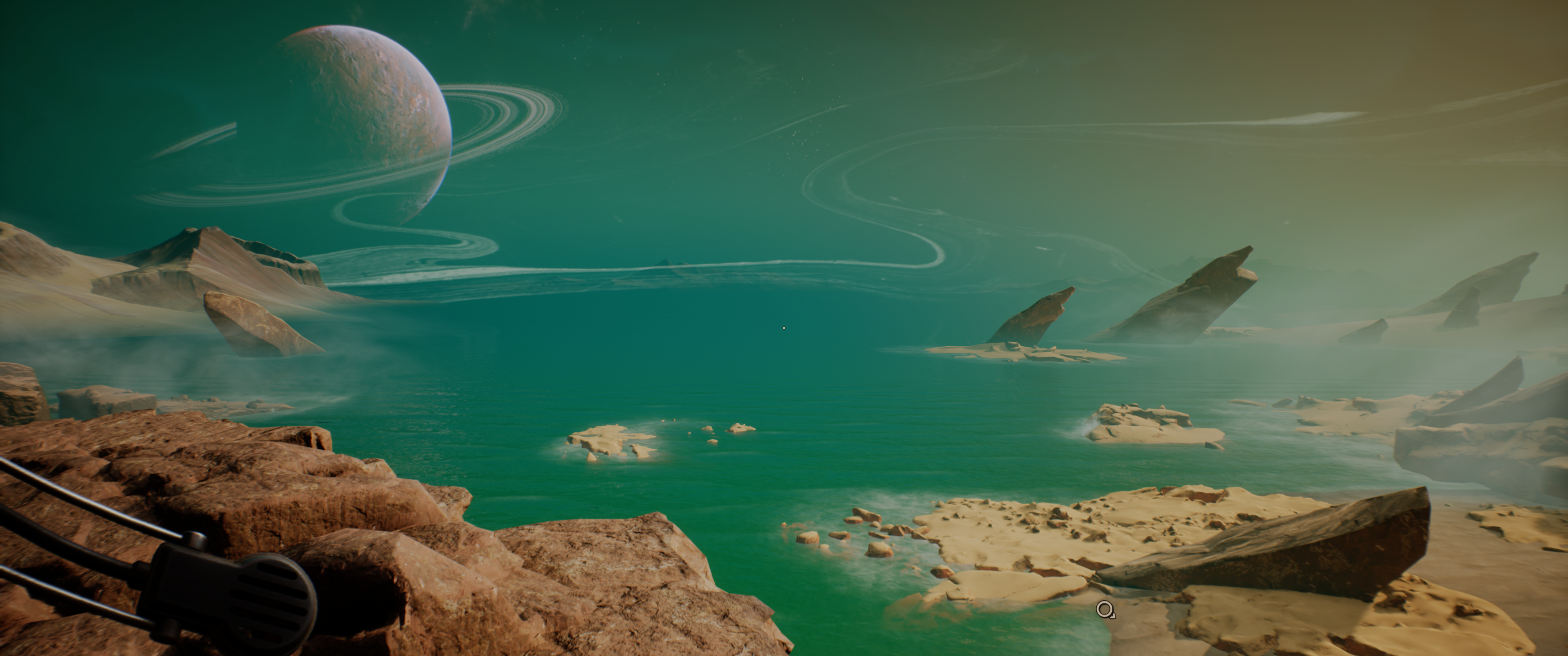
A blue-green alien sea stretches to the horizon, with a ringed planet hovering overhead.
Regis III has some beautiful vistas

Mechanically, you walk and climb around the desert environment. You drive rovers, operate computers and navigate with a scanner and a metal detector. Dr Yasna automatically tracks important notes and maps in her journal, which you can refer to if lost. She talks over the radio with Novik, the Dragonfly’s “astrogator” or captain, getting context and guidance.

The Invincible has a fantastic retro-futuristic aesthetic, reminiscent of The Forbidden Planet, Gerry Anderson’s Thunderbirds or Space 1999. Controls are large and analog. Robots lack the modern pseudo-organic look. Spaceships are gleaming rockets. Technology is practical and grounded, electromechanical instead of electronic. Even futuristic inventions like force fields are just applied electromagnetism with bulky wires, magnets, and insulators.

The aesthetic makes The Invincible believable and distinct hard science fiction. It also reduces complex apparatuses to simple controls that require no instructions, which is perfect for a game.

The aesthetic grounds The Invincible to the late 1950s or early 1960s. The developers did not introduce modern sensibilities or conveniences. The characters smoke. They lack the equivalent of mobile phones, although you can find a bulky Pong game console. The developers even retained some esoteric names from the novel, like calling a spaceship’s captain an “astrogator”.

The soundtrack is unsettling, an often discordant mix of percussive and theremin-like synthesized instruments. It ensures you always feel on edge. Nothing is ever quite right. It recasts the barren scenery, often starkly beautiful, as alien and isolating. The instrument choice also reinforces the 1950s/60s science fiction feel.

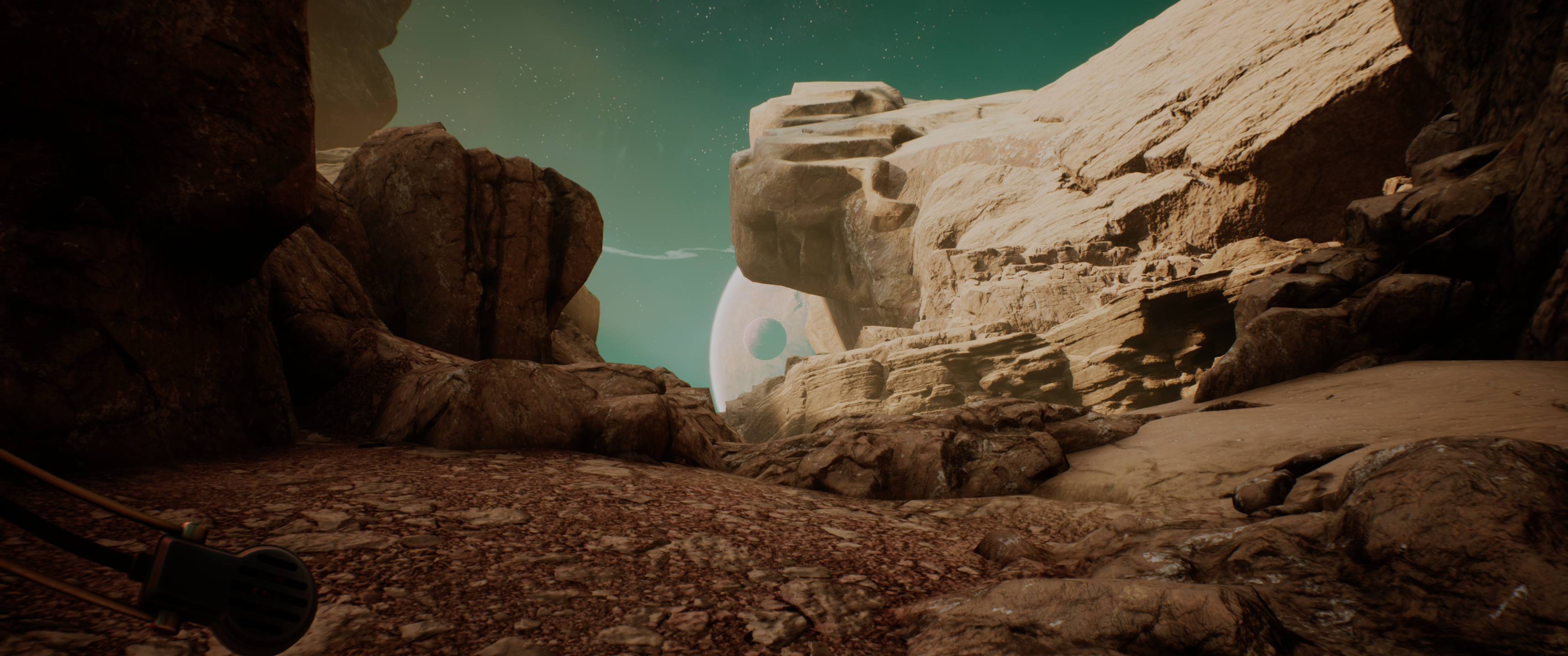
A rocky ravine reveals a planet or moon peeking at the end. Yasna's space suit's microphone is ever present on the bottom left.
Your microphone and nearby alien planets are a subtle but constant reminder of where you are

The Invincible generates a comic of Yasna’s progress and decisions. It summarises the story and highlights important decisions. The game shows you the last panel when reloading a save to give the player context quickly. Once again, it fits with the pulp comics popular during the 1950s and 60s.

Thematically, The Invincible deals with humility and hubris. Humanity’s Ozymandian discoveries on Regis III challenge our understanding of life and intelligence. Our anthropomorphization and existing taxonomies can hinder as much as help. For example, the separation between biological and machine is not always clear. Yansa’s isolation means she has to resort to her basic wits and grit.

The Invincible shows us some things will always be beyond our mastery. Humanity’s weapons, for all their might, assume human constraints and thinking. Even humanity’s advanced medical science cannot regain lost memories. The significance and irony of the game’s title slowly becomes clear toward the game’s end.

Despite its futuristic setting and existentialism, The Invincible is ultimately about human nature. Amidst the Cold War-like paranoia and mistrust between Yansa’s pseudo-European Commonwealth and the pseudo-American Alliance, our similarities outnumber our differences. The Commonwealth’s and Alliance’s different technologies are interoperable. Human touches like sharing cigarettes can potentially unite us, as can challenges like those on Regis III.

The Invincible is short, taking six or seven hours to complete, but it is about the right length. There is some replayability. Most of the game is linear despite appearances, although you can make decisions at key moments to steer the remaining story and reach different endings. Achievements reward attention to detail or acting unpredictably.

The Invincible will appeal to those looking for contemplative science fiction with a strong visual and audio aesthetic. The developers have been faithful to Stanislaw Lem’s vision, which still holds up today. While humanity has not visited other planets as in the game, it is easy to consider humanity the master of its domain. The Invincible reminds us that the universe may have other plans.

“Industrial Annihilation” Early Access Review: Too Early to Tell

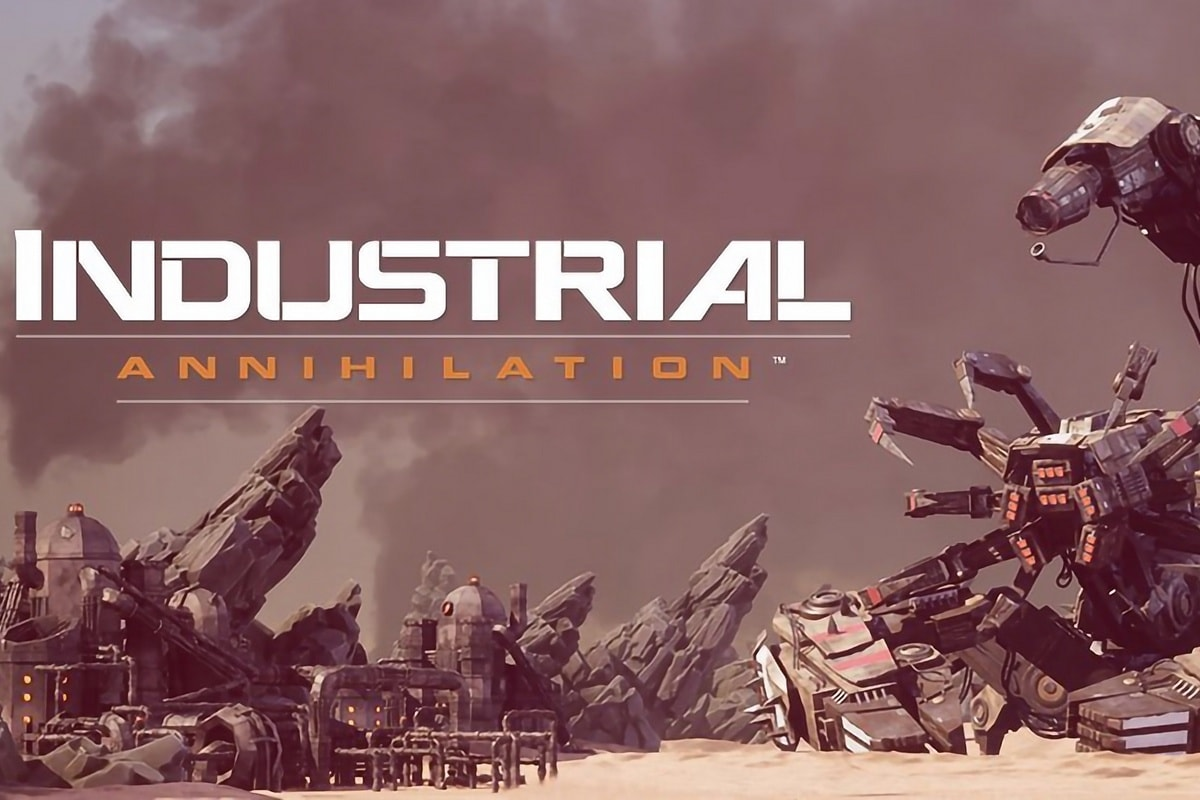
I was lucky enough to receive an early access code for Industrial Annihilation. Initially, it appears to be a standard real-time strategy (RTS) game. You play a giant robot commander teleported onto a battlefield who then gathers resources, builds a base, and raises an army to defeat opponents.

The main difference between Industrial Annihilation and previous RTS games is logistics. Resources must be physically transported between buildings via conveyor belts or trucks. Mid- and late-game buildings or units also require intermediate components instead of just mined or gathered resources.

As a result, Industrial Annihilation is as much a factory game, like Factorio, as it is an RTS, like Planetary Annihilation. Experienced factory game players will feel at home with the early access version’s more strategic, measured play that optimizes base building. However, experienced RTS players may miss the hectic urgency to out-build, out-manoeuvre and destroy their opponents.

Unfortunately, the early access version of Industrial Annihilation does not address how these disparate play styles will complement each other. While both modern RTS and factory games have roots in early RTS games, each engages distinct player groups. The success of Industrial Annihilation hinges on their synergy.

As expected, the pre-release version is not what we would expect from a completed game. For example, Industrial Annihilation comes with a four-mission campaign. These are intended as tutorials, but guidance is minimal. The player has to figure out what buildings and units do and how to achieve the required goals. This can be fun but also tiresome and frustrating.

Moreover, Industrial Annihilation lacks many quality-of-life features, like showing the unit’s weapon range, an energy management overview or double tapping a group’s number to centre the camera on it. Placing conveyor belts and connectors is fiddly. The audio is minimal. You cannot even save your game, so if you get impatient during a tutorial mission and go blasting away with your commander, you may need to replay the entire multi-hour mission if you screw up.

Releasing a version of the game in this state is risky. Many have criticized the developers for Industrial Annihilation‘s poor quality and unclear vision. Early access games are often more polished and complete. However, releasing an early access version is also a brave attempt to engage the player base early to find bugs and elicit broad feedback.

Whether you should engage with Industrial Annihilation now depends on your tolerance for in-complete software and whether you want to be part of the development journey. Industrial Annihilation has the potential for something special, but it is only potential for now.

“Everspace 2” Review: A Wonderful Space ARPG

Everspace 2 is a space fight simulator with 3D movement focusing heavily on combat, exploration and puzzles. Rockfish Games, the developer, describes Everspace 2 as a “space shooter” with “RPG elements” on its Steam page. That is untrue. Everspace 2 is an action role playing game (ARPG) like Diablo or Path of Exile. And it is terrific.

You play Adam Roslin, an ex-military fighter pilot working for an uncaring and manipulative corporation. After a routine mission goes wrong, you are captured by outlaws and escape to a long abandoned base. You and your fellow escapees then rebuild and prepare for a heist that could set you all free.

Flying your ship in Everspace 2 is a joy. The controls are less detailed than those of more complex space simulators like Elite Dangerous. Still, such an outwardly arcade-like game offers a surprising degree of control. Dodging enemy fire, circling capital ships, and navigating maze-like tunnels all feel fluid and natural.

The combat is vibrant, frantic and engaging. Like most ARPGs, you usually fight swarms of weaker enemies, each with different weapons, defences, and abilities. This structure provides constant variety and changing tactics. Your relative strength also fuels the requisite power fantasy. 

A warm red star and a blue nebula shine through an asteroid field

Locations also contain puzzles, providing cerebral but slower-paced play. As you fly around, your sensors can detect and track nearby loot, mineral deposits or other points of interest. Your ship has a tractor beam that you can use to pick up and move things around, such as removing debris from a passage or picking up a battery to slot it into a socket elsewhere. These usually unlock doors or containers of potential ship upgrades.

Everspace 2 tells its main story through cut scenes showing hand-drawn images with voice-overs. While low-budget, this style works well for a game focused on flying spaceships. The main quest has excellent pacing while introducing more about the universe and its inhabitants.

There are plenty of side quests and activities, too. As with many RPGs, they are often the most interesting, flesh out the world and introduce unique NPCs. Chasing rogue AIs, rescuing trapped miners, or appeasing crime lords are all on the cards. Racing tracks and rifts filled with difficult enemies satiate those seeking a challenge.

Mechanically, Everspace 2 is a testament to game balance. Everything, including your character, gear, and enemies, is geared to a level. Level differences are more pronounced than in other games. Foes more than a few levels above you are deadly. Those a few levels beneath you will be merely speed bumps. Everspace 2 periodically increases the level of enemies to keep the challenge consistent.

A ringed planet seen from the surface of a desert planet

Aesthetically, Everspace 2 is beautiful. Each location is a postcard, with asteroids, massive space stations, aging wrecks, vertigo-inducing icebergs and/or vibrant nebulae. Many are varied and original, like an iceberg in a solar flare or a megafauna skeleton, evoking wonder and appreciation. Each star system also has its distinct look, making them feel unique. 

The electronica soundtrack is also on point, supporting the sci-fi feel. The zen-like cruising pieces contrast with the exciting, upbeat combat ones.

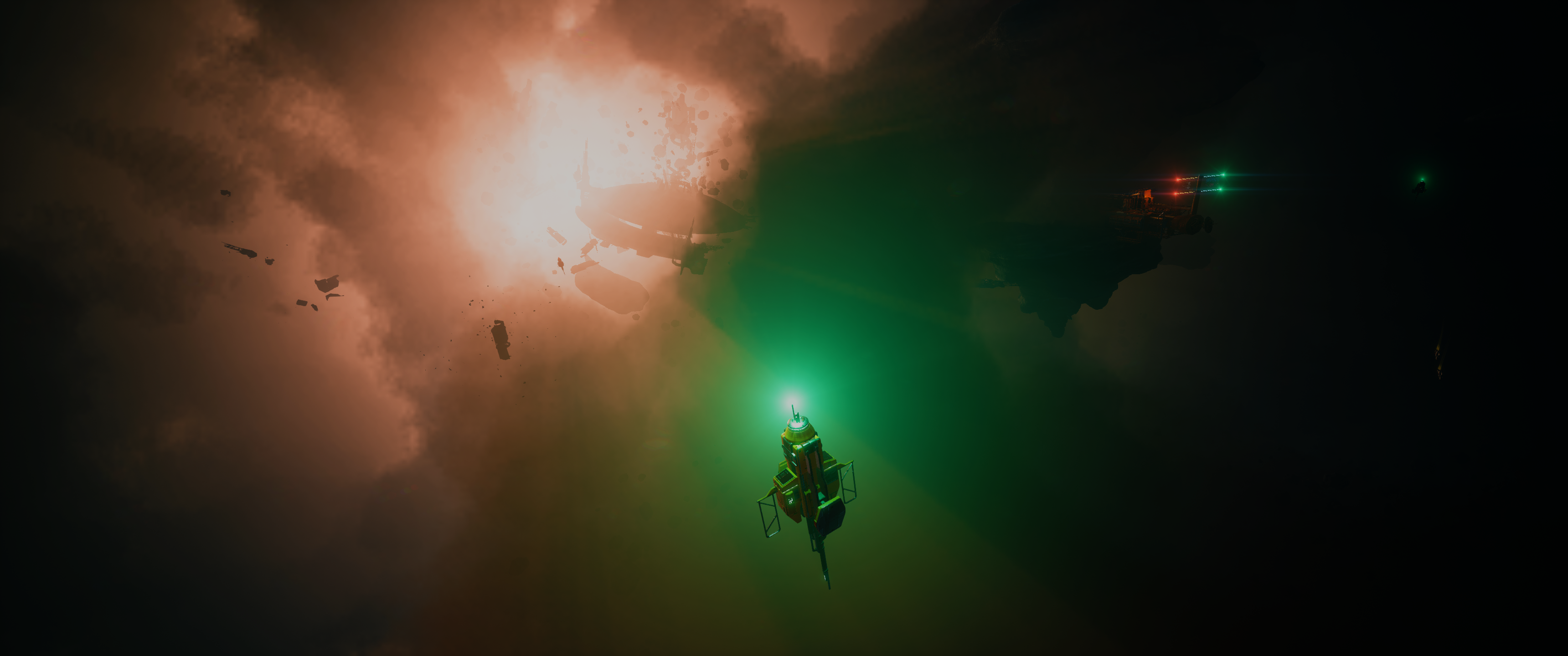
A green beacon in the middle of a dark gas cloud

However, Everspace 2 is not perfect. My biggest gripe is with the writing in the main storyline. No one expects deep or complex writing from an ARPG, but this does not excuse poor writing. 

The characters need more substance. Ben and Delia are just cardboard cutouts and deserve motivation and agency. Maddock becomes a contrived, grumpy omni-antagonist. Combining some supporting characters, like Ben and Tareem, would have enhanced both. Everspace 2 also unnecessarily sexualizes a female supporting character at one point. 

Similarly, the early main story has too much “I need you to do this, but I am not going to tell you why for at least two cut scenes.” It feels unnecessarily opaque and confrontational. The game also removes the player’s agency at a few key moments, railroading you. 

My other gripe is with loot management. Most of the copious loot enemies drop is trash you sell or disassemble for crafting components. The rare upgrade is fun, and Everspace 2‘s crafting system means you will always have suitable weapons, modules or consumables. 

However, the constant gear drops and level churn mean periodically yanking yourself out of the fun combat and puzzle game loops to clear your inventory. Loot management is a broader problem with ARPGs’ variable intermittent reward structure, but it is still a problem.

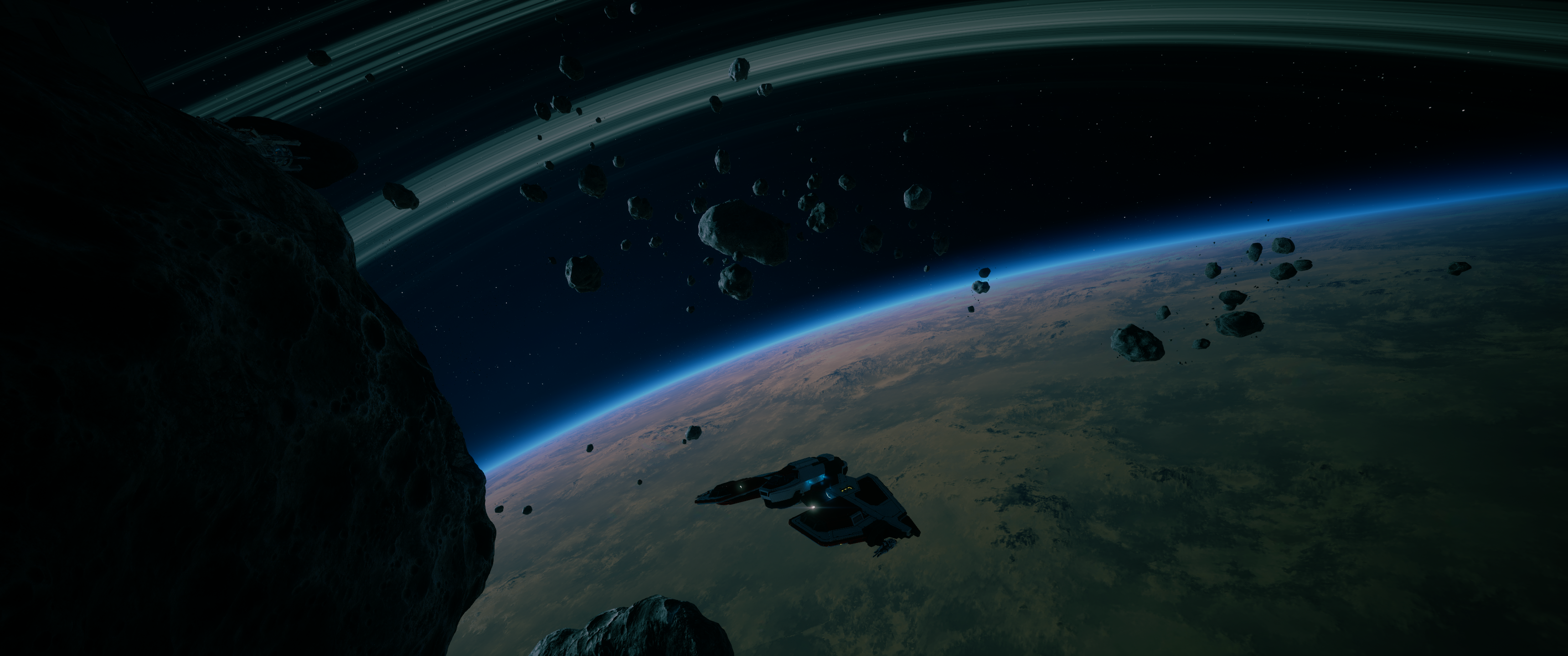
A ship in an asteroid field hovering over a ringed planet

I initially thought Everspace 2‘s lack of replayability would be a problem. It lacks a skill tree or other ARPG elements that specialize your character. No advancement or story choice blocks off content. ARPGs have traditionally used these to encourage players to create different characters to replay content differently.

However, being able to quickly switch out a new ship or experiment with new weapons or modules means experimentation or change is refreshingly easy. Meanwhile, the perk and challenge systems provide attainable alternative goals that offer useful benefits instead of gatekeeping high-level content from less dedicated players. 

Ultimately, Everspace 2 is a game that knows what it wants to be. It doubles down on that explore -> shoot -> loot -> craft game loop. If you enjoy that loop, and you will find out quickly or via the free demo, the game promises hours of the same. Otherwise, you will bounce off Everspace 2 hard.

Everspace 2 also knows what it does not want to be. It is single-player and offline, eschewing the complex code, gameplay loops and community management required for multiplayer or online play. It focuses on quality over quantity, providing a few well-developed star systems to explore. There is no piracy, salvage, political simulation or other distractions.

It took me about 60 hours to complete the main quest, including most side quests and challenges. As with most RPGs, you could complete it in under half that time, but you would miss the best content. Meanwhile, the developers continue expanding and enhancing the game, showing a welcome love and attention to detail. If only all ARPGs were this good.

“Chants of Sennaar” Review: The Tower of Babel in Game Form

Chants of Sennaar is a 3D puzzle game developed by Rundisc. It focuses on decoding and translating languages, combining the deductive reasoning from The Return of the Obra Din with the language learning from Heaven’s Gate.

The goal of Chants of Sennaar is to ascend to the top of a vast tower, learning the language of each level’s inhabitants as you go. Of course, nothing tells you that. You infer it from the game’s conversations and level design.

The mechanics of learning languages are simple and ingenious. You encounter glyphs, symbols that represent words, in writing, signs, or conversation. You infer a glyph’s meaning from its context. For example, a glyph on a sign over a bottle probably means bottle. 

A ruler using alien numbers.
A clever, succinct way to convey numbers

You automatically capture glyphs in your notebook, where you can type in a meaning or clue. Those meanings are written above the glyphs, giving a rough translation on the fly. You can then iterate with different meanings until you are happy.

Occasionally, you draw pictures in your notebook and then match glyphs to their drawings. If you get all the glyphs correct, the game confirms their meanings, making inferring the meaning of other glyphs easier. In the worst-case scenario, you can keep guessing until you get it right.

Clearly, the main challenge in Chants of Sennaar is inferring or deducing the meanings of glyphs. The languages are simple, restricted to 40 to 50 words each. Some languages even embed hints or patterns in the glyphs themselves. 

However, decoding languages is not straightforward. The tower’s levels are non-linear, so missing a vital clue is easy. Language and meaning are also flexible. If I see a glyph next to an arrow pointing up, does the glyph mean up, high, north, ascend, or just arrow?

Meanwhile, Chants of Sennaar is a puzzle game at heart. Beyond language translation, some puzzles are stealth sections where you must sneak past guards. Some areas are maze-like. Some have simple lever combinations. Sometimes, you must find an item that will unlock a puzzle elsewhere. The variety keeps things fresh. There is even a Flappy Bird mini-game to find.

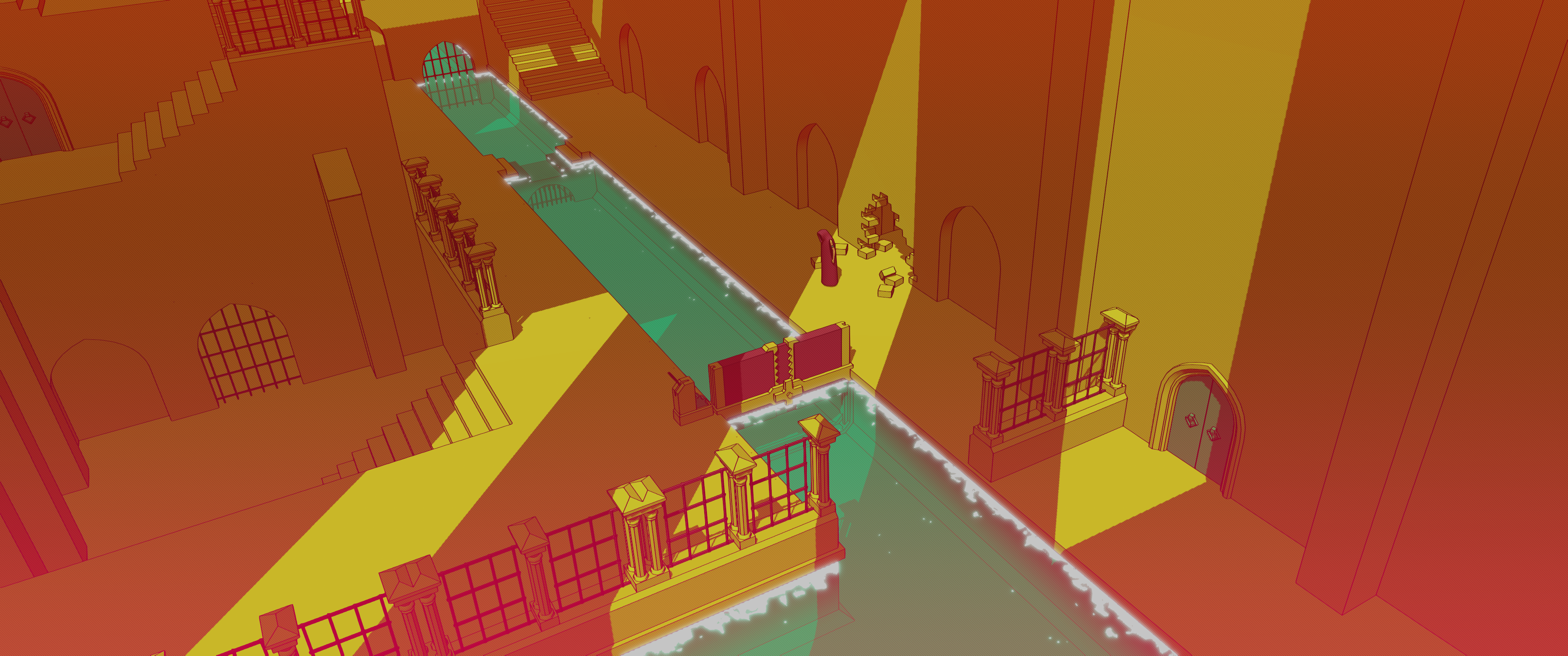
Your character blocked by a canal.
Your first puzzle

The game’s cel shaded art style is simplistic but on point. For example, the yellow and orange walled areas of the Devotees, complete with cats and crows, are obviously different from the blue walls and red water of the Warriors, complete with distant but intrigued lizards.

The audio and soundtrack are subtle but thematic. Early pieces are mainly orchestral but include obscure instruments, drums, claps and other tribal influences to give it a primitive feel. The instrument balance shifts subtly as you progress and discover the true nature of the tower. The audio is mainly environmental, with wonderfully high-quality bubbling water and wind at times.

My criticisms of Chants of Sennaar are few. While the game tracks the glyphs and meanings, it does not track word order. This omission makes translating between some languages more challenging. You can repeat conversations, but you do not track them in your notebook. This decision keeps your notebook decluttered but means you must return to where that conversation occurred to replay it. Some puzzles get obtuse toward the end, too.

Overall, completing Chants of Sennaar is a cerebral ten to fifteen hours for those who love language puzzles. If you do not, this game will be frustrating, boring or both. However, given that its rarest achievement has a 25.8% completion rate at the time of writing, Chants of Sennaar has found its feet with a niche but dedicated audience.

“Enshrouded” Review: Good with Potential for Great

Enshrouded is a new early access, cooperative, survival crafting game from Keen Games. You play a “flameborn”, a magically enhanced human in a post-apocalyptic fantasy world. The “shroud”, a deadly mist, has covered parts of the world, filling them with alien and dangerous inhabitants. Your job is to learn what happened and restore the world.

Mechanically, Enshrouded plays like other fantasy survival crafting games. You start with little but rags. You explore, find or mine materials, craft weapons and shelter, and fight enemies. There is plenty of lore to discover, mainly as glowing notes left in long abandoned places. You can craft a grappling hook and a glider aid in traversal. You can fast travel once you unlock the destinations, usually requiring light traversal and puzzle solving. There is no hunger or thirst meter – you are an immortal flameborn – but enemies are balanced to the buffs given by food and drink.

Enshrouded‘s combat is very Souls-like, at least for melee characters. Timing, parrying and dodging are critical, although the creatures are generally more forgiving than anything from From Software. Non-melee characters are easier to play. Magic operates like a bow and arrow, with a staff firing magic spells instead of arrows. There is a stealth system, allowing you to snipe enemies from afar or backstab them up close.

The quests and crafting are standard for the genre. Quests progressively take you further afield and push the lore. You can rescue other NPC flameborn survivors, who provide unique crafting recipes and quests. Completing quests and acquiring new materials provide new crafting recipes. Most crafting requires crafting stations, which takes time and encourages you to head out into the world while you wait.

Enshrouded‘s building is voxel-based. You place floors, walls and ceilings individually, mixing and matching the materials to taste. Aesthetically, crude stone or thatch rooves are easy to mass produce but intentionally look uneven and primitive. You can discover better-looking materials, which require more and rarer ingredients. Mechanically, buildings provide shelter, which gives a stamina buff. The rescued NPCs also need shelter to produce more complex recipes. 

Enshrouded‘s character advancement options follow a skill tree model. It covers the usual archetypes from a “sword and board” (melee weapon and shield) tank to a two-handed barbarian, a mage, a healer and a stealthy assassin. You gain XP from killing enemies, completing quests and gathering resources. You gain skill points when you level up or fell a shroud root, mushroom-like growths that create the shroud. Skills cost different amounts depending on their utility. You can also respec cheaply, making exploring different builds easy.

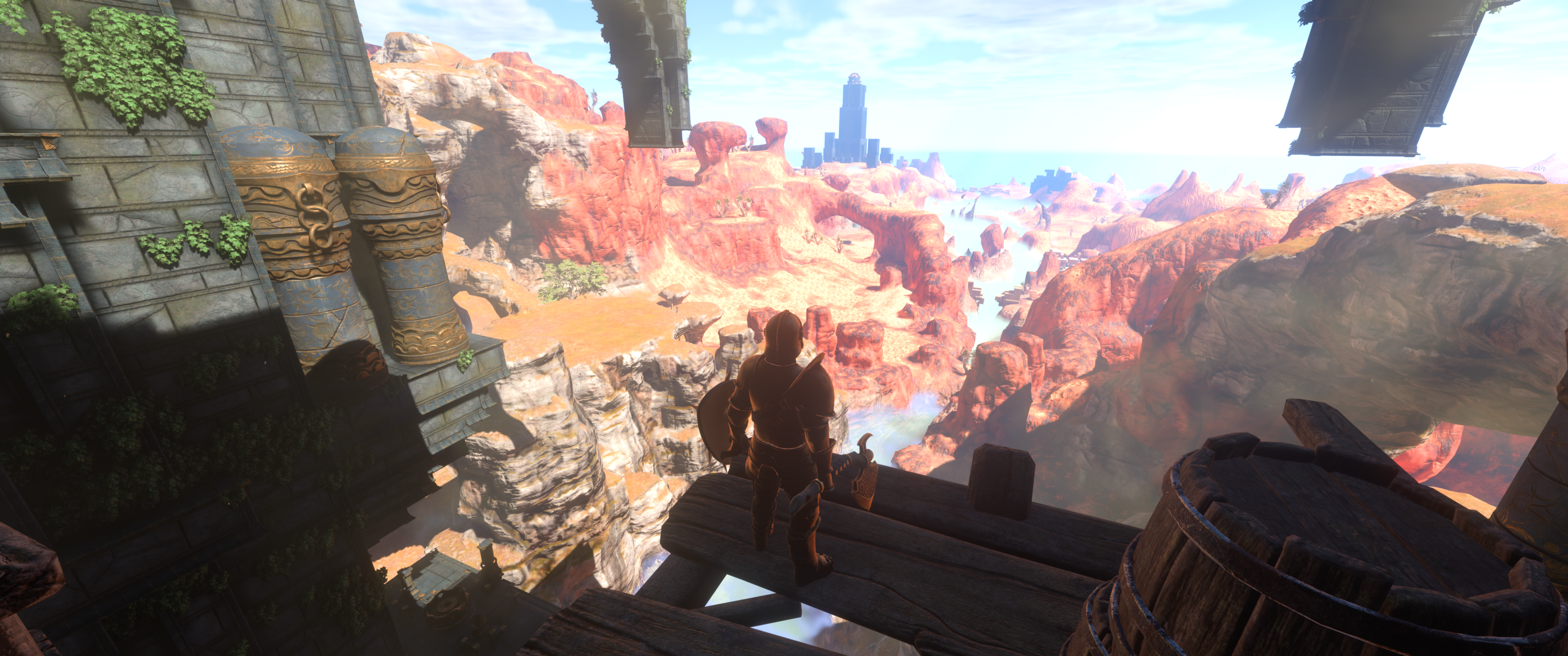
More generally, the quality and amount of content in Enshrouded is excellent. Apart from a few enemies getting stuck in the terrain and the occasional visual glitch, the game was flawless. The panoramic vistas are lovely, and the eerie green, blue and yellow lights shining through the shroud at night give it an alien, unworldly feel. Enshrouded‘s skill tree hints at something wonderfully complex and bristling with undiscovered synergies, like Path of Exile, in the final game.

An armored figure standing on a high stone ruin overlooking a shrouded desert valley.
Yet another beautiful panorama, looking down from an ancient stone ruin into an enshrouded valley

Critiquing an early access game is arguably unfair. After all, Enshrouded is unfinished and has a long development road ahead. However, there is enough to hint at what it could be and where problems lie. 

Enshrouded‘s biggest problem is there is little extrinsic reward for exploration. The hand-crafted map is enormous and dotted with areas to explore. However, quests will take you to most of the essential places and get the critical rewards. The tidbits of lore are flavourful but disjointed. Flame shrines give unique rewards, but I accumulated all I needed early on. There are too few enemy types and each has fixed behaviour, potentially leading to repetitious and unchallenging combat. I was swimming in bows, staves and wands but, as a melee build, I found the first useful non-quest item in a chest sixty hours into the game. By the time I reached the Kindlewastes, the last accessible area, I had lost the exploration buzz. Walking down the next unexplored path felt like a chore. This issue is a “must fix”, particularly with so much of the map still unavailable.

Enshrouded‘s late-game crafting requires too much effort for too little reward. I was happily defeating level 30 creatures wearing low-20s gear. The only crafting you need is unlocking higher “flame levels”, which opens up previously inaccessible shrouded areas. While you keep unlocking new crafting recipes, higher-level crafting requires more tedium: more ingredients, longer crafting time, and heading back to lower-level regions. Inventory management becomes tiresome. Planting and harvesting crops is convenient, but doing so plant by plant gets repetitive quickly. 

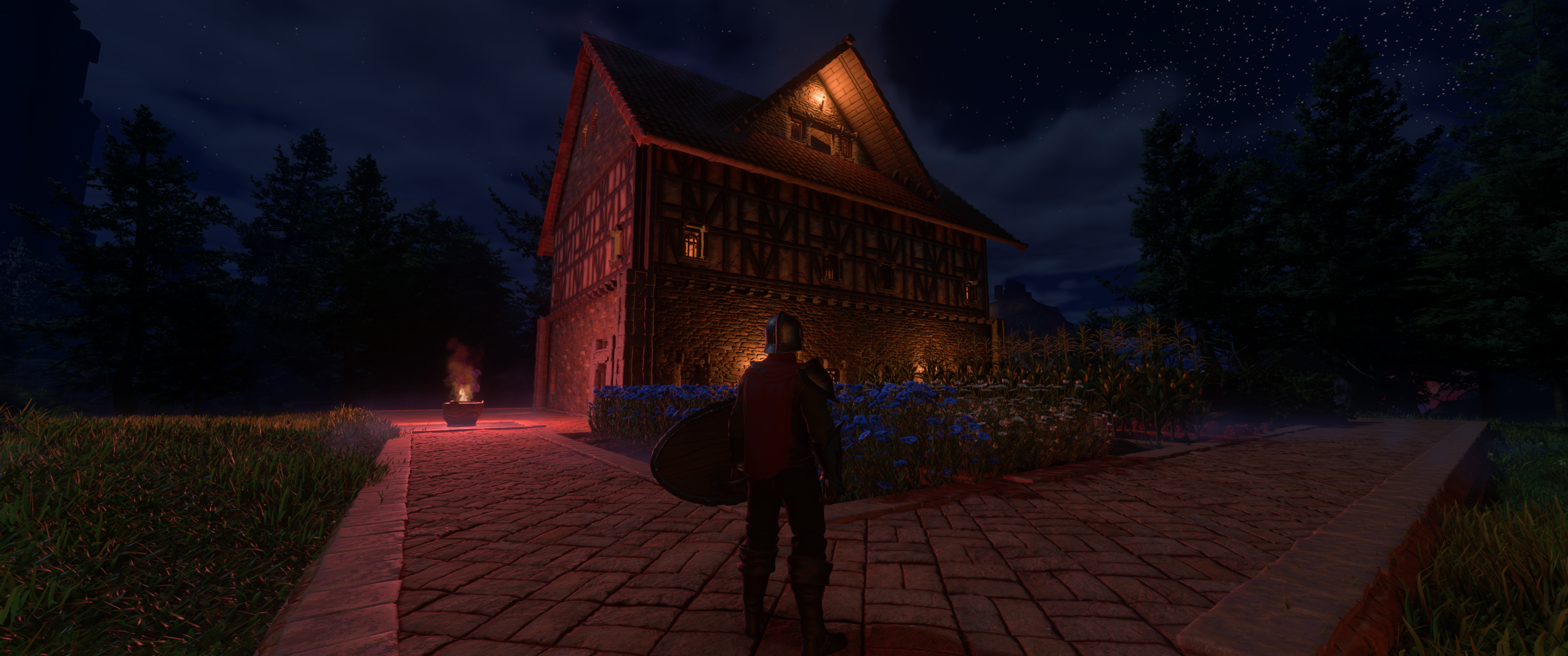
There is little incentive to build Enshrouded‘s beautiful bases. With dozens of materials available and the developer’s apparent effort, it screams out for an in-game need to build more. Unfortunately, once you make a sufficiently large structure, usually at the starting location using basic materials, you can fast travel back to it whenever needed. Replacing fast travel with a point-to-point mechanism or requiring crops to be planted in their native biome might help.

An armored figure standing before a modest house and garden.
My modest abode at night, complete with garden.

Lastly, Enshrouded has a few balance issues. Melee characters are underpowered early on, and suitable upgrades are hard to find. Spell-casting and ranged characters are more powerful, easier to play and have more plentiful gear. 

Enshrouded has the foundations for a great game. The quality and amount of content for an early access title are excellent and hint at a truly great game. The game has what it needs at the moment: solid foundations and exposure. Now Keen Games must refine Enshrouded‘s unique solution to the survival-crafting equation. As with pinnacles of the genre like Subnautica and Valheim, this will be a lengthy process. I hope Keen Games can take the time and resources to realise Enshrouded‘s potential.

AX Healing Krait Mk II Build

An Elite Dangerous ship build that heals shielded “tank” ships when fighting Thargoid interceptors in wings or teams.

This arrangement is similar to how MMORPGs structure groups. The “tanks”, usually Imperial Cutters or Federal Corvettes with Prismatic Shields, try to draw the interceptor’s fire by staying close, hot and dishing out damage. Healers try to keep the tanks’ shields up, particularly when hit by an interceptor’s lightning attack. Dedicated anti-swarm and anti-scout ships handle the thargon swarms and scouts. The rest try to draw damage using more traditional anti-xeno builds and tactics.

This post assumes you are familiar with Thargoid interceptor combat.

Goals

Create a ship to:

  1. Heal tanks’ shields. This requires the Regenerative Sequence experimental effect on Beam Lasers.
  2. Remove the caustic debuff from tanks. This requires a Decontamination Limpet Controller and a Cargo Rack for limpets.
  3. Reach tanks. Beam lasers and limpets are only effective within a kilometre or so. This build needs the speed and agility to reach them.
  4. Survive around hostile thargoids, including thargon swarms and scouts. This requires strong shields, strong hull and removing your own caustic debuff.

Build

Krait Mk II blueprint by CMDR-Arithon (https://swat-portal.com/forum/gallery/image/9624-krait-mk-ii/)

Link: EDSY (have it open as you read about the build for easy reference)

Healing is a fun way to contribute while giving a different set of challenges. Elite Dangerous rarely creates opportunities for different roles within a team. A healer’s focus is on enabling others to be more effective.

Other ships, notably the Anaconda, can provide more raw healing power because they have more hard points and a larger power distributor. However, the Krait Mk II is faster and more agile, helping you get to more mobile tanks when needed or be more forgiving when you are out of position.

Healing:

  1. Healing Beams: Efficient Beam Lasers with the Regeneration Sequence experimental effect are the best way to regenerate allies’ shields. The Regeneration Sequence experimental effect restores a team- or wingmate’s shields instead of damaging them. Efficient means you can fire the lasers for as long as possible, healing to heal through an interceptor’s lightning attack. The Concordant Sequence experimental effect increases the regeneration rate of the shield for ten seconds. However, the buff does not stack and tanks’ prismatic shields often have a slow regeneration rate.
  2. Fixed Weapons: Tanks are usually large, slow-moving targets. Fixed weapons give enough extra damage/healing to make them worth it.
  3. Power Distributor: An interceptor’s lightning attack will drain a tank’s shield quickly, particularly if it temporarily disables the tank’s Power Distributor. A Weapon Focused Power Distributor, four pips weapons and a full capacitor allow you to keep restoring the shields for 30+ seconds.
  4. Decontamination: A Decontamination Limpet Controller and copious Cargo Racks for limpets means you can help remove the caustic debuff from tanks or, if attention permits, other allies. However, this can be challenging. Scouts, thargon swarms and interceptors often shoot off attached limpets. Limpets are also slow, and even a slow Federal Corvette can outrun a limpet. Cooperation with the tank is required. In a pinch, decon limpets can repair hull, including your own.
  5. Tagging: Remember to shoot the interceptor a few times for a second. Otherwise, you will not get any combat bonds when it dies.

Defence

  1. Shields: Many AX pilots prefer to go shieldless. However, given nearby tanks should be keeping the interceptor’s attention and scouts, thargon swarms or other interceptors may be nearby, strong shields soak up most of the damage that should be coming this ship’s way. If the shield drops, consider a reboot/repair to quickly restore it to 50%.
  2. Caustic Sink Launcher: Given the difficulty of heating up with a shield and Efficient Beam Lasers along with the prominence of caustic clouds and missiles, a Caustic Sink Launcher helps keep the healer focused on the tank’s health and not its own.
  3. Absolute Damage: Guardians do absolute damage so maximize raw shield and hull strength where possible.
  4. No Guardian Modules: A Glaive’s anti-guardian module field will not worry this build.
  5. No Shutdown Field Neutralizer: Most tanks have a Shutdown Field Neutralizer that will protect you. If not, swap one of the Shield Boosters for it.

Tactics

  1. Team structure: Ensure you are in a wing or team with the tanks. Otherwise, your Regeneration Sequence Beam Lasers will damage their shields, not heal them. It also helps you easily locate your tanks by looking at the blue points on your radar.
  2. Positioning: Keep the tanks within one kilometre and between the interceptor and you. Beam Lasers are most effective within 800 m. This position also reduces the chance the interceptor will target you.
  3. Pip management: The default choice is two pips in systems and four in weapons. You will occasionally need to put pips into engines to boost away from caustic missiles or catch up to a distant tank.
  4. Anti-Interceptor Shield: If your team is struggling against an interceptor, firing five beam weapons against its shield will bring it down quickly. However, this will bring you in range of its lightning attack and will put you on its target list for caustic missiles. Target the shield with care.
  5. Anti-scout: Destroying scouts is challenging but surprisingly doable if you can get up close. It can keep you occupied while waiting for interceptors to jump in.

“The Creator” Review: A Complex Juggling Act

Warning: This review contains light spoilers.

When I watched the trailers and read the synopses of The Creator, I thought this would be a movie about the dangers of artificial intelligence (AI). In an age where the technology sector has commoditized machine learning, calling it AI, this movie seemed to promise yet another warning about unchecked technological advancement and humanity’s negative tendencies. However, I was wrong.

The Creator is set in 2065. The global West wages war against AI after an AI nuked Los Angeles. It follows Joshua, an undercover US soldier sent to infiltrate AI society. Grieving for Maya, his dead wife, he pursues an AI superweapon while balancing his loyalties between his single-minded US military superiors and the AI community that adopted him.

If examining AI is The Creator‘s focus, it has a few premises the audience needs to accept. Humanity has also created artificial general intelligences (AGIs), AIs that are conscious and have emotions. AGIs can be housed in robots and control them to a human-like level of coordination and ability.

Humanity has also created life-like human robots called simulants. Their faces are clearly human, but a slight turn of their heads reveals their obvious ear canal-less artificiality. They have feet firmly planted on each side of the uncanny valley.

So far, this is standard science fiction fair. However, The Creator goes further. Human consciousness can be read, stored, and uploaded into a robot. Your soul can now be digitized. Add to this that humans are encouraged to lend their likeness to simulants, that damaging a robot destroys the housed AI and that simulants can eat and drink. The superweapon is a robotic child with a child’s presumed innocence, hitting parental instincts hard. Can the movie humanize AI more? Can you distance it from modern-day AI more?

That was when I realized The Creator is not a warning about AI’s dangers. It could have been a fantasy epic about souls and magic. The Creator merely adopts the current zeitgeist for broader audience appeal.

Instead, it is two things. The first is a critique of the West’s exceptionalism. Like the “War on Terror”, the war in The Creator is a battle for New Asia’s hearts and minds. The USA is not fighting the people of New Asia, only the AI they harbour. The alleged lie at the start of the war, that errant programming and not AI launched the nuke, hits hard. This lie parallels the lie that Iraq possessed weapons of mass destruction, necessitating its invasion. As his motives shift away from the West’s established truths, Joshua slowly becomes a “terrorist”. Nuance and sympathy are trodden underfoot by the unwavering West.

The movie’s war is also a new Vietnam War, one that the USA is determined to win. The new AI society is based in New Asia, spanning most of South East Asia today. The film juxtaposes jungles, rice paddies and longtail boats with towering megastructures. Technology and tradition are ubiquitous. Women joke as they construct new simulants just like they would weave clothing. Most of the movie was shot on location rather than using a green screen, giving the movie a natural, tangible feel. 

Unlike in the Vietnam War, the USA does not put thousands of troops on the ground, endangering its citizens to suppress a resistant populace in rugged terrain. Instead, the space station, the USS NOMAD (North American Orbital Mobile Aerospace Defence), looms in the skies. It is a miniature version of Star Wars‘ death star, poised to rain nuclear freedom. It becomes a symbol of technological and industrial superiority but also oppression.

When the USA fights on the ground, it uses its industry. The huge tanks rumbling through the jungle, large enough to make a Warhammer 40K player envious, epitomize the American approach to warfare: technologically lead and ruthlessly efficient. Their telltale thunderous sound and size intimidate and deter as much as their weapons do.

The Creator portrays US soldiers as bloodthirsty and uncaring. “It is only programming,” they say as they slaughter enemy robots indistinguishable from humans a few moments before. Contrast this with the AI, who lack weapons larger than small arms. They seem a minuscule threat against the disproportionate might of the West. They constantly lament the war, claiming they only want peace. 

This confronting portrayal reinforces Joshua’s plight. Seeing the USA’s military-industrial complex from the receiving end is something few Western viewers have likely considered. Seeing near-religious fervour on the faces of what traditionally are the rational good guys is startling. 

However, if you humanize the West’s enemies beyond that of humans and present them as homogeneously pacifist and constantly sympathetic, you risk a straw man fallacy. The Creator tries to shatter the USA’s self-image of a perfect, altruistic world policeman. However, this is a well-trodden path and more complex than the movie’s simplistic portrayal. Geopolitics is about shades of grey, not black and white.

Secondly, The Creator examines Joshua and his grief. His robotic arm and leg, lost when the nuke hit Los Angeles, make the war personal. The movie’s initial scenes and copious flashbacks see him in a loving relationship with Maya, his pregnant wife. Her apparent death at the movie’s start sends him into depression.

However, the prospect of Maya’s survival lures him back. He forges a Faustian bargain with his US military superiors to help find Nirmata, the AIs’ head architect. The child-like AI superweapon, Alphie, could be a facsimile of his unborn child. Pursuing love is a noble ideal, but has fate given Joshua a second chance or is he delaying hurtful acceptance with a technological substitute?

Meanwhile, The Creator is full of religious allegories. Technology offers the ability to be reborn and live forever, albeit in a robotic body. The AIs’ reverence for Nirmata and the saffron-cloaked monks’ inability to harm it borders on worship. The USA’s bomb robot bows before Alphie’s deific ability to control machines remotely. The final scenes depict a battle in heaven, and the grief-filled survivors return to earth weary from their pyrrhic victory. These and Hans Zimmer’s operatic soundtrack add gravitas and impetus, if not a slight unreality, to Joshua’s journey. The Creator is not merely a story. It wants to be a modern-day fable.

Ultimately, The Creator wants to say a lot, possibly too much. I applaud the vision and scope. It is dense and ambitious, and its special effects are fantastic. However, The Creator reduces complex issues like Western hypocrisy and AI’s potential to forces of nature, nearly overshadowing its examination of grief. The movie juggles many ideas and metaphors simultaneously but almost drops a few.