
Warning: This review contains light spoilers.
When I watched the trailers and read the synopses of The Creator, I thought this would be a movie about the dangers of artificial intelligence (AI). In an age where the technology sector has commoditized machine learning, calling it AI, this movie seemed to promise yet another warning about unchecked technological advancement and humanity’s negative tendencies. However, I was wrong.
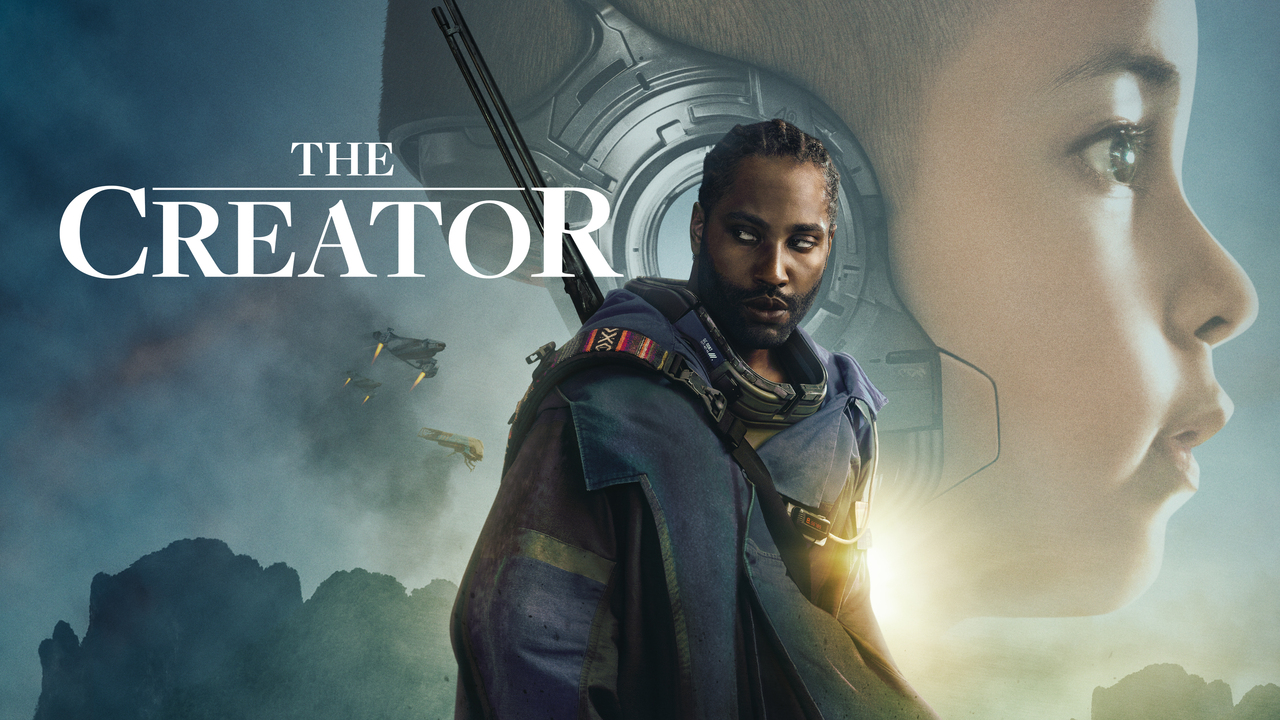
The Creator is set in 2065. The global West wages war against AI after an AI nuked Los Angeles. It follows Joshua, an undercover US soldier sent to infiltrate AI society. Grieving for Maya, his dead wife, he pursues an AI superweapon while balancing his loyalties between his single-minded US military superiors and the AI community that adopted him.
If examining AI is The Creator‘s focus, it has a few premises the audience needs to accept. Humanity has also created artificial general intelligences (AGIs), AIs that are conscious and have emotions. AGIs can be housed in robots and control them to a human-like level of coordination and ability.
Humanity has also created life-like human robots called simulants. Their faces are clearly human, but a slight turn of their heads reveals their obvious ear canal-less artificiality. They have feet firmly planted on each side of the uncanny valley.
So far, this is standard science fiction fair. However, The Creator goes further. Human consciousness can be read, stored, and uploaded into a robot. Your soul can now be digitized. Add to this that humans are encouraged to lend their likeness to simulants, that damaging a robot destroys the housed AI and that simulants can eat and drink. The superweapon is a robotic child with a child’s presumed innocence, hitting parental instincts hard. Can the movie humanize AI more? Can you distance it from modern-day AI more?
That was when I realized The Creator is not a warning about AI’s dangers. It could have been a fantasy epic about souls and magic. The Creator merely adopts the current zeitgeist for broader audience appeal.
Instead, it is two things. The first is a critique of the West’s exceptionalism. Like the “War on Terror”, the war in The Creator is a battle for New Asia’s hearts and minds. The USA is not fighting the people of New Asia, only the AI they harbour. The alleged lie at the start of the war, that errant programming and not AI launched the nuke, hits hard. This lie parallels the lie that Iraq possessed weapons of mass destruction, necessitating its invasion. As his motives shift away from the West’s established truths, Joshua slowly becomes a “terrorist”. Nuance and sympathy are trodden underfoot by the unwavering West.
The movie’s war is also a new Vietnam War, one that the USA is determined to win. The new AI society is based in New Asia, spanning most of South East Asia today. The film juxtaposes jungles, rice paddies and longtail boats with towering megastructures. Technology and tradition are ubiquitous. Women joke as they construct new simulants just like they would weave clothing. Most of the movie was shot on location rather than using a green screen, giving the movie a natural, tangible feel.
Unlike in the Vietnam War, the USA does not put thousands of troops on the ground, endangering its citizens to suppress a resistant populace in rugged terrain. Instead, the space station, the USS NOMAD (North American Orbital Mobile Aerospace Defence), looms in the skies. It is a miniature version of Star Wars‘ death star, poised to rain nuclear freedom. It becomes a symbol of technological and industrial superiority but also oppression.
When the USA fights on the ground, it uses its industry. The huge tanks rumbling through the jungle, large enough to make a Warhammer 40K player envious, epitomize the American approach to warfare: technologically lead and ruthlessly efficient. Their telltale thunderous sound and size intimidate and deter as much as their weapons do.
The Creator portrays US soldiers as bloodthirsty and uncaring. “It is only programming,” they say as they slaughter enemy robots indistinguishable from humans a few moments before. Contrast this with the AI, who lack weapons larger than small arms. They seem a minuscule threat against the disproportionate might of the West. They constantly lament the war, claiming they only want peace.
This confronting portrayal reinforces Joshua’s plight. Seeing the USA’s military-industrial complex from the receiving end is something few Western viewers have likely considered. Seeing near-religious fervour on the faces of what traditionally are the rational good guys is startling.
However, if you humanize the West’s enemies beyond that of humans and present them as homogeneously pacifist and constantly sympathetic, you risk a straw man fallacy. The Creator tries to shatter the USA’s self-image of a perfect, altruistic world policeman. However, this is a well-trodden path and more complex than the movie’s simplistic portrayal. Geopolitics is about shades of grey, not black and white.
Secondly, The Creator examines Joshua and his grief. His robotic arm and leg, lost when the nuke hit Los Angeles, make the war personal. The movie’s initial scenes and copious flashbacks see him in a loving relationship with Maya, his pregnant wife. Her apparent death at the movie’s start sends him into depression.
However, the prospect of Maya’s survival lures him back. He forges a Faustian bargain with his US military superiors to help find Nirmata, the AIs’ head architect. The child-like AI superweapon, Alphie, could be a facsimile of his unborn child. Pursuing love is a noble ideal, but has fate given Joshua a second chance or is he delaying hurtful acceptance with a technological substitute?
Meanwhile, The Creator is full of religious allegories. Technology offers the ability to be reborn and live forever, albeit in a robotic body. The AIs’ reverence for Nirmata and the saffron-cloaked monks’ inability to harm it borders on worship. The USA’s bomb robot bows before Alphie’s deific ability to control machines remotely. The final scenes depict a battle in heaven, and the grief-filled survivors return to earth weary from their pyrrhic victory. These and Hans Zimmer’s operatic soundtrack add gravitas and impetus, if not a slight unreality, to Joshua’s journey. The Creator is not merely a story. It wants to be a modern-day fable.
Ultimately, The Creator wants to say a lot, possibly too much. I applaud the vision and scope. It is dense and ambitious, and its special effects are fantastic. However, The Creator reduces complex issues like Western hypocrisy and AI’s potential to forces of nature, nearly overshadowing its examination of grief. The movie juggles many ideas and metaphors simultaneously but almost drops a few.
 The Single Player