
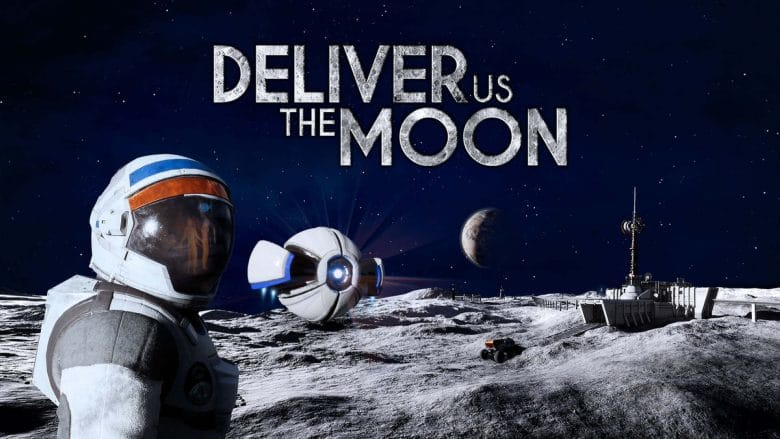
Deliver Us the Moon is a first-person interactive fiction game similar to Tacoma, Event[0], The Station or Stardrop. You play an astronaut blasting off an environmentally-devastated, near-future Earth to restore the energy transmission from the moon after it mysteriously shuts off.
Deliver Us the Moon could be called a walking simulator, a genre uncharitably named for its simplicity and monotony. Like many walking simulators, much of Deliver Us the Moon involves the lone player exploring their immediate area, finding notable objects to scan or historical scenes to review then solving simple puzzles to unlock progress to the next area. There is no branching narrative or progression.
However, unlike some walking simulators, Deliver Us the Moon packs variety. It includes multiple mini-games like docking spaceships, driving moon rovers, repairing robots or aiming radar dishes. Its space scenes impart the feeling of weightlessness, potentially disorienting the player with “up” only denoted by the occasional sign, screen or seat. Limited oxygen makes scenes in space or on the lunar surface tense. Sometimes you lose yourself staring at the desolate but beautiful lunar surface. Sometimes you are just desperately surviving. It is more What Remains of Edith Finch than Dear Esther.
Like many interactive fiction games, Deliver Us the Moon is short, taking seven to eight hours to finish. However, given its weighty story, it feels about the right length. Its brevity and economy contrast with unending contemporary live service games. It also becomes more accessible – you complete it in a few gaming sessions.
The success of an interactive fiction game depends on how well it resonates with the player. The key is the adage, “Show, don’t tell”. Rather than telling you how you or some player surrogate acted or felt, it places you in that situation, drip-feeding you background and context. When the game finally asks you to care, it feels natural after surmounting challenges and discovering lore organically.
At first, Deliver Us the Moon‘s setting and premise may seem far-fetched. Climate change is a genuine problem. However, Deliver Us the Moon‘s world exhausts natural resources and desertifies sooner than even pessimistic climate projections. Extended stays in space or on the lunar surface require huge, Earth-side teams to support them. Given our understanding of physics, beaming sufficient energy from the moon to power the Earth is impractical.
However, Deliver Us the Moon is not a game about environmentalism, technology or space. Its puzzles are never hard enough to frustrate or block progress.
Deliver Us the Moon is about how personal connections drive us, such as protecting family or camaraderie. It is about how alienating disconnection can be, even when the world is a stake. Amidst space’s vastness, alienness and hostility, the small things matter.
Deliver Us the Moon will appeal to those who enjoy empathising with a good story and can relate to its themes. You will enjoy Deliver Us the Moon if you enjoyed Firewatch or Gone Home but want more interactivity, some tense moments or a science fiction setting. Like other interactive fiction games, those looking for something challenging, action-filled or longer should look elsewhere.
 The Single Player