
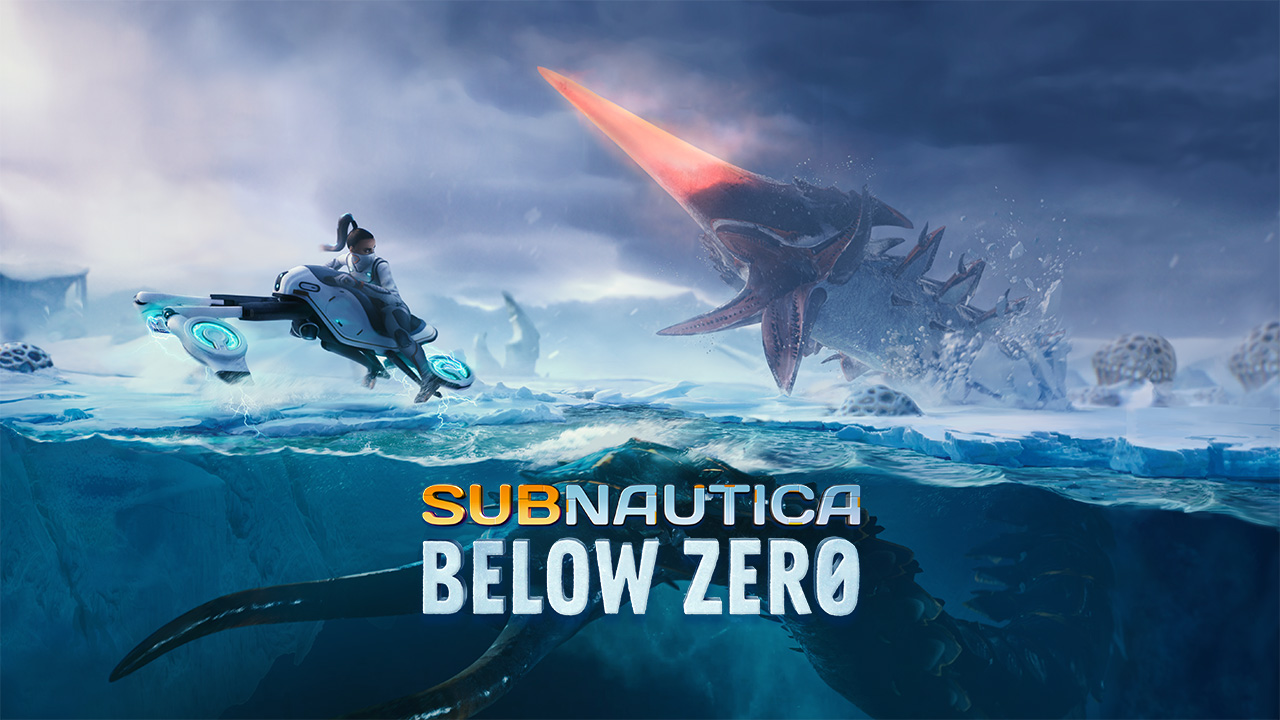
Subnautica: Below Zero is the latest survival horror game from Unknown Worlds. Originally a mod for the successful Subnautica, this game is more evolutionary than revolutionary. However, it continues to deliver the almost perfect combination of exploration, tension, frustration, achievement and wonder as the original.
You play Robin Ayou, a xenologist investigating her sister’s death. The game starts by jumping out of an orbiting spacecraft over planet 4546B, the same as Subnautica, amidst a meteor shower. After a quick scramble to the safety and warmth of the ocean, the game settles into a more sedate pace driven by the player.
While Subnautica: Below Zero has a storyline, it only serves to bookend the core game loop. The player’s curiosity and experiences drive the real story. While the voice-acted log entries from previous inhabitants flesh out the world and give context, a narrow escape from a leviathan is far more memorable.
The game loop consists of exploring the environment, avoiding threats, gathering materials then crafting tools, vehicles and bases to venture further. Robin starts with minimal resources and capabilities but has a Star Trek-like fabricator to prepare food and create tools.
The game loop’s freedom occasionally frustrates. If you miss a cave that leads to the next area or a fabricator blueprint to progress, there may be few hints to guide you.
The game’s setting moves from the sunny tropics into the frigid arctic. Some biomes are familiar from Subnautica, like the safe shallows and kelp forest, and some are new, like the vertical ecosystem of the lilypad islands and fantastic, disorienting crystal caves. The move allows some rebalancing. For example, the oxygen plant replaces brain coral, switching a permanent source of oxygen for a temporary one when doing “the bends”-defying freedives.
However, the main reason for the move is mechanical. The game needs equivalent challenges on land as underwater. Moving the setting to the arctic replaces the standard underwater oxygen meter with a hypothermia meter and oxygen plants with steam vents. Add aggressive fauna, exploitable flora and the Snowfox, a hoverbike, and you have a challenging, rewarding and intuitive environment to explore.
The flippancy implied above does not mean the on land environment lacks thought or care. For example, the thermal lillies found near Robin’s initial crash site keep Robin warm, subtly teach the player to leverage their environment, provide something to scan and reinforce the planet’s alienness. There is a trick to counter each land predator, which Robin can discover through trial and error, old logs or fabricable blueprints. Pengwings and penglings are cute, and the robotic spy pengwing has the right mixture of retro-futurism and novelty. The fast-changing weather means players must be on their toes or risk disorientation.
As for below the water, the map is smaller both laterally and vertically than Subnautica. Many areas are claustrophobically narrow and maze-like. Getting lost is easy. Players should carry extra food, water and supplies just in case. Beacons and scanning rooms also help.
The smaller map and narrower spaces dictated vehicle changes from Subnautica to Subnautica: Below Zero. The modular and practical sea truck replaces the mammoth cyclops, which would be too large to manoeuvre, and the zippy sea moth, whose speed would highlight the smaller map. Sonar, required to navigate the open spaces of the original game at night, is no longer needed.
The developers have crafted a sensory experience similar to games like Abzu or Beyond Blue. I often stopped and listened to the gentle sound of rain on the water’s surface, swam with the glow whales or marvelled at aurorae. The colours are oversaturated, making the world feel vibrant and “larger than life”. Each biome also has a distinct colour palette, helping segregate them or the player locate themselves at a glance.
The soundtrack is very similar to the original. Extended, sweeping chords give the impression of the vast unknown. The initial songs use electronic instruments, providing a science fiction feel. “Artic Peeper”, for example, reminds me of the Mass Effect series’ citadel music. However, later tracks give way to xylophones, claves and drums, creating a more primitive, haunting and naturalistic feel.
Subnautica: Below Zero’s themes are subtle. When zipping along in the sea truck, failing to dodge the oblivious and slow swimming fish, I considered humanity’s impact on planet 4546B. Experiencing the natural wonders through Robin’s eyes is only possible because her technology and resource gathering did not materially impact the environment. Can humanity have its cake and eat it, too? The game’s nonviolence and the lack of weapons are also well-publicized.
While the game’s genre is “survival horror”, Subnautica was more effective at generating tension and dread. Perhaps this was my meta-game thinking, but the predators and environmental hazards felt more challenging than frightening. No biomes matched the old blood kelp biome. Predator roars lost their impact from overuse and could have been more distinct.
The relative lack of Subnautica: Below Zero’s new content and ideas is more a testament to the original’s strength than the new game’s unoriginality. The third-party music tracks discoverable for the in-game jukebox are a tribute to the original’s popularity and impact. Those looking for an encore with a new map, residents and story will be pleased. A straight play through the storyline takes about 20 hours. However, most will take far longer as they explore every inch of the environment at their own pace. Remember to play with the pengwings!
 The Single Player